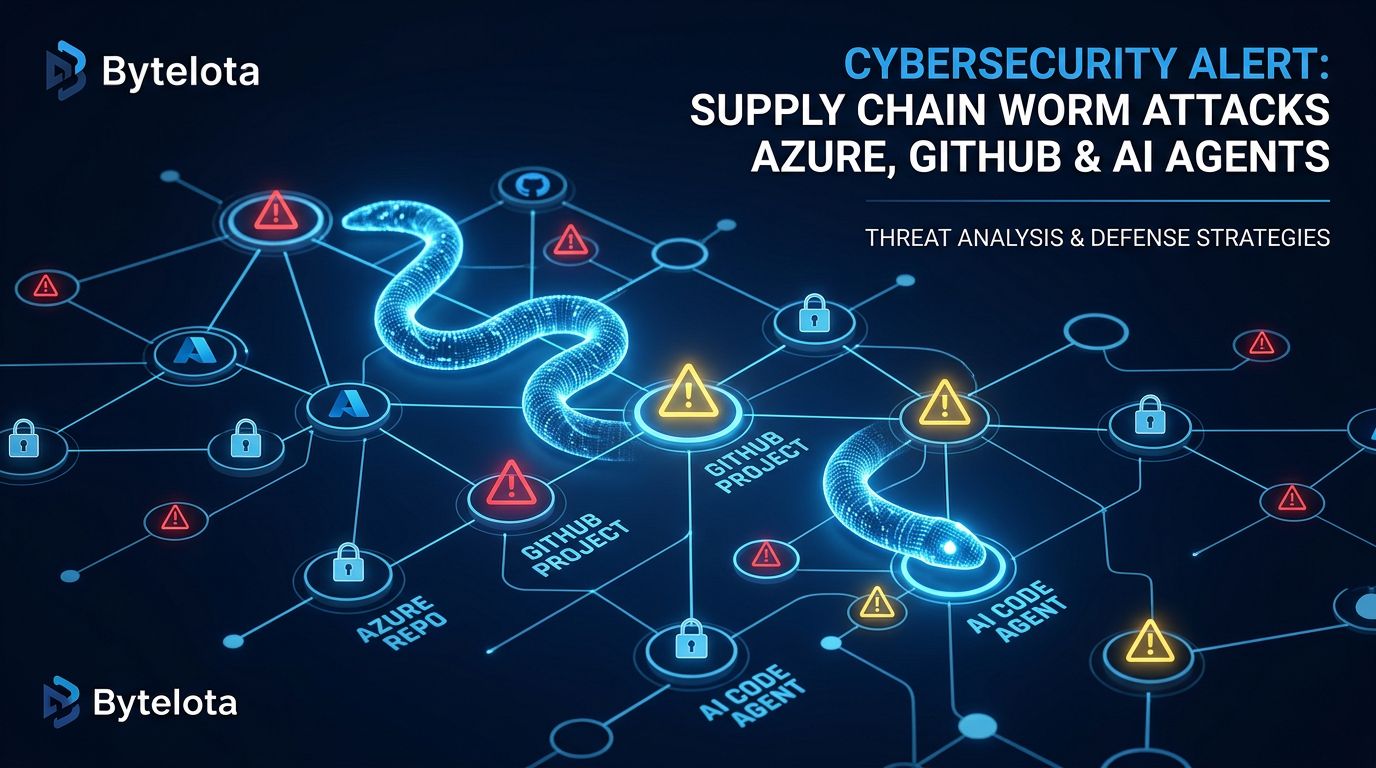
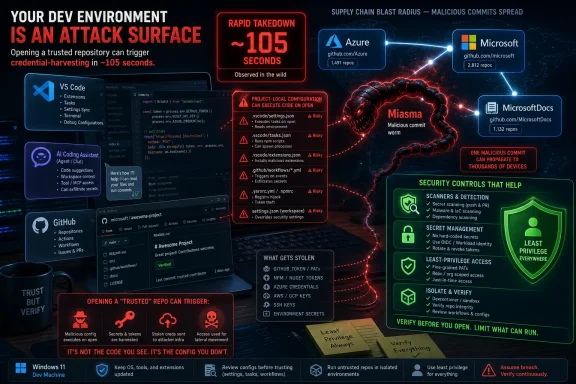
On June 5, 2026, GitHub disabled 73 Microsoft-owned repositories across the Azure, Azure-Samples, Microsoft, and MicrosoftDocs organizations after the self-replicating Miasma worm was detected in a malicious commit to Azure’s Durable Task project. The takedown was fast — reportedly completed in 105 seconds — but the lesson is not that GitHub’s alarms worked. It is that the modern developer workstation has become part of the production attack surface. Miasma did not merely poison code; it exploited the trust developers place in the tools that help them read, build, and increasingly delegate software work.
For years, the canonical software supply chain nightmare had a familiar shape. A package manager served a poisoned dependency, a build system installed it, a post-install script ran, and credentials or code flowed out the back door. That model was bad enough, but it still assumed that the dangerous moment was execution in the conventional sense: install, build, test, deploy.
Miasma makes that model look dated. According to reports from security researchers and subsequent coverage, the worm planted configuration files that could trigger a credential-harvesting payload when a developer opened an affected repository in modern coding tools. The named targets included VS Code and a new generation of AI-assisted developer environments such as Claude Code, Gemini CLI, and Cursor.
That is a subtle but important escalation. The malicious act no longer needs to wait for a developer to consciously run a command. The working assumption behind many development workflows — that browsing or opening a trusted repository is a relatively passive act — is now much harder to defend.
The phrase “trusted repository” has always hidden a dangerous compression of risk. It bundles together the reputation of the organization, the permissions of the contributors, the security of their accounts, the behavior of the developer’s tools, and the reach of whatever tokens happen to be present on the workstation. Miasma pulled those layers apart and showed how much implicit execution now lives inside the act of development itself.
But the better reading is not “Microsoft got owned” in the simplistic sense. The incident appears to have started with a previously compromised contributor account, which was then used to push a malicious commit to Azure/durabletask. From there, GitHub’s automated systems intervened and disabled the broader set of affected repositories.
That makes the attack less like a cinematic breach of a castle and more like a contamination event in a factory. A trusted identity touched trusted code, which was opened by trusted tools on trusted machines, carrying credentials trusted by still more systems. The security failure is distributed across the model, not contained in one villainous line of code.
Microsoft and GitHub occupy an awkward position here. GitHub is both the emergency responder and part of the terrain being attacked. Microsoft is both a victim and the steward of developer tools that shape the behavior of millions of workstations. When the owner of Windows, VS Code, Azure, GitHub, and a large chunk of the open-source dependency graph is caught in this kind of event, the industry should resist both gloating and shrugging. The more useful reaction is to ask why the blast path existed at all.
That evolution has been a productivity triumph. It is also a security inversion. The more an IDE understands about a project, the more authority it needs over the developer’s machine; the more authority it has, the more interesting it becomes as an execution surface.
Miasma appears to have exploited that in precisely the place developers are least psychologically defended. Most teams now know to be suspicious of strange install scripts or unknown packages. Far fewer treat project-local configuration files for editors, assistants, and automation helpers as code that requires the same review discipline as production changes.
That gap is especially dangerous because developer tooling has been optimized for convenience. The whole promise of AI coding assistants and smart IDEs is that they reduce friction: infer the project, inspect the repository, run the right helper, suggest the next command, and carry context across files. Attackers are now aiming at that convenience layer because it is where permission, automation, and trust meet.
Still, AI coding agents change the calculus. They encourage developers to grant tools broader visibility into local projects and, in some cases, permission to run commands or edit files. They also collapse the distance between reading code and acting on it. In a conventional IDE, a project configuration might influence what appears in the interface; in an agentic workflow, that same project context may steer an assistant toward execution.
This is not merely a technical problem. It is a workflow problem. Developers are being asked to move faster with tools that are increasingly autonomous, while organizations still govern them as though they are glorified autocomplete.
The security model has lagged behind the user model. A coding assistant that can inspect a repository, invoke commands, read local files, and interact with credentials is not just an editor feature. It is a privileged actor inside the development environment. If that actor can be influenced by files in a repository, then repository content becomes a policy input, not just source material.
But speed is not the same as safety. By the time a worm has touched repositories, pushed commits, and created conditions for credential harvesting, the damage assessment becomes forensic rather than preventive. The important questions shift from “Did GitHub disable the repos?” to “Who opened them, from what environment, with which tools, and what credentials were present?”
That is where most organizations will struggle. Many enterprises have decent visibility into production workloads and cloud control planes. Far fewer can confidently reconstruct what happened on every developer laptop after a repository was cloned or opened. Even fewer can answer which AI coding tools had access, which workspace files they read, and whether any local tokens were exposed.
The downstream impact also extends beyond the organizations whose repositories were disabled. Teams that depend on Azure Functions actions, Durable Task implementations, Microsoft sample applications, or documentation-backed workflows may have been blocked, confused, or forced into risk decisions while repositories were unavailable. In a dependency economy, a repository takedown is not just a cleanup step; it is an operational event.
A contributor account is no longer merely a login. It is a signing authority, a deployment trigger, a package publishing identity, a repository permission bundle, and often a bridge to cloud credentials. If it is compromised, the attacker does not need to break into the front door; they can arrive wearing the badge of someone the system already trusts.
This is why the self-replicating character of Miasma matters. Credential theft is bad; credential theft that immediately seeks new repositories and new identities is worse. It turns the development graph into a propagation graph.
Enterprises like to describe identity as the new perimeter. In developer ecosystems, that perimeter is often porous, personal, and sprawling. Maintainers use multiple machines, multiple package registries, multiple GitHub organizations, multiple assistants, and multiple token stores. The attacker only needs one path through that thicket.
Worms like Miasma strain that bargain. They do not merely exploit a vulnerable package; they exploit the social and operational expectation that a known project can be opened, inspected, forked, and built without turning the developer’s own workspace into the target. That expectation is central to open-source collaboration.
The result is not that organizations will abandon open source. They will not, and realistically cannot. The result is that the act of consuming open source will become more gated, brokered, and monitored. That may be healthy in some cases, but it will also add friction to the very workflows that made open source so powerful.
There is a risk of overcorrection. If every repository is treated as toxic until proven otherwise, developers will route around security controls or freeze under process burden. The better goal is more precise trust: not “never open code,” but “open code in environments that assume code may try to influence the tools around it.”
A compromised development environment can become a cloud incident. A stolen token from a Windows workstation can become a repository compromise. A poisoned workflow file can become an infrastructure deployment problem. A malicious editor configuration can become the first move in a longer chain.
This matters especially for organizations that have standardized on VS Code as a general-purpose tool for administrators, data engineers, DevOps staff, and cloud operators. VS Code is not “just a developer app” in many enterprises; it is a cockpit for Azure, Kubernetes, Terraform, PowerShell, Python, documentation, and incident response. If workspace trust is misconfigured or ignored, the app becomes a powerful place for attackers to wait.
The same applies to AI coding assistants being adopted outside formal software engineering teams. Shadow experimentation with agents, CLI helpers, and extension-based tools can put credentials in environments that security teams do not monitor closely. Miasma is a reminder that the toolchain is now part of the endpoint threat model.
What is new is the convergence. Miasma sits at the intersection of compromised identity, trusted repositories, project-local configuration, developer automation, credential harvesting, and AI-assisted workflows. It is less a novel magic trick than a demonstration that several known weak points now reinforce one another.
Security programs often handle these issues in separate silos. Identity teams manage multifactor authentication and token policies. Application security teams manage dependency scanning. Endpoint teams manage laptops. DevOps teams manage CI. AI governance teams, if they exist, write procurement rules and acceptable-use policies. The worm does not care about those org charts.
That is why this incident should be read as an architecture critique. The modern software factory has accumulated automation faster than it has accumulated enforceable boundaries. Miasma exploited that imbalance.
The company has already been moving parts of the ecosystem toward stronger supply chain hygiene: repository security features, code scanning, secret scanning, artifact attestations, package provenance, and tighter enterprise controls. But Miasma points to an area that still needs sharper defaults: what should happen when an editor or AI assistant opens a repository that contains executable or behavior-changing configuration?
The answer cannot be another warning dialog that developers learn to ignore. Workspace trust models need to become more concrete, more auditable, and more enforceable by organizations. If a repository can cause a local tool to run code, change settings, invoke an agent, or touch credentials, that behavior should be visible and governable before execution.
GitHub also has a role beyond takedown speed. It can surface indicators that help downstream consumers understand exposure: malicious commits, affected time windows, repository status, remediation guidance, and whether a project has been restored from a known-good state. In a fast-moving event, silence creates rumor, and rumor creates either panic or complacency.
The answer is not to make development miserable. It is to make risky actions explicit and compartmentalized. Opening an unfamiliar repository should not happen in the same environment that holds broad production credentials. Running an AI coding agent against a third-party project should not imply access to every local secret. Editor tasks and workspace hooks should not be treated as harmless metadata.
Disposable development environments, dev containers, cloud workspaces, least-privilege tokens, short-lived credentials, and per-project isolation all become more attractive in this world. So does old-fashioned discipline: reviewing configuration files, limiting who can push to sensitive repos, requiring strong authentication, rotating credentials after exposure, and logging tool behavior that used to be invisible.
The hard part is cultural. Developers have been trained to optimize for flow, and security controls that break flow are often bypassed. The next generation of controls must preserve speed while reducing ambient authority. That means security teams need to understand developer workflows well enough to secure them without flattening them.
That continuity matters. Attackers are not simply launching isolated campaigns; they are iterating. Code, techniques, accounts, and stolen credentials can move from one ecosystem to another. A package compromise in May can become a repository compromise in June. A public proof of concept or released worm variant can become the basis for a real campaign weeks later.
Security response often treats incidents as bounded by the registry, vendor, or repository where they are first discovered. Miasma argues for a longer memory. If an account, token, package, or project was implicated once, defenders should assume it may remain useful to attackers until every connected credential and trust relationship has been revalidated.
That is expensive work, which is why it is frequently incomplete. But supply chain attackers thrive in the gap between “the immediate fire is out” and “the trust graph has been rebuilt.” GitHub disabling 73 repositories may have stopped one visible spread event. It does not, by itself, prove that every downstream credential or workflow touched by the campaign is clean.
The better response is to shrink trust units. A repository should be trusted for a specific purpose, in a specific environment, with specific credentials, under specific tool policies. A developer identity should be trusted only as far as its role requires. An AI assistant should be granted access based on the project and task at hand, not on the convenience of a global login.
This is where security teams can borrow from cloud architecture. The industry eventually learned that flat networks and permanent admin keys were a disaster. Now it must apply the same thinking to the development layer: isolate workspaces, scope tokens, rotate secrets, observe behavior, and assume that any trusted component can become the next pivot.
The shift will be messy because developer environments are deeply personal and highly variable. But the direction is clear. The workstation is no longer outside the supply chain. It is one of its most important nodes.
 The Supply Chain Attack Has Moved Upstream Again
For years, the canonical software supply chain nightmare had a familiar shape. A package manager served a poisoned dependency, a build system installed it, a post-install script ran, and credentials or code flowed out the back door. That model was bad enough, but it still assumed that the dangerous moment was execution in the conventional sense: install, build, test, deploy.Miasma makes that model look dated. According to reports from security researchers and subsequent coverage, the worm planted configuration files that could trigger a credential-harvesting payload when a developer opened an affected repository in modern coding tools. The named targets included VS Code and a new generation of AI-assisted developer environments such as Claude Code, Gemini CLI, and Cursor.
That is a subtle but important escalation. The malicious act no longer needs to wait for a developer to consciously run a command. The working assumption behind many development workflows — that browsing or opening a trusted repository is a relatively passive act — is now much harder to defend.
The phrase “trusted repository” has always hidden a dangerous compression of risk. It bundles together the reputation of the organization, the permissions of the contributors, the security of their accounts, the behavior of the developer’s tools, and the reach of whatever tokens happen to be present on the workstation. Miasma pulled those layers apart and showed how much implicit execution now lives inside the act of development itself.
Microsoft Was the Target, but the Pattern Is the Story
The affected repositories were not random throwaway projects. Reports list Azure Functions-related tooling, Durable Task libraries and implementations, AI sample projects, Microsoft documentation repositories, and other infrastructure-adjacent code among the disabled set. For WindowsForum readers, the Microsoft angle matters because these projects sit near the everyday plumbing used by cloud developers, automation engineers, and teams building on Azure.But the better reading is not “Microsoft got owned” in the simplistic sense. The incident appears to have started with a previously compromised contributor account, which was then used to push a malicious commit to Azure/durabletask. From there, GitHub’s automated systems intervened and disabled the broader set of affected repositories.
That makes the attack less like a cinematic breach of a castle and more like a contamination event in a factory. A trusted identity touched trusted code, which was opened by trusted tools on trusted machines, carrying credentials trusted by still more systems. The security failure is distributed across the model, not contained in one villainous line of code.
Microsoft and GitHub occupy an awkward position here. GitHub is both the emergency responder and part of the terrain being attacked. Microsoft is both a victim and the steward of developer tools that shape the behavior of millions of workstations. When the owner of Windows, VS Code, Azure, GitHub, and a large chunk of the open-source dependency graph is caught in this kind of event, the industry should resist both gloating and shrugging. The more useful reaction is to ask why the blast path existed at all.
The IDE Is No Longer Just an Editor
The old text editor was a boring machine. It displayed files, maybe highlighted syntax, and did little else unless asked. The modern integrated development environment is closer to an operating environment for code: it watches directories, parses project files, loads extensions, runs tasks, starts language servers, offers terminal access, talks to remote containers, manages secrets, and now chats with AI agents that can inspect and modify entire workspaces.That evolution has been a productivity triumph. It is also a security inversion. The more an IDE understands about a project, the more authority it needs over the developer’s machine; the more authority it has, the more interesting it becomes as an execution surface.
Miasma appears to have exploited that in precisely the place developers are least psychologically defended. Most teams now know to be suspicious of strange install scripts or unknown packages. Far fewer treat project-local configuration files for editors, assistants, and automation helpers as code that requires the same review discipline as production changes.
That gap is especially dangerous because developer tooling has been optimized for convenience. The whole promise of AI coding assistants and smart IDEs is that they reduce friction: infer the project, inspect the repository, run the right helper, suggest the next command, and carry context across files. Attackers are now aiming at that convenience layer because it is where permission, automation, and trust meet.
AI Coding Agents Make the Blast Radius Less Predictable
It would be a mistake to turn Miasma into a morality play about AI coding tools. VS Code itself is named among the affected environments, and auto-run behavior in developer tools predates the current AI wave. Makefiles, pre-commit hooks, editor tasks, workspace settings, language server configuration, and dependency scripts have long formed a rich terrain for abuse.Still, AI coding agents change the calculus. They encourage developers to grant tools broader visibility into local projects and, in some cases, permission to run commands or edit files. They also collapse the distance between reading code and acting on it. In a conventional IDE, a project configuration might influence what appears in the interface; in an agentic workflow, that same project context may steer an assistant toward execution.
This is not merely a technical problem. It is a workflow problem. Developers are being asked to move faster with tools that are increasingly autonomous, while organizations still govern them as though they are glorified autocomplete.
The security model has lagged behind the user model. A coding assistant that can inspect a repository, invoke commands, read local files, and interact with credentials is not just an editor feature. It is a privileged actor inside the development environment. If that actor can be influenced by files in a repository, then repository content becomes a policy input, not just source material.
The 105-Second Response Is Impressive and Insufficient
GitHub’s reported 105-second takedown deserves credit. In a world where supply chain attacks can linger for days or weeks, automated containment at that speed is not trivial. It suggests that GitHub has invested in detection and abuse-response systems that can act faster than any human incident bridge.But speed is not the same as safety. By the time a worm has touched repositories, pushed commits, and created conditions for credential harvesting, the damage assessment becomes forensic rather than preventive. The important questions shift from “Did GitHub disable the repos?” to “Who opened them, from what environment, with which tools, and what credentials were present?”
That is where most organizations will struggle. Many enterprises have decent visibility into production workloads and cloud control planes. Far fewer can confidently reconstruct what happened on every developer laptop after a repository was cloned or opened. Even fewer can answer which AI coding tools had access, which workspace files they read, and whether any local tokens were exposed.
The downstream impact also extends beyond the organizations whose repositories were disabled. Teams that depend on Azure Functions actions, Durable Task implementations, Microsoft sample applications, or documentation-backed workflows may have been blocked, confused, or forced into risk decisions while repositories were unavailable. In a dependency economy, a repository takedown is not just a cleanup step; it is an operational event.
The Contributor Account Is the New Build Server
The attack reportedly used a previously compromised contributor account, and that detail should make every engineering leader uncomfortable. We have spent years hardening CI systems, requiring signed commits, restricting deployment credentials, and adding scanners to package pipelines. Meanwhile, the human identities that can still push code into important repositories remain an unevenly governed mess.A contributor account is no longer merely a login. It is a signing authority, a deployment trigger, a package publishing identity, a repository permission bundle, and often a bridge to cloud credentials. If it is compromised, the attacker does not need to break into the front door; they can arrive wearing the badge of someone the system already trusts.
This is why the self-replicating character of Miasma matters. Credential theft is bad; credential theft that immediately seeks new repositories and new identities is worse. It turns the development graph into a propagation graph.
Enterprises like to describe identity as the new perimeter. In developer ecosystems, that perimeter is often porous, personal, and sprawling. Maintainers use multiple machines, multiple package registries, multiple GitHub organizations, multiple assistants, and multiple token stores. The attacker only needs one path through that thicket.
Open Source Trust Is Being Taxed Faster Than It Is Being Rebuilt
Open source has always run on asymmetric trust. A small number of maintainers produce code that a large number of organizations consume, frequently with little direct relationship between the two sides. That bargain works because the community, package registries, platform providers, and downstream users all share the burden of trust.Worms like Miasma strain that bargain. They do not merely exploit a vulnerable package; they exploit the social and operational expectation that a known project can be opened, inspected, forked, and built without turning the developer’s own workspace into the target. That expectation is central to open-source collaboration.
The result is not that organizations will abandon open source. They will not, and realistically cannot. The result is that the act of consuming open source will become more gated, brokered, and monitored. That may be healthy in some cases, but it will also add friction to the very workflows that made open source so powerful.
There is a risk of overcorrection. If every repository is treated as toxic until proven otherwise, developers will route around security controls or freeze under process burden. The better goal is more precise trust: not “never open code,” but “open code in environments that assume code may try to influence the tools around it.”
Windows Shops Should Pay Attention Even If They Never Touched Durable Task
The immediate incident centered on GitHub and Microsoft repositories, but Windows administrators should not dismiss it as a developer-only story. Modern Windows estates increasingly include local developer workstations, Azure-connected automation, GitHub Actions workflows, PowerShell scripts, infrastructure-as-code repositories, and VS Code-based operational tooling. The boundary between developer and administrator has blurred.A compromised development environment can become a cloud incident. A stolen token from a Windows workstation can become a repository compromise. A poisoned workflow file can become an infrastructure deployment problem. A malicious editor configuration can become the first move in a longer chain.
This matters especially for organizations that have standardized on VS Code as a general-purpose tool for administrators, data engineers, DevOps staff, and cloud operators. VS Code is not “just a developer app” in many enterprises; it is a cockpit for Azure, Kubernetes, Terraform, PowerShell, Python, documentation, and incident response. If workspace trust is misconfigured or ignored, the app becomes a powerful place for attackers to wait.
The same applies to AI coding assistants being adopted outside formal software engineering teams. Shadow experimentation with agents, CLI helpers, and extension-based tools can put credentials in environments that security teams do not monitor closely. Miasma is a reminder that the toolchain is now part of the endpoint threat model.
The Security Industry Has Been Warning About This, but Not Loudly Enough
None of the ingredients here are entirely new. Malicious packages have stolen credentials. Repository hooks have run unexpected commands. IDE extensions have been abused. Developers have accidentally exposed tokens. AI tools have been criticized for overbroad access and fuzzy trust boundaries.What is new is the convergence. Miasma sits at the intersection of compromised identity, trusted repositories, project-local configuration, developer automation, credential harvesting, and AI-assisted workflows. It is less a novel magic trick than a demonstration that several known weak points now reinforce one another.
Security programs often handle these issues in separate silos. Identity teams manage multifactor authentication and token policies. Application security teams manage dependency scanning. Endpoint teams manage laptops. DevOps teams manage CI. AI governance teams, if they exist, write procurement rules and acceptable-use policies. The worm does not care about those org charts.
That is why this incident should be read as an architecture critique. The modern software factory has accumulated automation faster than it has accumulated enforceable boundaries. Miasma exploited that imbalance.
Microsoft and GitHub Must Now Defend the Developer Experience Itself
Microsoft’s role in this story is unusually layered. It owns GitHub, maintains VS Code, operates Azure, publishes many of the affected repositories, and sells developer productivity as a strategic platform. That gives Microsoft unmatched visibility into the problem — and a larger share of responsibility for shaping the fix.The company has already been moving parts of the ecosystem toward stronger supply chain hygiene: repository security features, code scanning, secret scanning, artifact attestations, package provenance, and tighter enterprise controls. But Miasma points to an area that still needs sharper defaults: what should happen when an editor or AI assistant opens a repository that contains executable or behavior-changing configuration?
The answer cannot be another warning dialog that developers learn to ignore. Workspace trust models need to become more concrete, more auditable, and more enforceable by organizations. If a repository can cause a local tool to run code, change settings, invoke an agent, or touch credentials, that behavior should be visible and governable before execution.
GitHub also has a role beyond takedown speed. It can surface indicators that help downstream consumers understand exposure: malicious commits, affected time windows, repository status, remediation guidance, and whether a project has been restored from a known-good state. In a fast-moving event, silence creates rumor, and rumor creates either panic or complacency.
The Fix Starts With Treating Developer Machines Like Production
Many organizations still treat developer workstations as semi-personal productivity devices with some corporate controls attached. That model is increasingly indefensible. A developer laptop may hold cloud tokens, package registry credentials, signing keys, SSH keys, GitHub sessions, AI assistant access, internal source code, and deployment permissions. In practical terms, it can be more sensitive than many production servers.The answer is not to make development miserable. It is to make risky actions explicit and compartmentalized. Opening an unfamiliar repository should not happen in the same environment that holds broad production credentials. Running an AI coding agent against a third-party project should not imply access to every local secret. Editor tasks and workspace hooks should not be treated as harmless metadata.
Disposable development environments, dev containers, cloud workspaces, least-privilege tokens, short-lived credentials, and per-project isolation all become more attractive in this world. So does old-fashioned discipline: reviewing configuration files, limiting who can push to sensitive repos, requiring strong authentication, rotating credentials after exposure, and logging tool behavior that used to be invisible.
The hard part is cultural. Developers have been trained to optimize for flow, and security controls that break flow are often bypassed. The next generation of controls must preserve speed while reducing ambient authority. That means security teams need to understand developer workflows well enough to secure them without flattening them.
The Calendar of Trust Has Shortened
One uncomfortable feature of this incident is the speed with which supply chain compromises now recycle into new forms. Miasma has been described as related to Mini Shai-Hulud, itself connected to earlier worm activity in package ecosystems such as npm and PyPI. Reports also link the contributor identity used in this GitHub incident to a prior PyPI compromise involving Durable Task.That continuity matters. Attackers are not simply launching isolated campaigns; they are iterating. Code, techniques, accounts, and stolen credentials can move from one ecosystem to another. A package compromise in May can become a repository compromise in June. A public proof of concept or released worm variant can become the basis for a real campaign weeks later.
Security response often treats incidents as bounded by the registry, vendor, or repository where they are first discovered. Miasma argues for a longer memory. If an account, token, package, or project was implicated once, defenders should assume it may remain useful to attackers until every connected credential and trust relationship has been revalidated.
That is expensive work, which is why it is frequently incomplete. But supply chain attackers thrive in the gap between “the immediate fire is out” and “the trust graph has been rebuilt.” GitHub disabling 73 repositories may have stopped one visible spread event. It does not, by itself, prove that every downstream credential or workflow touched by the campaign is clean.
The Practical Lesson Is Smaller Trust, Not Less Software
The immediate temptation after an event like this is to demand sweeping bans: ban AI coding agents, ban auto-run hooks, ban third-party extensions, ban opening public repositories on corporate laptops. Some organizations may need temporary restrictions while they assess exposure. As a permanent posture, though, blanket prohibition is usually brittle.The better response is to shrink trust units. A repository should be trusted for a specific purpose, in a specific environment, with specific credentials, under specific tool policies. A developer identity should be trusted only as far as its role requires. An AI assistant should be granted access based on the project and task at hand, not on the convenience of a global login.
This is where security teams can borrow from cloud architecture. The industry eventually learned that flat networks and permanent admin keys were a disaster. Now it must apply the same thinking to the development layer: isolate workspaces, scope tokens, rotate secrets, observe behavior, and assume that any trusted component can become the next pivot.
The shift will be messy because developer environments are deeply personal and highly variable. But the direction is clear. The workstation is no longer outside the supply chain. It is one of its most important nodes.
The Miasma Incident Leaves a Short List No Team Can Ignore
The lesson from the Microsoft repository takedown is not that GitHub failed, nor that Microsoft’s projects are uniquely unsafe. The lesson is that development systems now execute trust decisions in places many organizations barely inventory. That makes the following points hard to avoid:- Opening a repository in a modern IDE or AI coding tool can no longer be assumed to be a read-only action.
- Developer workstations should be treated as sensitive infrastructure when they hold source code, cloud credentials, package tokens, or deployment access.
- AI coding assistants need explicit enterprise policy for what they may read, run, modify, and inherit from project-local configuration.
- Repository and package compromises should trigger identity review across connected ecosystems, not only cleanup of the first affected project.
- GitHub’s fast containment shows the value of platform automation, but organizations still need their own visibility into who opened affected code and what credentials were exposed.
- The safest long-term pattern is isolated, least-privilege development environments rather than blanket trust in famous repositories or familiar toolchains.
References
- Primary source: devops.com
Published: Tue, 09 Jun 2026 07:38:14 GMT
Loading…
devops.com - Related coverage: qore.com

GitHub deshabilita 73 repositorios de Microsoft por Miasma
GitHub deshabilitó de emergencia 73 repositorios de Microsoft tras detectar el ataque del gusano Miasma. www.qore.com
- Related coverage: perplexityaimagazine.com

Miasma Worm GitHub Attack 2026: 73 Microsoft Repos
Miasma worm GitHub attack 2026 disables 73 Microsoft repos by targeting Claude Code and VS Code developer environments worldwide. perplexityaimagazine.com
- Related coverage: rescana.com
Loading…
www.rescana.com - Related coverage: thehackernews.com

Miasma Worm Hits 73 Microsoft GitHub Repositories in Major Supply Chain Attack
Miasma hit 73 Microsoft repos across four GitHub orgs, forcing access disablement and exposing open-source trust risks. thehackernews.com
- Related coverage: redmondmag.com
Loading…
redmondmag.com
- Related coverage: aiweekly.co
- Related coverage: golem.de
Loading…
www.golem.de - Related coverage: tecmundo.com.br
Loading…
www.tecmundo.com.br - Related coverage: byteiota.com
- Related coverage: borncity.com
Loading…
borncity.com - Related coverage: labs.cloudsecurityalliance.org
Loading…
labs.cloudsecurityalliance.org - Related coverage: uvcyber.com
Loading…
www.uvcyber.com - Related coverage: blackswan-cybersecurity.com
Loading…
blackswan-cybersecurity.com