

Microsoft’s Copilot now ships with a playful, shape‑shifting companion called Mico — a small, animated “pet” meant to humanize voice interactions while sitting atop the same Copilot intelligence that powers query answering, document assistance, and agentic actions.
Microsoft unveiled the Copilot Fall Release in late October 2025 as a package of updates that push Copilot from a simple chat widget toward a persistent, multimodal assistant. The most visible element of that release is Mico: an intentionally non‑human, animated orb that reacts to tone, color, and touch during voice sessions. The company presents Mico as an interaction layer — a visual cue and companion for voice and learning flows, not a separate model or replacement for Copilot’s reasoning engines. Mico arrives alongside several substantive Copilot upgrades:
If Microsoft solves the latency and accuracy tradeoffs, keeps privacy and governance front and center, and lets users decide whether they want a digital pet on their desktop, Mico could meaningfully broaden how people talk to their computers. If the company treats it as a marketing flourish without shoring up core reliability and ethical guardrails, Mico will likely be remembered as a charming detour in the long arc of AI interfaces — notable, instructive, and ultimately ephemeral. For a grounded briefing on the Copilot Fall Release and Mico’s role in Microsoft’s human‑centered AI strategy, consult Microsoft’s Copilot blog and recent product updates; coverage from Reuters, The Verge, Windows Central and Ars Technica provides independent reporting and analysis of the rollout and its reception.
Mico is live for many U.S. users; administrators and curious users should check Copilot settings to enable or disable the animated persona and to review memory and privacy controls before enabling voice‑first experiences broadly.
Source: WebProNews Microsoft Launches Mico: Whimsical AI Pet for Copilot Interactions
 Background / Overview
Microsoft unveiled the Copilot Fall Release in late October 2025 as a package of updates that push Copilot from a simple chat widget toward a persistent, multimodal assistant. The most visible element of that release is Mico: an intentionally non‑human, animated orb that reacts to tone, color, and touch during voice sessions. The company presents Mico as an interaction layer — a visual cue and companion for voice and learning flows, not a separate model or replacement for Copilot’s reasoning engines. Mico arrives alongside several substantive Copilot upgrades:- Voice and Vision refinements, where Copilot listens and — with permission — can “see” screen content to summarize and suggest actions.
- Long‑term memory and personalization controls, enabling user‑managed retention of preferences or project context.
- Copilot Groups, a shared session model that supports dozens of participants for collaborative planning and summarization.
- New conversational modes such as Real Talk (a style that pushes back or challenges assumptions) and Learn Live (a Socratic, voice‑led tutoring flow).
What Mico Is — Design and Interaction
A deliberately non‑human face
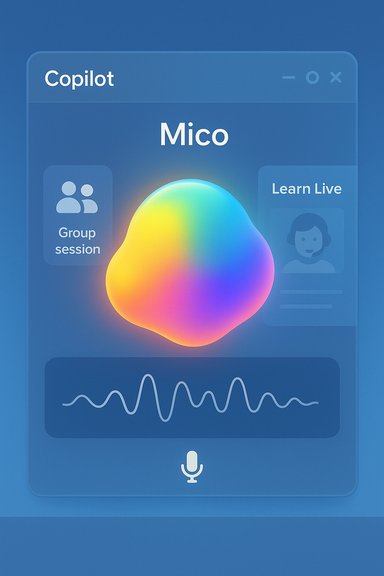
Mico is not a photoreal avatar. The design team chose an abstract, blob‑like form — a bright, amorphous “spot” that shifts in color, size and micro‑expression to convey conversational state: listening, thinking, acknowledging, or reacting playfully. That non‑human aesthetic is intentional; Microsoft hopes it will avoid the uncanny valley and reduce the risk of deep emotional attachment.How it behaves
- When Copilot is listening, Mico animates to show attention.
- When Copilot is reasoning, Mico exhibits a “thinking” posture and subtler motion.
- For positive or upbeat exchanges, it brightens and bounces; for serious or sad content, it adopts more subdued colors.
Where Mico appears
Mico is primarily surfaced in:- Copilot voice sessions (Windows 11, Copilot app, and select mobile surfaces),
- Learn Live tutoring flows,
- Some group Copilot experiences and the Copilot home surface.
The Technical Underpinnings — What’s Confirmed
Mico is a presentation layer
Microsoft describes Mico as a presentation or persona layer that sits on top of Copilot’s existing models and orchestration. It is not a separate intelligence: Copilot still handles speech‑to‑text, reasoning, retrieval, and actions while Mico visualizes states like “listening” and “thinking.”Model integrations and compute
Copilot’s backend is evolving quickly: Microsoft has integrated GPT‑5 variants into Copilot Studio and Microsoft 365 Copilot, and Copilot Studio documentation confirms makers can choose GPT‑5 models for agents and that GPT‑5 Chat is available in production contexts in supported regions. This family of models underpins Copilot’s improved responsiveness and reasoning, which in turn supports features that Mico helps visualize (e.g., long responses, multi‑step actions). Microsoft’s Copilot Studio update also notes support for a model routing approach (choosing the best model for a given task), plus experimental GPT‑5.2 variants in early release environments. In short, Copilot's intelligence — the engine Mico rides on — is increasingly powered by GPT‑5 family models in Microsoft’s stack.On‑device / low‑latency targets
Microsoft is promoting differentiated Copilot experiences on “Copilot+ PCs” with on‑device NPUs and hardware acceleration to lower latency for voice/vision tasks. The fidelity of Mico’s real‑time animation depends on those performance targets; without local acceleration, animation may lag behind audio or command execution. Microsoft’s platform notes and preview coverage describe these hardware‑software pairings as part of the broader Copilot experience.Why Microsoft Built Mico — Product and Strategic Rationale
Microsoft’s stated goal is to reduce the social friction of talking to machines. Voice interactions can be awkward because users lack the nonverbal cues of human conversation: who’s speaking, when to take the floor, whether the assistant is still working. Mico provides those nonverbal cues, improving turn‑taking, signaling processing status, and making extended voice sessions (tutoring, group planning) less socially awkward. Strategically, Microsoft also needs to differentiate Copilot in a crowded field. Competitors such as Google emphasize raw efficiency and model prowess; Microsoft is betting that personality + utility will increase adoption and engagement among casual and creative users. The combination of memory, groups, and a visual persona is designed to create stickier interactions and a clearer product identity.User Reactions: Early Signals and Community Sentiment
Early adopters and reviewers show a polarized mix of delight and skepticism.- Positive reactions emphasize Mico’s charm and the small moments of delight it can create: the avatar can make task sessions feel lighter, reduce the awkward silence in voice modes, and provide approachable entrance points for nontechnical users. Several hands‑on writeups praised the Learn Live mode and how Mico lowers the barrier to speaking to Copilot.
- Critical voices worry about anthropomorphism and misplaced trust: when a system simulates emotional responses, users may unconsciously infer sentience or deeper understanding than the model actually has. Researchers and commentators have flagged the psychological risk of parasocial relationships with AI agents — a concern amplified when memory features create apparent continuity across sessions.
- Enterprise users are pragmatic: many appreciate the opt‑out toggles and governance surfaces (memory controls), but some question whether an avatar belongs in productivity workflows where speed and clarity matter more than charm. Adoption metrics for Copilot historically show pockets of heavy use and broader stretches of low engagement; Microsoft appears to be using Mico to move some users down the engagement funnel.
Integration and Scalability — Where Mico May Succeed or Stall
Opportunities
- Onboarding and adoption: For users unfamiliar with voice computing, a friendly avatar can reduce hesitation and increase trial. Mico could be a low‑friction gateway for voice‑first features like Learn Live and Copilot Groups.
- Accessibility & multi‑modal learning: Visual cues plus voice may benefit visually oriented learners or people who need stronger feedback loops during tutoring sessions. The Learn Live mode pairing is an example where Mico’s presence has a plausible use case.
- Cross‑platform persona: If Microsoft makes Mico configurable and consistent across Windows, Edge and mobile, it could become a unifying brand element that eases multi‑device workflows.
Risks and friction points
- Performance vs. charm: Early reports of sluggish Copilot responses and occasional inaccuracies risk turning Mico’s animations into perceived glitches. A slow or incorrect reply accompanied by a bouncy animation will frustrate users rather than amuse them. Microsoft must prioritize sync and latency so the visual feedback matches backend behavior.
- Enterprise fit: In finance, healthcare, legal and other regulated sectors, polished productivity and auditable decisions matter more than personality. Mico will likely remain opt‑out in those contexts; the real question is whether it can deliver measurable productivity improvements beyond engagement signals.
- Privacy and perception: Emotion detection and analysis — even if superficial — can raise data‑use questions. Microsoft emphasizes consent and controls, but organizations and privacy advocates will scrutinize any features that process voice tone or infer emotional state. Where memory persists, governance must be clear and auditable.
Ethics, Trust, and the Uncanny Line
Mico singles out several ethical fault lines that the industry has been circling for years:- Anthropomorphism: When an interface looks responsive, people sometimes attribute motives and understanding that aren’t there. Simulated empathy can be comforting, but it may also mislead users about the assistant’s capabilities. Transparency and UI signals that make limitations explicit are essential. Microsoft states Mico is an optional persona layer, which helps, but the psychological effects deserve monitoring.
- Emotional manipulation: Designers must avoid using simulated warmth to nudge behavior or extract more engagement from vulnerable users. Ethical guardrails are needed if features like memory or tone analysis are used to tailor persuasive content. Microsoft’s published guidance emphasizes user control and consent, but implementation details will be judged in practice.
- Regulatory readiness: As persona‑driven interfaces proliferate, regulators may demand clearer disclosures and limits on emotionally evocative design in certain domains (education, mental health, child‑facing apps). Microsoft’s opt‑in design and enterprise governance tools may help, but they are not a substitute for external accountability.
Practical Considerations: Admins, Power Users, and IT Teams
- Policy and Governance: IT admins should inventory Copilot capabilities across the tenant and decide where Mico (and other persona features) are permitted. Microsoft documentation indicates memory artifacts for enterprise contexts inherit tenant security and residency controls, but admins will want clear policies.
- Performance testing: Organizations deploying Copilot in low‑latency contexts should evaluate network paths and on‑device acceleration. Mico’s responsiveness depends on timely backend responses; otherwise, the avatar’s feedback loop breaks.
- User education: Teach staff what Mico is — a UI persona — and where to find memory controls or disable the avatar. Plain‑language explainers can reduce confusion and curb unrealistic expectations.
- Pilot, measure, iterate: Roll out Mico and voice experiences in pilots; measure actual productivity gains (task completion rates, time‑to‑answer), not just engagement metrics. Early signals from Microsoft suggest interaction time rises with more expressive features, but task completion improvements are less clear — pilot data will be decisive.
Where Mico Might Go Next — Roadmap Possibilities
- Deeper personalization and skins: Users have already requested greater customization (appearance, reaction thresholds, mute certain behaviors). Microsoft has historically iterated based on community feedback and may expose richer skinning or preference controls.
- Team‑level personas for collaboration: Imagine a shared Mico in Copilot Groups that surfaces a group consensus or flags unresolved items visually. This could be a natural extension if Mico proves helpful in group workflows.
- Cross‑product expansion: If well‑received, Mico‑style personas could appear in Teams, Outlook or even Azure dashboards as optional visual anchors for voice‑driven workflows. This risks fragmentation if controls and privacy boundaries aren’t harmonized.
- Strict domain gating: For healthcare, finance, or other regulated verticals, Mico may be restricted to purely cosmetic modes or disabled entirely, while a stripped, audit‑friendly Copilot handles mission‑critical tasks.
Assessment: Strengths, Weaknesses, and a Practical Verdict
Strengths
- Approachability: Mico lowers the social barrier for voice interactions and could increase adoption among casual users and learners.
- Integration with substantive features: It is not a stand‑alone toy — Mico arrives with memory, groups, and Learn Live, making the overall package more than cosmetic.
- Optionality and controls: Microsoft has emphasized toggles and memory governance, which align with best practices for user control.
Weaknesses / Risks
- Perception mismatches: If backend accuracy and latency don’t match the polished visual cues, Mico will feel like a cosmetic overlay on a brittle system. Early reports of sluggishness in Copilot responses are a warning sign.
- Ethical and psychological concerns: Anthropomorphic cues can mislead; memory persistence can create perceived continuity that risks parasocial effects.
- Enterprise utility: For heavy productivity scenarios, Mico’s value must be proven via measurable productivity gains rather than anecdotal delight.
Hard Facts and Verified Claims (What We Can Reliably Confirm)
- Mico was announced as part of Microsoft’s Copilot Fall Release and surfaced publicly during late October 2025 product sessions.
- Mico is an optional, animated avatar that appears primarily in Copilot’s voice mode and certain learning/collaboration flows. Users can toggle the avatar off.
- Microsoft bundles Mico with substantive features: memory, Copilot Groups (roughly up to 30–32 participants), Real Talk conversational modes, and Learn Live tutoring.
- Copilot Studio and Microsoft documentation show that GPT‑5 family models are available for agents and that Microsoft is routing model choice to balance speed and depth of reasoning — confirming that Copilot’s backend uses GPT‑5 class models where enabled.
Claims That Deserve Caution or Remain Partially Verified
- The claim that Mico “reads” emotions with human‑level accuracy should be treated cautiously. Microsoft has described Mico as reacting to tone and context, but the underlying inference quality (how reliably it detects specific emotions) is not independently verifiable from public documentation. Treat detailed claims about “emotion detection” accuracy as provisional until Microsoft publishes technical evaluations or third parties validate them. Caveat emptor.
- Assertions about broad uptake or long‑term retention impact (e.g., that Mico will materially raise enterprise task completion rates) are speculative; public usage metrics so far show increased interaction times but not necessarily proportional productivity gains. Pilot data and longitudinal studies are needed for firm conclusions.
Practical Recommendations for Users and IT Leaders
- Turn on Mico in small, voluntary pilots first. Measure real productivity outcomes — task completion, time saved, user satisfaction — rather than engagement alone.
- Document memory controls and educate users on how to view/delete what Copilot remembers. Treat memory as a managed data asset in tenant governance.
- For regulated or mission‑critical contexts, default to Mico off and require explicit admin enablement. Ensure logs and audit trails exist for decisions assisted by Copilot.
- Watch for updates on model routing and GPT‑5 availability for your tenant — model choices affect accuracy and latency, which in turn affect the perceived quality of Mico’s animations.
Conclusion
Mico is an emblem of where consumer AI design is headed: a blend of utility and personality that aims to make voice interactions less alien and more human‑friendly. It’s an elegant interface experiment built on tangible backend upgrades — the GPT‑5 family, memory primitives, and group collaboration tools — but its long‑term value depends on execution.If Microsoft solves the latency and accuracy tradeoffs, keeps privacy and governance front and center, and lets users decide whether they want a digital pet on their desktop, Mico could meaningfully broaden how people talk to their computers. If the company treats it as a marketing flourish without shoring up core reliability and ethical guardrails, Mico will likely be remembered as a charming detour in the long arc of AI interfaces — notable, instructive, and ultimately ephemeral. For a grounded briefing on the Copilot Fall Release and Mico’s role in Microsoft’s human‑centered AI strategy, consult Microsoft’s Copilot blog and recent product updates; coverage from Reuters, The Verge, Windows Central and Ars Technica provides independent reporting and analysis of the rollout and its reception.
Mico is live for many U.S. users; administrators and curious users should check Copilot settings to enable or disable the animated persona and to review memory and privacy controls before enabling voice‑first experiences broadly.
Source: WebProNews Microsoft Launches Mico: Whimsical AI Pet for Copilot Interactions
