

Microsoft's attempt to scrub a mocking nickname from its own channels detonated into a classic Streisand effect: a simple keyword filter meant to curb “Microslop” references in the official Copilot Discord and Xbox ecosystem instead amplified the joke, exposed simmering community distrust of Microsoft’s AI push, and arrived at the worst possible moment—days after a shake-up in Xbox leadership and just before GDC 2026.
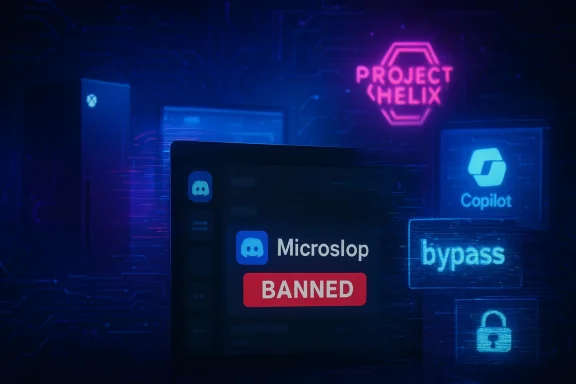
In early March 2026, users discovered that the term “Microslop”—a derisive portmanteau aimed at Microsoft’s AI efforts—was being blocked inside the official Microsoft Copilot Discord server. Reports of the filter surfaced publicly on March 1, 2026, and were quickly amplified by multiple outlets and community channels. The filter was simple: messages containing the word triggered an automated moderation response that prevented posting. Within hours, users began testing workarounds (Microsl0p, Micro-slop, Sloppysoft, etc.), and the attempt at suppression became its own meme.
That moderation action evolved into a more decisive measure: sections of the Copilot server were temporarily restricted and the server itself saw short-term lockdowns while Microsoft said it implemented stronger safeguards to manage spam and protect users from “harmful content.” Around the same time, the Xbox PC App reportedly picked up similar filters, further convincing users that Microsoft was actively policing that particular epithet across its owned properties.
The stakes were higher than a single moderation misstep for two reasons. First, the incident occurred days after Phil Spencer’s retirement and the appointment of Asha Sharma as the new head of Microsoft Gaming—an executive with a public history leading Microsoft’s CoreAI organization. Her February 2026 elevation heightened scrutiny about the future direction of Xbox. Second, Sharma and Microsoft had already positioned generative AI and Copilot as central components across Windows and Microsoft services—moves that generated enthusiastic adoption in some quarters and vocal skepticism in others. Announcing a console codename, Project Helix, on March 5, 2026, only intensified attention on how AI, hardware, and consumer-facing strategy might intersect under the new leadership.
For many users, that convergence is valuable: integrated assistants can speed workflows, offer helpful context, and enable new features. For others, Copilot’s ubiquity feels like a forced design philosophy—more about branding than polished utility. The "Microslop" critique is shorthand for that latter sentiment: AI features that feel slapped on, undercooked, or disruptive.
Critics argue that a CoreAI background signals a shift toward AI-first initiatives within Xbox—potentially at the expense of first-party game development or traditional console priorities. Supporters point out that software, services, and platform engineering are integral to modern consoles, and that an AI-literate leader could better navigate cloud gaming, cross-device integration, and performance optimization.
The optics mattered: the Copilot moderation incident occurred within a week of that leadership change and just before Sharma publicly teased the next Xbox under the codename Project Helix on March 5, 2026, saying it would “play your Xbox and PC games.”
This is fixable. Microsoft’s strengths—deep engineering resources, platform reach, and a strong partner ecosystem—mean it can design better moderation, communicate transparently, and demonstrate AI features that genuinely benefit users. But it will require humility and discipline: treat criticism as data, not an attack; swap blunt filters for nuanced moderation; and balance AI-first product moves with clear commitments to games, first-party content, and the social communities that sustain platform loyalty.
Project Helix may yet be an exciting hardware chapter for Xbox. To get there, Microsoft needs to rebuild some social capital. The Microslop meme will fade if the company can show measurable, user-centered improvements and a willingness to let candid critique coexist with community safety. Until then, every moderation misstep will be interpreted not as a technical glitch but as evidence of a deeper priority mismatch—and that is the real reputational risk Microsoft must manage as it pushes Copilot and AI across its products.
Source: GameRant Xbox Ridiculed Over New 'Microslop' Policy
 Background: what happened and why the timing matters
In early March 2026, users discovered that the term “Microslop”—a derisive portmanteau aimed at Microsoft’s AI efforts—was being blocked inside the official Microsoft Copilot Discord server. Reports of the filter surfaced publicly on March 1, 2026, and were quickly amplified by multiple outlets and community channels. The filter was simple: messages containing the word triggered an automated moderation response that prevented posting. Within hours, users began testing workarounds (Microsl0p, Micro-slop, Sloppysoft, etc.), and the attempt at suppression became its own meme.That moderation action evolved into a more decisive measure: sections of the Copilot server were temporarily restricted and the server itself saw short-term lockdowns while Microsoft said it implemented stronger safeguards to manage spam and protect users from “harmful content.” Around the same time, the Xbox PC App reportedly picked up similar filters, further convincing users that Microsoft was actively policing that particular epithet across its owned properties.
The stakes were higher than a single moderation misstep for two reasons. First, the incident occurred days after Phil Spencer’s retirement and the appointment of Asha Sharma as the new head of Microsoft Gaming—an executive with a public history leading Microsoft’s CoreAI organization. Her February 2026 elevation heightened scrutiny about the future direction of Xbox. Second, Sharma and Microsoft had already positioned generative AI and Copilot as central components across Windows and Microsoft services—moves that generated enthusiastic adoption in some quarters and vocal skepticism in others. Announcing a console codename, Project Helix, on March 5, 2026, only intensified attention on how AI, hardware, and consumer-facing strategy might intersect under the new leadership.
Overview: “Microslop” as symptom, not cause
The origin and meaning of “Microslop”
“Microslop” emerged as a shorthand complaint in online communities. It fuses Microsoft and “AI slop,” capturing resentment that the company has layered generative AI features onto products in ways some users see as intrusive, unfinished, or simply unnecessary. The term has been applied not just to Copilot but as a critique of perceived overreach—AI overlays in browsers, Edge redesigns inspired by Copilot, and AI-first UI tweaks that change long-standing workflows.Why a banned word made headlines
The mechanics were straightforward: an automated keyword filter intended to limit spam and abusive language matched “Microslop” and prevented those messages from appearing. But automatic filters are blunt instruments. Users rapidly bypassed the rule with minimal obfuscation, and the phenomenon flipped the moderation goal into a viral rallying cry. Online coverage and social sharing turned the ban into proof—real or symbolic—of the very problem critics were complaining about: heavy-handed management and overbearing corporate influence.Moderation misstep: technical and social analysis
Technical view: why keyword filters fail
Keyword-based moderation is low-cost and easy to deploy, but it has well-known weaknesses:- False positives and false negatives. Simple tokens miss contextual nuance and are trivial to evade with character substitution, punctuation, or spacing.
- Adaptation and escalation. Communities that want to protest will iterate quickly; a static filter invites creative circumvention.
- Scale problems. Automated filters that are overzealous can block legitimate conversation and force moderators into an arms race of manual reviews or broader restrictions.
Social view: community dynamics and the Streisand effect
Online communities react to perceived censorship. When a term that’s already a critique of product direction is suppressed, social-media amplification often follows a recognizable pattern:- Discovery: A community notices the block.
- Experimentation: Users test and bypass the filter.
- Amplification: Screenshots and reports spread to broader platforms.
- Mockery: Derivative terms and mock tools (browser extensions, memes) proliferate.
- Backlash: Trust erodes further as more users interpret the action as proof of overreach.
Corporate strategy intersection: Copilot, CoreAI, and Xbox
Microsoft’s AI posture and Copilot branding
Microsoft invested heavily in AI over the last several years. Copilot now represents both a product and a branding layer that ties AI features across Windows, Edge, Office, and Xbox experiences. The company’s collaboration with OpenAI and multi-billion-dollar investments contributed to making "Copilot" a visible, cross-cutting label.For many users, that convergence is valuable: integrated assistants can speed workflows, offer helpful context, and enable new features. For others, Copilot’s ubiquity feels like a forced design philosophy—more about branding than polished utility. The "Microslop" critique is shorthand for that latter sentiment: AI features that feel slapped on, undercooked, or disruptive.
Leadership change: Asha Sharma and the optics of an AI leader in gaming
Asha Sharma’s elevation to head Microsoft Gaming in late February 2026 was announced publicly with an effective date of February 23, 2026. Sharma previously led Microsoft’s CoreAI organization, which creates foundational AI infrastructure and tools for Microsoft products. That résumé instantly reframed the conversation: an AI-focused leader in charge of a console business triggered questions about priorities.Critics argue that a CoreAI background signals a shift toward AI-first initiatives within Xbox—potentially at the expense of first-party game development or traditional console priorities. Supporters point out that software, services, and platform engineering are integral to modern consoles, and that an AI-literate leader could better navigate cloud gaming, cross-device integration, and performance optimization.
The optics mattered: the Copilot moderation incident occurred within a week of that leadership change and just before Sharma publicly teased the next Xbox under the codename Project Helix on March 5, 2026, saying it would “play your Xbox and PC games.”
Project Helix: hardware, hybrid ambitions, and the narrative challenge
What Microsoft has said publicly
On March 5, 2026, Microsoft and the incoming Xbox executive signaled the codename Project Helix, promising a next-generation console that will “lead in performance” and support both Xbox and PC games. The timing—teasing hardware weeks after a leadership reshuffle and days after the moderation controversy—meant the announcement was interpreted through that prism.Technical implications and potential avenues
From the brief public hints, Project Helix appears aimed at several connected objectives:- Hybrid compatibility. A device that runs both Xbox and PC games suggests a broader move to blur hardware boundaries, increasing the value of Microsoft’s ecosystem across Game Pass, Xbox PC titles, and Windows.
- Performance focus. The promise to “lead in performance” signals a continued arms race with Sony and potential competition with PC hardware and Steam-like ecosystems.
- Developer alignment. Messaging around GDC suggests Microsoft will emphasize developer tooling and cross-platform performance, potentially leveraging internal AI tooling to optimize porting or scaling.
Community reaction: trust, backlash, and opportunity
Immediate fallout and meme culture
The Microslop episode quickly became a rallying point. Social posts, memes, and even browser extensions mocking the term circulated as users turned a moderation action into a broader critique. The phenomenon is instructive: community pushback often targets symbols that represent a company’s perceived direction. In this case, the banned word became a symbol for resentment about AI integration, perceived corporate tone-deafness, and leadership choices.Broader sentiment: not just about a word
Banning the term didn’t create the discontent—it exposed it. Underneath the joke lies a cluster of genuine user concerns:- Do AI features disrupt established workflows or privacy expectations?
- Are product decisions being made for PR or platform signaling rather than user value?
- Will the Xbox brand prioritize AI integration over exclusive content and hardware identity?
What Microsoft did right — and where it risked more harm
Strengths and defensible moves
- Rapid response to spam. Microsoft claims the filter targeted spam campaigns and “walls of text.” Pro-active moderation is appropriate when communities face coordinated disruptions.
- Temporary lockdowns to stabilize communities. Restricting access while implementing safeguards can be a responsible short-term step to protect users.
- Clear product momentum. Publicly teasing Project Helix and reaffirming a commitment to Xbox shows long-term product continuity and helps reassure partners that Microsoft intends to compete in hardware and software.
Risks and missteps
- Overly blunt moderation. Keyword filters are known to backfire when used on contentious topics—particularly when applied to non-abusive criticism.
- Perception of censorship. Even if the intent was to limit spam, community members experienced the action as interference with legitimate criticism.
- Timing and optics. The moderation incident coincided with an AI-focused leadership change and hardware tease—amplifying interpretations that Microsoft was prioritizing AI over gamer concerns.
- Missed opportunity for dialogue. Microsoft could have used the moment to publicly engage with community concerns about AI productization, rather than allowing the story to be framed as suppression.
Risk matrix: where this can lead for Microsoft and Xbox
- Brand erosion among core gamers. While mainstream adoption of Copilot features may be strong, vocal core communities on platforms like Discord, Reddit, and X can shape narratives that influence perception.
- Developer relations friction. If studios perceive the Xbox remit shifting away from content-first to AI tooling-first, recruitment and first-party studio morale could be affected.
- Regulatory and PR exposure. Heavy-handed moderation and opaque policy enforcement can attract scrutiny from press and watchdogs, especially where user data or automated moderation impacts are involved.
- Strategic distraction. Managing community backlash consumes executive attention and can delay rollout discussions at events like GDC that were meant to reset the narrative.
What Microsoft should do next: concrete steps
- Publicly clarify the moderation incident with actionable detail.
- Explain the technical nature of the filters, why they were deployed, and precisely when they were removed or adjusted.
- Offer transparent moderation policy documents for community channels.
- Publish a short, plain-language moderation FAQ specific to the Copilot Discord and Xbox App.
- Recommit to community dialogue.
- Host a live AMA or developer roundtable that includes both product and community moderation leads, scheduled for a specific date and time.
- Separate spam mitigation from legitimate critique.
- Implement rate limits and machine-learning spam detection rather than blunt keyword blocks for non-abusive content.
- Demonstrate the value of AI features with measurable improvements.
- Release case studies or short demos showing how Copilot features reduce friction, preserve privacy, and improve gameplay experiences.
- Reassure gaming continuity.
- Outline clear near-term plans for first-party content, hardware timelines, and developer support that confirm Xbox’s commitment to games—not just AI.
Lessons for platform moderation and product strategy
- Moderation needs context. Blocking tokens without context invites ridicule and alienation when those tokens become shorthand for a broader issue.
- Leadership signals matter. Executive backgrounds shape community expectations. When an AI executive takes over a consumer-facing game brand, explain the continuity and division of priorities early and often.
- Product-first proof beats marketing claims. If AI is the future, prove it through tangible, user-facing wins—smarter performance, meaningful accessibility features, or time-savings—rather than entirely through branding.
- Community culture is an asset. Communities are not just noise; they are early detectors of UX regressions, privacy concerns, and feature regressions. Treat them as partners, not adversaries.
SEO notes: why this story matters to readers searching for Copilot, Xbox, and Project Helix
This episode is relevant across several high-interest search topics:- Microsoft Copilot controversies and moderation
- Xbox leadership changes and Asha Sharma’s role
- Project Helix and the future of Xbox hardware
- Community reactions to AI in consumer products
- Discord moderation best practices and spam mitigation
Final analysis: bridge the gap between AI ambition and gamer trust
The Microslop debacle is instructive because it encapsulates a larger tension: Microsoft’s scale and ambition—deep AI investment, cross-product Copilot branding, and hardware aspirations like Project Helix—are now colliding with a fragmented, skeptical, and highly vocal user base. The incident exposed a governance gap: the engineering tools and the social contract were not aligned in a way that protected community trust.This is fixable. Microsoft’s strengths—deep engineering resources, platform reach, and a strong partner ecosystem—mean it can design better moderation, communicate transparently, and demonstrate AI features that genuinely benefit users. But it will require humility and discipline: treat criticism as data, not an attack; swap blunt filters for nuanced moderation; and balance AI-first product moves with clear commitments to games, first-party content, and the social communities that sustain platform loyalty.
Project Helix may yet be an exciting hardware chapter for Xbox. To get there, Microsoft needs to rebuild some social capital. The Microslop meme will fade if the company can show measurable, user-centered improvements and a willingness to let candid critique coexist with community safety. Until then, every moderation misstep will be interpreted not as a technical glitch but as evidence of a deeper priority mismatch—and that is the real reputational risk Microsoft must manage as it pushes Copilot and AI across its products.
Source: GameRant Xbox Ridiculed Over New 'Microslop' Policy