

Microsoft’s securityy playbook for 2026 centers on four interlocking priorities that together reframe identity as the primary control plane for defending modern networks: deploy AI-driven protection at operational speed, treat AI agents as governed identities, stitch identity and network controls into a single Access Fabric, and harden the identity foundation with phishing‑resistant authentication and robust recovery. These priorities reflect an urgent shift from static, perimeter-based controls to dynamic, context-aware access decisions—driven by telemetry, automation, and explicit governance—and they reshape how security teams must organize, instrument, and operate in the age of adversarial AI.
Security teams have spent years building Zero Trust architectures, tightening authentication, and reducing blast radius with least‑privilege models. But the rapid rise of generative and agentic AI has materially changed the adversary playbook: threat actors now automate credential abuse, craft hyper‑realistic phishing and deepfake lures, and orchestrate multi‑step intrusion campaigns at scale. Microsoft’s recent guidance packages these trends into operational recommendations intended to close “seams” between identity and network controls and to let defenders operate at machine speed.
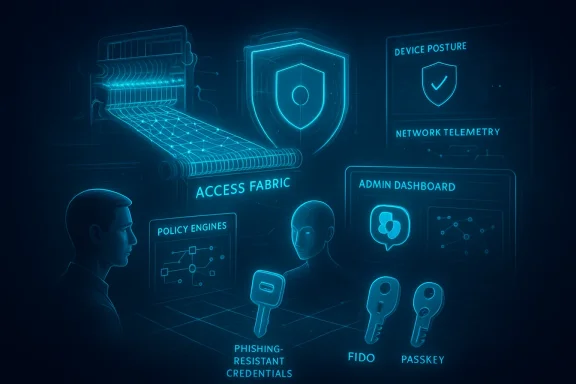
The practical implication is straightforward: defenders must move from periodic, manual controls to continuous, automated evaluation of trust that re‑assesses access during sessions and across layers. Microsoft frames this as an “Access Fabric” approach—an integrated, contextual policy and telemetry plane that continuously evaluates identity, device, network, application, and data signals to make real‑time access decisions.
Source: Microsoft Four priorities for AI-powered identity and network access security in 2026 | Microsoft Security Blog
 Background
Security teams have spent years building Zero Trust architectures, tightening authentication, and reducing blast radius with least‑privilege models. But the rapid rise of generative and agentic AI has materially changed the adversary playbook: threat actors now automate credential abuse, craft hyper‑realistic phishing and deepfake lures, and orchestrate multi‑step intrusion campaigns at scale. Microsoft’s recent guidance packages these trends into operational recommendations intended to close “seams” between identity and network controls and to let defenders operate at machine speed.The practical implication is straightforward: defenders must move from periodic, manual controls to continuous, automated evaluation of trust that re‑assesses access during sessions and across layers. Microsoft frames this as an “Access Fabric” approach—an integrated, contextual policy and telemetry plane that continuously evaluates identity, device, network, application, and data signals to make real‑time access decisions.
1. Implement fast, adaptive, and relentless AI‑powered protection
What Microsoft recommends
Microsoft urges organizations to integrate generative and agentic AI into identity workflows so security teams can reduce risk, accelerate decisions, and strengthen defenses in real time. AI agents assist with policy design and tuning, surface gaps in Conditional Access coverage, investigate anomalous sign‑ins, and automate repetitive investigative tasks—freeing humans to focus on judgment and escalation. Microsoft reports measurable admin productivity gains when using Copilot‑style agents for Conditional Access optimization.Why this matters now
Human-only workflows are too slow for an attacker ecosystem leveraging automation and AI. As detection windows compress, defenses must similarly compress action windows: fewer manual handoffs, more high‑confidence automated containment, and continuous posture correction. AI‑driven analysis—when governed—reduces mean time to detect and mean time to contain by enabling fast enrichment, correlation, and prescriptive playbooks.Strengths
- Speed and scale: AI agents can process large telemetry volumes and propose or enact responses faster than human teams alone.
- Consistency: Agents reduce configuration drift by recommending consistent policy decisions across the estate.
- Analyst productivity: Automating routine enrichment and triage multiplies SOC throughput and reduces analyst fatigue.
Risks and caveats
- Model drift and false positives: AI models degrade and can produce noisy alerts if training and telemetry are fragmented. Maintain human‑in‑the‑loop checkpoints for higher‑impact actions.
- Over‑automation: Automatically executing high‑impact remediations without rollback or canary testing can disrupt business continuity. Implement rollback paths and simulation testing.
- Visibility gaps: AI only helps where telemetry is complete; siloed telemetry yields blind spots and biased model outputs. Invest in centralized, normalized telemetry first.
Practical checklist (quick wins)
- Pilot AI agents for low-risk tasks: alert enrichment, draft investigation summaries, and Conditional Access recommendations.
- Instrument comprehensive telemetry: identity logs, network session data, endpoint telemetry, and data‑classification signals.
- Define automation governance: rollback procedures, audit trails, and escalation gates for human review.
2. Manage, govern, and protect AI and agents as first‑class identities
The core shift
AI agents must be owned, inventoried, and governed in the same way as human identities. That means giving agents explicit identities, human sponsors, lifecycle controls, and least‑privilege access limits—because unsanctioned agents create a new form of shadow IT and data exfiltration risk. Microsoft’s Entra Agent ID and Entra Internet Access are examples of tooling designed to register, monitor, and gate agent behavior.Operational challenges
- Agent sprawl: rapid adoption of productivity AI multiplies autonomous agents that can call external services and persist credentials. Without governance, engines and data flows leak.
- External exposure: agents that access the internet or third‑party AI services can become inadvertent exfiltration conduits if not filtered or proxied.
Governance controls to deploy
- Inventory and sponsorship: require a named human sponsor for every agent and automated lifecycle policies for onboarding and retirement.
- Identity and access policy: assign per‑agent identities and apply Conditional Access/least‑privilege policies, JIT where appropriate.
- Network and DLP integration: enforce guardrails on internet access, block prompt injection vectors, and prevent sensitive data flow to unsanctioned AI services.
Strengths
- Auditability: agent identities make it possible to trace actions and hold teams accountable.
- Granular risk control: per‑agent policies allow differentiated privileges for different classes of automation.
Risks and mitigations
- Failure to track agents: orphaned or forgotten agents are high‑risk. Automate lifecycle expiration and require periodic re‑attestation.
- Complex policy surface: adding agents increases policy management load—reduce friction with templates and policy inheritance.
3. Extend Zero Trust principles everywhere with an integrated Access Fabric
What an Access Fabric is
The Access Fabric is a design pattern: a unified decision plane that consumes identity, device posture, network telemetry, app sensitivity, and business context and enforces consistent, continuous, risk‑based access decisions across cloud, on‑premises, and edge. It eliminates policy seams between identity solutions and network access controls. Microsoft positions Entra Conditional Access as an example of the unified policy engine for such a fabric.Why integration matters
Most organizations run multiple identity and network products—this tool sprawl yields disconnected policies and blind spots that attackers exploit. Integrating telemetry and enforcement produces:- richer context for access decisions,
- the ability to re‑evaluate trust during sessions, and
- centralized policy management to reduce human error.
Strengths
- Better signal correlation: combining identity and network signals raises fidelity of risk scoring and reduces false positives.
- Single policy plane: central policy management reduces inconsistent enforcement across diverse access vectors.
Implementation steps
- Map current identity and network vendors and identify policy gaps. Prioritize integration where crown‑jewel resources are exposed.
- Normalize telemetry into a central SIEM/XDR so models and policy engines can reason with unified context.
- Move to continuous access evaluation: enforce session re‑checks on context changes (device posture, location, or anomalous behavior).
Risks and caveats
- Migration complexity: consolidating or integrating multiple vendors is operationally heavy; choose a staged approach: integrate signals first, then converge policy enforcement.
- False sense of security: an Access Fabric improves signal fidelity but depends on telemetry completeness and correct model tuning. Validate with live red‑team and blue‑team exercises.
4. Strengthen the identity and access foundation: start secure and stay secure
Baseline controls
Microsoft emphasizes phishing‑resistant credentials, strong identity proofing, and protective guardrails for recovery. Passkeys, physical security keys, and device‑bound authentication for privileged accounts form the foundation. Verified identity for onboarding and recovery—combining government ID checks with biometric verification—reduces impersonation risk in account recovery flows.Why this is high leverage
Most breaches still begin with credential theft or abused tokens. Investing in phishing‑resistant authentication and short‑lived credentials dramatically reduces the attack surface and the ROI of credential-based attacks. Enforcing these controls for admin and high‑risk accounts yields outsized reductions in account‑takeover probability.Recommended minimums
- Phishing‑resistant MFA for all privileged and high‑risk accounts (FIDO2 / hardware-backed passkeys).
- Enforce Conditional Access baselines: require device compliance checks, block legacy auth, and apply risk‑based session policies.
- Harden recovery paths: require high‑assurance verification for account recovery and enroll new users with passkeys before granting resource access.
Strengths
- Prevents the most common pivot: credential compromise.
- Supports regulatory resilience: clearer audit trails and stronger identity proofing help with compliance and incident reporting.
Risks and operational tradeoffs
- User experience friction: high‑assurance onboarding for certain cohorts can increase support load; balance by segmenting user populations and using synced passkeys where appropriate.
- Recovery complexity: stronger recovery must remain practical—build robust, auditable recovery playbooks and automated validation to support helpdesk workflows.
Cross‑cutting governance: where the program fails or succeeds
Model governance and observability
AI and automation need the same lifecycle controls as any critical system: model versioning, performance validation, input/output logging, and a requirement for explainability of high‑impact decisions. Operationalize model health metrics (precision, recall, false‑positive rate) and schedule retraining based on telemetry drift.Telemetry quality and retention
Large, normalized telemetry stores with long enough retention windows are essential for both model training and forensic hunts—attack timelines are compressing and can still have long dwell phases that require retrospective analysis.Collective defense and intel sharing
No enterprise can see everything. Participating in sector ISACs, sharing anonymized telemetry where lawful, and integrating curated threat feeds materially improves detection and accelerates takedown of shared infrastructure abused by attackers.Critical analysis: strengths, blind spots, and unverified claims
Notable strengths of Microsoft’s priorities
- Holistic architecture: Putting identity at the core while integrating network signals is a strong, pragmatic evolution of Zero Trust for hybrid estates. It reduces policy drift and improves real‑time decisioning.
- Operational realism: The recommendations balance automation with governance—encouraging human oversight for high‑impact actions and canary testing for automation rollouts.
- Emphasis on agent governance: Recognizing agents as first‑class identities addresses a real risk vector that many organizations have only recently started to see.
Practical blind spots and implementation friction
- Integration burden: Many orgs run multiple vendors and legacy systems; building an Access Fabric without disrupting operations requires careful phased work and often sizable engineering investment.
- Data completeness: The effectiveness of AI agents and continuous evaluation depends on unified telemetry; organizations with fragmented logging will see less benefit and more false positives.
- Human factors: Stronger identity controls and stricter recovery workflows can increase helpdesk volume and user friction unless balanced with self‑service validated recovery paths.
Claims that require verification or caution
- Productivity statistics (for example, precise percentage improvements in task completion times) are useful directional signals but should be validated against independent benchmarks and against each tenant’s own telemetry. Treat vendor‑provided performance claims as starting points for proof‑of‑value pilots rather than guaranteed outcomes.
- Global telemetry claims (percent increases in specific behaviors) are sampling‑dependent; they must be contextualized by sector, region, and product footprint. Plan with scenario‑based risk assessments rather than single global metrics.
Recommended roadmap for identity and access leaders (90–365 days)
0–90 days (discover and pilot)
- Inventory identities: humans, service principals, CI/CD runners, and any running agents. Enforce human sponsorship and expiration for agents.
- Apply phishing‑resistant MFA to top 90% of privileged exposure. Require hardware‑backed credentials for admins.
- Pilot AI agents for low‑risk tasks and measure impact on MTTD/MTTR and analyst time. Implement audit trails and rollback paths.
90–180 days (integrate and automate)
- Centralize telemetry into SIEM/XDR; normalize identity, network, and endpoint signals.
- Begin enforcing Conditional Access policies that combine identity and device posture, and add continuous session evaluation for critical apps.
- Implement DLP gates and network filtering for AI endpoints to prevent prompt‑level exfiltration.
180–365 days (operationalize and scale)
- Expand agent governance: automated lifecycle actions, per‑agent least‑privilege, and telemetry gating.
- Move more remediation playbooks into trusted automation with canary rollouts; track rollback rates and success KPIs.
- Run full IR simulations that include AI‑assisted phishing and credential compromise scenarios; measure improvements and iterate.
Final assessment
Microsoft’s four priorities for 2026—AI‑powered protection, agent governance, an integrated Access Fabric, and a hardened identity foundation—are pragmatic and aligned with observed adversary trends. Implemented together, they close critical gaps that arise when identity and network enforcement live in silos, and they enable defenders to operate with the speed and context necessary against AI‑augmented attackers. However, success depends on execution discipline: complete telemetry, phased integration, clear governance for AI, and measurable pilot validation. Organizations should treat vendor claims as hypotheses to test in their own environments, focus on data quality before sweeping automation, and prioritize phishing‑resistant credentials and controlled recovery paths for the highest‑risk accounts. The threat landscape will continue evolving, but a program that combines identity‑first engineering, integrated policy enforcement, and accountable AI governance will be better positioned to tip the scales in favor of defenders.Source: Microsoft Four priorities for AI-powered identity and network access security in 2026 | Microsoft Security Blog
