

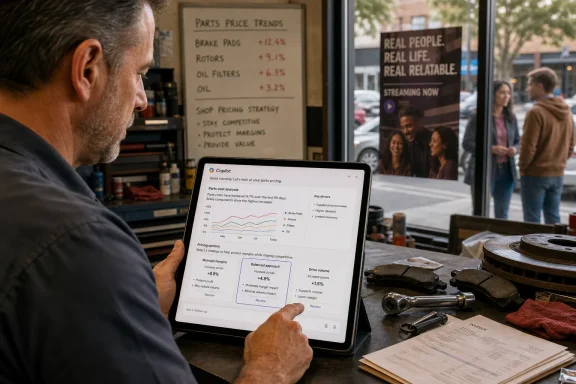
Microsoft’s latest Microsoft 365 with Copilot advertisement, Pete, launched globally on June 11, 2026, through Panay Films and follows an auto repair shop owner using Copilot to analyze rising parts costs, weigh pricing options, and keep customer charges fair across streaming and digital platforms.
That is the factual answer, but it undersells why the spot matters. Microsoft is no longer merely advertising artificial intelligence as a futuristic productivity layer for executives, developers, or enterprise architects. With Pete, the company is trying to make Copilot feel like the shop-floor business partner for the person who fixes your brakes, manages supplier invoices, and has to explain every price increase face to face.
For much of the generative AI boom, the industry’s favorite demo has been the blank document that magically becomes a polished memo. That demo made sense for early adopters, but it also narrowed the perceived audience. If AI was always shown writing strategy decks, summarizing meetings, or drafting emails, it looked like a tool for people whose work already happened inside corporate software.
Pete shifts the camera to a different kind of knowledge work. The owner of an auto repair shop may not describe himself as a “knowledge worker,” but his job is full of data, judgment, communication, and trade-offs. Parts costs move, customers resist higher bills, margins tighten, and every decision has a reputational cost.
That is precisely the terrain Microsoft wants Copilot to occupy. The ad’s premise is not that Copilot replaces Pete’s expertise. It is that Copilot helps him organize the messy inputs of a business decision quickly enough to make the human judgment easier.
The garage setting is important because it domesticate the technology. Microsoft is trying to make AI less like a spectacle and more like another tool in the office, the parts room, and the customer conversation.
That is a subtler sell than “save time,” and it is probably a smarter one. Small businesses do not buy software because a vendor promises an abstract productivity gain. They buy when software appears to reduce a recurring anxiety: cash flow, pricing, staffing, customer retention, compliance, inventory, or the nagging fear of making the wrong call with incomplete information.
In Pete, rising parts prices become the narrative device for that anxiety. Everyone who has run a small business understands the trap. Absorb the cost and margins suffer; pass it on too aggressively and customers leave; wait too long and the books start lying to you.
Microsoft’s bet is that Copilot can be framed as the companion that turns scattered business context into something actionable. That framing matters because AI adoption is no longer blocked only by capability. It is blocked by trust, habit, and the uncomfortable question of whether the tool actually understands the work at hand.
Panay Films’ recurring structure gives Microsoft a portfolio of small narratives instead of a single grand claim. Each spot can test a different emotional register. One can focus on entrepreneurship, another on time pressure, another on creativity, another on operational decision-making.
That approach also avoids a trap that has plagued AI advertising since 2023. When brands overstate what AI can do, the ads quickly become uncanny or absurd. When they understate it, the technology looks like autocomplete with better branding.
The named-character format gives Microsoft room to walk between those extremes. Pete does not need Copilot to become a different person. He needs help seeing the numbers clearly enough to make a decision he can defend.
That makes the small-business pitch both risky and valuable for Microsoft. If Copilot can be shown working in everyday business software, attached to familiar tasks, and producing useful recommendations without a specialist in the loop, it becomes easier to imagine adoption outside the Fortune 500.
But the promise has to be grounded. A small repair shop does not need an AI assistant that speaks in transformation clichés. It needs help with the boring but consequential details: price comparisons, invoice history, supplier options, customer communications, and the difference between a one-time spike and a trend.
The ad’s use of rising parts costs is therefore well chosen. It is not an exotic AI use case. It is a recognizable business problem that combines arithmetic, context, and judgment. That is where Copilot has the best chance to look practical rather than ornamental.
Pete fits that strategic turn. The ad does not appear to sell one isolated feature. It sells the idea of Copilot as a layer that connects business tools, data, and decisions.
That distinction is crucial for Microsoft. The company’s advantage is not that it invented generative AI, nor that it alone can offer a capable model. Its advantage is distribution: Word, Excel, Outlook, Teams, SharePoint, OneDrive, Dynamics, and the administrative fabric around them.
If Copilot becomes valuable, it will be because it sits where business information already lives. Pete is a consumer-facing expression of that enterprise architecture argument.
That gap is especially visible in the small-business market. Large enterprises can assign teams to pilots, governance, training, and measurement. Small businesses often cannot. They need the product to explain itself inside the work.
The Pete character is doing that explanatory labor for Microsoft. He gives viewers a proxy user who is not a prompt engineer, not a consultant, and not a technology executive. He is someone with a real business problem and limited tolerance for software theater.
That is why the campaign’s success will depend less on whether the ad is charming and more on whether the product experience matches the story. If a real Pete opens Microsoft 365 with Copilot and finds configuration friction, licensing confusion, or generic output, the emotional promise collapses quickly.
That makes sense because the boundary between consumer and business awareness has blurred. A small business owner may encounter Copilot messaging while watching a show at night, then confront the same brand inside Microsoft 365 the next morning. The campaign is designed to normalize the assistant before the purchase conversation begins.
This is a long game. Microsoft needs Copilot to feel inevitable without feeling imposed. The more often viewers see AI helping recognizable workers with ordinary problems, the easier it becomes for Microsoft to present Copilot as part of the modern work baseline.
But mass-market placement also raises expectations. A streaming ad does not give Microsoft the luxury of nuance. It compresses the product into a promise: this will help you make better decisions. The product then has to carry the weight of that compression.
Still, the risk is obvious. Business decisions are not just data problems. They involve supplier relationships, local competition, customer loyalty, timing, and instinct built from years of experience. AI can assist with the analysis, but it cannot own the consequences.
Microsoft’s challenge is to make that boundary clear. The best version of Copilot is a reasoning aid that helps users see options, summarize trade-offs, and prepare communications. The dangerous version is a confidence machine that makes uncertain recommendations look more authoritative than they are.
The Pete spot appears to choose the safer lane by emphasizing support rather than substitution. That is the right message. But as Copilot becomes more agentic and more embedded, Microsoft will need to keep reminding users where assistance ends and accountability begins.
If Microsoft succeeds in making Copilot feel approachable to small business owners and department heads, IT teams will face more user-driven demand. That demand will not arrive as a neat architecture request. It will arrive as, “Why can’t we use the thing from the ad to analyze our costs?”
That is where governance becomes unavoidable. Copilot’s usefulness depends on access to business data, and access to business data depends on permissions, retention policies, identity hygiene, and information architecture. A charming ad cannot fix overshared files, stale SharePoint sites, or poorly classified financial documents.
In that sense, Pete is a reminder that AI readiness is often just IT fundamentals under a brighter spotlight. If the data estate is chaotic, Copilot will inherit the chaos. If permissions are sloppy, Copilot may surface what users technically can access but should never have been able to see.
The ad campaign cannot answer all of that. It can only create desire. The licensing and onboarding experience must do the rest.
This is where Microsoft has historically struggled. The company is excellent at creating product families and less excellent at making the buying path feel obvious to non-specialists. Copilot adds another layer because the customer is not merely buying software; the customer is authorizing an AI system to work with company information.
For a small shop, that distinction matters. The owner may be willing to pay for a tool that helps with pricing decisions. The same owner may hesitate if the setup path feels like enterprise administration in miniature.
Here, the human remains the story. Copilot is present as a capability, not a mascot demanding affection. That is a more mature way to advertise AI.
It also matches how useful AI tends to disappear into workflows. The best assistant is not the one users remember because it performed theatrics. It is the one that helped them finish a task, make a decision, or communicate clearly enough to move on.
That is the emotional register Microsoft needs. In a market crowded with AI claims, restraint can be more persuasive than spectacle.
That ambition is larger than any one commercial. It touches Windows, Office, Teams, security, endpoint management, and cloud identity. It also touches the cultural shift from using apps to asking systems to coordinate work across apps.
The garage story helps because it compresses that ambition into something ordinary. A business owner faces a cost increase. Copilot helps analyze the situation. The owner makes a decision. The customer relationship survives.
That is the narrative Microsoft wants repeated across industries. Replace auto parts with legal documents, supply contracts, school budgets, construction bids, patient intake, or nonprofit fundraising, and the pitch remains the same.
That depends on details. The problem must feel real. The tool must feel useful. The decision must remain human. The customer must not be reduced to a spreadsheet row.
If Microsoft gets those details right, Pete could help move Copilot out of the executive keynote and into the everyday imagination of small firms. If it gets them wrong, the ad becomes another glossy AI vignette: pleasant, forgettable, and disconnected from the actual friction of running a business.
The stakes are larger than one campaign because Microsoft is trying to teach the market what workplace AI is for. The answer it offers in Pete is refreshingly concrete: not magic, not replacement, not disruption for its own sake, but help with the next hard decision.
That is the factual answer, but it undersells why the spot matters. Microsoft is no longer merely advertising artificial intelligence as a futuristic productivity layer for executives, developers, or enterprise architects. With Pete, the company is trying to make Copilot feel like the shop-floor business partner for the person who fixes your brakes, manages supplier invoices, and has to explain every price increase face to face.
 Microsoft Trades the AI Demo for the Neighborhood Garage
For much of the generative AI boom, the industry’s favorite demo has been the blank document that magically becomes a polished memo. That demo made sense for early adopters, but it also narrowed the perceived audience. If AI was always shown writing strategy decks, summarizing meetings, or drafting emails, it looked like a tool for people whose work already happened inside corporate software.Pete shifts the camera to a different kind of knowledge work. The owner of an auto repair shop may not describe himself as a “knowledge worker,” but his job is full of data, judgment, communication, and trade-offs. Parts costs move, customers resist higher bills, margins tighten, and every decision has a reputational cost.
That is precisely the terrain Microsoft wants Copilot to occupy. The ad’s premise is not that Copilot replaces Pete’s expertise. It is that Copilot helps him organize the messy inputs of a business decision quickly enough to make the human judgment easier.
The garage setting is important because it domesticate the technology. Microsoft is trying to make AI less like a spectacle and more like another tool in the office, the parts room, and the customer conversation.
The Real Product Being Sold Is Confidence
The most revealing detail in the campaign is not that Copilot analyzes costs. Spreadsheets have analyzed costs for decades. The real pitch is that Copilot can help a small business owner reach a decision with more confidence and less friction.That is a subtler sell than “save time,” and it is probably a smarter one. Small businesses do not buy software because a vendor promises an abstract productivity gain. They buy when software appears to reduce a recurring anxiety: cash flow, pricing, staffing, customer retention, compliance, inventory, or the nagging fear of making the wrong call with incomplete information.
In Pete, rising parts prices become the narrative device for that anxiety. Everyone who has run a small business understands the trap. Absorb the cost and margins suffer; pass it on too aggressively and customers leave; wait too long and the books start lying to you.
Microsoft’s bet is that Copilot can be framed as the companion that turns scattered business context into something actionable. That framing matters because AI adoption is no longer blocked only by capability. It is blocked by trust, habit, and the uncomfortable question of whether the tool actually understands the work at hand.
Panay Films Gives Copilot a Human Face
The campaign’s production lineage also matters. Pete joins earlier Copilot stories including Hank, Jimmy, Georgia, and Erin, continuing a format that presents AI through individual workers rather than feature checklists. This is classic Microsoft enterprise marketing with a warmer shell: name the person, show the pressure, let the software become the invisible assist.Panay Films’ recurring structure gives Microsoft a portfolio of small narratives instead of a single grand claim. Each spot can test a different emotional register. One can focus on entrepreneurship, another on time pressure, another on creativity, another on operational decision-making.
That approach also avoids a trap that has plagued AI advertising since 2023. When brands overstate what AI can do, the ads quickly become uncanny or absurd. When they understate it, the technology looks like autocomplete with better branding.
The named-character format gives Microsoft room to walk between those extremes. Pete does not need Copilot to become a different person. He needs help seeing the numbers clearly enough to make a decision he can defend.
Small Business Is the Hardest Audience and the Best Story
There is a reason the garage is more persuasive than the boardroom. Small businesses are unforgiving environments for software. The owner is often the buyer, admin, accountant, customer service lead, and escalation manager. A tool that creates more setup work than it removes will be abandoned quickly.That makes the small-business pitch both risky and valuable for Microsoft. If Copilot can be shown working in everyday business software, attached to familiar tasks, and producing useful recommendations without a specialist in the loop, it becomes easier to imagine adoption outside the Fortune 500.
But the promise has to be grounded. A small repair shop does not need an AI assistant that speaks in transformation clichés. It needs help with the boring but consequential details: price comparisons, invoice history, supplier options, customer communications, and the difference between a one-time spike and a trend.
The ad’s use of rising parts costs is therefore well chosen. It is not an exotic AI use case. It is a recognizable business problem that combines arithmetic, context, and judgment. That is where Copilot has the best chance to look practical rather than ornamental.
Microsoft Is Repositioning Copilot Around Workflows, Not Wonder
The broader Copilot story has been moving away from the “chatbot in the sidebar” era. Microsoft’s product strategy has increasingly centered on integrated workflows, agents, business context, and the idea that Copilot is most useful when it can operate across Microsoft 365 rather than inside a single prompt box.Pete fits that strategic turn. The ad does not appear to sell one isolated feature. It sells the idea of Copilot as a layer that connects business tools, data, and decisions.
That distinction is crucial for Microsoft. The company’s advantage is not that it invented generative AI, nor that it alone can offer a capable model. Its advantage is distribution: Word, Excel, Outlook, Teams, SharePoint, OneDrive, Dynamics, and the administrative fabric around them.
If Copilot becomes valuable, it will be because it sits where business information already lives. Pete is a consumer-facing expression of that enterprise architecture argument.
The Campaign Also Reveals Microsoft’s Adoption Problem
Advertising a tool as friendly and practical usually means the vendor knows it still needs to lower psychological resistance. Copilot is powerful, but for many businesses it remains an abstract subscription line item. The gap between “AI can help your company” and “AI helps me decide what to charge for a brake job” is the gap Microsoft is trying to close.That gap is especially visible in the small-business market. Large enterprises can assign teams to pilots, governance, training, and measurement. Small businesses often cannot. They need the product to explain itself inside the work.
The Pete character is doing that explanatory labor for Microsoft. He gives viewers a proxy user who is not a prompt engineer, not a consultant, and not a technology executive. He is someone with a real business problem and limited tolerance for software theater.
That is why the campaign’s success will depend less on whether the ad is charming and more on whether the product experience matches the story. If a real Pete opens Microsoft 365 with Copilot and finds configuration friction, licensing confusion, or generic output, the emotional promise collapses quickly.
Streaming Placement Turns AI Into Household Advertising
The decision to launch Pete globally across Hulu, Paramount+, Peacock, and digital platforms is also telling. Microsoft is not hiding Copilot inside business trade publications. It is treating workplace AI as mass-market infrastructure.That makes sense because the boundary between consumer and business awareness has blurred. A small business owner may encounter Copilot messaging while watching a show at night, then confront the same brand inside Microsoft 365 the next morning. The campaign is designed to normalize the assistant before the purchase conversation begins.
This is a long game. Microsoft needs Copilot to feel inevitable without feeling imposed. The more often viewers see AI helping recognizable workers with ordinary problems, the easier it becomes for Microsoft to present Copilot as part of the modern work baseline.
But mass-market placement also raises expectations. A streaming ad does not give Microsoft the luxury of nuance. It compresses the product into a promise: this will help you make better decisions. The product then has to carry the weight of that compression.
The Ad’s Best Argument Is Also Its Biggest Risk
The central argument of Pete is that Copilot can help a small business make smarter decisions using the information already inside its tools. That is compelling because it avoids the worst excesses of AI hype. It does not claim the machine understands the customer better than the owner does.Still, the risk is obvious. Business decisions are not just data problems. They involve supplier relationships, local competition, customer loyalty, timing, and instinct built from years of experience. AI can assist with the analysis, but it cannot own the consequences.
Microsoft’s challenge is to make that boundary clear. The best version of Copilot is a reasoning aid that helps users see options, summarize trade-offs, and prepare communications. The dangerous version is a confidence machine that makes uncertain recommendations look more authoritative than they are.
The Pete spot appears to choose the safer lane by emphasizing support rather than substitution. That is the right message. But as Copilot becomes more agentic and more embedded, Microsoft will need to keep reminding users where assistance ends and accountability begins.
For IT Pros, the Commercial Is a Governance Story in Disguise
WindowsForum readers may see a streaming ad and instinctively separate it from the work of IT administration. That would be a mistake. Every friendly Copilot campaign eventually becomes a deployment question.If Microsoft succeeds in making Copilot feel approachable to small business owners and department heads, IT teams will face more user-driven demand. That demand will not arrive as a neat architecture request. It will arrive as, “Why can’t we use the thing from the ad to analyze our costs?”
That is where governance becomes unavoidable. Copilot’s usefulness depends on access to business data, and access to business data depends on permissions, retention policies, identity hygiene, and information architecture. A charming ad cannot fix overshared files, stale SharePoint sites, or poorly classified financial documents.
In that sense, Pete is a reminder that AI readiness is often just IT fundamentals under a brighter spotlight. If the data estate is chaotic, Copilot will inherit the chaos. If permissions are sloppy, Copilot may surface what users technically can access but should never have been able to see.
The Small-Business Copilot Pitch Will Rise or Fall on Packaging
Microsoft 365 has always been strong at bundling. That strength is also a source of customer confusion. For small businesses, the Copilot story needs to be brutally simple: what plan includes it, what it can access, what it costs, and what administrative work is required before it becomes useful.The ad campaign cannot answer all of that. It can only create desire. The licensing and onboarding experience must do the rest.
This is where Microsoft has historically struggled. The company is excellent at creating product families and less excellent at making the buying path feel obvious to non-specialists. Copilot adds another layer because the customer is not merely buying software; the customer is authorizing an AI system to work with company information.
For a small shop, that distinction matters. The owner may be willing to pay for a tool that helps with pricing decisions. The same owner may hesitate if the setup path feels like enterprise administration in miniature.
Pete Is a Better Copilot Mascot Than a Robot
One of the smarter choices in the campaign is that the memorable figure is Pete, not Copilot. Microsoft has often struggled when it tries to personify software too directly. Clippy became iconic for all the wrong reasons because the character represented interruption more than assistance.Here, the human remains the story. Copilot is present as a capability, not a mascot demanding affection. That is a more mature way to advertise AI.
It also matches how useful AI tends to disappear into workflows. The best assistant is not the one users remember because it performed theatrics. It is the one that helped them finish a task, make a decision, or communicate clearly enough to move on.
That is the emotional register Microsoft needs. In a market crowded with AI claims, restraint can be more persuasive than spectacle.
The Garage Door Opens Onto Microsoft’s Bigger AI Ambition
Pete is not just a small-business ad. It is part of Microsoft’s attempt to make Copilot the default interface for work. The company wants users to see AI not as an optional experiment, but as a natural extension of Microsoft 365.That ambition is larger than any one commercial. It touches Windows, Office, Teams, security, endpoint management, and cloud identity. It also touches the cultural shift from using apps to asking systems to coordinate work across apps.
The garage story helps because it compresses that ambition into something ordinary. A business owner faces a cost increase. Copilot helps analyze the situation. The owner makes a decision. The customer relationship survives.
That is the narrative Microsoft wants repeated across industries. Replace auto parts with legal documents, supply contracts, school budgets, construction bids, patient intake, or nonprofit fundraising, and the pitch remains the same.
The Pete Test Is Whether Real Users Feel Seen
The campaign’s immediate job is awareness, but its deeper test is recognition. Does the intended viewer see Pete as a credible version of themselves, or as a polished ad character wearing small-business clothes?That depends on details. The problem must feel real. The tool must feel useful. The decision must remain human. The customer must not be reduced to a spreadsheet row.
If Microsoft gets those details right, Pete could help move Copilot out of the executive keynote and into the everyday imagination of small firms. If it gets them wrong, the ad becomes another glossy AI vignette: pleasant, forgettable, and disconnected from the actual friction of running a business.
The stakes are larger than one campaign because Microsoft is trying to teach the market what workplace AI is for. The answer it offers in Pete is refreshingly concrete: not magic, not replacement, not disruption for its own sake, but help with the next hard decision.
The Garage Version of Copilot Leaves Five Practical Signals
The useful thing about Pete is that it gives administrators, business owners, and Microsoft watchers a clearer read on where the Copilot story is headed. The spot is marketing, but marketing often reveals the product truth a company most wants customers to believe.- Microsoft is positioning Copilot as a decision-support tool for everyday business operators, not only as a productivity booster for office workers.
- The campaign’s small-business framing suggests Microsoft knows Copilot must feel practical before it can feel indispensable.
- The use of streaming platforms shows Microsoft wants AI assistance to become a mainstream workplace expectation, not a niche enterprise concept.
- The ad’s credibility will depend on whether real Microsoft 365 environments can deliver the smooth, contextual experience the campaign implies.
- IT teams should read the campaign as a warning that user demand for Copilot may arrive faster than governance maturity.
- The strongest version of Copilot keeps the human owner accountable while making the analysis faster, clearer, and easier to explain.
References
- Primary source: shots.net
Published: 2026-06-11T16:01:28.625292
Microsoft introduces us to Pete | shots
Panay Films launches new Microsoft Copilot campaign. shots.net
- Official source: blogs.microsoft.com
Introducing the First Frontier Suite built on Intelligence + Trust - The Official Microsoft Blog
Today Microsoft is announcing: Wave 3 of Microsoft 365 Copilot Expanded model diversity with Claude and next-gen OpenAI models available today General availability of Agent 365 on May 1 for $15 per user General availability of the new Microsoft 365 E7: The Frontier Suite on May 1 for $99 per...blogs.microsoft.com - Related coverage: techcrunch.com
Microsoft launches Scout, an OpenClaw-inspired personal assistant | TechCrunch
Launched at Build, Microsoft Scout is a new AI assistant meant to bring the power and flexibility of OpenClaw into the Microsoft 365 system.techcrunch.com - Related coverage: techradar.com
'A new category of agents': Microsoft reveals Scout, its first "Autopilot", which wants to change how you work for good | TechRadar
Say hello to Autopilots from Microsoftwww.techradar.com - Related coverage: windowscentral.com
Microsoft Copilot Wave 3 adds AI agents and E7 Frontier Suite | Windows Central
Microsoft Copilot is rolling out more agentic AI control and model support in a new subscription tier for Microsoft 365.www.windowscentral.com - Official source: microsoft.com
Microsoft 365 Roadmap | Microsoft 365
The Microsoft 365 Roadmap lists updates that are currently planned for applicable subscribers. Check here for more information on the status of new features and updates.www.microsoft.com
- Related coverage: computerworld.com
Microsoft unveils Scout, an autonomous AI agent built on OpenClaw – Computerworld
Scout is the first of a new breed of ‘autopilot’ agents in Microsoft 365 that can carry out tasks independently. www.computerworld.com
- Related coverage: tech.yahoo.com
Microsoft launches new personal AI agent, Microsoft Scout
There's a ton of AI announcements at Microsoft Build. This new AI agent is a big one.tech.yahoo.com - Related coverage: businesschief.com
Microsoft Announces Scout, an Always-On AI Agent for Teams | Business Chief
Microsoft announces Scout, an always-on AI agent for Teams and Microsoft 365 that schedules, drafts and chases work while employees are offline businesschief.com
- Official source: techcommunity.microsoft.com
Microsoft Frontier Program expands to individual Microsoft subscribers | Microsoft Community Hub
The Frontier program that gives commercial Microsoft 365 Copilot customers early access to exciting, cutting-edge capabilities is now coming to individuals... techcommunity.microsoft.com
- Related coverage: petri.com
Microsoft 365 Copilot Gets New Agentic Experiences, Copilot Cowork Preview
Microsoft is expanding Microsoft 365 Copilot with new agentic experiences, the Copilot Cowork preview, and the general availability of Agent 365. petri.com
- Related coverage: eweek.com
Microsoft’s New AI Agent Brings ‘Always-On’ Automation to Microsoft 365 | eWeek
Microsoft introduced Scout at Build 2026, an always-on AI agent for Microsoft 365 built on OpenClaw with new security controls. www.eweek.com
- Official source: news.microsoft.com
- Official source: download.microsoft.com
