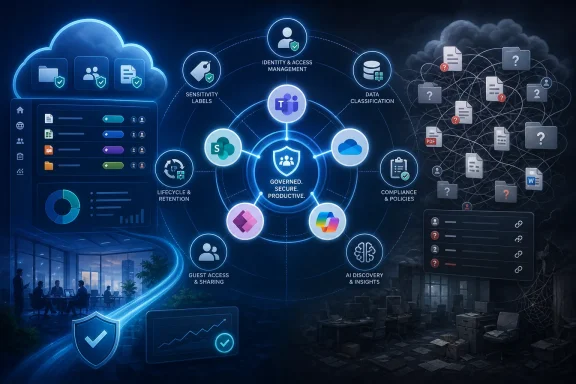
Microsoft 365 governance is becoming a defining security and operational challenge as organizations expand collaboration, consolidate content in the cloud, and introduce AI assistants that can surface information at unprecedented speed. Info-Tech Research Group’s newly published
Govern Microsoft 365 blueprint argues that too many tenants are still managed as a collection of technical settings rather than as a business-aligned governance program—a gap that can leave sensitive data overshared, ownership unclear, and AI readiness dangerously incomplete.
The warning arrives at a consequential moment for Microsoft 365 customers. Microsoft Teams, SharePoint Online, OneDrive, Exchange Online, Power Platform, and Microsoft 365 Copilot increasingly form a connected work environment rather than a set of separate productivity services. That integration is valuable, but it also means a poor decision in one area—such as permissive SharePoint sharing or unmanaged group creation—can have effects across the broader tenant.
Info-Tech’s central argument is straightforward:
configuration is not governance. Default settings, one-off exceptions, and reactive fixes may keep a tenant running, but they do not provide the ownership model, policy framework, evidence trail, or decision-making discipline needed to manage data at enterprise scale. As Copilot and other AI-driven capabilities use existing permissions to locate relevant business content, longstanding access problems can become far more visible and consequential.
 Overview: Why Microsoft 365 Governance Has Become an Enterprise Issue
Microsoft 365 has changed the way organizations create, share, retain, and discover information. Documents that once lived in departmental file shares or inboxes are now distributed across Teams channels, SharePoint sites, OneDrive libraries, group mailboxes, meeting recordings, Loop workspaces, and integrated business applications.
This distributed model makes work faster. Employees can coauthor documents, share knowledge across departments, collaborate with guests, and access business content from nearly any device. Yet the same flexibility can create a sprawling information environment where content ownership, permission inheritance, retention responsibilities, and acceptable-use expectations are not always clear.
The problem is not that Microsoft 365 lacks controls. In fact, the platform includes a substantial range of administrative, identity, compliance, information protection, lifecycle management, auditing, and access governance capabilities. The challenge is that these tools require organizations to make deliberate decisions about how their business should operate.
That is where governance becomes essential. A
Microsoft 365 governance program defines the purpose behind technical controls. It establishes who owns decisions, what information requires protection, how collaboration should work, how long records must be kept, when content should be deleted, and what level of access is appropriate for employees, contractors, partners, guests, and automated agents.
Without that foundation, the tenant can slowly become harder to secure and more expensive to manage.
The Core Warning: Default Configuration Is Not a Control Strategy
Info-Tech identifies overreliance on default configurations as a recurring weakness. That concern is well founded. Default settings are designed to help organizations get started, accommodate broad usage scenarios, and reduce deployment friction. They are not a substitute for a company’s own risk decisions.
A tenant that accepts default settings without reviewing them may be making implicit choices about external sharing, anonymous links, guest access, group creation, retention, device access, collaboration boundaries, and the handling of sensitive information. Those choices might be reasonable for some organizations, but they may be entirely unsuitable for a regulated enterprise, a public-sector institution, a healthcare provider, a financial firm, or a company handling intellectual property.
Defaults Can Be Useful—but Only as a Starting Point
There is nothing inherently wrong with default settings. They accelerate adoption, establish baseline functionality, and give smaller organizations a manageable entry point. The risk emerges when defaults become permanent simply because no one has been assigned responsibility for revisiting them.
A mature governance program should ask practical questions such as:
- Which users can create Microsoft 365 Groups, Teams, SharePoint sites, and Power Platform environments?
- Can employees invite external guests, and if so, under what conditions?
- Are anonymous sharing links permitted, restricted, or disabled?
- Which teams or sites can store sensitive business, financial, legal, personnel, or customer information?
- How are inactive Teams, sites, groups, and OneDrive accounts reviewed?
- What happens to data when an employee changes role or leaves the organization?
- Which business functions own data classification decisions?
- Which collaboration spaces require more restrictive access, retention, or sharing controls?
- How will AI tools be governed when they retrieve and summarize content based on a user’s existing permissions?
These are not purely technical questions. They require input from legal, compliance, records management, security, human resources, business leadership, and the teams that create and use the content every day.
Governance Intent Must Come Before Technical Settings
The strongest element of Info-Tech’s approach is its emphasis on defining governance direction before implementing controls. This reverses a common pattern in which administrators activate features, apply policies, and later attempt to explain the business rationale.
A better sequence starts with outcomes. An organization may decide, for example, that it needs to enable rapid cross-functional collaboration while protecting product designs, preserving legally required records, reducing uncontrolled external sharing, and preparing for Microsoft 365 Copilot. From there, it can translate those priorities into specific policies and configurations.
That policy-first model creates a more defensible environment. It allows the organization to explain
why a restriction exists, who approved it, which business risk it addresses, and how it should be measured over time.
AI Raises the Stakes for Data and Access Governance
The expansion of AI features changes the urgency of Microsoft 365 governance. Microsoft 365 Copilot is designed to respect the signed-in user’s existing permissions. It does not grant a user access to files, emails, chats, or sites that the user could not otherwise access.
That safeguard is important, but it does not solve oversharing. If a user already has broad access to content because of historical permissions, overly inclusive groups, legacy sharing links, or poorly managed sites, AI can make that accessible content easier to locate, summarize, connect, and reuse.
In other words,
Copilot does not create broken permissions—but it can expose the business consequences of permissions that were already too broad.
The “Permission Debt” Problem
Many organizations carry a form of accumulated
permission debt. Over years of collaboration, employees may have been added to Teams, SharePoint groups, project sites, shared folders, and distribution lists that no longer reflect their current responsibilities.
This often happens for understandable reasons:
- A project needed rapid collaboration during a deadline.
- A manager granted access to solve an immediate problem.
- A contractor was invited into a workspace and never removed.
- A team site was created for a short-term initiative but remained active indefinitely.
- A department reorganized without systematically reviewing access.
- A shared document was distributed through a broad link instead of a controlled group.
- Ownership of a Team or SharePoint site changed informally rather than through a documented process.
Each individual decision may seem minor. Over time, however, the tenant can become a web of inherited access and unclear ownership. AI-powered search and summarization increase the practical value of cleaning up that debt because they lower the effort required for authorized users to find information that was already available to them.
Copilot Readiness Is Really Data Readiness
Organizations sometimes frame Copilot preparation as a licensing, deployment, training, or prompt-engineering exercise. Those elements matter, but the more fundamental question is whether the underlying data environment is ready.
A credible
Microsoft 365 Copilot readiness strategy should include:
- Reviewing SharePoint and OneDrive sharing posture.
- Identifying potentially overshared sites and files.
- Reducing unnecessary broad access groups.
- Validating site and team ownership.
- Establishing clear rules for guest and external collaboration.
- Applying sensitivity labels where appropriate.
- Defining retention and disposition expectations.
- Reviewing data loss prevention policies.
- Clarifying which information is appropriate for AI-assisted work.
- Monitoring how Copilot is being used and which content sources are being referenced.
The goal is not to lock down collaboration until it becomes unusable. The goal is to create
intentional access: people should have the information they need for their roles, while sensitive content should not be broadly exposed simply because no one ever revisited an old permission structure.
The Governance Gaps Identified by Info-Tech
Info-Tech’s blueprint points to several governance failures that will feel familiar to Microsoft 365 administrators. The value of grouping these issues together is that it shows they are not isolated operational annoyances. They are connected symptoms of a governance model that has not kept pace with the platform.
Unclear Accountability and Fragmented Ownership
Microsoft 365 commonly sits at the intersection of multiple internal teams. IT may manage the tenant and service availability. Identity teams may control access and authentication. Security may define monitoring and incident response. Legal and compliance teams may determine retention obligations. Business units may own the content and approve external collaboration.
Problems arise when all of these parties have responsibilities but no one has clear decision authority.
An organization may have excellent administrators and capable security professionals, yet still struggle if it cannot answer basic ownership questions:
- Who approves new external-sharing rules?
- Who decides whether a business unit can use a more permissive collaboration model?
- Who owns the lifecycle policy for inactive Teams and SharePoint sites?
- Who is responsible for reviewing access to high-value content?
- Who decides what constitutes a record?
- Who approves exceptions to a standard security policy?
- Who owns user education and acceptable-use guidance?
A
RACI model—defining who is Responsible, Accountable, Consulted, and Informed—can be especially valuable here. It does not eliminate difficult decisions, but it prevents decisions from disappearing into organizational gaps.
Unmanaged Content Growth and Data Sprawl
Data sprawl is one of the most persistent Microsoft 365 governance problems. Collaboration platforms make it easy to create content, copy content, share it broadly, and leave it in place long after its immediate value has passed.
A single project can generate Teams conversations, channel files, meeting recordings, OneNote notebooks, Planner plans, SharePoint pages, OneDrive working copies, email attachments, and exported reports. If the project closes, those artifacts may remain scattered across several services with inconsistent retention and ownership.
Unmanaged data growth creates multiple risks:
- Sensitive information may remain accessible longer than necessary.
- Employees may struggle to identify the authoritative version of a document.
- Legal discovery and records management processes may become more complex.
- Storage and administrative overhead can grow.
- Stale sites and groups can retain excessive permissions.
- AI systems may surface outdated or contextually misleading content.
- Business knowledge may become trapped in abandoned collaboration spaces.
Lifecycle governance is therefore not merely about deleting old files. It is about ensuring that content has a known purpose, owner, retention rule, and disposition path.
Reactive Policies Instead of Built-In Guardrails
Info-Tech also highlights delayed governance decisions: policies often arrive only after an incident, audit finding, data exposure, or disruptive business problem. That reactive approach is expensive because administrators must remediate a large installed base while maintaining user trust and continuity.
A more sustainable model builds guardrails into the lifecycle of collaboration itself. For example, a Team or SharePoint site creation process can require owners, a business purpose, a classification choice, a sensitivity label where needed, and an expiration or review date.
This does not have to mean a slow, centralized ticket queue for every new workspace. Automation can preserve speed while capturing the information needed for accountability. A well-designed self-service process can be more secure than uncontrolled creation because it gives users an easy approved path rather than encouraging workarounds.
A Policy-First Microsoft 365 Governance Model
Info-Tech’s framework emphasizes several core actions: set governance direction, assess current capabilities, translate intent into controls, clarify ownership, and embed governance through communication and policy. For Windows and Microsoft 365 administrators, this is a practical blueprint for moving from disconnected tools to an operating model.
1. Define the Business Outcomes Governance Must Protect
The first step is to define governance objectives in business terms. Security teams should avoid beginning with a list of product features or configuration toggles. Instead, establish the outcomes that the organization needs from Microsoft 365.
Typical objectives may include:
- Protecting customer, employee, financial, and intellectual-property data.
- Enabling secure internal and external collaboration.
- Supporting records retention, legal hold, and regulatory requirements.
- Reducing the risk of unauthorized disclosure.
- Providing users with predictable and understandable sharing options.
- Making ownership and access reviews auditable.
- Supporting AI adoption without amplifying oversharing risks.
- Maintaining operational resilience and manageable administration.
This direction should be documented in plain language and approved by the stakeholders who will be accountable for the resulting trade-offs.
2. Assess the Current Tenant Honestly
A governance maturity assessment should evaluate more than settings. It should examine people, process, technology, documentation, ownership, evidence, and user behavior.
Key assessment areas include:
- Identity and privileged access management.
- Multi-factor authentication and Conditional Access coverage.
- External sharing and guest lifecycle processes.
- Teams, group, and SharePoint site provisioning.
- Ownership requirements and inactive-owner detection.
- OneDrive sharing patterns.
- Sensitivity label design and adoption.
- Data loss prevention coverage.
- Retention, records management, and disposition processes.
- Audit logging and incident response readiness.
- Data access review practices.
- Copilot and agent governance.
- User training and acceptable-use communications.
The objective is not to produce a perfect score. It is to identify the gaps that pose the highest business and security risks, then prioritize remediation in a realistic sequence.
3. Translate Policy Into Enforceable Controls
Policies that cannot be implemented, monitored, or explained are not sufficient. Governance intent must be expressed through a combination of technical controls, operational procedures, and behavioral expectations.
For example, a policy stating that confidential data must not be shared externally should be supported by controls such as sensitivity labels, encryption where appropriate, restricted sharing settings, data loss prevention rules, group membership processes, and monitoring. It should also be accompanied by training that explains how employees recognize confidential content and what sharing options are permitted.
This is where Microsoft Purview, Microsoft Entra, SharePoint Advanced Management, Teams administration, and Microsoft 365 audit capabilities can become part of a connected governance architecture rather than separate administrative consoles.
4. Make Owners Accountable Throughout the Lifecycle
Every meaningful collaboration space should have a recognized owner. That owner does not need to be a technical administrator, but they should understand their responsibility for membership, purpose, data handling, and periodic review.
At a minimum, governance should define:
- Minimum and maximum numbers of owners for Teams and SharePoint sites.
- What happens when an owner leaves the organization.
- How owners confirm that a workspace remains active and necessary.
- When access should be reviewed.
- How business purpose and classification are recorded.
- How workspace owners request exceptions.
- When inactive sites should be archived, restricted, or retired.
Ownership is often where governance succeeds or fails. If no business person feels responsible for a workspace, IT becomes the accidental owner of content it cannot fully understand.
5. Communicate Rules in User Language
A technical control without communication can produce confusion, frustration, and attempts to bypass the platform. Governance must explain the reasons behind policies and provide users with clear alternatives when a default option is restricted.
An effective communication plan should cover:
- Why the organization is changing a policy.
- Which users and workloads are affected.
- What users should do differently.
- Where to find approved collaboration options.
- How to request an exception.
- How to report a possible oversharing or data-handling concern.
- What new AI capabilities can and cannot be used for.
Good governance is not a hidden set of administrator settings. It is a shared operating model that employees can understand and follow.
Practical Controls That Matter Most
Organizations do not need to deploy every Microsoft 365 governance feature at once. They should begin with controls that address the largest exposure areas and establish a foundation for continued improvement.
Identity, Authentication, and Privileged Access
Identity is the front door to Microsoft 365. Strong governance should include multi-factor authentication, carefully designed Conditional Access policies, least-privilege administration, privileged role governance, and disciplined break-glass procedures.
Administrative roles deserve particular scrutiny. Global Administrator access should be limited, justified, and monitored. Role assignments should be reviewed regularly, especially where third parties, service accounts, or temporary operational needs are involved.
Sharing and Guest Access
External collaboration is often necessary, but it should be intentional. Organizations should define which business scenarios permit guest access, what approval process applies, how guests are reviewed, and how long access can remain active.
SharePoint and OneDrive sharing settings should align with the sensitivity of the content. A blanket approach can be problematic in either direction: overly open sharing creates exposure, while overly restrictive policies can drive users to unsanctioned tools.
The goal is a practical, tiered model. Standard collaboration spaces may allow managed external sharing, while sensitive or regulated sites may require stricter membership control and prohibit anonymous links.
Sensitivity Labels and Information Protection
Sensitivity labels can help organizations classify and protect data based on business meaning. A label can support measures such as encryption, content markings, sharing restrictions, and container-level settings for Teams, Microsoft 365 Groups, and SharePoint sites.
However, labels are not a magic solution. A complex labeling taxonomy that users cannot understand will produce inconsistent adoption. Organizations should start with a manageable number of labels that reflect genuine business categories, such as Public, General, Confidential, and Highly Confidential.
Automation can improve coverage, particularly where sensitive information types or well-defined patterns can be recognized. Still, automated classification requires careful testing to avoid excessive false positives, user disruption, or a false sense of security.
Retention, Records, and Disposition
Retention is a governance decision with legal, compliance, security, and cost implications. Keeping everything forever is not necessarily safer. Excessively retained data can increase discovery burdens, preserve outdated information, and leave sensitive content accessible longer than needed.
Microsoft Purview offers retention and records management capabilities that can help organizations retain or delete content across Microsoft 365 workloads according to policy. The challenge is defining defensible retention schedules and applying them consistently.
Effective lifecycle governance should distinguish between:
- Routine business documents.
- Operational communications.
- Financial and regulatory records.
- Legal-hold content.
- High-value intellectual property.
- Temporary working materials.
- Personal employee content.
- Inactive project artifacts.
Disposition should be governed just as carefully as retention. Before data is permanently removed, organizations may need review workflows, proof of disposition, or special handling for records.
Strengths of the Info-Tech Blueprint
Info-Tech’s blueprint is notable because it frames Microsoft 365 governance as an organizational capability rather than a technical cleanup project. That is the right lens for an environment that affects almost every employee and business function.
The framework’s strongest features include:
- Business alignment: It begins with the outcomes governance should achieve rather than a vendor feature checklist.
- Clearer accountability: The inclusion of RACI-oriented tools addresses a common failure point in collaboration platforms.
- Practical artifacts: A control map, capability assessment, acceptable-use policies, and communications plan can help turn strategy into execution.
- AI relevance: The framework correctly identifies permissions, classification, and data sprawl as central concerns for Copilot-era governance.
- Scalability: A structured model can help organizations avoid repeated one-off configuration decisions as new Microsoft 365 services and AI capabilities emerge.
This approach can also give IT leaders a better way to discuss investment with executives. Instead of asking for funding to “improve SharePoint settings,” governance teams can connect initiatives to risk reduction, regulatory readiness, collaboration quality, AI enablement, and operational efficiency.
Risks and Limitations Organizations Should Not Ignore
A governance framework is useful, but it does not remove the hard work of implementation. Organizations should be cautious about treating any assessment or blueprint as a turnkey solution.
Governance Can Become Bureaucracy
If governance processes are too slow or too complicated, employees may abandon approved tools and use personal accounts, consumer file-sharing services, unapproved messaging applications, or email attachments. That can create the very shadow IT risk governance was meant to reduce.
The right model uses controls proportionate to risk. Low-risk internal collaboration should be straightforward. Higher-risk external sharing, regulated data handling, and privileged access should involve stronger controls and review.
Technical Features May Require Licensing and Operational Capacity
Many advanced Microsoft 365 governance capabilities depend on licensing, data quality, policy design, and administrator expertise. Organizations should not assume that every desired control is available in every subscription level or that enabling a feature produces an immediate security outcome.
Planning must include licensing validation, pilot testing, policy tuning, support readiness, and a realistic operational model. A sophisticated feature that no team has time to maintain may be less valuable than a simpler control that is consistently reviewed.
AI Governance Is Broader Than Copilot
Microsoft 365 Copilot may be the most visible AI concern, but it is not the only one. Organizations also need policies for AI agents, third-party AI tools, browser-based AI services, content uploaded to external systems, automated workflows, and the use of enterprise data in custom applications.
A Microsoft 365 governance program should connect to the larger enterprise AI governance model. This includes approved-use definitions, data handling rules, vendor risk assessment, human oversight expectations, monitoring, and incident response.
The Path Forward for Microsoft 365 Administrators
The practical response to Info-Tech’s warning is not a rushed tenant lockdown. It is a structured effort to replace accidental collaboration patterns with deliberate governance.
A useful starting sequence is:
- Establish an executive-backed governance group that includes IT, security, compliance, legal, records management, and business representatives.
- Inventory the current environment by examining active Teams, SharePoint sites, OneDrive sharing, guest access, privileged roles, labels, retention policies, and high-risk data locations.
- Identify the highest-priority risks such as anonymous links, ownerless sites, excessive external access, inactive workspaces, broad permissions, or unmanaged sensitive content.
- Define a target operating model covering ownership, provisioning, access review, lifecycle management, exceptions, and user responsibilities.
- Implement foundational controls for identity, authentication, sharing, ownership, labeling, audit, and retention before pursuing more advanced automation.
- Prepare the data estate for AI by reducing oversharing, improving classification, validating access boundaries, and setting clear acceptable-use rules.
- Measure governance continuously through ownership coverage, inactive-site reduction, guest review completion, sharing posture, label adoption, policy exceptions, and remediation outcomes.
The most important principle is consistency. Microsoft 365 governance is not completed when the first set of policies is deployed. It must evolve as organizational structures change, new services are adopted, collaboration patterns shift, and AI features create new ways to discover and use information.
Conclusion
Info-Tech Research Group’s
Govern Microsoft 365 blueprint highlights a growing reality for enterprises: the security and usability of Microsoft 365 depend less on isolated settings than on the quality of the governance model surrounding them. As Teams, SharePoint, OneDrive, Purview, Entra, Copilot, and related services become more interconnected, unclear ownership and unmanaged data cannot remain background operational issues.
The central risk is not simply that organizations may have permissive settings. It is that they may not know which decisions were made, who owns the resulting data, whether access remains appropriate, or how AI will change the practical discoverability of information across the tenant.
A policy-first approach offers a more durable answer. By defining business objectives, assigning accountable owners, translating intent into enforceable controls, managing the data lifecycle, and communicating expectations clearly, organizations can support secure collaboration without sacrificing the speed and flexibility that made Microsoft 365 essential in the first place.