

Microsoft said on April 29, 2026, that Microsoft 365 Copilot has reached 20 million paid enterprise seats, with major customers including Accenture, Bayer, Johnson & Johnson, Mercedes-Benz, and Roche expanding deployments across Word, Excel, Outlook, Teams, PowerPoint, and related Microsoft 365 workflows. The number matters less as a vanity metric than as a sign that Copilot has crossed from experiment into procurement habit. Microsoft’s wager is that AI becomes valuable not when workers open a chatbot, but when the chatbot disappears into the daily grind of documents, meetings, spreadsheets, and email. That makes Copilot’s rise both a product story and a power story: Microsoft is trying to turn Office’s monopoly of attention into the default operating layer for enterprise AI.
For most of the generative AI boom, the central question around workplace assistants has been deceptively simple: will employees actually use them? The answer, at least inside Microsoft’s customer base, is beginning to look less theoretical. Twenty million paid seats is not universal adoption across the Microsoft 365 estate, but it is enough to change the conversation from “Can Microsoft sell AI?” to “How deeply can Microsoft embed AI into the habits it already owns?”
That distinction matters because Microsoft does not need Copilot to win a beauty contest against every standalone AI tool. It needs Copilot to be close enough, secure enough, governed enough, and already present enough that CIOs can rationalize buying it at scale. In enterprise software, proximity is a feature. The tool that sits next to the data, identity system, compliance controls, and procurement contract often beats the tool that wins a benchmark.
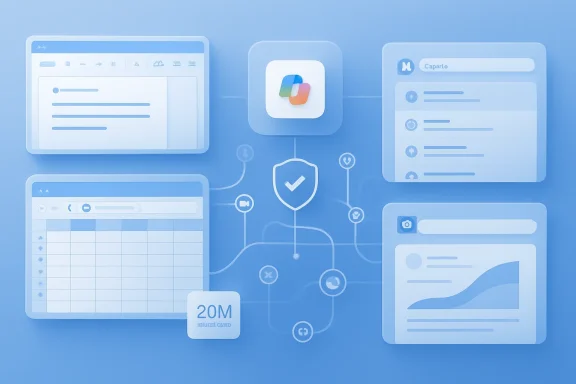
Copilot’s most important interface is not a chat box. It is the ribbon, the sidebar, the meeting recap, the suggested rewrite, the spreadsheet action, the PowerPoint draft, and the Teams summary that appear where office work already happens. Microsoft is betting that AI adoption will resemble previous waves of enterprise software adoption: less a revolution than a slow annexation of familiar screens.
That is why the Accenture deal looms so large. A deployment of more than 740,000 seats is not a departmental pilot with a friendly innovation team; it is a statement that a large professional-services firm believes AI assistance is becoming baseline infrastructure for knowledge work. Accenture’s own business depends on turning technology shifts into client programs, so its Copilot rollout is also a market signal to every enterprise executive watching the consultants for cues.
That substrate gives Microsoft unusual leverage. A company evaluating AI assistants must weigh not only output quality but identity management, data residency, auditing, security, training, support, procurement, and the risks of employees pasting sensitive data into consumer tools. Microsoft arrives with an answer that is not always thrilling, but is extremely legible to enterprise IT: keep the AI inside the Microsoft 365 boundary, attach it to existing permissions, and administer it with familiar controls.
This is the same playbook that made Teams a pandemic-era giant. Microsoft did not need Teams to be the best communication product in every respect. It needed Teams to be included, integrated, manageable, and good enough for the default buyer. Copilot extends that logic to generative AI, but with a richer prize: if Microsoft can become the place where employees ask questions of company data, generate artifacts, and delegate routine tasks, it moves from selling productivity software to mediating productivity itself.
The price tag has always been the friction point. Microsoft 365 Copilot entered the market as a premium add-on, and critics have fairly noted that paid penetration across the broader Microsoft 365 base remains modest. But the enterprise software market does not move evenly. It starts with heavily instrumented pilots, expands through executive mandates, and then gets absorbed into renewal cycles. Twenty million paid seats suggests Copilot has not conquered the base, but it has established a serious beachhead.
That gap between demo and habit has haunted the entire AI software market. The first wave sold possibility. The second wave has to prove recurrence. Enterprises do not pay indefinitely for tools that employees try twice and ignore, and CIOs have become more disciplined about asking for usage telemetry, workflow integration, and measurable savings.
Microsoft’s latest numbers are designed to answer that critique. The company says queries per user are rising, and Satya Nadella has argued that weekly engagement is approaching the level of core Microsoft work habits. If that framing holds, it would mark a meaningful change: Copilot would no longer be a novelty attached to Office, but a recurring motion inside Office.
Still, the numbers deserve sober interpretation. Seats are not the same as productive usage, and usage is not the same as business value. A company can buy licenses for strategic reasons, competitive anxiety, bundled discounting, or executive pressure. But enterprise software does not need every user to become a zealot immediately. It needs enough users in enough repeatable scenarios to justify the renewal.
That is a qualitative shift. A summarizer can be wrong and still be useful if a human reviews the output. An agent that edits a financial model, restructures a deck, or rewrites a document workflow begins to touch the work product more directly. The risk surface expands from “Did the AI say something inaccurate?” to “Did the AI take the wrong action in a system of record?”
Microsoft knows this, which is why its enterprise pitch leans so heavily on governance. The company wants customers to see agents not as rogue bots but as managed software components operating under Microsoft 365 permissions. That framing will appeal to IT departments exhausted by shadow AI, but it also raises the stakes for administrators. The more capable Copilot becomes, the more important it is to know what data it can see, what actions it can take, and how those actions are logged.
Agent Mode also reflects a broader industry pivot away from chat as the final form of AI. Chat is flexible, but it puts too much burden on the user to invent workflows. Agents promise something more operational: specify an outcome, let the system plan steps, call tools, revise output, and return a completed artifact. That is where the productivity gains may be larger, but also where failure becomes more expensive.
That matters for customers. Different models have different strengths, costs, latency profiles, reasoning styles, and safety behaviors. A model that is strong at prose may not be the best choice for spreadsheet operations. A model that handles coding well may not be optimal for summarizing legal documents. A model that is fast and cheap may be sufficient for routine edits, while a slower and more expensive model may be reserved for complex reasoning.
For Microsoft, the multi-model strategy has another benefit: it reduces dependence on any one supplier while strengthening Microsoft’s role as the orchestration layer. If Copilot can route work among models, enforce policy, respect permissions, and present a single enterprise interface, Microsoft captures the customer relationship even when the underlying intelligence comes from multiple vendors. In that world, the model providers compete underneath the Microsoft experience.
This is classic platform behavior. The platform abstracts complexity, standardizes access, and taxes the transaction. Copilot may look like an AI assistant to users, but to Microsoft it is also a control plane: a way to decide which models, tools, files, permissions, and workflows meet inside the enterprise.
The first challenge is data readiness. Copilot can only be as safe as the permissions and information architecture beneath it. If a company’s SharePoint sites are a decade-old maze of overshared folders, stale files, and ambiguous ownership, an AI assistant can surface that mess with alarming efficiency. Generative AI does not create bad access hygiene, but it makes bad access hygiene newly visible.
The second challenge is role design. Copilot’s value is uneven across job functions. A consultant producing decks, a sales manager preparing account summaries, a lawyer reviewing drafts, and an analyst working in Excel may all benefit, but not in identical ways. Blanket licensing can accelerate adoption, but targeted enablement is what turns a license into a workflow.
The third challenge is measurement. AI productivity often shows up in soft increments: fewer minutes spent drafting, faster preparation, less context switching, quicker first versions. Those gains are real, but they are slippery. Enterprises will need better telemetry and better internal studies if they want to separate genuine productivity from the comforting illusion of activity.
That is where Copilot’s future will be decided. The killer app for workplace AI may not be a single dazzling feature. It may be the accumulation of small conveniences across a thousand workdays: the meeting recap that rescues someone who was double-booked, the email draft that gets a manager past the blank page, the Excel explanation that helps a non-specialist understand a model, the PowerPoint starter deck that is merely adequate but immediate.
This is why Microsoft’s claim about deeper engagement matters more than the headline seat number. A license can be bought centrally; habit must be won individually. If workers learn that Copilot reliably reduces friction, they will use it without a mandate. If they learn that it produces plausible mediocrity requiring constant correction, it will become another corporate icon people ignore.
The difficulty is that both experiences can coexist in the same organization. Power users with well-structured data and clear workflows may see meaningful gains. Casual users may struggle to write effective prompts or may ask the assistant to do work it cannot yet do well. Microsoft’s challenge is not merely to improve the model; it is to make successful use less dependent on user sophistication.
But the more subtle competitive threat is fragmentation. Employees already use different tools for writing, coding, research, design, data analysis, and communication. If AI follows that pattern, Microsoft may own the Office layer while losing high-value tasks to specialized assistants. A worker may use Copilot for meeting summaries, Claude for long-document reasoning, ChatGPT for brainstorming, a finance-specific tool for modeling, and a CRM-native agent for sales workflows.
Microsoft’s answer is to make Copilot broad enough and governed enough that enterprises prefer consolidation. The company does not have to eliminate every specialist. It has to become the sanctioned default and the integration point through which specialists are tolerated. That is why model choice, agents, Copilot Studio, Microsoft Graph, and Azure AI are part of the same strategic picture.
The risk for Microsoft is that “good enough everywhere” can become “best nowhere.” Enterprise buyers like consolidation, but workers gravitate toward tools that make them feel more capable. If Copilot’s quality lags visibly behind standalone competitors in important tasks, shadow AI will persist no matter what procurement prefers.
This is where Microsoft’s model is stronger than many AI challengers. The company can monetize AI through Microsoft 365, Azure consumption, GitHub, Dynamics, security products, Windows, and partner ecosystems. It does not need every dollar of AI value to flow through a single chatbot subscription. Copilot is one part of a wider strategy to make AI an upsell across the Microsoft estate.
Even so, the margins of AI productivity software remain an open question. Running advanced models at enterprise scale is expensive, especially when users move from occasional prompts to frequent queries and agentic workflows. Microsoft’s financial disclosures have repeatedly pointed to AI infrastructure costs alongside growth. The business works best if usage rises, model serving becomes more efficient, and customers accept higher average revenue per user.
That is why the shift to multi-model routing is not just a feature story. It is also a cost story. If Microsoft can send simpler tasks to cheaper models and reserve premium reasoning for harder work, it can improve both user experience and economics. The future of Copilot may depend as much on routing efficiency as on raw model intelligence.
That strategy has had uneven results on the desktop. Windows users have not universally welcomed Copilot buttons, AI-branded settings, or features that feel more promotional than essential. The PC remains a deeply personal work environment, and Microsoft’s history of nudging users toward strategic services has made some enthusiasts wary. Enterprise Copilot adoption does not erase that skepticism.
But the Microsoft 365 numbers explain why Redmond keeps pushing. If AI becomes an enterprise purchasing category, Windows cannot remain just the place where applications run. It has to become an endpoint in an AI-managed workflow, tied to identity, policy, security posture, and local context. Copilot+ PCs, Recall-style concepts, on-device models, and cloud agents all fit into that longer arc, even when individual features stumble.
The lesson is that Microsoft’s AI strategy is not one product. It is a campaign to make every Microsoft surface more valuable when connected to every other Microsoft surface. Copilot in Word is easier to sell when it understands Teams meetings. Copilot in Teams is more useful when it can produce Word documents. Copilot in Windows becomes more plausible when enterprise workers already use Copilot elsewhere.
That can be powerful, but it also deepens dependency. The more workflows are built around Copilot, the harder it becomes to evaluate alternatives on clean terms. Documents, permissions, habits, prompts, agents, connectors, and training programs all become part of the switching cost. Microsoft has always benefited from file-format gravity and user familiarity; Copilot adds behavioral gravity.
There is also a cultural dependency. If employees become accustomed to AI-generated first drafts, AI summaries, and AI-mediated analysis, organizations will need to decide what quality control looks like. The danger is not that workers become lazy in some simplistic sense. The danger is that companies normalize a layer of machine-generated plausibility without updating review practices, accountability, and authorship norms.
This is where IT, legal, compliance, and business leadership must work together rather than treating Copilot as a software rollout. The questions are organizational: which outputs can be trusted, which require review, which workflows may be automated, which data should be excluded, and how employees should disclose or verify AI-assisted work. Copilot adoption is ultimately a governance project wearing a productivity costume.
Microsoft’s Copilot surge is the clearest evidence yet that generative AI is being absorbed into the enterprise through the boring channels that always win: licensing agreements, admin consoles, compliance promises, familiar applications, and executive pressure to modernize. The next year will determine whether those 20 million seats become a durable productivity layer or an expensive badge of AI participation. Either way, the center of gravity has shifted: workplace AI is no longer waiting outside Office asking to be invited in; it is already inside the document, the inbox, the meeting, and the spreadsheet, learning how much work companies are willing to hand over.
Source: Tech Times Microsoft Copilot Adoption Surges as Enterprise AI Usage Reaches New Highs Across Microsoft 365 Apps
 Copilot’s Real Breakthrough Is Distribution, Not Genius
For most of the generative AI boom, the central question around workplace assistants has been deceptively simple: will employees actually use them? The answer, at least inside Microsoft’s customer base, is beginning to look less theoretical. Twenty million paid seats is not universal adoption across the Microsoft 365 estate, but it is enough to change the conversation from “Can Microsoft sell AI?” to “How deeply can Microsoft embed AI into the habits it already owns?”That distinction matters because Microsoft does not need Copilot to win a beauty contest against every standalone AI tool. It needs Copilot to be close enough, secure enough, governed enough, and already present enough that CIOs can rationalize buying it at scale. In enterprise software, proximity is a feature. The tool that sits next to the data, identity system, compliance controls, and procurement contract often beats the tool that wins a benchmark.
Copilot’s most important interface is not a chat box. It is the ribbon, the sidebar, the meeting recap, the suggested rewrite, the spreadsheet action, the PowerPoint draft, and the Teams summary that appear where office work already happens. Microsoft is betting that AI adoption will resemble previous waves of enterprise software adoption: less a revolution than a slow annexation of familiar screens.
That is why the Accenture deal looms so large. A deployment of more than 740,000 seats is not a departmental pilot with a friendly innovation team; it is a statement that a large professional-services firm believes AI assistance is becoming baseline infrastructure for knowledge work. Accenture’s own business depends on turning technology shifts into client programs, so its Copilot rollout is also a market signal to every enterprise executive watching the consultants for cues.
Microsoft Has Turned Office Into an AI Toll Road
The genius of Microsoft 365 Copilot is not that it makes Word write better prose than a dedicated writing assistant or Excel reason better than a specialist data tool. The genius is that Microsoft has positioned Copilot as a paid upgrade to the work surface many organizations cannot realistically abandon. Office is not merely a suite of applications; it is the substrate of corporate communication.That substrate gives Microsoft unusual leverage. A company evaluating AI assistants must weigh not only output quality but identity management, data residency, auditing, security, training, support, procurement, and the risks of employees pasting sensitive data into consumer tools. Microsoft arrives with an answer that is not always thrilling, but is extremely legible to enterprise IT: keep the AI inside the Microsoft 365 boundary, attach it to existing permissions, and administer it with familiar controls.
This is the same playbook that made Teams a pandemic-era giant. Microsoft did not need Teams to be the best communication product in every respect. It needed Teams to be included, integrated, manageable, and good enough for the default buyer. Copilot extends that logic to generative AI, but with a richer prize: if Microsoft can become the place where employees ask questions of company data, generate artifacts, and delegate routine tasks, it moves from selling productivity software to mediating productivity itself.
The price tag has always been the friction point. Microsoft 365 Copilot entered the market as a premium add-on, and critics have fairly noted that paid penetration across the broader Microsoft 365 base remains modest. But the enterprise software market does not move evenly. It starts with heavily instrumented pilots, expands through executive mandates, and then gets absorbed into renewal cycles. Twenty million paid seats suggests Copilot has not conquered the base, but it has established a serious beachhead.
The Seat Count Is Impressive Because Earlier Doubts Were Real
It is easy to forget how uncertain Copilot’s path looked after its initial launch. The demo version of generative AI in Office was dazzling: summarize this meeting, draft that proposal, turn these notes into slides, explain this spreadsheet. The daily version was messier. Some users saw magic; others saw bland prose, hallucinated confidence, formatting hiccups, or an assistant that helped most when the worker already knew exactly what to ask.That gap between demo and habit has haunted the entire AI software market. The first wave sold possibility. The second wave has to prove recurrence. Enterprises do not pay indefinitely for tools that employees try twice and ignore, and CIOs have become more disciplined about asking for usage telemetry, workflow integration, and measurable savings.
Microsoft’s latest numbers are designed to answer that critique. The company says queries per user are rising, and Satya Nadella has argued that weekly engagement is approaching the level of core Microsoft work habits. If that framing holds, it would mark a meaningful change: Copilot would no longer be a novelty attached to Office, but a recurring motion inside Office.
Still, the numbers deserve sober interpretation. Seats are not the same as productive usage, and usage is not the same as business value. A company can buy licenses for strategic reasons, competitive anxiety, bundled discounting, or executive pressure. But enterprise software does not need every user to become a zealot immediately. It needs enough users in enough repeatable scenarios to justify the renewal.
The Agent Shift Changes the Product From Helper to Actor
The next phase of Copilot is more consequential than the seat milestone because it changes what Microsoft is asking users to trust. Early Copilot experiences were mostly assistive. They summarized, drafted, rewrote, suggested, and explained. Agent Mode points toward a more aggressive model in which Copilot performs multi-step work inside Word, Excel, and PowerPoint.That is a qualitative shift. A summarizer can be wrong and still be useful if a human reviews the output. An agent that edits a financial model, restructures a deck, or rewrites a document workflow begins to touch the work product more directly. The risk surface expands from “Did the AI say something inaccurate?” to “Did the AI take the wrong action in a system of record?”
Microsoft knows this, which is why its enterprise pitch leans so heavily on governance. The company wants customers to see agents not as rogue bots but as managed software components operating under Microsoft 365 permissions. That framing will appeal to IT departments exhausted by shadow AI, but it also raises the stakes for administrators. The more capable Copilot becomes, the more important it is to know what data it can see, what actions it can take, and how those actions are logged.
Agent Mode also reflects a broader industry pivot away from chat as the final form of AI. Chat is flexible, but it puts too much burden on the user to invent workflows. Agents promise something more operational: specify an outcome, let the system plan steps, call tools, revise output, and return a completed artifact. That is where the productivity gains may be larger, but also where failure becomes more expensive.
Multi-Model Copilot Is Microsoft Admitting One Model Will Not Rule Them All
One of the more interesting developments in Copilot’s evolution is Microsoft’s multi-model approach. The company has spent years being identified with OpenAI, and for good reason: the partnership gave Microsoft a head start in commercializing generative AI across Azure, GitHub, Bing, Windows, and Microsoft 365. But Copilot’s inclusion of Anthropic models in some Microsoft 365 experiences is a quiet acknowledgement that enterprise AI will not be a single-model religion.That matters for customers. Different models have different strengths, costs, latency profiles, reasoning styles, and safety behaviors. A model that is strong at prose may not be the best choice for spreadsheet operations. A model that handles coding well may not be optimal for summarizing legal documents. A model that is fast and cheap may be sufficient for routine edits, while a slower and more expensive model may be reserved for complex reasoning.
For Microsoft, the multi-model strategy has another benefit: it reduces dependence on any one supplier while strengthening Microsoft’s role as the orchestration layer. If Copilot can route work among models, enforce policy, respect permissions, and present a single enterprise interface, Microsoft captures the customer relationship even when the underlying intelligence comes from multiple vendors. In that world, the model providers compete underneath the Microsoft experience.
This is classic platform behavior. The platform abstracts complexity, standardizes access, and taxes the transaction. Copilot may look like an AI assistant to users, but to Microsoft it is also a control plane: a way to decide which models, tools, files, permissions, and workflows meet inside the enterprise.
The CIO’s Copilot Problem Is No Longer Whether to Test It
For IT leaders, the Copilot conversation has moved from curiosity to governance. A year ago, many organizations were asking whether they should run a pilot. Now the harder question is how to scale without creating a costly layer of poorly measured automation. Buying AI is easy compared with changing the way people work.The first challenge is data readiness. Copilot can only be as safe as the permissions and information architecture beneath it. If a company’s SharePoint sites are a decade-old maze of overshared folders, stale files, and ambiguous ownership, an AI assistant can surface that mess with alarming efficiency. Generative AI does not create bad access hygiene, but it makes bad access hygiene newly visible.
The second challenge is role design. Copilot’s value is uneven across job functions. A consultant producing decks, a sales manager preparing account summaries, a lawyer reviewing drafts, and an analyst working in Excel may all benefit, but not in identical ways. Blanket licensing can accelerate adoption, but targeted enablement is what turns a license into a workflow.
The third challenge is measurement. AI productivity often shows up in soft increments: fewer minutes spent drafting, faster preparation, less context switching, quicker first versions. Those gains are real, but they are slippery. Enterprises will need better telemetry and better internal studies if they want to separate genuine productivity from the comforting illusion of activity.
Workers Will Judge Copilot by the Boring Stuff
The public conversation about AI often gravitates toward dramatic capabilities: reasoning, agents, autonomous workflows, multimodal input, synthetic media. Office workers tend to judge tools by more mundane criteria. Did it save me ten minutes before a meeting? Did it summarize the thread accurately? Did it turn a rough outline into something I could send? Did it avoid making me clean up a mess?That is where Copilot’s future will be decided. The killer app for workplace AI may not be a single dazzling feature. It may be the accumulation of small conveniences across a thousand workdays: the meeting recap that rescues someone who was double-booked, the email draft that gets a manager past the blank page, the Excel explanation that helps a non-specialist understand a model, the PowerPoint starter deck that is merely adequate but immediate.
This is why Microsoft’s claim about deeper engagement matters more than the headline seat number. A license can be bought centrally; habit must be won individually. If workers learn that Copilot reliably reduces friction, they will use it without a mandate. If they learn that it produces plausible mediocrity requiring constant correction, it will become another corporate icon people ignore.
The difficulty is that both experiences can coexist in the same organization. Power users with well-structured data and clear workflows may see meaningful gains. Casual users may struggle to write effective prompts or may ask the assistant to do work it cannot yet do well. Microsoft’s challenge is not merely to improve the model; it is to make successful use less dependent on user sophistication.
The Competitive Threat Is Not Just Google or OpenAI
Microsoft’s most obvious competitors are easy to name. Google wants Gemini to become the AI layer for Workspace. OpenAI wants ChatGPT to remain the default front door for general-purpose AI work. Anthropic is pushing Claude into more enterprise contexts. Salesforce, ServiceNow, Workday, Atlassian, and a long list of vertical vendors all want agents embedded where specialized work happens.But the more subtle competitive threat is fragmentation. Employees already use different tools for writing, coding, research, design, data analysis, and communication. If AI follows that pattern, Microsoft may own the Office layer while losing high-value tasks to specialized assistants. A worker may use Copilot for meeting summaries, Claude for long-document reasoning, ChatGPT for brainstorming, a finance-specific tool for modeling, and a CRM-native agent for sales workflows.
Microsoft’s answer is to make Copilot broad enough and governed enough that enterprises prefer consolidation. The company does not have to eliminate every specialist. It has to become the sanctioned default and the integration point through which specialists are tolerated. That is why model choice, agents, Copilot Studio, Microsoft Graph, and Azure AI are part of the same strategic picture.
The risk for Microsoft is that “good enough everywhere” can become “best nowhere.” Enterprise buyers like consolidation, but workers gravitate toward tools that make them feel more capable. If Copilot’s quality lags visibly behind standalone competitors in important tasks, shadow AI will persist no matter what procurement prefers.
The Economics Are Still the Unfinished Chapter
The AI boom has made revenue growth and capital spending inseparable. Microsoft’s latest results show enormous demand for cloud and AI services, but also the continuing cost of building and operating the infrastructure behind them. Copilot is valuable to Microsoft not simply because it sells seats, but because it helps justify the company’s massive AI infrastructure investment with recurring software revenue.This is where Microsoft’s model is stronger than many AI challengers. The company can monetize AI through Microsoft 365, Azure consumption, GitHub, Dynamics, security products, Windows, and partner ecosystems. It does not need every dollar of AI value to flow through a single chatbot subscription. Copilot is one part of a wider strategy to make AI an upsell across the Microsoft estate.
Even so, the margins of AI productivity software remain an open question. Running advanced models at enterprise scale is expensive, especially when users move from occasional prompts to frequent queries and agentic workflows. Microsoft’s financial disclosures have repeatedly pointed to AI infrastructure costs alongside growth. The business works best if usage rises, model serving becomes more efficient, and customers accept higher average revenue per user.
That is why the shift to multi-model routing is not just a feature story. It is also a cost story. If Microsoft can send simpler tasks to cheaper models and reserve premium reasoning for harder work, it can improve both user experience and economics. The future of Copilot may depend as much on routing efficiency as on raw model intelligence.
The Windows Angle Is the Same Story in a Different Shell
For WindowsForum readers, Copilot’s enterprise surge should be understood as part of Microsoft’s larger attempt to make AI ambient across the PC, the browser, the cloud, and the productivity suite. The company has tried to plant Copilot in Windows, Edge, Bing, Teams, Outlook, Office apps, and developer tools because it wants AI to feel less like a destination and more like a layer.That strategy has had uneven results on the desktop. Windows users have not universally welcomed Copilot buttons, AI-branded settings, or features that feel more promotional than essential. The PC remains a deeply personal work environment, and Microsoft’s history of nudging users toward strategic services has made some enthusiasts wary. Enterprise Copilot adoption does not erase that skepticism.
But the Microsoft 365 numbers explain why Redmond keeps pushing. If AI becomes an enterprise purchasing category, Windows cannot remain just the place where applications run. It has to become an endpoint in an AI-managed workflow, tied to identity, policy, security posture, and local context. Copilot+ PCs, Recall-style concepts, on-device models, and cloud agents all fit into that longer arc, even when individual features stumble.
The lesson is that Microsoft’s AI strategy is not one product. It is a campaign to make every Microsoft surface more valuable when connected to every other Microsoft surface. Copilot in Word is easier to sell when it understands Teams meetings. Copilot in Teams is more useful when it can produce Word documents. Copilot in Windows becomes more plausible when enterprise workers already use Copilot elsewhere.
The New Office Bargain Comes With New Dependencies
The old Office bargain was simple: companies paid Microsoft for reliable tools to create, communicate, and manage work. The new bargain is more intimate. Companies are being asked to let Microsoft’s AI interpret their meetings, draft their communications, summarize their documents, reason over their data, and increasingly act inside their files.That can be powerful, but it also deepens dependency. The more workflows are built around Copilot, the harder it becomes to evaluate alternatives on clean terms. Documents, permissions, habits, prompts, agents, connectors, and training programs all become part of the switching cost. Microsoft has always benefited from file-format gravity and user familiarity; Copilot adds behavioral gravity.
There is also a cultural dependency. If employees become accustomed to AI-generated first drafts, AI summaries, and AI-mediated analysis, organizations will need to decide what quality control looks like. The danger is not that workers become lazy in some simplistic sense. The danger is that companies normalize a layer of machine-generated plausibility without updating review practices, accountability, and authorship norms.
This is where IT, legal, compliance, and business leadership must work together rather than treating Copilot as a software rollout. The questions are organizational: which outputs can be trusted, which require review, which workflows may be automated, which data should be excluded, and how employees should disclose or verify AI-assisted work. Copilot adoption is ultimately a governance project wearing a productivity costume.
The Numbers Tell CIOs to Move, But Not to Sprint Blindly
Microsoft’s seat milestone is a signal that waiting for the AI market to settle may no longer be a viable enterprise strategy. But it is not a command to license everyone tomorrow. The smart response is neither panic buying nor reflexive skepticism; it is structured deployment with ruthless attention to where the tool actually changes work.- Organizations should treat Microsoft 365 Copilot as a workflow product, not a chatbot subscription.
- Large seat purchases will deliver value only if permissions, data hygiene, and retention policies are cleaned up before broad rollout.
- Agent Mode raises the governance bar because Copilot is beginning to act inside documents rather than merely comment on them.
- Multi-model support gives Microsoft flexibility, but customers still need to understand where data goes and which tenant settings control model access.
- The strongest early business cases will come from repeatable knowledge-work patterns such as meeting follow-up, document drafting, spreadsheet analysis, sales preparation, and executive communications.
- Copilot’s success should be measured by recurring use and task completion, not by license counts or launch-day enthusiasm.
Microsoft’s Copilot surge is the clearest evidence yet that generative AI is being absorbed into the enterprise through the boring channels that always win: licensing agreements, admin consoles, compliance promises, familiar applications, and executive pressure to modernize. The next year will determine whether those 20 million seats become a durable productivity layer or an expensive badge of AI participation. Either way, the center of gravity has shifted: workplace AI is no longer waiting outside Office asking to be invited in; it is already inside the document, the inbox, the meeting, and the spreadsheet, learning how much work companies are willing to hand over.
Source: Tech Times Microsoft Copilot Adoption Surges as Enterprise AI Usage Reaches New Highs Across Microsoft 365 Apps
