

Microsoft 365 Copilot experienced reported service disruption on June 11, 2026, affecting Copilot Chat and related Microsoft 365 access for some users, while a crypto project called Ruvi used the incident to pitch its on-chain AI “superapp” and $RUVI presale. The comparison is convenient, but it is not clean. A cloud outage is a real operational problem; a token sale is a financial proposition wearing infrastructure language. The interesting story is not that decentralized AI has suddenly beaten Microsoft, but that Microsoft’s AI centralization has created the perfect opening for much riskier challengers to sound plausible.
The Copilot outage story lands because it touches a nerve Windows users already understand. When Word, Outlook, Teams, Edge, and Windows search all acquire the same AI branding, a failure in one service no longer feels like a narrow SaaS incident. It feels like the operating environment itself has become dependent on a remote intelligence layer.
That is the strategic bet Microsoft has made. Copilot is not merely another chatbot tab; it is being threaded through Microsoft 365, Windows, Edge, Azure, security tooling, and enterprise workflows. The more useful that becomes, the more painful downtime becomes.
The June 11 reports, along with earlier June complaints, suggest the obvious: AI assistants are now part of the productivity stack, and users notice when they vanish. Whether the peak number was precisely 12,000 user reports, whether the interruption lasted two hours or four, and whether every named surface was equally affected matters less than the structural point. Microsoft has trained users to treat Copilot as infrastructure, and infrastructure gets judged by uptime.
That is a harsher standard than the one applied to novelty AI demos. If Copilot is just a helpful button, downtime is annoying. If Copilot is how a sales team drafts proposals, how an analyst interrogates spreadsheets, or how an administrator summarizes tickets, downtime becomes a workflow failure.
Enterprise IT has lived this movie before. Authentication outages, DNS failures, expired certificates, routing mistakes, bad deployments, and cloud-region incidents have all turned supposedly distributed services into surprisingly synchronized failures. AI does not repeal those old failure modes; it adds new ones.
But the leap from “centralized AI can fail” to “buy this presale token” is where readers should slow down. A public blockchain can record ownership, payments, access rights, or governance votes. It does not magically provide GPU capacity, low-latency inference, model safety, customer support, regulatory compliance, or a credible service-level agreement.
Ruvi’s own described architecture appears to recognize that reality by keeping heavy model inference off-chain while using the chain for settlement and token mechanics. That may be sensible engineering. It also means the project is not literally running large AI models “on-chain” in the way a casual reader might infer. The expensive work still happens somewhere else.
If Teams is down, companies know how to fall back to email, phones, or another meeting platform. If Exchange has issues, administrators know where to look, what to tell users, and how to triage impact. If Copilot silently stops summarizing meetings, drafting responses, grounding answers in tenant data, or executing agentic workflows, the failure mode is less mature.
That matters because AI features often fail ambiguously. A document does not get summarized. A prompt returns a generic error. A business process waits for an output no human has been assigned to produce manually. The more “agentic” the workflow, the more the outage resembles an invisible broken worker.
Microsoft’s challenge, then, is not only uptime. It is observability. Admins need clear incident reporting, per-tenant impact, audit trails, fallback behavior, and predictable degradation. Otherwise, Copilot becomes both powerful and slippery: important enough to matter, opaque enough to frustrate incident response.
That is a lot of claims doing different jobs. The product claims are meant to show utility. The tokenomics claims are meant to suggest scarcity. The staking and buyback language is meant to imply income and demand. The comparison with Copilot is meant to give the whole thing urgency.
For WindowsForum readers, the right posture is neither reflexive dismissal nor credulous enthusiasm. Decentralized AI projects may eventually solve meaningful problems around attribution, marketplace access, usage metering, and contributor compensation. But a token presale is not the same thing as resilient infrastructure, and a product demo is not the same thing as enterprise-grade reliability.
The most important word in Ruvi’s pitch may be “contributors.” If users refine outputs, generate training signals, or improve systems, there is a legitimate debate over whether platforms should compensate them. Microsoft, OpenAI, Google, Anthropic, and others largely operate on a service-access model: users pay, or their employers pay, and the vendor owns the product layer. Crypto projects promise a more participatory economy. The promise is attractive. The execution risk is enormous.
That is not a fatal flaw. Hybrid architectures can be useful. A public ledger can make token supply visible. Smart contracts can enforce certain distribution rules. On-chain settlement can reduce some kinds of platform discretion.
But the key operational questions remain stubbornly off-chain. Who hosts the models? Who pays for compute? What happens when the inference provider fails? How are abuse, copyright complaints, illegal content, privacy requests, and model updates handled? Who is accountable when an AI output causes harm?
Microsoft has imperfect but recognizable answers to many of those questions. It has enterprise contracts, compliance programs, admin controls, identity integration, support channels, and a large security organization. Those do not prevent outages, but they do create a framework for responsibility.
A presale-stage AI token project has to prove that it can offer more than a different accounting layer. It has to prove durability, governance, safety, liquidity, security, and user demand after the speculative phase cools. That is a much harder test than capitalizing on a bad Copilot day.
For prospective buyers, the distinction is not academic. A fixed non-mintable supply is only as comforting as the contracts, permissions, upgrade paths, treasury controls, liquidity arrangements, and vesting terms around it. A token can be non-mintable and still expose buyers to other risks.
The promised economics also require skepticism. Buyback-and-burn programs depend on actual revenue, transparent execution, and governance that cannot be quietly changed. Staking yields described as coming from platform revenue need evidence of that revenue, not just projections. Presale pricing that emphasizes a jump from one phase to the next is designed to create urgency.
That urgency is the opposite of good due diligence. If an investment must be made before a countdown ends, buyers are being pushed toward emotion. In a market filled with abandoned roadmaps and thinly traded tokens, the burden of proof belongs with the seller.
Microsoft can lose user confidence through repeated outages, confusing branding, licensing changes, privacy mistakes, and opaque incident communication. That is especially dangerous because Copilot is being positioned as a strategic layer across work and personal computing. The more Microsoft says AI is the future of Windows and Microsoft 365, the less patience users will have for vague failure modes.
Ruvi faces a different trust problem. It must convince users that its app works, that its models are useful, that its reward economy is sustainable, that its token is not merely a speculative vehicle, and that its governance will not be captured by insiders or whales. It must also convince non-crypto users that wallet friction, token volatility, and regulatory uncertainty are worth tolerating.
That is a much taller mountain than a press release suggests. Microsoft’s outage gives Ruvi a rhetorical opening, not a victory.
Microsoft 365 Copilot sits inside a world organizations already manage: Entra ID, Purview, Defender, Intune, SharePoint, Exchange, Teams, audit logs, retention policies, conditional access, and procurement contracts. That integration is precisely why outages matter, but it is also why Microsoft remains hard to displace.
A decentralized AI superapp may appeal to individual creators, crypto-native communities, and users frustrated by locked-down AI platforms. It may even develop useful tooling. But replacing Microsoft’s enterprise AI layer requires far more than model count and tokenomics.
It requires identity integration, data-loss prevention, tenant isolation, legal agreements, regional data handling, admin reporting, incident response, accessibility, support, compliance mapping, and predictable billing. Those are boring requirements, but boring requirements are what keep large organizations from imploding.
This is where the press-release comparison becomes most strained. Copilot’s outage exposes a reliability gap in Microsoft’s AI ambitions. It does not automatically validate the operational readiness of a crypto AI platform.
Large AI vendors usually respond by pointing to service value. Users get productivity in exchange for subscription fees, data controls, and access to models. That is a defensible model, especially in enterprise contexts where data governance matters more than token rewards.
But it may not satisfy everyone. Creators, prompt engineers, annotators, domain experts, and community contributors may want more direct participation in the value chain. A system that pays users for useful feedback is not inherently silly. In fact, it may become one of the more important experiments in AI economics.
The danger is that real compensation models can be bundled with speculative token mechanics that transfer risk to users. Paying contributors for valuable work is one thing. Convincing buyers that a token price target is just around the corner is another.
That instability is partly normal. AI products are evolving quickly. Microsoft is trying to integrate a new computing layer into old productivity surfaces while competitors race to do the same. The product is going to change.
But Windows users have reason to demand discipline. When AI features are optional experiments, churn is tolerable. When they become default entry points in operating systems and office software, churn becomes governance. Users need clear controls, clear failure messages, and clear boundaries between local computing and cloud-dependent assistance.
The June outage reports are therefore less a scandal than a warning. Microsoft wants Copilot to become ambient. Ambient systems must be dependable enough to fade into the background, not brittle enough to remind everyone where the servers are.
Crypto projects thrive in that gap. They promise ownership where platforms offer subscriptions. They promise transparency where vendors offer dashboards. They promise community economics where hyperscalers offer licensing tiers. Even when the execution is doubtful, the critique often lands.
Microsoft should not dismiss that as mere token hype. If users are receptive to a presale pitch after a Copilot outage, that says something about the trust deficit around AI platforms. Reliability, communication, and user agency are no longer peripheral product issues. They are central to whether people accept AI as infrastructure.
At the same time, WindowsForum readers should be careful not to confuse frustration with validation. A bad day for Microsoft is not financial advice. A clever whitepaper is not proof of sustainable demand. A token burn is not a substitute for a resilient service.
That asymmetry is powerful marketing. It is also unfair in both directions. Microsoft must prove Copilot can handle real-world dependency at global scale. Ruvi must prove it can survive beyond presale momentum and deliver real utility without leaning on speculative urgency.
For readers trying to separate signal from noise, the useful takeaways are narrower than the pitch suggests:
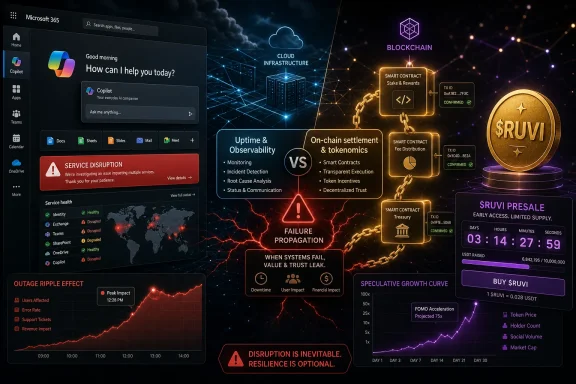 Microsoft’s AI Cloud Now Has a Visibility Problem
The Copilot outage story lands because it touches a nerve Windows users already understand. When Word, Outlook, Teams, Edge, and Windows search all acquire the same AI branding, a failure in one service no longer feels like a narrow SaaS incident. It feels like the operating environment itself has become dependent on a remote intelligence layer.That is the strategic bet Microsoft has made. Copilot is not merely another chatbot tab; it is being threaded through Microsoft 365, Windows, Edge, Azure, security tooling, and enterprise workflows. The more useful that becomes, the more painful downtime becomes.
The June 11 reports, along with earlier June complaints, suggest the obvious: AI assistants are now part of the productivity stack, and users notice when they vanish. Whether the peak number was precisely 12,000 user reports, whether the interruption lasted two hours or four, and whether every named surface was equally affected matters less than the structural point. Microsoft has trained users to treat Copilot as infrastructure, and infrastructure gets judged by uptime.
That is a harsher standard than the one applied to novelty AI demos. If Copilot is just a helpful button, downtime is annoying. If Copilot is how a sales team drafts proposals, how an analyst interrogates spreadsheets, or how an administrator summarizes tickets, downtime becomes a workflow failure.
The Single Point of Failure Argument Is Stronger Than the Token Pitch
Ruvi’s promotional framing takes Microsoft’s outage and turns it into a lesson about centralization. In broad terms, that argument is not absurd. If one vendor controls identity, application integration, model routing, policy enforcement, billing, and inference access, then a fault in that vendor’s service fabric can ripple widely.Enterprise IT has lived this movie before. Authentication outages, DNS failures, expired certificates, routing mistakes, bad deployments, and cloud-region incidents have all turned supposedly distributed services into surprisingly synchronized failures. AI does not repeal those old failure modes; it adds new ones.
But the leap from “centralized AI can fail” to “buy this presale token” is where readers should slow down. A public blockchain can record ownership, payments, access rights, or governance votes. It does not magically provide GPU capacity, low-latency inference, model safety, customer support, regulatory compliance, or a credible service-level agreement.
Ruvi’s own described architecture appears to recognize that reality by keeping heavy model inference off-chain while using the chain for settlement and token mechanics. That may be sensible engineering. It also means the project is not literally running large AI models “on-chain” in the way a casual reader might infer. The expensive work still happens somewhere else.
Copilot’s Weakness Is Dependency, Not Merely Downtime
The more durable criticism of Copilot is not that it had an outage. Every serious online service has outages. The issue is that Microsoft is turning Copilot into a dependency before many organizations have built operational playbooks around AI failure.If Teams is down, companies know how to fall back to email, phones, or another meeting platform. If Exchange has issues, administrators know where to look, what to tell users, and how to triage impact. If Copilot silently stops summarizing meetings, drafting responses, grounding answers in tenant data, or executing agentic workflows, the failure mode is less mature.
That matters because AI features often fail ambiguously. A document does not get summarized. A prompt returns a generic error. A business process waits for an output no human has been assigned to produce manually. The more “agentic” the workflow, the more the outage resembles an invisible broken worker.
Microsoft’s challenge, then, is not only uptime. It is observability. Admins need clear incident reporting, per-tenant impact, audit trails, fallback behavior, and predictable degradation. Otherwise, Copilot becomes both powerful and slippery: important enough to matter, opaque enough to frustrate incident response.
Ruvi Turns a Reliability Debate Into a Market Narrative
Ruvi’s pitch is a familiar one in crypto: take a real problem in a dominant platform, name the structural flaw, and present token ownership as the user’s escape hatch. The press material emphasizes 20-plus AI models, text, image, video, and audio generation, contributor rewards, a fixed five-billion-token supply, buyback-and-burn mechanics, staking yield, and phased presale pricing.That is a lot of claims doing different jobs. The product claims are meant to show utility. The tokenomics claims are meant to suggest scarcity. The staking and buyback language is meant to imply income and demand. The comparison with Copilot is meant to give the whole thing urgency.
For WindowsForum readers, the right posture is neither reflexive dismissal nor credulous enthusiasm. Decentralized AI projects may eventually solve meaningful problems around attribution, marketplace access, usage metering, and contributor compensation. But a token presale is not the same thing as resilient infrastructure, and a product demo is not the same thing as enterprise-grade reliability.
The most important word in Ruvi’s pitch may be “contributors.” If users refine outputs, generate training signals, or improve systems, there is a legitimate debate over whether platforms should compensate them. Microsoft, OpenAI, Google, Anthropic, and others largely operate on a service-access model: users pay, or their employers pay, and the vendor owns the product layer. Crypto projects promise a more participatory economy. The promise is attractive. The execution risk is enormous.
“On-Chain AI” Still Has to Answer Off-Chain Questions
The phrase on-chain AI is doing heavy marketing work across the industry. In practice, most serious AI systems cannot put model inference fully on a public chain without running into cost, speed, privacy, and scale constraints. The chain can coordinate, meter, escrow, verify, or govern. The model usually runs in conventional compute environments.That is not a fatal flaw. Hybrid architectures can be useful. A public ledger can make token supply visible. Smart contracts can enforce certain distribution rules. On-chain settlement can reduce some kinds of platform discretion.
But the key operational questions remain stubbornly off-chain. Who hosts the models? Who pays for compute? What happens when the inference provider fails? How are abuse, copyright complaints, illegal content, privacy requests, and model updates handled? Who is accountable when an AI output causes harm?
Microsoft has imperfect but recognizable answers to many of those questions. It has enterprise contracts, compliance programs, admin controls, identity integration, support channels, and a large security organization. Those do not prevent outages, but they do create a framework for responsibility.
A presale-stage AI token project has to prove that it can offer more than a different accounting layer. It has to prove durability, governance, safety, liquidity, security, and user demand after the speculative phase cools. That is a much harder test than capitalizing on a bad Copilot day.
The Audit Claim Deserves More Scrutiny Than the Outage Claim
Ruvi’s promotional language leans heavily on the word “audited.” In crypto, that word can mean many things. It might mean a smart-contract audit by a reputable security firm. It might mean a lighter review. It might mean an internal review or a marketing claim not yet backed by a public report.For prospective buyers, the distinction is not academic. A fixed non-mintable supply is only as comforting as the contracts, permissions, upgrade paths, treasury controls, liquidity arrangements, and vesting terms around it. A token can be non-mintable and still expose buyers to other risks.
The promised economics also require skepticism. Buyback-and-burn programs depend on actual revenue, transparent execution, and governance that cannot be quietly changed. Staking yields described as coming from platform revenue need evidence of that revenue, not just projections. Presale pricing that emphasizes a jump from one phase to the next is designed to create urgency.
That urgency is the opposite of good due diligence. If an investment must be made before a countdown ends, buyers are being pushed toward emotion. In a market filled with abandoned roadmaps and thinly traded tokens, the burden of proof belongs with the seller.
Microsoft’s Problem Is Trust at Scale; Ruvi’s Problem Is Trust at Birth
The contrast between Microsoft and Ruvi is not simply centralized versus decentralized. It is mature trust versus speculative trust. Microsoft has the credibility of scale and the burden of scale. Ruvi has the freedom of being early and the burden of proving it is real.Microsoft can lose user confidence through repeated outages, confusing branding, licensing changes, privacy mistakes, and opaque incident communication. That is especially dangerous because Copilot is being positioned as a strategic layer across work and personal computing. The more Microsoft says AI is the future of Windows and Microsoft 365, the less patience users will have for vague failure modes.
Ruvi faces a different trust problem. It must convince users that its app works, that its models are useful, that its reward economy is sustainable, that its token is not merely a speculative vehicle, and that its governance will not be captured by insiders or whales. It must also convince non-crypto users that wallet friction, token volatility, and regulatory uncertainty are worth tolerating.
That is a much taller mountain than a press release suggests. Microsoft’s outage gives Ruvi a rhetorical opening, not a victory.
Enterprise IT Will Not Replace Copilot With a Presale Token
For sysadmins and IT leaders, the practical question is not whether Ruvi is a clever counter-narrative. It is whether an organization could rely on it. For most enterprises today, the answer is likely no.Microsoft 365 Copilot sits inside a world organizations already manage: Entra ID, Purview, Defender, Intune, SharePoint, Exchange, Teams, audit logs, retention policies, conditional access, and procurement contracts. That integration is precisely why outages matter, but it is also why Microsoft remains hard to displace.
A decentralized AI superapp may appeal to individual creators, crypto-native communities, and users frustrated by locked-down AI platforms. It may even develop useful tooling. But replacing Microsoft’s enterprise AI layer requires far more than model count and tokenomics.
It requires identity integration, data-loss prevention, tenant isolation, legal agreements, regional data handling, admin reporting, incident response, accessibility, support, compliance mapping, and predictable billing. Those are boring requirements, but boring requirements are what keep large organizations from imploding.
This is where the press-release comparison becomes most strained. Copilot’s outage exposes a reliability gap in Microsoft’s AI ambitions. It does not automatically validate the operational readiness of a crypto AI platform.
The User Compensation Argument Is the One Microsoft Should Not Ignore
Still, Ruvi’s sharpest critique should make Microsoft uncomfortable. Users increasingly suspect that they are training systems without sharing in the upside. Every prompt, correction, thumbs-down, rewritten answer, and workflow pattern can become a signal that improves a platform they do not own.Large AI vendors usually respond by pointing to service value. Users get productivity in exchange for subscription fees, data controls, and access to models. That is a defensible model, especially in enterprise contexts where data governance matters more than token rewards.
But it may not satisfy everyone. Creators, prompt engineers, annotators, domain experts, and community contributors may want more direct participation in the value chain. A system that pays users for useful feedback is not inherently silly. In fact, it may become one of the more important experiments in AI economics.
The danger is that real compensation models can be bundled with speculative token mechanics that transfer risk to users. Paying contributors for valuable work is one thing. Convincing buyers that a token price target is just around the corner is another.
Windows Users Are Becoming AI Infrastructure Testers
Windows users are in a strange position. They are not merely receiving finished AI products; they are helping vendors discover what AI infrastructure breaks like at mass scale. Copilot buttons appear, disappear, move, get renamed, gain new privileges, lose features behind licensing boundaries, and occasionally fail.That instability is partly normal. AI products are evolving quickly. Microsoft is trying to integrate a new computing layer into old productivity surfaces while competitors race to do the same. The product is going to change.
But Windows users have reason to demand discipline. When AI features are optional experiments, churn is tolerable. When they become default entry points in operating systems and office software, churn becomes governance. Users need clear controls, clear failure messages, and clear boundaries between local computing and cloud-dependent assistance.
The June outage reports are therefore less a scandal than a warning. Microsoft wants Copilot to become ambient. Ambient systems must be dependable enough to fade into the background, not brittle enough to remind everyone where the servers are.
The Crypto Counteroffer Is Flashy Because the Cloud Offer Is Frustrating
The appeal of Ruvi’s narrative depends on a real frustration: users do not like feeling locked into a service they cannot inspect, cannot influence, and cannot rely on during outages. Centralized AI has made enormous capability available quickly, but it has also concentrated power over access, pricing, model behavior, and downtime.Crypto projects thrive in that gap. They promise ownership where platforms offer subscriptions. They promise transparency where vendors offer dashboards. They promise community economics where hyperscalers offer licensing tiers. Even when the execution is doubtful, the critique often lands.
Microsoft should not dismiss that as mere token hype. If users are receptive to a presale pitch after a Copilot outage, that says something about the trust deficit around AI platforms. Reliability, communication, and user agency are no longer peripheral product issues. They are central to whether people accept AI as infrastructure.
At the same time, WindowsForum readers should be careful not to confuse frustration with validation. A bad day for Microsoft is not financial advice. A clever whitepaper is not proof of sustainable demand. A token burn is not a substitute for a resilient service.
The Copilot Outage Gave Ruvi a Megaphone, Not a Mandate
The most concrete lesson from this episode is that AI reliability is now a competitive story. Microsoft’s scale makes its failures visible. Ruvi’s smallness lets it frame itself as an alternative before it has endured the same pressure.That asymmetry is powerful marketing. It is also unfair in both directions. Microsoft must prove Copilot can handle real-world dependency at global scale. Ruvi must prove it can survive beyond presale momentum and deliver real utility without leaning on speculative urgency.
For readers trying to separate signal from noise, the useful takeaways are narrower than the pitch suggests:
- Microsoft’s reported June Copilot disruptions show that AI assistants are already important enough to create visible productivity pain when they fail.
- The phrase “decentralized AI” does not eliminate the need for off-chain compute, reliable hosting, security controls, and accountable operations.
- Ruvi’s claims about model count, fixed supply, audits, staking, and buybacks should be treated as claims requiring verification, not as settled facts.
- A token presale is fundamentally different from buying access to a mature enterprise service, and it carries volatility, liquidity, regulatory, and execution risk.
- The strongest argument for projects like Ruvi is user participation in AI value creation, not the simplistic idea that blockchains make outages disappear.
- Microsoft’s best response is not to mock crypto competitors, but to make Copilot more observable, controllable, and resilient for the administrators who must support it.
References
- Primary source: openpr.com
Published: 2026-06-13T01:48:11.913577
Microsoft 365 Copilot Outage Hits Over 12,000 Users While Ruvi
Press release - Institutional Business Press - Microsoft 365 Copilot Outage Hits Over 12,000 Users While Ruvi (RUVI) Runs 20+ AI Models Onchain - published on openPR.comwww.openpr.com - Related coverage: globenewswire.com
Ruvi AI (RUVI) Launches Major Ecosystem Upgrade Featuring
DUBAI, United Arab Emirates, May 29, 2026 (GLOBE NEWSWIRE) -- Ruvi AI has launched a major ecosystem upgrade featuring 20+ autonomous AI agents given its...www.globenewswire.com - Related coverage: techtimes.com
Microsoft Copilot Fails Twice in June: Enterprise IT Has No SLA Protection for AI Downtime
Microsoft Copilot outage on June 11 was the second major disruption in 11 days, exposing a critical enterprise reliability gap: Copilot carries no financially backed SLA comparable to Exchangewww.techtimes.com - Related coverage: windowscentral.com
Microsoft 365 is paywalling most of Copilot in its Office apps | Windows Central
Commercial customers will soon need a Microsoft 365 Copilot license to use Copilot Chat in Word, Excel, PowerPoint, and OneNote.www.windowscentral.com - Related coverage: docs.ruvi.io
Introduction · Ruvi AI
Introduction. Section 01 of 19 of the Ruvi AI Whitepaper. Create anything. Own what you build.docs.ruvi.io - Related coverage: statusgator.com
Microsoft Copilot (Microsoft 365) Status. Check if Microsoft Copilot (Microsoft 365) is down or having an outage. | StatusGator
Microsoft Copilot (Microsoft 365) down? Check the current Microsoft Copilot (Microsoft 365) status right now, learn about outages, downtime, incidents, and issues.statusgator.com
- Related coverage: pingoru.io
Is Microsoft Down? Outages, Status & Downtime — July 2026 · Pingoru
Microsoft had 1 major outage in the last 30 days, totaling 2h 4m of downtime. Track Microsoft status, get email + webhook alerts the moment Microsoft reports an incident, outage, or maintenance window. Free for 5 monitors. pingoru.io
- Related coverage: vaasblock.com
Build 2026's Agentic Copilot Pitch Followed a 14,000-User Outage
At Build 2026 Nadella called Copilot 'the first truly agentic OS.' 72 hours earlier, 14,000 users reported it down. The pattern is the problem.www.vaasblock.com - Related coverage: techradar.com
Microsoft admits an Office bug exposed confidential user emails to Copilot | TechRadar
Copilot was ignoring 'confidential' email flagswww.techradar.com - Related coverage: wordpress.fau.edu
- Related coverage: coinspeaker.com
Is Ruvi AI Legit or a Scam? Detailed Analysis and Presale Review
In our post, you can discover whether Ruvi AI is a legit decentralized AI superapp or a risky presale project without promise. Explore its tokenomics, security, and roadmaps in our guide.www.coinspeaker.com - Related coverage: downforeveryoneorjustme.com
Is Copilot down? Live status and problems past 24 hours
Live problems for Copilot. Error received? Down? Slow? Check what is going on. downforeveryoneorjustme.com
- Related coverage: isdown.app
Is Microsoft Copilot Down? Check current status and user reports | IsDown
Check if Microsoft Copilot is down right now. Live Microsoft Copilot status, real-time outage detection, and instant alerts when Microsoft Copilot has issues. Free 14-day trial. isdown.app
- Related coverage: tomsguide.com
Microsoft outage now 'resolved' — latest updates as 365, Outlook and Teams return | Tom's Guide
Everything you need to know about the major Microsoft outagewww.tomsguide.com - Related coverage: labs.cloudsecurityalliance.org
CSA research note M365 Copilot CVE 2026 24299 20260505 csa styled
PDF documentlabs.cloudsecurityalliance.org
- Related coverage: feministfutures.socialsciences.ucsb.edu
- Related coverage: oregon.gov
- Official source: news.microsoft.com
- Official source: techcommunity.microsoft.com
