

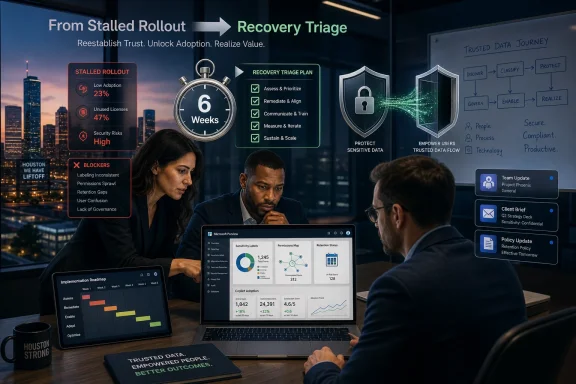
EPC Group announced on June 29, 2026, from Houston, Texas, a fixed-fee, six-week Microsoft 365 Copilot Rescue Engagement aimed at enterprises whose Copilot rollouts have stalled after licensing, deployment, or early pilots. The pitch is not that Microsoft’s AI assistant is broken, but that many organizations turned it on before they made their data, permissions, labels, governance, and users ready for it. That distinction matters because the next phase of enterprise AI spending will not be won by demos; it will be won by operational discipline. Copilot is becoming less of a software purchase and more of a mirror held up to every messy Microsoft 365 tenant an organization has avoided cleaning.
The first wave of Microsoft 365 Copilot adoption was sold, implicitly and sometimes explicitly, as a productivity upgrade hiding inside tools workers already use. Word would draft. Outlook would summarize. Teams would remember. Excel would analyze. The problem is that enterprise software rarely fails because a button does not exist; it fails because the human, data, compliance, and incentive systems around the button are not ready for it.
That is the market EPC Group is now naming with its “rescue” engagement. The company says too many organizations bought licenses, switched on the feature, and then watched adoption settle far below the expectations that justified the purchase. According to the announcement, EPC is targeting companies that have already spent the money and now need to explain why usage, trust, and measurable return have not followed.
This is a clever piece of positioning because it reframes Copilot disappointment as a recoverable governance problem rather than a failed bet. That framing will appeal to CIOs who do not want to admit they bought shelfware, to CFOs who want a route back to measurable ROI, and to security teams that were never comfortable with “turn it on and see what happens” as an AI strategy. It also says something important about the maturity of the Microsoft 365 Copilot market: the services economy has moved from deployment to remediation.
The phrase “rescue engagement” carries a whiff of consulting theater, but the underlying diagnosis is hard to dismiss. Microsoft 365 tenants are often years of SharePoint sprawl, Teams entropy, stale OneDrive permissions, half-used sensitivity labels, orphaned groups, inconsistent retention policies, and informal data practices dressed up as collaboration. Copilot does not create those problems. It makes them easier to see, easier to query, and in the worst cases easier to expose.
That is why the EPC announcement leans so heavily on governance and data readiness rather than prompt-writing tricks. The company’s six-week program begins with diagnostics across Microsoft Purview sensitivity labeling and data-security posture, Copilot usage and adoption telemetry, semantic model and data-estate readiness, and prompt and response governance. That may sound like a consultant’s menu, but it maps closely to the failure modes IT departments have been reporting since generative AI entered the Microsoft 365 estate.
The seductive promise of Copilot was that it could meet workers where they already are. But meeting workers where they are also means meeting their data where it already is, and enterprise data is often not where leadership imagines it to be. It is in project sites no one owns, chats with unclear retention, shared folders with permissive access, old Power BI models whose business logic is disputed, and documents whose sensitivity was never labeled because the previous compliance initiative ran out of steam.
In that context, the model is not the whole product. The product is the model plus the organization’s information architecture. Copilot may be impressive in a curated demo tenant, but an actual enterprise deployment asks a more uncomfortable question: does the company’s Microsoft 365 environment contain the right knowledge, governed in the right way, available to the right people, with enough trust that employees will use the output?
That is not an AI question in the narrow sense. It is a digital workplace question, a records-management question, a security question, and a change-management question. EPC’s bet is that enterprises will increasingly pay specialists to answer it because the Copilot invoice has made the cost of avoidance visible.
The National Law Review release cites Gartner research suggesting weekly active usage of licensed Microsoft 365 Copilot seats remains in the 20-to-30 percent range across many organizations. It also references Gartner commentary that justifying full-scale deployment can be “quite challenging,” with many organizations pausing rollouts to figure out where Copilot genuinely fits. Even allowing for the limits of third-party surveys and conference-stage generalizations, that finding tracks with the broader enterprise pattern: buying AI is easier than changing work.
Low weekly activity is not automatically a failure. Some employees may need Copilot only occasionally. Some roles may benefit more from targeted automations or business-specific agents than from a general-purpose assistant in Office apps. Some organizations may have started with too broad a license assignment because they wanted optionality rather than immediate usage.
But if a company is paying a per-user premium on top of existing Microsoft 365 subscriptions, “occasional value” becomes harder to defend at scale. The business case for Copilot depends on repeated use in workflows that matter: drafting, summarizing, meeting follow-up, knowledge retrieval, analysis, customer communication, policy work, and decision support. If users try it twice, get a mediocre answer from stale content, and return to old habits, the rollout has not failed spectacularly. It has failed quietly, which is often worse.
That quiet failure is what rescue services are designed to monetize. They promise to convert a vague adoption malaise into a bounded diagnostic and remediation plan. In six weeks, EPC says it can establish a baseline, rank blockers by impact and effort, implement controls, build an adoption cadence, tune data foundations, and leave behind an ROI measurement framework. Whether that is enough depends heavily on the size and condition of the tenant, but the structure is aimed at the right executive anxiety: “Are we wasting money every month?”
Microsoft has consistently argued that Copilot respects existing Microsoft 365 permissions. That is reassuring only if those permissions are already correct. In many enterprises, they are not. The old problem was that an employee could perhaps find something they should not have found if they knew where to look; the new problem is that a natural-language assistant may make buried information feel much closer to the surface.
This is not a theoretical concern for regulated industries. Legal, healthcare, financial services, government, and energy organizations all live with data boundaries that are partly technical and partly procedural. If a tenant contains overshared HR material, sensitive commercial terms, litigation files, source documents for audits, or customer records in loosely governed locations, Copilot can become the executive summary engine for a permissions mistake.
That does not mean Copilot is inherently unsafe. It means Copilot raises the return on good governance and the penalty for bad governance at the same time. A well-governed tenant gains a powerful retrieval and synthesis layer. A poorly governed tenant gains a more convenient way to discover its own negligence.
EPC’s use of Microsoft Purview as a central part of the engagement is therefore not incidental. Purview is the governance and compliance machinery Microsoft wants enterprises to use for information protection, data loss prevention, labeling, retention, and auditability. If Copilot is the glamorous interface, Purview is the plumbing that determines whether the interface can be trusted.
The trouble is that plumbing work is slow, political, and cross-functional. Labeling taxonomies require business agreement. Data loss prevention policies require tuning. Access reviews generate friction. Retention rules can collide with legal, operational, and cultural habits. A six-week rescue can start that work and fix obvious gaps, but the deeper point is that Copilot value depends on a governance program that does not end when the consultants leave.
Copilot makes the champion idea more consequential because generative AI changes habits rather than merely adding features. Users need to learn when to delegate, when to verify, when to distrust a confident answer, and how to reshape work around an assistant that is useful but not authoritative. That is not the same as teaching someone where a button lives in the ribbon.
The adoption failure EPC describes is familiar: employees experiment, fail to see immediate value, and retreat. Some ask one vague question, receive generic output, and conclude the tool is overhyped. Others do not know which workloads are approved, which data can be used, or whether their manager expects them to save time, improve quality, or simply appear AI-forward. In that ambiguity, non-use becomes the safe option.
A meaningful champion network does not merely evangelize Copilot. It translates the tool into role-specific habits. A legal operations team needs different examples than a sales team. Finance analysts need different guardrails than communications staff. Engineers, HR business partners, procurement managers, and executives each need patterns that map to their own work and risk profile.
That is why adoption cannot be separated from governance. If employees are told to use Copilot but not told what good use looks like, they will either avoid it or use it in ways that make compliance teams nervous. If they are locked down so tightly that the assistant cannot reach useful content, they will dismiss it as a toy. The practical middle ground is a set of approved patterns, trained local advocates, and telemetry that shows whether habits are actually forming.
But six weeks also reveals the limits of the promise. A deeply messy Microsoft 365 tenant cannot be fully remediated in a month and a half. Years of content sprawl, decentralized site ownership, unclear data classification, and uneven business process maturity do not disappear because Copilot made them embarrassing. The realistic value of such an engagement is prioritization, not purification.
That may still be valuable. Many enterprises do not need perfection before expanding Copilot; they need to know which risks block adoption, which groups can safely proceed, which data sources are too unreliable, and which business processes provide the best early ROI. A strong rescue engagement should separate problems that must be fixed now from problems that can be governed over time.
The diagnostic phase is therefore the heart of the offering. If it is rigorous, it can tell leadership whether the rollout stalled because users were untrained, content was untrustworthy, labels were incomplete, permissions were risky, or the licensed population simply did not have use cases strong enough to justify the spend. Those are very different problems. Treating them all as “Copilot adoption” is how enterprises waste another quarter.
The remediation phase is more delicate. Implementing sensitivity labels and Purview controls, forming champion networks, tuning semantic models, and defining prompt and response boundaries are all plausible six-week activities if the scope is contained. But if the organization expects a rescue engagement to make every business unit AI-ready, it is setting up the second disappointment before the first one has been fully diagnosed.
EPC Group is well positioned for that narrative because its announcement connects Copilot remediation to a wider “Governed AI on Microsoft” framework spanning Microsoft Purview, Microsoft Fabric, Power BI, Microsoft 365, Microsoft Entra, and Copilot governance. That is not accidental. Copilot sits on top of Microsoft’s productivity stack, but enterprise AI programs quickly pull in identity, analytics, data engineering, compliance, and lifecycle management.
The company is also using the rescue engagement as a doorway into longer-term services. Its announcement points customers toward AI Center of Excellence consulting and a Virtual Chief AI Officer service for ongoing governance, roadmap, and risk leadership. That is the natural progression: diagnose the stalled rollout, stabilize it, then sell an operating model to prevent relapse.
Skeptics will see this as the predictable consulting industrial complex forming around another Microsoft SKU. They are not entirely wrong. Every major platform shift produces a services layer, and every services layer has incentives to make the problem sound urgent, complex, and insufficiently addressed by internal staff.
But the cynical reading is not the whole reading. Enterprise AI really is complex. The governance, data, and adoption gaps are real. Many organizations genuinely do not have a senior AI operating model, and many security teams are being asked to bless deployments whose risk boundaries remain fuzzy. A good partner can accelerate decisions that internal committees have been circling for months.
The danger is that organizations outsource judgment along with labor. A consultant can design governance patterns, configure controls, and build dashboards. It cannot decide what level of AI risk the business is willing to accept, which workflows deserve investment, or whether a thousand additional Copilot licenses are better than targeted automation in five high-value departments. Those remain executive decisions.
This is where Microsoft’s bundling strength can become a double-edged sword. Copilot’s greatest advantage is proximity. It lives inside the tools knowledge workers already use, and it can draw on Microsoft Graph signals and organizational content in ways a disconnected chatbot cannot. That proximity is powerful when the tenant is healthy.
But proximity also means Copilot inherits the organization’s disorder. A specialized AI tool trained around a narrow workflow may outperform a broad assistant for specific use cases because its data boundaries, task design, and success measures are clearer. Copilot has the distribution advantage; narrower tools may have the workflow advantage.
That is why EPC’s ROI measurement framework is more than a closing deliverable. Enterprises need to know where Copilot is the right abstraction and where it is not. Meeting summaries and email drafting are useful, but they may not justify broad premium licensing on their own. Higher-value scenarios usually require connection to business process, trusted data, repeatable prompts, and management expectations.
The next phase of enterprise AI will likely be less about whether a company “has Copilot” and more about which employee populations, business processes, and data domains are mature enough to benefit from it. That is a less exciting story than universal AI transformation, but it is much closer to how enterprise value is actually created.
That shift matters for IT leaders trying to get budget. It is often difficult to secure investment for information architecture, labeling, retention, access reviews, or content cleanup when the benefit is framed as avoiding an abstract future problem. Attach that same work to Copilot ROI, and the conversation changes. Suddenly, governance is not a tax. It is a prerequisite for a tool the business already bought.
This may be the healthiest side effect of the Copilot wave. If AI forces organizations to confront oversharing, stale content, unclear ownership, and weak data semantics, then even a stalled rollout can produce lasting value. The enterprise may become more governable because AI made the cost of disorder impossible to ignore.
The reverse is also true. If organizations treat governance as a one-time gate before Copilot expansion, they will recreate the same problem at larger scale. New Teams will be created. New files will be shared. New agents will be built. New data sources will be connected. New employees will join, leave, and change roles. The tenant is not a museum; it is a living system.
That is why EPC’s announcement repeatedly gestures toward operating discipline after the six-week engagement. The rescue is a reset, not a final state. Copilot value compounds only if governance, adoption, measurement, and data quality become recurring practices rather than launch-phase ceremonies.
That is important. Enterprise technology programs often continue under a fog of optimism because acknowledging underperformance threatens careers, vendor relationships, and budget assumptions. A “rescue” engagement offers a politically useful middle path. The project did not fail; it stalled. The licenses were not wasted; the foundation was incomplete. The answer is not retreat; it is remediation.
There is some truth in that. Microsoft 365 Copilot arrived in a market primed by ChatGPT enthusiasm, board-level AI pressure, and vendor narratives about productivity gains. Many organizations were always going to buy first and rationalize later. The result was predictable: broad pilots, uneven training, unclear metrics, security discomfort, and a scramble to define value after deployment.
But buyers should be careful not to let the rescue narrative excuse poor decision-making. If an organization licensed thousands of users without identifying workflows, data readiness, success metrics, and adoption owners, that is not merely a governance gap. It is a procurement and leadership gap. The consultant can help repair it, but the lesson should be remembered before the next AI platform arrives.
The better takeaway is not “Copilot needs rescuing.” It is that AI rollouts invert the usual enterprise software sequence. You cannot simply deploy, train, and optimize later. With generative AI tied to corporate knowledge, the quality of the deployment depends heavily on decisions made before users ever type a prompt.
That lesson is not unique to Microsoft. Every enterprise AI system that touches internal knowledge will face the same collision between model capability and organizational readiness. The model can summarize what it can reach, reason over what it can understand, and help with workflows users are willing to change. It cannot, by itself, fix stale data, confused permissions, unclear business ownership, or distrust born from bad early experiences.
EPC’s six-week rescue package is therefore both a service announcement and a marker in the evolution of enterprise AI. The first era was wonder. The second was procurement. The third, now arriving, is accountability. Companies that bought Copilot are being forced to ask whether they prepared the ground for it, and the answer is often uncomfortable.
The winners will not be the organizations that turn on the most AI features the fastest. They will be the ones that make their data trustworthy, their governance durable, their use cases specific, and their measurement honest. Copilot may yet become a daily habit for many workers, but only where enterprises stop treating it like a switch and start treating it like a system.
 The Copilot Hangover Arrives Right on Schedule
The first wave of Microsoft 365 Copilot adoption was sold, implicitly and sometimes explicitly, as a productivity upgrade hiding inside tools workers already use. Word would draft. Outlook would summarize. Teams would remember. Excel would analyze. The problem is that enterprise software rarely fails because a button does not exist; it fails because the human, data, compliance, and incentive systems around the button are not ready for it.That is the market EPC Group is now naming with its “rescue” engagement. The company says too many organizations bought licenses, switched on the feature, and then watched adoption settle far below the expectations that justified the purchase. According to the announcement, EPC is targeting companies that have already spent the money and now need to explain why usage, trust, and measurable return have not followed.
This is a clever piece of positioning because it reframes Copilot disappointment as a recoverable governance problem rather than a failed bet. That framing will appeal to CIOs who do not want to admit they bought shelfware, to CFOs who want a route back to measurable ROI, and to security teams that were never comfortable with “turn it on and see what happens” as an AI strategy. It also says something important about the maturity of the Microsoft 365 Copilot market: the services economy has moved from deployment to remediation.
The phrase “rescue engagement” carries a whiff of consulting theater, but the underlying diagnosis is hard to dismiss. Microsoft 365 tenants are often years of SharePoint sprawl, Teams entropy, stale OneDrive permissions, half-used sensitivity labels, orphaned groups, inconsistent retention policies, and informal data practices dressed up as collaboration. Copilot does not create those problems. It makes them easier to see, easier to query, and in the worst cases easier to expose.
Microsoft Sold an Assistant, but Enterprises Bought an Operating Model
Microsoft 365 Copilot is priced and marketed as a user productivity product, but in a large organization it behaves more like an operating-model change. It depends on identity, permissions, content hygiene, information protection, adoption management, and management telemetry. If those foundations are weak, the assistant has little chance of becoming a daily habit outside a narrow group of enthusiasts.That is why the EPC announcement leans so heavily on governance and data readiness rather than prompt-writing tricks. The company’s six-week program begins with diagnostics across Microsoft Purview sensitivity labeling and data-security posture, Copilot usage and adoption telemetry, semantic model and data-estate readiness, and prompt and response governance. That may sound like a consultant’s menu, but it maps closely to the failure modes IT departments have been reporting since generative AI entered the Microsoft 365 estate.
The seductive promise of Copilot was that it could meet workers where they already are. But meeting workers where they are also means meeting their data where it already is, and enterprise data is often not where leadership imagines it to be. It is in project sites no one owns, chats with unclear retention, shared folders with permissive access, old Power BI models whose business logic is disputed, and documents whose sensitivity was never labeled because the previous compliance initiative ran out of steam.
In that context, the model is not the whole product. The product is the model plus the organization’s information architecture. Copilot may be impressive in a curated demo tenant, but an actual enterprise deployment asks a more uncomfortable question: does the company’s Microsoft 365 environment contain the right knowledge, governed in the right way, available to the right people, with enough trust that employees will use the output?
That is not an AI question in the narrow sense. It is a digital workplace question, a records-management question, a security question, and a change-management question. EPC’s bet is that enterprises will increasingly pay specialists to answer it because the Copilot invoice has made the cost of avoidance visible.
The ROI Problem Is Really an Adoption Problem Wearing a Finance Badge
The most politically dangerous phrase in any AI rollout is “measurable return on investment.” It sounds clinical, but inside an enterprise it quickly becomes personal. Procurement wants to know whether the license renewal is justified. Business-unit leaders want to know why their people are not using the expensive new tool. IT wants to know whether the problem is training, configuration, data quality, or unrealistic expectations.The National Law Review release cites Gartner research suggesting weekly active usage of licensed Microsoft 365 Copilot seats remains in the 20-to-30 percent range across many organizations. It also references Gartner commentary that justifying full-scale deployment can be “quite challenging,” with many organizations pausing rollouts to figure out where Copilot genuinely fits. Even allowing for the limits of third-party surveys and conference-stage generalizations, that finding tracks with the broader enterprise pattern: buying AI is easier than changing work.
Low weekly activity is not automatically a failure. Some employees may need Copilot only occasionally. Some roles may benefit more from targeted automations or business-specific agents than from a general-purpose assistant in Office apps. Some organizations may have started with too broad a license assignment because they wanted optionality rather than immediate usage.
But if a company is paying a per-user premium on top of existing Microsoft 365 subscriptions, “occasional value” becomes harder to defend at scale. The business case for Copilot depends on repeated use in workflows that matter: drafting, summarizing, meeting follow-up, knowledge retrieval, analysis, customer communication, policy work, and decision support. If users try it twice, get a mediocre answer from stale content, and return to old habits, the rollout has not failed spectacularly. It has failed quietly, which is often worse.
That quiet failure is what rescue services are designed to monetize. They promise to convert a vague adoption malaise into a bounded diagnostic and remediation plan. In six weeks, EPC says it can establish a baseline, rank blockers by impact and effort, implement controls, build an adoption cadence, tune data foundations, and leave behind an ROI measurement framework. Whether that is enough depends heavily on the size and condition of the tenant, but the structure is aimed at the right executive anxiety: “Are we wasting money every month?”
Data Sprawl Turns Copilot From Assistant Into Liability
The most important sentence in EPC’s announcement is not the quote about failed models. It is the observation that sensitivity-label coverage is often incomplete, forcing administrators to restrict Copilot to a narrow group of low-risk users to avoid oversharing and data exposure. That is where the Copilot story leaves the glossy AI keynote and returns to the unglamorous world of permissions, labels, retention, and access reviews.Microsoft has consistently argued that Copilot respects existing Microsoft 365 permissions. That is reassuring only if those permissions are already correct. In many enterprises, they are not. The old problem was that an employee could perhaps find something they should not have found if they knew where to look; the new problem is that a natural-language assistant may make buried information feel much closer to the surface.
This is not a theoretical concern for regulated industries. Legal, healthcare, financial services, government, and energy organizations all live with data boundaries that are partly technical and partly procedural. If a tenant contains overshared HR material, sensitive commercial terms, litigation files, source documents for audits, or customer records in loosely governed locations, Copilot can become the executive summary engine for a permissions mistake.
That does not mean Copilot is inherently unsafe. It means Copilot raises the return on good governance and the penalty for bad governance at the same time. A well-governed tenant gains a powerful retrieval and synthesis layer. A poorly governed tenant gains a more convenient way to discover its own negligence.
EPC’s use of Microsoft Purview as a central part of the engagement is therefore not incidental. Purview is the governance and compliance machinery Microsoft wants enterprises to use for information protection, data loss prevention, labeling, retention, and auditability. If Copilot is the glamorous interface, Purview is the plumbing that determines whether the interface can be trusted.
The trouble is that plumbing work is slow, political, and cross-functional. Labeling taxonomies require business agreement. Data loss prevention policies require tuning. Access reviews generate friction. Retention rules can collide with legal, operational, and cultural habits. A six-week rescue can start that work and fix obvious gaps, but the deeper point is that Copilot value depends on a governance program that does not end when the consultants leave.
The Champion Network Is Not Corporate Fluff This Time
Enterprise IT veterans have heard “champion network” so many times that it can sound like a slideware ritual. Find enthusiastic users, train them, give them talking points, and hope adoption spreads through the organization like sourdough starter. For many software rollouts, that model produces a brief Yammer post, a few lunch-and-learns, and a slow fade.Copilot makes the champion idea more consequential because generative AI changes habits rather than merely adding features. Users need to learn when to delegate, when to verify, when to distrust a confident answer, and how to reshape work around an assistant that is useful but not authoritative. That is not the same as teaching someone where a button lives in the ribbon.
The adoption failure EPC describes is familiar: employees experiment, fail to see immediate value, and retreat. Some ask one vague question, receive generic output, and conclude the tool is overhyped. Others do not know which workloads are approved, which data can be used, or whether their manager expects them to save time, improve quality, or simply appear AI-forward. In that ambiguity, non-use becomes the safe option.
A meaningful champion network does not merely evangelize Copilot. It translates the tool into role-specific habits. A legal operations team needs different examples than a sales team. Finance analysts need different guardrails than communications staff. Engineers, HR business partners, procurement managers, and executives each need patterns that map to their own work and risk profile.
That is why adoption cannot be separated from governance. If employees are told to use Copilot but not told what good use looks like, they will either avoid it or use it in ways that make compliance teams nervous. If they are locked down so tightly that the assistant cannot reach useful content, they will dismiss it as a toy. The practical middle ground is a set of approved patterns, trained local advocates, and telemetry that shows whether habits are actually forming.
Six Weeks Is a Triage Window, Not a Transformation
EPC’s fixed-fee, six-week structure is commercially smart because it gives buyers a contained decision. A stalled rollout is already politically awkward; the last thing a CIO wants is an open-ended consulting odyssey with unclear deliverables. Six weeks sounds short enough to approve, long enough to produce visible artifacts, and concrete enough to fit between quarterly business reviews.But six weeks also reveals the limits of the promise. A deeply messy Microsoft 365 tenant cannot be fully remediated in a month and a half. Years of content sprawl, decentralized site ownership, unclear data classification, and uneven business process maturity do not disappear because Copilot made them embarrassing. The realistic value of such an engagement is prioritization, not purification.
That may still be valuable. Many enterprises do not need perfection before expanding Copilot; they need to know which risks block adoption, which groups can safely proceed, which data sources are too unreliable, and which business processes provide the best early ROI. A strong rescue engagement should separate problems that must be fixed now from problems that can be governed over time.
The diagnostic phase is therefore the heart of the offering. If it is rigorous, it can tell leadership whether the rollout stalled because users were untrained, content was untrustworthy, labels were incomplete, permissions were risky, or the licensed population simply did not have use cases strong enough to justify the spend. Those are very different problems. Treating them all as “Copilot adoption” is how enterprises waste another quarter.
The remediation phase is more delicate. Implementing sensitivity labels and Purview controls, forming champion networks, tuning semantic models, and defining prompt and response boundaries are all plausible six-week activities if the scope is contained. But if the organization expects a rescue engagement to make every business unit AI-ready, it is setting up the second disappointment before the first one has been fully diagnosed.
Microsoft’s Partner Economy Finds the Second Sale
There is also a broader Microsoft ecosystem story here. The first sale was Copilot licensing. The second sale is everything required to make Copilot usable, safe, and defensible. Partners that once made money from SharePoint migrations, Power BI dashboards, Teams governance, security baselines, and Microsoft 365 tenant operations can now bundle those capabilities into AI-readiness and Copilot recovery packages.EPC Group is well positioned for that narrative because its announcement connects Copilot remediation to a wider “Governed AI on Microsoft” framework spanning Microsoft Purview, Microsoft Fabric, Power BI, Microsoft 365, Microsoft Entra, and Copilot governance. That is not accidental. Copilot sits on top of Microsoft’s productivity stack, but enterprise AI programs quickly pull in identity, analytics, data engineering, compliance, and lifecycle management.
The company is also using the rescue engagement as a doorway into longer-term services. Its announcement points customers toward AI Center of Excellence consulting and a Virtual Chief AI Officer service for ongoing governance, roadmap, and risk leadership. That is the natural progression: diagnose the stalled rollout, stabilize it, then sell an operating model to prevent relapse.
Skeptics will see this as the predictable consulting industrial complex forming around another Microsoft SKU. They are not entirely wrong. Every major platform shift produces a services layer, and every services layer has incentives to make the problem sound urgent, complex, and insufficiently addressed by internal staff.
But the cynical reading is not the whole reading. Enterprise AI really is complex. The governance, data, and adoption gaps are real. Many organizations genuinely do not have a senior AI operating model, and many security teams are being asked to bless deployments whose risk boundaries remain fuzzy. A good partner can accelerate decisions that internal committees have been circling for months.
The danger is that organizations outsource judgment along with labor. A consultant can design governance patterns, configure controls, and build dashboards. It cannot decide what level of AI risk the business is willing to accept, which workflows deserve investment, or whether a thousand additional Copilot licenses are better than targeted automation in five high-value departments. Those remain executive decisions.
The Real Competition Is Not Another Chatbot
When Microsoft 365 Copilot underperforms, the comparison is rarely just “Copilot versus no Copilot.” It is Copilot versus other claims on the IT budget. Security modernization, endpoint management, cloud cost control, data platform work, app rationalization, and industry-specific AI tools all compete for the same attention. If Copilot cannot show repeatable value, it becomes another premium subscription in a crowded stack.This is where Microsoft’s bundling strength can become a double-edged sword. Copilot’s greatest advantage is proximity. It lives inside the tools knowledge workers already use, and it can draw on Microsoft Graph signals and organizational content in ways a disconnected chatbot cannot. That proximity is powerful when the tenant is healthy.
But proximity also means Copilot inherits the organization’s disorder. A specialized AI tool trained around a narrow workflow may outperform a broad assistant for specific use cases because its data boundaries, task design, and success measures are clearer. Copilot has the distribution advantage; narrower tools may have the workflow advantage.
That is why EPC’s ROI measurement framework is more than a closing deliverable. Enterprises need to know where Copilot is the right abstraction and where it is not. Meeting summaries and email drafting are useful, but they may not justify broad premium licensing on their own. Higher-value scenarios usually require connection to business process, trusted data, repeatable prompts, and management expectations.
The next phase of enterprise AI will likely be less about whether a company “has Copilot” and more about which employee populations, business processes, and data domains are mature enough to benefit from it. That is a less exciting story than universal AI transformation, but it is much closer to how enterprise value is actually created.
Governance Becomes the New Adoption Surface
For years, Microsoft 365 governance was treated as defensive hygiene. It existed to prevent data loss, satisfy auditors, manage lifecycle bloat, and reduce administrative chaos. Copilot changes the emotional valence of that work. Governance is no longer merely the thing that stops bad outcomes; it becomes the thing that enables useful AI.That shift matters for IT leaders trying to get budget. It is often difficult to secure investment for information architecture, labeling, retention, access reviews, or content cleanup when the benefit is framed as avoiding an abstract future problem. Attach that same work to Copilot ROI, and the conversation changes. Suddenly, governance is not a tax. It is a prerequisite for a tool the business already bought.
This may be the healthiest side effect of the Copilot wave. If AI forces organizations to confront oversharing, stale content, unclear ownership, and weak data semantics, then even a stalled rollout can produce lasting value. The enterprise may become more governable because AI made the cost of disorder impossible to ignore.
The reverse is also true. If organizations treat governance as a one-time gate before Copilot expansion, they will recreate the same problem at larger scale. New Teams will be created. New files will be shared. New agents will be built. New data sources will be connected. New employees will join, leave, and change roles. The tenant is not a museum; it is a living system.
That is why EPC’s announcement repeatedly gestures toward operating discipline after the six-week engagement. The rescue is a reset, not a final state. Copilot value compounds only if governance, adoption, measurement, and data quality become recurring practices rather than launch-phase ceremonies.
The Six-Week Rescue Says More About Buyers Than Sellers
The emergence of a Copilot rescue package is itself a market signal. It says enough enterprises have moved past curiosity and into disappointment that a firm can package recovery as a product. It also says organizations want a way to admit trouble without calling the original decision a mistake.That is important. Enterprise technology programs often continue under a fog of optimism because acknowledging underperformance threatens careers, vendor relationships, and budget assumptions. A “rescue” engagement offers a politically useful middle path. The project did not fail; it stalled. The licenses were not wasted; the foundation was incomplete. The answer is not retreat; it is remediation.
There is some truth in that. Microsoft 365 Copilot arrived in a market primed by ChatGPT enthusiasm, board-level AI pressure, and vendor narratives about productivity gains. Many organizations were always going to buy first and rationalize later. The result was predictable: broad pilots, uneven training, unclear metrics, security discomfort, and a scramble to define value after deployment.
But buyers should be careful not to let the rescue narrative excuse poor decision-making. If an organization licensed thousands of users without identifying workflows, data readiness, success metrics, and adoption owners, that is not merely a governance gap. It is a procurement and leadership gap. The consultant can help repair it, but the lesson should be remembered before the next AI platform arrives.
The better takeaway is not “Copilot needs rescuing.” It is that AI rollouts invert the usual enterprise software sequence. You cannot simply deploy, train, and optimize later. With generative AI tied to corporate knowledge, the quality of the deployment depends heavily on decisions made before users ever type a prompt.
The Copilot Recovery Playbook Is Becoming Visible
EPC’s announcement is most useful when read not as a press release for one firm, but as a sketch of the emerging recovery playbook for enterprise Copilot programs. The details will vary by organization, but the pattern is becoming clearer: find the usage gap, inspect the tenant, repair the governance foundations, teach the work, and measure the result.- Organizations should treat low Copilot usage as a diagnostic signal rather than a simple training problem.
- Permission hygiene, sensitivity labels, and Purview controls are now adoption enablers, not just compliance safeguards.
- Copilot value depends on role-specific use cases that are concrete enough for employees to repeat in real work.
- A six-week rescue can prioritize and unblock a stalled rollout, but it cannot substitute for long-term tenant governance.
- ROI measurement needs to connect usage telemetry to business outcomes, not merely count whether users clicked the assistant.
- Broad licensing should follow evidence of durable value in specific populations, not precede it as an act of faith.
Enterprises Will Learn to Stop Treating AI as a Feature Toggle
The most generous interpretation of EPC Group’s new offering is that it acknowledges a truth many enterprises are learning the expensive way: Microsoft 365 Copilot is not a magic layer sprinkled over Office documents. It is a high-friction organizational change disguised as a friendly assistant. The interface is conversational, but the implementation is architectural.That lesson is not unique to Microsoft. Every enterprise AI system that touches internal knowledge will face the same collision between model capability and organizational readiness. The model can summarize what it can reach, reason over what it can understand, and help with workflows users are willing to change. It cannot, by itself, fix stale data, confused permissions, unclear business ownership, or distrust born from bad early experiences.
EPC’s six-week rescue package is therefore both a service announcement and a marker in the evolution of enterprise AI. The first era was wonder. The second was procurement. The third, now arriving, is accountability. Companies that bought Copilot are being forced to ask whether they prepared the ground for it, and the answer is often uncomfortable.
The winners will not be the organizations that turn on the most AI features the fastest. They will be the ones that make their data trustworthy, their governance durable, their use cases specific, and their measurement honest. Copilot may yet become a daily habit for many workers, but only where enterprises stop treating it like a switch and start treating it like a system.
References
- Primary source: The National Law Review
Published: Mon, 29 Jun 2026 17:21:49 GMT
Loading…
natlawreview.com - Official source: microsoft.com
Your request has been blocked. This could be due to several reasons.
www.microsoft.com
- Related coverage: epcgroup.net
Loading…
www.epcgroup.net - Related coverage: datastudios.org
Loading…
www.datastudios.org - Related coverage: aguidetocloud.com
Loading…
www.aguidetocloud.com - Related coverage: atonementlicensing.com
Microsoft 365 Copilot Pricing 2026: True Cost Decoded
Microsoft 365 Copilot lists at $30 per user per month. Realised cost lands at $66 to $87 after the E3 or E5 prerequisite. Get the 2026 pricing math.atonementlicensing.com
- Related coverage: windowscentral.com
Microsoft combines Office and Copilot Pro under new $20 subscription | Windows Central
Microsoft has announced a new productivity subscription that combines Microsoft 365 Family and Copilot Pro under one $20 a month subscription dubbed Microsoft 365 Premium.www.windowscentral.com - Official source: learn.microsoft.com
Microsoft 365 Copilot Usage Report - Microsoft 365 admin | Microsoft Learn
The Microsoft 365 Copilot usage report helps admins measure user adoption, prompt activity, and agent engagement. Explore key metrics and insights today.learn.microsoft.com - Related coverage: intuitionlabs.ai
Loading…
intuitionlabs.ai - Related coverage: techradar.com
Microsoft spent billions on Copilot, but only 3.3% of users are actually paying for the AI tools | TechRadar
Microsoft spent $37.5 billion on AI tools, with limited returns so farwww.techradar.com - Related coverage: waymakeros.com
Loading…
www.waymakeros.com - Related coverage: tomshardware.com
Microsoft offers a one-year free Microsoft 365 subscription to college students — eligible users get 50% off the monthly plan after the first year | Tom's Hardware
This promo will save you $100 for the first year of Microsoft 365.www.tomshardware.com - Related coverage: hbs.net
- Official source: cdn-dynmedia-1.microsoft.com
- Official source: techcommunity.microsoft.com
- Official source: info.microsoft.com