

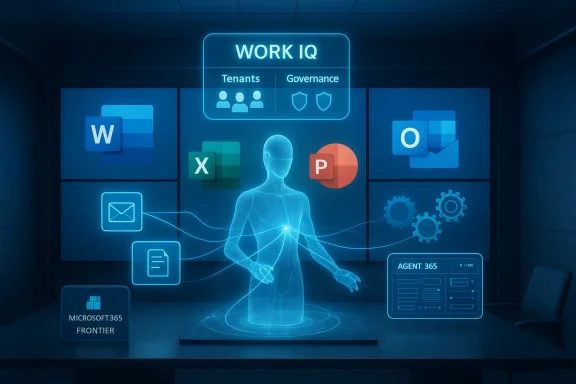
Microsoft’s latest push to make AI do work for you — not just suggest it — arrives as Wave 3 of Microsoft 365 Copilot, and it’s a serious statement about where the company thinks productivity software needs to go next. The headline items are clear: Copilot Cowork, built in close collaboration with Anthropic and powered by the technology behind Claude Cowork; a broader rollout of agentic experiences across Word, Excel, PowerPoint, and Outlook (what Microsoft previously called Agent Mode); expanded model choice inside Copilot Chat; and an enterprise control plane called Agent 365 that together sit inside a new Microsoft 365 E7 Frontier offering. These changes are rolling out in phases starting with research previews and Frontier access in March 2026, and key commercial availability and pricing are tied to May 1, 2026.
Microsoft has been layering generative AI into Office apps for more than a year, but until now most features operated as one-off assistants that answer prompts, propose text, or generate slides. Wave 3 is the pivot from assistant-as-adviser to assistant-as-executor: agents that plan, act over time, reason across documents and apps, and return editable, app-native artifacts rather than blobs of exported text.
This is not just a UI update. It’s a shift in architecture and product strategy that embraces three principles:
Key characteristics:
Highlights by app:
Crucially, Microsoft expands model choice: Claude (Anthropic) is now available in mainline Copilot Chat via the Frontier program alongside Microsoft’s OpenAI-powered models. The platform will pick the “right model for the job” by default, while also offering users and admins the option to select a specific model in many scenarios.
Planned availability and pricing:
Limitations to watch:
Benefits:
Productivity scenarios that improve immediately:
Quantifying ROI: Microsoft claims substantial adoption growth in Copilot seats and agent deployments, but enterprise ROI will vary by process complexity, data maturity, and governance readiness. Pilot with high-value, repeatable workflows and measure time-to-completion, error reduction, and rework avoided.
That said, the shift to agents changes the operational dynamics of IT. The most successful adopters will be those that:
Wave 3 of Microsoft 365 Copilot is a consequential move: it converts Copilot from an assistant into a procedural workforce that lives inside the apps enterprises use every day. That opens exciting productivity possibilities — and it raises governance, security, and cost-management demands that must be met if those possibilities are to be realized safely. For organizations willing to invest in governance and phased pilots, the payoff could be significant; for those that rush without controls, the operational and compliance risks could be painful. The next several months will show whether agentic productivity becomes an incremental efficiency or a foundational change in how knowledge work is delivered.
Source: XDA Microsoft 365 Copilot's new wave of features has been announced, with some nice productivity-boosting tools
 Background: Why Wave 3 matters
Microsoft has been layering generative AI into Office apps for more than a year, but until now most features operated as one-off assistants that answer prompts, propose text, or generate slides. Wave 3 is the pivot from assistant-as-adviser to assistant-as-executor: agents that plan, act over time, reason across documents and apps, and return editable, app-native artifacts rather than blobs of exported text.This is not just a UI update. It’s a shift in architecture and product strategy that embraces three principles:
- Embedded, app-native outputs — AI edits and creates inside Word, Excel, PowerPoint, and Outlook rather than producing external files that must be re-integrated.
- Multi-model intelligence — Microsoft is no longer single-vendor in Copilot’s brain; it will route tasks to the model best suited for the job.
- Operational control — the company expects agents to scale and has built Agent 365 to give IT and security teams governance tools similar to how they manage users today.
What’s new in Wave 3: feature overview
Copilot Cowork — Anthropic’s Cowork inside Microsoft 365
Copilot Cowork is the marquee capability of Wave 3: a long‑running, multi‑step agent designed to execute complex workflows end-to-end. Microsoft says Cowork can orchestrate tasks such as preparing a customer meeting by assembling slides, pulling financials, emailing stakeholders, and scheduling prep time — all from a single request while keeping the user informed and able to intervene.Key characteristics:
- Built with Anthropic’s agentic technology and the same “agentic harness” concept used by Claude Cowork, but integrated into Microsoft 365.
- Runs within a customer’s Microsoft 365 tenant and cloud environment so enterprise controls, audit logging, and governance apply.
- Uses Work IQ (Microsoft’s context layer) to reason over emails, files, meetings, and relationships when executing tasks.
- Initially available to a limited set of customers as a research preview and through Microsoft’s Frontier program in March 2026.
Agents in Word, Excel, PowerPoint, and Outlook
Wave 3 makes agentic functionality first-class inside Office apps. Microsoft describes these as no longer a separate “mode” but as embedded capabilities that produce app-native artifacts — e.g., a Word document with real styles and tracked changes, an Excel workbook with formulas and pivot tables, or a PowerPoint deck that respects your design system.Highlights by app:
- Word: major rewrites, structural edits, document polishing and alignment to corporate style guides using contextual signals (meetings, files, emails).
- Excel: multi-step scenario modeling, automated formula repair and generation, pivot and dashboard creation that recalculates as source data changes.
- PowerPoint: generate decks that match brand kits, layouts and object styles, with the capacity to convert chat intent into finished slides.
- Outlook: chat-driven drafting, sending, and scheduling — including the ability to have Copilot send emails from within chat contexts.
Copilot Chat enhancements and model choice
Copilot Chat becomes the central entry point for chat-first creation and execution. Wave 3 expands chat’s role so you can start in conversation and then have the system create final artifacts inside the relevant app.Crucially, Microsoft expands model choice: Claude (Anthropic) is now available in mainline Copilot Chat via the Frontier program alongside Microsoft’s OpenAI-powered models. The platform will pick the “right model for the job” by default, while also offering users and admins the option to select a specific model in many scenarios.
Agent 365 — governance and control plane
As agents proliferate, Microsoft introduces Agent 365, a control plane to observe, secure, and govern agents across an organization. It extends familiar management approaches — using Microsoft Admin Center, Entra (identity), Defender, and Purview — to handle agents the way IT handles employees.Planned availability and pricing:
- Agent 365: generally available May 1, 2026, priced at $15 per user per month.
- Microsoft 365 E7 (Frontier Suite): available May 1, 2026, priced at $99 per user per month (bundles E5 + Copilot + Agent 365 + security features).
How Copilot Cowork actually works (and where it differs from Claude Cowork)
At a technical level, Copilot Cowork imports the agentic design pattern Anthropic demonstrated with Claude Cowork — i.e., models that can plan, invoke tools, operate asynchronously, and produce persistent outputs. Microsoft’s implementation layers three differentiators on top:- Tenant-native execution — Cowork tasks execute within a customer’s Microsoft 365 tenant and cloud environment, enabling enterprise data protection, compliance, and identity integration.
- Work IQ grounding — agents have access to a persistent context built from your files, meetings, and communications so their outputs are grounded in the organization’s current state.
- Observability and governance — actions are auditable, reviewable, and can be paused or steered by users and admins.
Limitations to watch:
- Copilot Cowork in Microsoft is cloud-run, not local execution — a deliberate tradeoff for centralized governance but a difference from some Claude Cowork deployments that emphasized local processing.
- Availability starts as a research preview in Frontier; typical enterprise customers should expect controlled pilots before organization-wide rollout.
Multi-model intelligence: benefits and complexity
Microsoft’s explicit embrace of multi-model intelligence is strategic and pragmatic. Rather than betting exclusively on a single provider, Copilot will route problems to the model best suited for the task — OpenAI’s latest generative reasoning models for some tasks, and Anthropic’s Claude for others.Benefits:
- Access to a broader set of reasoning strengths (different models excel at different tasks).
- Faster adoption of breakthrough innovations from various model vendors without rewriting product plumbing.
- Flexibility for enterprises that may prefer particular vendor properties for regulatory, accuracy, or compatibility reasons.
- Model selection introduces additional decision points for IT: Which model is default? Which models are allowed? How do you control data flows when multiple vendors are involved?
- Billing and telemetry become more complex when different models impose separate metering or cost structures behind the scenes.
- Testing and validation: model behavior can vary significantly by provider; organizations must expand QA and compliance reviews to account for the mix.
Security, privacy, and governance: the critical control plane
Microsoft positions Wave 3 as intelligence plus trust — and the trust piece is where enterprise IT will spend most of their energy. Key guardrails Microsoft highlights include:- Enterprise Data Protection (EDP) and enforcement of tenant permissions and sensitivity labels so agents only process content when allowed.
- Saving outputs to OneDrive/SharePoint with tenant-level controls; minimizing version sprawl by keeping work inside managed storage.
- Agent 365 for visibility, governance, and lifecycle control of agents.
- Integration with existing security services — Defender, Entra, Intune, and Purview — to extend familiar controls to agents.
- Agent sprawl: Microsoft reports rapid agent creation in previews; without rules and quotas, the number of active agents could balloon and create management headaches.
- Phishing and social engineering against agents: if agents send/receive emails or interact with external systems, they can be the target of malicious inputs — Microsoft explicitly warns agents can be phished just like humans.
- Data residency and third-party models: when an agent uses an external model vendor, organizations must validate where data is processed and whether that meets regulatory obligations.
- Explainability and auditing: automated, multi-step agent actions need clear, tamper-resistant audit trails and human-readable rationales for compliance.
Real-world benefits: what teams will actually gain
Wave 3’s most immediate wins are practical and often mundane — the kinds of time savings that compound across teams.Productivity scenarios that improve immediately:
- Sales teams generate tailored decks and one-click send-to-prospect workflows, shaving hours from prep time.
- Finance teams run scenario modeling in Excel and get native formulas, explanations, and pivot tables rather than static reports.
- HR and legal teams draft and iterate policies or offer letters grounded in the organization’s current documents and precedent.
- Managers get meeting prep packs assembled automatically from recent files, emails, and transcripts.
Quantifying ROI: Microsoft claims substantial adoption growth in Copilot seats and agent deployments, but enterprise ROI will vary by process complexity, data maturity, and governance readiness. Pilot with high-value, repeatable workflows and measure time-to-completion, error reduction, and rework avoided.
For admins and IT leaders: rollout checklist
If your organization is evaluating Wave 3, start with these practical steps:- Join Frontier or request early access to test Copilot Cowork and model choices in a controlled environment.
- Map high-value workflows (sales decks, budgeting, compliance reporting) suitable for agent automation.
- Define policies for model selection — which vendors are permitted and under what circumstances.
- Set up Agent 365 governance ahead of scale: agent approval workflows, quotas, monitoring dashboards, and alerting.
- Update data classification and sensitivity labels so agents process only what is permitted.
- Run red-team scenarios for agent-targeted phishing and malicious prompts to test resilience and response playbooks.
- Budget for cost-modeling: agent usage and multi-model routing may introduce new metering and compute spend.
The competitive and strategic landscape
Wave 3 signals Microsoft’s choice to be a platform for an ecosystem of models rather than a single-model vendor. That has immediate market implications:- It reduces vendor lock-in and gives Microsoft flexibility to integrate the “best” model features as they appear.
- It puts Microsoft in direct competitive conversation with Anthropic, OpenAI, and enterprise players (Salesforce, Google) who are building agent or task-focused products.
- It raises the bar for incumbents: traditional SaaS features are now threatened by agents that can replace or automate parts of the software value chain.
Known limitations and remaining questions
Wave 3 is not a finished product; it arrives with caveats and open questions enterprises must respect:- Availability varies: many features begin in Frontier previews and roll out regionally over months. Some markets may see delayed support.
- Model behavior consistency: different models produce different styles and may disagree on facts; testing and guardrails are necessary.
- Regulatory and compliance unknowns: for highly regulated industries, the third-party model processing and telemetry need careful legal review.
- Cost and licensing tradeoffs: Microsoft’s new bundles (Agent 365 at $15/user/month, M365 E7 at $99/user/month) create choices: per-user pricing remains prominent, but heavier agent usage could push customers toward different consumption models over time.
- Vendor dependencies: while multi-model is an advantage, it also means organizations must manage relationships and technical dependencies across multiple AI providers.
Bottom line: who wins, who needs caution
Wave 3 is an important evolution for Microsoft 365 Copilot. For knowledge workers and teams burdened by repetitive, multi-step processes, Copilot Cowork and embedded agents have the potential to deliver measurable productivity gains. The combination of model choice and a governance-first approach is smart product strategy: it gives customers flexibility while promising enterprise controls.That said, the shift to agents changes the operational dynamics of IT. The most successful adopters will be those that:
- pilot with high-value workflows,
- treat agents as first-class, governed digital workers,
- invest in monitoring, and
- update policies and incident response for agent-specific threats.
Practical recommendations (fast checklist)
- For CIOs and CISOs: start Agent 365 planning now; set acceptance criteria for agents and establish an approval board.
- For IT admins: enable tenant-level sensitivity labels and OneDrive/SharePoint controls before enabling Cowork pilots.
- For compliance teams: document where models process data and update vendor contracts accordingly.
- For procurement: model forecasted agent usage and negotiate bundled E7 pricing if forecasts justify it.
- For team leads: identify two high-impact workflows to pilot Cowork (e.g., monthly reporting, customer-prep packs) and measure cycle-time improvements.
Wave 3 of Microsoft 365 Copilot is a consequential move: it converts Copilot from an assistant into a procedural workforce that lives inside the apps enterprises use every day. That opens exciting productivity possibilities — and it raises governance, security, and cost-management demands that must be met if those possibilities are to be realized safely. For organizations willing to invest in governance and phased pilots, the payoff could be significant; for those that rush without controls, the operational and compliance risks could be painful. The next several months will show whether agentic productivity becomes an incremental efficiency or a foundational change in how knowledge work is delivered.
Source: XDA Microsoft 365 Copilot's new wave of features has been announced, with some nice productivity-boosting tools