

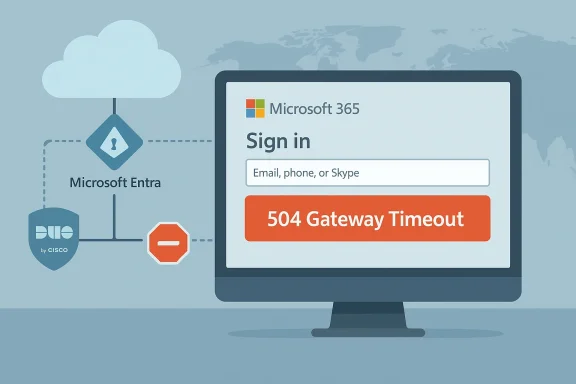
Microsoft’s authentication systems briefly tripped over a dependency on Monday, leaving some North American users unable to complete sign‑ins to Microsoft 365 because Multi‑Factor Authentication (MFA) requests returned 504 “gateway timeout” errors — a disruption Microsoft logged as incident MO1237461 while engineers and a third‑party vendor worked to restore normal traffic.
Microsoft 365 is the backbone of productivity for millions of organizations: email (Exchange Online), collaboration (Teams, SharePoint), and identity (Microsoft Entra) are tightly integrated. When MFA is enforced — via Microsoft Entra Conditional Access or third‑party providers — authentication flows call out to the MFA service as part of the sign‑in path. If that MFA step fails, users can be prevented from signing into otherwise healthy services. Microsoft’s incident MO1237461 described exactly this symptom: users in North America receiving 504 gateway timeout responses when trying to access services that require MFA.
A 504 Gateway Timeout is a standard HTTP response code that means a gateway or proxy did not receive a timely response from an upstream server needed to complete the request. In distributed authentication flows that cross multiple vendors and networks, a timeout can occur anywhere along the chain — from the Microsoft Entra front end to an external MFA vendor or an intermediate carrier — and will manifest to the user as a failure to complete authentication.
Two technical patterns make this fragile:
Caveat: tenant‑level visibility remains important. Microsoft’s public status portal sometimes reports “operational” for global services while detailed incident text and tenant health dashboards carry the specific incident details. To fully validate root cause, enterprise admin logs (Entra sign‑in logs, Conditional Access evaluation traces) are the authoritative source for each tenant.
For IT teams the lesson is actionable: diversify authentication methods for critical accounts, pre‑stage break‑glass options that do not depend on the same vendor chain, and rehearse recovery steps for third‑party MFA failures. For cloud providers and vendors, the episode underscores the need for tighter coordination, clearer SLA expectations for security‑critical integrations, and timeout‑aware architecture that reduces cascading failures. The outage was resolved, but the structural choices it highlighted remain a standing operational priority for any organization that treats identity as both security control and system dependency.
Source: Stocktwits Is Microsoft Down? MSFT 365 Error Reports Spike On Downdetector, Company Says It Is Investigating The Issue
 Background / Overview
Microsoft 365 is the backbone of productivity for millions of organizations: email (Exchange Online), collaboration (Teams, SharePoint), and identity (Microsoft Entra) are tightly integrated. When MFA is enforced — via Microsoft Entra Conditional Access or third‑party providers — authentication flows call out to the MFA service as part of the sign‑in path. If that MFA step fails, users can be prevented from signing into otherwise healthy services. Microsoft’s incident MO1237461 described exactly this symptom: users in North America receiving 504 gateway timeout responses when trying to access services that require MFA.A 504 Gateway Timeout is a standard HTTP response code that means a gateway or proxy did not receive a timely response from an upstream server needed to complete the request. In distributed authentication flows that cross multiple vendors and networks, a timeout can occur anywhere along the chain — from the Microsoft Entra front end to an external MFA vendor or an intermediate carrier — and will manifest to the user as a failure to complete authentication.
What happened: a short, verifiable timeline
Initial detection and symptom window
- Microsoft posted that it was investigating a North America‑scoped issue where users “may be experiencing 504 gateway timeout errors” when accessing services that require MFA. This was surfaced to tenants as incident MO1237461.
- Customers and outage monitors reported spikes in error submissions on outage trackers and community channels as authentication attempts failed and services that enforce MFA became unreachable for affected users.
Vendor involvement and mitigation
- Microsoft’s tenant‑visible updates later indicated the company was analyzing third‑party authentication dependencies as part of the investigation. Independent status pages from the third‑party MFA vendor (Duo by Cisco) showed an active incident relating to 504 Gateway Timeouts on Microsoft Entra sign‑ins and recorded a fix deployment that restored successful authentications. Microsoft’s final status update confirmed mitigation and said Microsoft services were operating as expected while the third‑party deployed the corrective change.
Scope and duration
- Microsoft and multiple tenant status pages scoped the impact primarily to the North America region and to organizations that use the affected third‑party MFA link in their Entra flows. The event lasted a few hours from detection to mitigation, with customers reporting intermittent recovery as fix rollouts completed and routing stabilized.
Why a third‑party MFA dependency can take down sign‑in
Authentication in modern cloud identity systems is built as a series of coordinated API calls and redirects. For a typical MFA‑enforced Microsoft 365 sign‑in the flow can look like this:- User submits credentials to Microsoft Entra (formerly Azure AD).
- Entra evaluates policies and — if MFA is required — triggers a challenge to the registered MFA provider or method.
- The MFA provider (Microsoft’s built‑in MFA, Duo, or another vendor) responds with a success or failure.
- Entra finalizes the token issuance and grants access to the requested service.
Two technical patterns make this fragile:
- Synchronous call chains: many identity flows block until an MFA provider responds; there’s no graceful fallback if an external factor is slow or unreachable.
- Time‑budget mismatches and gateway timeouts: HTTP proxies, load balancers, and API gateways each implement their own timeout windows. If any upstream service takes longer than an intermediate gateway’s allowed time, that intermediate element returns a 504. As MDN and common CDN vendors explain, 504s indicate a timing problem between servers rather than a malformed response.
Verifying the root cause: what the evidence shows
The strongest, cross‑checked evidence points to a third‑party provider (Duo by Cisco) being the proximate cause of the authentication timeouts:- Microsoft’s incident message identified third‑party authentication dependencies are being analyzed, and the final tenant update confirmed mitigation after the third‑party deployed a fix.
- Duo’s public status page logged an incident specifically about 504 Gateway Timeouts when Duo MFA was called from Microsoft Entra and recorded a fix deployment with subsequent monitoring and a postmortem entry. That timeline directly aligns with customer reports and Microsoft’s tenant updates.
- Community telemetry (Downdetector and enterprise help channels) showed correlated spikes in Microsoft 365/Outlook errors and Duo reports during the same window, consistent with an MFA‑path failure rather than a wholesale outage of Microsoft’s consumer services.
Caveat: tenant‑level visibility remains important. Microsoft’s public status portal sometimes reports “operational” for global services while detailed incident text and tenant health dashboards carry the specific incident details. To fully validate root cause, enterprise admin logs (Entra sign‑in logs, Conditional Access evaluation traces) are the authoritative source for each tenant.
Impact: what broke, who felt it, and collateral effects
- Immediate user impact: affected users received 504 errors at the MFA challenge step and could not complete sign‑in to Microsoft 365 apps that enforce MFA. This produced blocked email access, inability to join Teams meetings using corporate accounts, and disrupted single‑sign‑on for federated apps.
- Administrative pain: IT admins faced the classic catch‑22: disabling MFA or widening Conditional Access exceptions can restore access quickly but materially degrades security posture. Many organizations rely on “break glass” emergency accounts or pre‑staged exception rules to recover when a vendor dependency fails; those who hadn’t prepared experienced longer disruptions. Community threads show admins using YubiKeys, alternative auth methods, or tenant break‑glass accounts to regain access.
- Market and sentiment: outage reports coincided with negative short‑term investor sentiment: news aggregators and market commentary noted a decline in Microsoft shares the morning of the incident. While service incidents contribute to sentiment, market movement is multifactorial and should not be attributed solely to a single technical glitch.
- Ecosystem effects: any third‑party integration that uses Entra for identity (SAML/OIDC federations, VPN MFA integrations, SaaS SSO) can experience downstream failure if the MFA link in the chain is broken. Organizations with dependency on external carriers for SMS/phone factors can also see added fragility.
Strengths and weaknesses revealed by the incident
Notable strengths
- Rapid detection and coordination: Microsoft surfaced the issue to tenants quickly with an incident ID and updates, and the vendor in question publicly recorded investigations and remediation steps on its status page. That transparency helped administrators triage and coordinate.
- Limited scope to MFA flow: because the failure sat in the MFA path rather than in core mailbox or storage systems, many consumer‑facing endpoints remained available for users who weren’t forced through the problematic chain. Microsoft indicated consumer services were not broadly impacted. Where architecture isolates auxiliary services, core availability is preserved.
Structural weaknesses and risks
- Single points of failure in identity chains: reliance on a single external MFA vendor — or on synchronous MFA calls without resilient fallback logic — transforms an otherwise minor service degradation into a full account lockout for users. This is a systemic risk in modern identity architectures.
- Operational complexity for recovery: undoing MFA requirements or applying emergency exceptions is operationally risky and often requires administrative access that may itself be subject to the same failure. That circular dependency complicates incident response. Community reports documented admins needing alternate authentication methods or pre‑provisioned break‑glass accounts to regain control.
- Third‑party dependencies and vendor transparency: when critical authentication steps rely on a vendor, fast, accurate status updates and a coordinated runbook between vendor and platform provider are essential. The public evidence shows both Microsoft and the third party posted updates, but the episode highlights the governance risk of outsourcing security‑critical capabilities.
Practical guidance for IT teams (what to do now)
If your organization uses Microsoft Entra/Entra MFA and one or more third‑party MFA providers, follow these recommended steps to reduce risk and shorten future recovery time.- Short‑term triage (during an incident)
- Check the Microsoft 365 Service Health dashboard and your tenant’s incident MO1237461 details for official guidance and timestamps.
- Confirm the third‑party vendor’s status page for correlated outages and follow their remediation guidance. For the Feb 23 event, Duo’s status page contained useful incident updates.
- Use pre‑staged break‑glass accounts that rely on independent authentication (hardware token or local accounts) to regain admin access if needed. Do not make these accounts subject to the same MFA provider dependency.
- Avoid broad, permanent disabling of MFA to restore access; instead, use narrowly scoped conditional access exemptions with strict auditing and time limits.
- Medium‑term resilience strategies
- Implement multiple, diverse MFA methods (authenticator app + hardware token + FIDO2) and ensure administrators and break‑glass accounts have methods that don’t route through the same vendor. Microsoft Entra supports multiple verification options and Conditional Access named locations to reduce forced external calls for on‑network users.
- Adopt an authentication “time‑budget” architecture: instrument Entra sign‑in logs, set sensible gateway and API timeouts, and design for graceful fallbacks when an upstream factor is slow. This minimizes cascading 504s.
- Test disaster recovery runbooks that explicitly cover third‑party MFA failures. Exercises should include scenarios where MFA providers are unreachable and verify that mission‑critical workflows can continue under restricted yet safe conditions.
- Long‑term architectural changes
- Consider deploying a multi‑vendor MFA strategy or an on‑premise hardware token option for critical admin accounts and break glass. Physical tokens and FIDO2 keys avoid reliance on telephony and remote push services that are subject to carrier and vendor outages.
- Use Conditional Access to allow named‑location bypasses for known secure networks (with caution): this can reduce unnecessary external MFA calls for on‑premises workstations while still protecting remote sessions. Microsoft documentation explains trusted IPs and Conditional Access patterns for this purpose.
For end users: short checklist
- If you’re locked out, try alternative network paths (different ISP, phone hotspot) and another authentication method if available (text code, hardware token). Sometimes routing triggers different MFA endpoints.
- Check company communications — your IT team should publish guidance if they need you to use personal devices or phone calls temporarily.
- Be patient with IT: the tradeoff between security and availability is real. Do not ask IT to disable MFA permanently. Instead ask for documented, temporary exception plans.
What this means for Microsoft and the cloud identity landscape
The incident is a practical reminder of two trends that define modern cloud reliability:- Enterprises are increasingly secure by routing critical controls (MFA) through specialized vendors. This improves security posture but increases systemic dependency risk. Organizations must balance security with operational resiliency through diverse MFA methods and tested recovery playbooks.
- Visibility and communication matter. Public vendor status pages and tenant health dashboards shorten incident windows by enabling rapid coordination. In this event Microsoft and the third‑party both posted updates, and tenant admins used those to coordinate emergency responses. Faster, more granular telemetry — and agreed‑upon runbooks across vendor ecosystems — will reduce future MTTR.
Conclusion
Monday’s 504 gateway timeout incident showed how a failure in the MFA path — specifically a third‑party MFA vendor interaction with Microsoft Entra — can quickly escalate into a broad productivity disruption for organizations that enforce MFA. The event was identified as incident MO1237461, scoped to North America, and was mitigated after the third‑party deployed a fix; Microsoft confirmed that its own services were operating as expected and that authentication success returned after the vendor remediation.For IT teams the lesson is actionable: diversify authentication methods for critical accounts, pre‑stage break‑glass options that do not depend on the same vendor chain, and rehearse recovery steps for third‑party MFA failures. For cloud providers and vendors, the episode underscores the need for tighter coordination, clearer SLA expectations for security‑critical integrations, and timeout‑aware architecture that reduces cascading failures. The outage was resolved, but the structural choices it highlighted remain a standing operational priority for any organization that treats identity as both security control and system dependency.
Source: Stocktwits Is Microsoft Down? MSFT 365 Error Reports Spike On Downdetector, Company Says It Is Investigating The Issue