

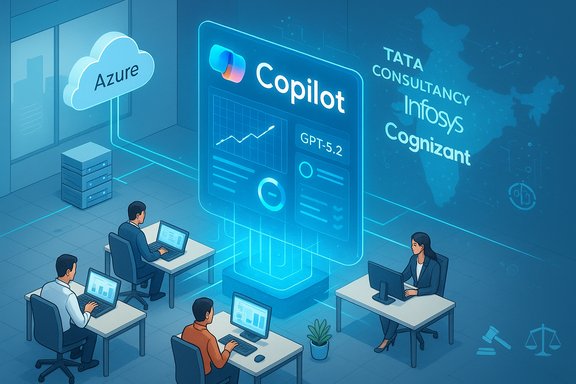
Microsoft’s headline AI moves on December 11–12—rolling OpenAI’s GPT‑5.2 into Microsoft 365 Copilot and Copilot Studio, announcing a major set of partnerships with Indian IT giants, and reaffirming a multi‑billion dollar infrastructure commitment in India—arrived on the same trading day that a large collective action over Windows Server licensing broadened into a potentially material legal exposure. The juxtaposition of aggressive product and market expansion on one hand and renewed antitrust pressure on the other crystallizes the two narratives investors and enterprise customers will weigh into 2026: rapid monetization of Copilot and agentic AI versus regulatory and litigation risk tied to cloud dominance and licensing practices.
Microsoft spent much of 2025 positioning Copilot, Azure and its strategic partnership with OpenAI at the center of its enterprise growth story. The company’s strategy has been to monetize AI via subscription and licensing for knowledge workers (Microsoft 365 Copilot, GitHub Copilot), embed agentic AI into workflows (Copilot Studio agents), and leverage Azure to host compute and model-serving infrastructure. The December announcements accelerate that trajectory by refreshing the AI model layer to GPT‑5.2 and by locking in scale deployments through major systems integrators and service providers. At the same time, regulators and private claimants in the UK have been scrutinizing how Microsoft licenses Windows Server and whether terms materially disadvantage rival clouds such as AWS and Google Cloud. An opt‑out collective action in the UK seeks to certify claims totaling roughly £2.1 billion alleging higher charges and licensing structures that nudge customers toward Azure. That litigation sits atop parallel competition inquiries and increases the chance of protracted legal noise even if the ultimate financial exposure is resolved via settlement or limited damages.
Source: AD HOC NEWS Microsoft’s AI Ambitions Face Legal Headwinds
 Background
Microsoft spent much of 2025 positioning Copilot, Azure and its strategic partnership with OpenAI at the center of its enterprise growth story. The company’s strategy has been to monetize AI via subscription and licensing for knowledge workers (Microsoft 365 Copilot, GitHub Copilot), embed agentic AI into workflows (Copilot Studio agents), and leverage Azure to host compute and model-serving infrastructure. The December announcements accelerate that trajectory by refreshing the AI model layer to GPT‑5.2 and by locking in scale deployments through major systems integrators and service providers. At the same time, regulators and private claimants in the UK have been scrutinizing how Microsoft licenses Windows Server and whether terms materially disadvantage rival clouds such as AWS and Google Cloud. An opt‑out collective action in the UK seeks to certify claims totaling roughly £2.1 billion alleging higher charges and licensing structures that nudge customers toward Azure. That litigation sits atop parallel competition inquiries and increases the chance of protracted legal noise even if the ultimate financial exposure is resolved via settlement or limited damages. What Microsoft announced this week
GPT‑5.2 in Microsoft 365 Copilot and Copilot Studio
- Microsoft made GPT‑5.2 available in the Microsoft 365 Copilot product family and in Copilot Studio, positioning two variants—GPT‑5.2 Thinking (for complex reasoning) and GPT‑5.2 Instant (for fast, efficient writing and routine tasks)—as the new default choices for enterprise usage patterns. The company described the rollout as immediate for enterprise Copilot licensees with phased expansion to broader plans.
- GPT‑5.2 is the latest OpenAI frontier model and was launched publicly on December 11; OpenAI describes the model family as optimized across speed, reasoning, and multimodal capability, with flavors aimed at different performance‑cost tradeoffs. Microsoft’s move embeds that model directly into productivity contexts—email, calendar, documents and meetings—where Copilot metrics matter most for monetization.
Strategic partnerships and a $17.5 billion India commitment
- Microsoft publicly announced strategic deals with four major Indian IT firms—Tata Consultancy Services (TCS), Infosys, Wipro, and Cognizant—that will collectively deploy over 200,000 Microsoft Copilot licenses to their internal teams and client engagements. Microsoft portrayed these companies as “frontier firms” for agentic AI adoption and said each partner will deploy more than 50,000 licenses.
- Complementing the partnerships, Microsoft committed $17.5 billion in India for cloud and AI infrastructure, skilling and operations over the next four years, including expanded hyperscale data center capacity and in‑country data processing for Copilot in regulated sectors. Microsoft framed the investment as its largest in Asia and a strategic bet on India as an AI talent and scale market.
The UK collective action: structure, allegations and immediate stakes
What the claim alleges
The collective action filed in the UK (opt‑out format) alleges Microsoft has charged higher licensing fees for running Windows Server on rival cloud platforms (AWS, Google Cloud, Alibaba Cloud) versus Azure and has structured licensing and feature differentials to make Azure comparatively cheaper and more operationally attractive. The claim further alleges degradation of the Windows Server experience on rival platforms as part of a broader strategy to leverage Windows dominance into cloud market share gains. Claimants estimate potential damages in the region of £2.1 billion.Legal mechanics and timeline
The claim is lodged with the UK Competition Appeal Tribunal (CAT). The immediate phase determines whether the CAT will grant a “collective proceedings order” certifying the class action so it can proceed to full litigation. Microsoft has asked the tribunal to dismiss the claim on the grounds that the claimant’s methodology for calculating damages is unreliable and that the claim does not set out an adequate basis for quantifying losses. The tribunal’s deliberations can take weeks to months and a certification decision would be an early milestone, not a final adjudication.Potential outcomes for Microsoft and customers
- Dismissal at certification: the tribunal could refuse to certify the claim if it finds the damages methodology fundamentally flawed—this would minimize near‑term financial exposure but leave regulatory scrutiny intact.
- Certified litigation and eventual settlement: certification would open discovery and potentially drive settlement negotiations; settlements in collective actions often include financial compensation plus remedial changes to practices.
- Certification and trial loss: a trial loss could produce a material damages award and stronger regulatory remedies; even without a large payout, injunctive or behavioral remedies could force licensing changes with business model impact.
Market reaction, insider activity and accuracy checks
Stock movement and technical levels
Microsoft shares traded down modestly into the Friday close after the combined announcements and the UK hearing, testing the mid‑$470s support zone cited by traders. Closing prints reported on major finance services show a close in the $478–$479 range on December 12, with intraday lows touching around $476—a technical area to monitor as immediate support. Several analyst‑consensus aggregators continue to show average price targets in the low‑to‑mid $600s, reflecting sizable upside expectations from many sell‑side firms despite near‑term political and legal noise.Insider transaction reporting — a cautionary note
Some market reports summarized a Bradford L. Smith transaction on December 12 involving 3,842 shares. SEC filings show a Form 4 acceptance date of December 12, 2025 that discloses share purchases and sales of that quantity, but the underlying trades were executed on earlier dates in April and May 2025 (the Form 4 reports the originally executed transaction dates). In other words, the December 12 filing date does not necessarily mean a fresh trade occurred on that day—rather, the SEC document was accepted or made available then. Reporters and automated feeds sometimes conflate filing acceptance dates with transaction execution dates; accurate interpretation requires reading the Form 4 transaction date fields. This nuance is important because it changes how investors interpret insider intent.- The practical implication: the headline number (3,842 shares, roughly in the low six‑figure dollar range at typical April/May prices) is small relative to Microsoft’s float and to prior Brad Smith sales disclosed earlier in 2025. Investors should not treat the December filing acceptance as a contemporaneous signal of executive sentiment without checking the original transaction dates.
Commercial implications: Copilot monetization and India strategy
Why GPT‑5.2 matters commercially
GPT‑5.2 brings improvements in reasoning, long‑context understanding and task structure that are particularly valuable inside productivity workflows—summarizing long meeting threads, synthesizing email threads, generating multi‑section plans, and building complex spreadsheets and presentations. Embedding GPT‑5.2 inside Copilot and Copilot Studio gives Microsoft two levers:- Product differentiation (better in‑app results vs. commodity chat models).
- Pricing leverage (tiers for higher‑performance models and agent‑orchestration services).
India plays both scale and sovereignty cards
The $17.5 billion commitment and the four IT‑partner deployments are tightly coupled messages. On one hand, Microsoft signals preparedness to host large volumes of compute and data inside India (hyperscale centers, in‑country Copilot processing). On the other hand, placing Copilot licenses inside major service providers creates embedded demand: integrators will consume Azure, embed Copilot into client engagements, and upskill workforces around Microsoft’s stack. This is a textbook enterprise strategy to create durable revenue streams anchored in a local market that is both huge and geopolitically important. Benefits for Microsoft and customers include:- Lower latency and compliant data residency options for regulated sectors.
- Scale advantages through anchor deployments inside big service providers.
- A stronger case for enterprise renewals when Copilot is operationally integrated into business processes.
Legal and regulatory risk: assessing the size and seriousness of the UK claim
Is £2.1 billion an existential threat?
No—on its face the headline figure, while large, is not existential for a company with Microsoft’s revenue and cash flow scale. The number, however, matters because:- It frames the reputational narrative and can increase the probability of broader regulatory remedies.
- It invites other claimants or jurisdictions to pursue coordinated actions.
- It could force changes to licensing terms that alter the economics of Windows Server as an input to third‑party cloud providers.
Likely timelines and investor impacts
- Short term (weeks–months): certification decision and press cycles. Expect increased volatility around court filings and regulator statements.
- Medium term (months–two years): litigation discovery, expert damages modeling, potential settlement talks; regulators may announce behavioral remedies or open formal enforcement actions.
- Long term (two+ years): final judicial resolution or negotiated licensing changes; by then product monetization (Copilot subscriptions, Azure consumption) will have had time to either validate or underperform against current analyst forecasts.
Strategic tradeoffs and what to watch next
Key metrics to watch for validating Microsoft’s AI monetization thesis
- Copilot seat growth and average revenue per seat in Microsoft’s Intelligent Cloud and Productivity segments.
- Azure consumption tied to model hosting and inference (reported as product usage or growth in Azure AI services).
- Renewal rates and enterprise contract upsells that explicitly mention Copilot or Copilot Studio deployments.
- Progress on in‑country data processing in strategic markets and any government or enterprise announcements confirming sovereign adoption.
Legal/regulatory red flags investors should monitor
- CAT certification decision timeline and reasoning.
- CMA public statements or remedies that may demand licensing changes.
- Parallel probes in the EU or U.S. that could multiply legal exposure or create cross‑jurisdictional remedies.
- Any precedential findings that require Microsoft to change commercial or technical features of Windows Server licensing.
Strengths, risks and a balanced assessment
Notable strengths
- Integrated stack and go‑to‑market: Microsoft controls the productivity layer (Office/M365), developer tools (GitHub), cloud (Azure) and has privileged distribution through service partners—this makes Copilot deployments sticky and cross‑sell effective.
- Model access and productization: Immediate support for GPT‑5.2 gives Microsoft a first‑mover advantage in enterprise productivity AI adoption, particularly for customers who prioritize accuracy, long‑context reasoning, and compliance.
- Scale commitment: A $17.5 billion investment in a major growth market demonstrates capital allocation aligned with long‑term cloud and AI scale economics.
Material risks
- Litigation and regulatory cost: The UK collective action and CMA scrutiny could produce remedies that reduce Windows Server licensing flexibility or impose damages, which would be a direct commercial headwind for Azure and partner economics.
- Execution risk on capex and ROI: Massive infrastructure spending must translate into higher margins and monetization; if Copilot seat growth or Azure model consumption lags expectations, margins could be pressured.
- Perception and competitive response: Google, AWS and others are accelerating their enterprise AI offerings; competitive price moves, alternative integrated stacks, or regulatory remedies favoring interoperability could blunt Microsoft’s advantage.
Bottom line and practical takeaways for enterprise and investor audiences
- For enterprise IT buyers: the GPT‑5.2 rollout inside Copilot means improved automation and reasoning capabilities are now available in the productivity suite; organizations with regulated data should evaluate in‑country Copilot processing and sovereign options as part of risk‑compliant AI adoption.
- For channel partners and integrators: the announced Copilot license anchors from the four Indian IT firms validate a partner‑led delivery model. Firms that can wrap industry IP around Microsoft’s Copilot and deploy measurable productivity gains will capture most of the near‑term opportunity.
- For investors: Microsoft’s product momentum and distribution remain core positives. Analysts’ average price targets in the low‑to‑mid $600s reflect that optimism. However, the UK collective action and near‑term CMA pressure introduce legal and execution risk that could create volatility—monitor certification outcomes and early litigation disclosures closely.
- For legal and policy watchers: certification of the UK action would be a noteworthy test of how the courts treat platform licensing differentials when they intersect with cloud competition. A certification decision that allows extensive discovery could force Microsoft to defend detailed pricing and performance differentials in public.
Final thought
Microsoft is simultaneously doubling down on the AI era and confronting renewed competition and regulatory scrutiny that has followed the company through successive waves of platform leadership. The GPT‑5.2 integration, large partner deployments and the $17.5 billion India commitment are clear strategic accelerants for Copilot monetization and Azure consumption. At the same time, the UK collective action—while not an existential threat—adds a credible, process‑driving legal complication that could reshape licensing economics if it proceeds and prevails. Short‑term market moves will reflect this tug‑of‑war between innovation‑led growth hopes and litigation‑driven risk; long‑term outcomes will depend on Microsoft’s ability to convert model advances into durable revenue without inviting remedies that undercut its cloud economics. (Note: where public filings and reporting timelines intersect, be mindful of filing acceptance dates versus actual trade execution dates—SEC Form 4 acceptance on December 12, 2025 disclosed transactions executed in April–May 2025; the filing date should not be conflated with trade execution without checking the Form 4 transaction fields.Source: AD HOC NEWS Microsoft’s AI Ambitions Face Legal Headwinds
