

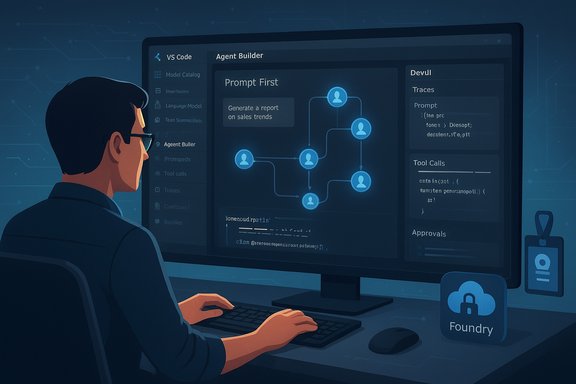
Microsoft’s latest push to make AI agents first-class development artifacts arrives as a pragmatic confluence of tooling, runtime services, and a new “prompt-first” cadence for building agents inside Visual Studio Code — and it changes how teams will prototype, test, and push agentic systems into regulated production environments.
Background
Microsoft has publicly previewed the Microsoft Agent Framework, an open-source SDK that explicitly unifies two prior toolchains — the enterprise-oriented Semantic Kernel and the research-focused AutoGen — into a single platform intended to carry projects from prototype to production without rewiring integrations. The framework is available on GitHub and packaged for both Python and .NET, and Microsoft positions it as the next step for teams building multi-agent orchestration, long-running workflows, and agent-to-agent collaborations. In parallel, the AI Toolkit for Visual Studio Code has been updated with a prompt-first workflow announced at GitHub Universe and rolled into a public preview. The idea is simple but consequential: instead of forcing developers to hand-code orchestrators and glue logic first, let them describe desired behavior in plain language and have GitHub Copilot and the toolkit help instantiate the agent scaffolding, prompts, and even code that wires to the underlying Agent Framework and Azure AI Foundry runtime. Microsoft’s documentation and VS Code extension details outline integrated capabilities such as a Model Catalog, interactive Playground, an Agent Builder for prompt engineering, tracing and evaluation tools — all designed to collapse prototyping and testing into the same IDE where code lives.What changed: the technical essentials
A single developer story: Semantic Kernel + AutoGen → Agent Framework
- Unified SDK and runtime: The Microsoft Agent Framework consolidates the production-grade connectors, telemetry, and security primitives of Semantic Kernel with the multi-agent orchestration patterns pioneered in AutoGen. That means teams can adopt advanced patterns like group chat, debate, and graph-based workflows while retaining enterprise capabilities such as OpenTelemetry tracing and Entra-backed identity.
- Multi‑language support: The framework provides APIs and packages for both Python and .NET, enabling organizations that standardize on C#/.NET to remain in their native environment rather than switching to Python-first ecosystems. GitHub README and release notes explicitly document pip and NuGet/dotnet package commands for quick onboarding.
- Graph-based workflows and observability: Built-in support for workflows that can checkpoint, stream, and resume — plus OpenTelemetry integration — is intended to make agent runs debuggable and auditable in production scenarios. The framework also includes DevUI tooling for interactive development.
Prompt-first in the IDE
- Natural-language-first agent creation: The AI Toolkit’s “prompt-first” mode lets developers describe the agent or goal in English; GitHub Copilot assists by generating agent manifests, prompt templates, and minimal scaffolding code that target the Agent Framework. Microsoft highlights examples that can be assembled in a handful of lines of code once prompts and tool definitions are defined.
- Integrated Model Catalog and Playground: Within VS Code, developers can discover models from providers (OpenAI, Anthropic, GitHub-hosted models, ONNX/Ollama local models), test them in the Playground, and then push the same model artifacts to Azure AI Foundry for scalable hosting. The extension’s Model Catalog and “Deploy to Azure AI Foundry” flows are core to the end-to-end dev/test/deploy experience.
- Agent Builder and MCP tool integration: Agent Builder focuses on prompt engineering and hooking agents to tools via the Model Context Protocol (MCP). MCP-compatible connectors let agents call external services (APIs, databases, hosted tools) using structured tool definitions so that tool usage is discoverable and governed. The Agent Builder also supports bulk-run evaluation and tracing.
Why this matters: the strategic case for enterprises and .NET teams
Microsoft’s thesis is straightforward: the biggest barrier to scaling agentic systems is developer velocity and operational safety. By packaging an IDE-first flow, an open SDK with enterprise features, and a cloud runtime designed for governance and observability, Microsoft aims to reduce friction across the lifecycle — from exploration to production.- For enterprise teams: The framework and Foundry runtime provide familiar enterprise controls — identity, telemetry, approvals, and long-running state — needed for regulated domains such as finance, healthcare, and automotive engineering. Microsoft and early partners emphasize those enterprise-grade primitives as a differentiator over research-first stacks. Real-world pilot examples from large firms show early validation of this positioning.
- For .NET developers: The Agent Framework’s .NET support means teams can build production-grade agents without abandoning their technology stack or governance patterns. That addresses a frequently cited pain point where Python-first agent tooling forced a technology fork that complicated audits and enterprise integration.
- For platform and tool vendors: Standardizing around MCP and Agent2Agent (A2A) protocols reduces adaptor work. Teams can reuse the same manifest, prompt templates, and CI artifacts across local debug, cloud Foundry deployment, and Microsoft 365 surfaces.
Early adoption and real-world use cases
Microsoft has publicly highlighted several enterprise partners piloting the framework for mission-critical workloads:- KPMG is using agents for audit automation inside its KPMG Clara platform — leveraging the framework’s governance and observability for regulated audit processes.
- BMW is piloting multi-agent workflows to analyze vehicle telemetry at scale, where durability and observability are essential to reduce analysis time from days to minutes in testing and analytics pipelines.
- Other organizations reported exploring pilots include Citrix, Fujitsu, Commerzbank, and Elastic, demonstrating cross-industry interest from finance and infrastructure to enterprise software. These are early adopter signals that the platform is being tested beyond lab demos.
Strengths: what Microsoft gets right
- End-to-end developer ergonomics: Integrating model discovery, prompt engineering, live testing, and deployment into VS Code drastically shortens the feedback loop that previously required switching between research notebooks, separate orchestrators, and cloud consoles. The AI Toolkit’s Model Catalog, Playground, and Agent Builder centralize these tasks.
- Enterprise-grade controls: Built-in OpenTelemetry tracing, Entra identity integration, human approval flows, and Azure AI Foundry hosting target exactly the governance requirements enterprises need to permit agentic actions against sensitive systems. The framework is explicitly engineered to preserve auditable artifacts such as prompt history, traces, and evaluation results.
- Cross-language portability: Providing both Python and .NET SDKs reduces the operational cost of adopting agent patterns across heterogeneous developer teams. The same agent manifest/workflow can be iterated locally and deployed to Foundry, reducing porting risk.
- Protocol-first interoperability: MCP and A2A support means agents can discover tools and call standardized endpoints rather than a brittle point-to-point adapter model. That reduces custom integration work and increases reuse across organizations and vendor ecosystems.
Risks, blind spots, and operational costs
- Complexity is still real: While the prompt-first flow lowers the barrier to starting an agent, deploying safe, long-running, auditable agents at scale requires careful system design. Workflow checkpointing, state reconciliation, and error-handling become central engineering concerns once agents are allowed to act on production systems. The tooling reduces but does not eliminate that complexity.
- Hallucinations and operational harm: Any agent that can take actions (create tickets, change configurations, suggest or commit code) raises the risk of AI hallucinations converting into harmful actions. Microsoft’s framework provides human-in-the-loop approvals and tracing, but organizations must operationalize those guardrails with approval policies, verification tests, and role-based limits.
- Data governance and cross-border flows: Agent workflows that call third‑party models or external MCP tools may transmit data outside an organization’s compliance perimeter. The framework warns users to manage where data flows and to review third-party handling. Enterprises must enforce tenant boundaries, consent flows, and retention policies to avoid exposure.
- Model and vendor routing opacity: Multi-model routing (choosing between Anthropic, OpenAI, or internal MAI models) introduces procurement and compliance complexity. Enterprises should demand clear model routing mappings, explainability for critical tasks, and deterministic fallback behavior in case a preferred endpoint is unavailable.
- Hidden cloud cost and infra dependencies: Running high‑volume agent workflows, especially those relying on large models or many concurrent tools, can incur significant compute and network costs. Azure AI Foundry and GB-class infrastructure provide scale but at a non-trivial price. Teams must model expected costs for inference, telemetry storage, and long‑running workflow checkpoints.
Practical guidance — how to evaluate and adopt responsibly
Quick technical baseline to get started (developer-friendly)
- Install the Agent Framework (Python):
- pip install agent-framework --pre
- Reference and examples are on the GitHub repo for README quickstarts.
- Install the .NET package (if using .NET):
- dotnet add package Microsoft.Agents.AI
- The .NET blog and GitHub provide step‑by‑step samples and Codespaces-ready samples to try “Hello World” agents.
- Add the AI Toolkit extension to Visual Studio Code:
- Use the VS Code Marketplace to install and explore Model Catalog, Playground, and Agent Builder. The extension includes “Deploy to Azure AI Foundry” flows and MCP server scaffolds.
- Prototype in the IDE:
- Use the prompt-first Agent Builder: write a plain-English description for the agent, let Copilot generate scaffolding, and run the flow locally in the Playground. Iterate prompts, add tests in Bulk Run, and trace executions in DevUI.
- Validate with CI and production controls:
- Store prompt templates and agent manifests in source control. Add automated evaluation (unit-like prompt tests) in GitHub Actions. Define approval gates for operations that touch production systems.
Governance checklist for IT and security teams
- Require human approval for any agent action that modifies configuration, performs financial transactions, or exposes regulated data.
- Enforce least-privilege identities for agent instances via Entra and role-based access controls.
- Log prompts, decision traces, tool calls, and outputs; ship telemetry to a secure, centralized observability pipeline.
- Limit external model usage for high‑sensitivity tasks; require internal model endpoints or vetted Azure-hosted models.
- Define a lifecycle and 30/60/90-day review cadence to deprecate stale agents, re-run evaluations, and remediate drift.
What to watch next
- Operational tooling maturity: Expect richer admin controls, deeper Purview/Compliance integration, and tenant-level governance features as the preview proceeds toward GA. These are necessary for regulated industries to adopt agents beyond pilot projects.
- Model transparency and routing policies: Enterprises will demand explicit mappings for which model is invoked by which agent in production — for cost, compliance, and procurement reasons. Look for clearer documentation and control planes for model routing.
- Community and standards adoption: The success of MCP and A2A-style protocols depends on community adoption and cross-vendor interoperability. If other vendors and OSS projects adopt these protocols, the ecosystem will become more composable and less vendor-locked.
- Independent audits and benchmarks: Claims about “production readiness” and performance should be validated with independent benchmark studies and security audits. Enterprises should request reproducible test artifacts and evidence that controls work at scale.
Verdict: pragmatic progress, not a silver bullet
Microsoft’s Agent Framework plus the prompt-first AI Toolkit materially lowers the friction for developers to build agentic systems — especially teams that need enterprise observability, governance, and .NET compatibility. The integrated VS Code experience, MCP tool model, and Foundry runtime create a coherent path from idea to production that many organizations have been asking for. However, the novelty of prompt-first creation should not be mistaken for operational triviality. Agents remain systems that require testing, observability, human oversight, and careful design to avoid costly mistakes. The vendor and partner testimonials are encouraging, but they must be validated inside specific organizational contexts with representative data and compliance reviews.Getting started resources and first steps (practical checklist)
- Install the AI Toolkit in Visual Studio Code and open the Agent Builder to try the prompt-first flow. Use the Playground to iterate on prompts and the Bulk Run feature to run prompt suites.
- Clone the Microsoft Agent Framework GitHub repo and run the Quickstart examples (Python and .NET) to see minimal agent scripts and a basic multi-agent workflow. The repo also includes a migration guide from Semantic Kernel and from AutoGen.
- Build evaluation suites: store prompt templates, expected outputs, and dataset-based metrics in the repo and add GitHub Actions to run continuous evaluations against model updates. This turns prompt engineering into a reproducible engineering workflow rather than a trial-and-error experiment.
- Pilot behind governance: choose a low‑risk but high‑value domain (for example, internal documentation automation or testing scaffolding) and enforce approval workflows for any agent that will act outside a sandbox. Monitor cost and accuracy, and refine approval criteria before expanding scope.
Microsoft’s “prompt-first” AI Toolkit update and the Microsoft Agent Framework together represent a meaningful step toward operationalizing agentic AI for mainstream development teams. They package decades of enterprise engineering lessons — tracing, identity, auditable artifacts — with modern prompt-first ergonomics and multi-agent research patterns. For teams that treat agents as software artifacts (versioned prompts, CI tests, traceable runs), this is a powerful new toolchain. For organizations that overlook governance, testing, and cost modeling, it’s a reminder that convenience alone is not a substitute for engineering discipline.
Source: WinBuzzer Microsoft's AI Toolkit Gets 'Prompt-First' Update - WinBuzzer
