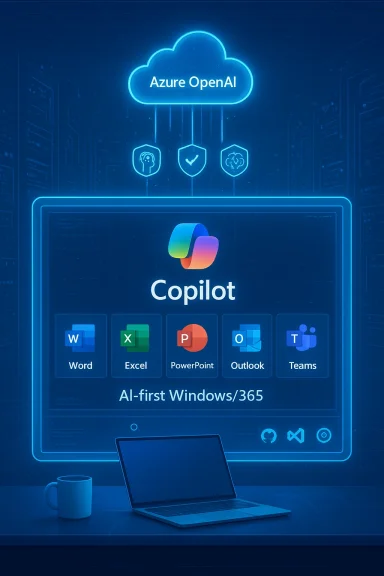
Microsoft is pivoting its AI strategy from headline-grabbing demos to pragmatic, measurable adoption—embedding generative AI across Windows, Microsoft 365, and Azure while building tools and metrics designed to drive real usage in businesses, government, and consumer environments.
Microsoft’s public AI push has evolved rapidly over the past two years, transitioning from early investments in model research and OpenAI partnership bets to a broad, product-level deployment strategy. The company’s move reflects a two-pronged objective: make AI genuinely useful to everyday users and position Microsoft’s cloud and PC ecosystem as the standard platform for enterprise-scale AI. This is visible in three parallel strands: deeper AI in Windows (Copilot), enterprise tooling and hosting on Azure (including the Azure AI Foundry concept), and measurement/advocacy through the AI Economy Institute’s diffusion work. Microsoft’s narrative now emphasizes adoption metrics and operational integration rather than just model size or benchmark wins. That change is notable because it reframes AI as a technology adoption challenge—covering skilling, device compatibility, workplace workflows, and trust—rather than solely a research or product-launch story. The company is backing that claim with public reports and product updates meant to accelerate and measure diffusion.
However, success is not guaranteed. The strategy relies on broad hardware compatibility, continued willingness of enterprises to trust a single vendor for stack and governance, and the resolution of data-economy tensions with publishers and creators. Market dynamics—like the rise of open-source model providers and independent hosting options—could fragment the landscape in ways that complicate Microsoft’s “one-platform” thesis. Additionally, infrastructure constraints and community pushback on data-center impact could slow the pace of rollout in specific regions. Ultimately, Microsoft’s approach is pragmatic and enterprise-savvy: not an all-or-nothing monopoly play but a platform-oriented strategy that eases adoption friction. For organizations prioritizing predictable governance and vendor support, that’s an attractive proposition. For those prioritizing model portability, price-sensitivity, or rapid open-source innovation, alternatives will remain compelling.
Yet the road to mainstream generative AI is layered with trade-offs: vendor-defined metrics require independent validation, the global digital divide demands public policy and investment, data-licensing frictions are reshaping the training-data economy, and the environmental and community costs of infrastructure must be managed transparently. For IT leaders and Windows users, the sensible path is cautious experimentation—pilot projects with clear KPIs, robust governance, and sustainability monitoring—while staying alert to vendor claims and the broader ecosystem shifts reshaping how AI will be used in practice.
Source: Windows Report https://windowsreport.com/microsoft-pushes-ai-into-the-mainstream-with-focus-on-real-adoption/
 Background
Microsoft’s public AI push has evolved rapidly over the past two years, transitioning from early investments in model research and OpenAI partnership bets to a broad, product-level deployment strategy. The company’s move reflects a two-pronged objective: make AI genuinely useful to everyday users and position Microsoft’s cloud and PC ecosystem as the standard platform for enterprise-scale AI. This is visible in three parallel strands: deeper AI in Windows (Copilot), enterprise tooling and hosting on Azure (including the Azure AI Foundry concept), and measurement/advocacy through the AI Economy Institute’s diffusion work. Microsoft’s narrative now emphasizes adoption metrics and operational integration rather than just model size or benchmark wins. That change is notable because it reframes AI as a technology adoption challenge—covering skilling, device compatibility, workplace workflows, and trust—rather than solely a research or product-launch story. The company is backing that claim with public reports and product updates meant to accelerate and measure diffusion. What Microsoft is rolling out and why it matters
Windows and Copilot: AI at the desktop edge
Microsoft has amplified AI inside Windows 11, positioning Windows Copilot as a central, always-available assistant across the OS. Recent Windows releases added natural-voice activation (for example, the “Hey, Copilot” wake phrase) and expanded vision capabilities to analyze what’s on-screen—features intended to integrate AI into everyday computing tasks like email triage, document drafting, and contextual help. For users, this means AI moves from a separate app to an integrated OS service that can be invoked in context. Why this matters: embedding AI at the operating system level reduces friction. When AI lives in the OS, features can hook directly into file explorers, productivity apps, and accessibility tools—making the AI experience more seamless for non-technical users and increasing the likelihood of routine usage rather than occasional experimentation.Azure AI Foundry and model hosting strategy
On the cloud side, Microsoft is building a layered approach to enterprise AI through initiatives like Azure AI Foundry, which the company presents as the modern application server for the AI era. This platform-level framing includes:- Hosting and orchestrating hundreds to thousands of models.
- Tools for deployment, routing requests to the best model for a task (a “model router”), and integrating models into applications.
- Mixed model catalogs that include Microsoft models, partner models, and third-party options (including choices like xAI's Grok).
Measurement: the AI Diffusion report
To support the adoption-first narrative, Microsoft now publishes a public measurement of AI usage called the AI Diffusion Report, produced by its AI Economy Institute. The report tracks the share of people who used a generative AI product during a reporting period and reports country-level and demographic trends. The most recent edition reports that roughly one in six people worldwide used generative AI in the second half of 2025, and it highlights a widening adoption gap between wealthier, highly digitized economies and lower-income regions. These numbers are important because they signal Microsoft’s intent to move the conversation from model performance to real-world reach and equity—metrics that matter to governments, enterprise customers, and partners deciding where to invest in AI skilling and infrastructure.Strategy: from bells and whistles to real adoption
Microsoft’s multi-level approach to adoption can be broken down into four concrete strategic pillars:- Platform integration: Bake AI into Windows, Microsoft 365, and the Azure platform to reduce friction and normalize usage across user populations.
- Enterprise tooling and governance: Offer lifecycle tooling (development, model routing, governance, telemetry) so enterprises can deploy responsibly at scale.
- Ecosystem openness: Host partner and third-party models alongside Microsoft’s own, enabling customers to pick models for price, latency, or regulatory reasons.
- Measurement and public advocacy: Publish adoption metrics to identify gaps, influence policy, and create a data-driven narrative for where investment is needed.
Adoption numbers and the global divide
What the metrics show
Microsoft’s AI Diffusion Report claims a measurable jump in global generative AI usage (the report cites an increase to roughly 16–17% of the global working-age population in H2 2025). It emphasizes that adoption grew faster in digitally advanced countries, with the UAE, Singapore, and several European nations showing particularly high diffusion rates. The U.S. remains a leader in infrastructure and model development but—according to the report—lags behind several smaller, highly digitized countries in per-capita user share.Interpretation and caveats
- The methodology Microsoft uses relies on aggregated telemetry adjusted for OS/device market share and internet penetration; this approach yields a usable global indicator but inherits biases from telemetry coverage and vendoror-specific signals. The report is transparent about methodology limits, but independent corroboration of absolute numbers is challenging. Readers should treat these figures as directional and company‑sourced measurements rather than independent audits. Caution is warranted when using vendor telemetry to compare countries or claim precise penetration rates.
- There are important policy and investment implications: the report’s finding of a widening global divide implies that without targeted infrastructure, language, and skilling investments, generative AI could reinforce existing inequalities in productivity and economic opportunity. Independent reporting and academic teams have similarly highlighted the accessibility and language barriers facing generative AI adoption.
Enterprise adoption: promises and practicalities
Why enterprises are moving
Enterprises prioritize solutions that reduce time-to-value. Microsoft’s pitch—integrated tools, security and compliance controls, and a single cloud surface—matches enterprise priorities: speed, governance, and vendor support. There are concrete examples of cost reductions and productivity improvements in verticals where Microsoft has piloted or announced AI deployments. Microsoft also claims high satisfaction numbers from customer rollouts in specific countries and verticals, which it uses to demonstrate real-world ROI.A note on vendor-provided metrics
When Microsoft reports metrics such as “85% of Fortune 500 companies use Microsoft AI,” the data often comes from its commissioned research or aggregated telemetry. Those numbers are useful signals but can carry confirmation bias since Microsoft defines "use" broadly and may count different product interactions as adoption. Independent audits or third-party surveys provide useful complements to vendor-supplied claims, and IT decision-makers should evaluate vendor ROI claims with pilot projects and clear KPIs. Treat enterprise adoption figures reported by platform vendors as directional; validate with pilots and independent analyses before large-scale rollouts.Consumer and societal impact
Windows 10 end-of-support and upgrade incentives
Microsoft’s AI push is coinciding with the end of free mainstream security support for Windows 10, a move that has the practical effect of nudging users and organizations toward Windows 11 if they want integrated AI features and continued security updates. For consumers with older hardware, this raises questions about forced upgrades, e‑waste, and the affordability of AI-enabled computing. Critics argue Microsoft’s product strategy could accelerate hardware churn unless the company offers supported paths for older devices or extended security options.Content, training data, and the crawler economy
The rapid appetite for training data has stressed the relationship between web publishers and AI companies. Infrastructure providers like Cloudflare have developed default protections to block AI crawlers by default unless publishers opt in or monetize access. Cloudflare reports hundreds of billions of bot requests blocked over recent months, a signal that the underlying data economy for large models is undergoing a reassessment about who pays and who benefits. This shift has consequences for model builders, publishers, and the future economics of generative AI.Energy and infrastructure footprint
AI model training and inference at scale consume substantial electricity and water for cooling data centers. Microsoft has made high-profile moves—such as power purchase and community commitments around data center placements—and has announced community-first infrastructure promises to cover energy impacts in host regions. Nonetheless, independent reporting highlights the scale of energy demand (including deals to restart nuclear plants to meet future needs), underscoring that widescale AI adoption is an infrastructure and environmental challenge as much as it is a software one. Enterprises and governments must evaluate energy, water, and grid impacts alongside productivity gains.Risks, trade-offs, and red flags
- Vendor-defined metrics and narrative control: Microsoft’s measurement and storytelling around “adoption” are persuasive but originate from company telemetry and commissioned studies, which can emphasize favorable signals. Independent verification should be sought for major procurement decisions. Flag: vendor-reported ROI and penetration metrics should be independently validated.
- Digital divide and language coverage: The AI diffusion numbers highlight a widening gap; language coverage and offline infrastructure remain major bottlenecks. Without targeted public investment, adoption will continue to vary dramatically by country and socioeconomic status.
- Content and licensing friction: As publishers and platforms push back against unlicensed data scraping, model builders will face higher costs for high-quality licensed data. This could stratify model quality by who can pay for provenance, reshaping the competitive landscape.
- Environmental and community impacts: Data centers are large energy and water consumers. Microsoft’s community-first pledges aim to mitigate local impacts, but the scale of AI’s infrastructure requirements means regional politics, utility capacity, and sustainability remain material constraints.
- Security and privacy in OS-level AI: Bringing AI into the operating system raises new security and privacy considerations—particularly around telemetry, on-device processing, and the boundaries between local and cloud inference. Enterprise security teams will need to update threat models and governance for Copilot-like agents that access corporate data.
What this means for IT professionals and Windows users
For IT leaders and CIOs
- Run pilots with clear KPIs. Don’t accept vendor adoption stats at face value—define productivity metrics and measure impact in your own environment.
- Prioritize governance. Ensure model provenance, data handling, and access controls align with compliance requirements before rolling out Copilot at scale.
- Budget for infrastructure and energy. Expect that large-scale AI deployments will have non-trivial power and networking implications; plan data center and cloud spend accordingly.
For PC and Windows administrators
- Assess hardware readiness for Windows 11 and AI features; where upgrades are not feasible, consider extended security options or managed service alternatives.
- Revisit endpoint security and data-loss prevention policies for Copilot-style assistants that can access on-device files and cloud data.
- Create internal skilling programs so employees can leverage AI features productively rather than treating them as novelty tools.
For consumers and small businesses
- Understand upgrade paths and cost implications; older machines may not support full AI feature sets.
- Use AI tools to streamline routine tasks but remain cautious about sharing sensitive data with cloud-based assistants without clear usage and retention policies.
Tactical recommendations
- Validate adoption claims: When a vendor cites adoption figures, request raw metrics or third-party audits where possible. Combine vendor telemetry with internal usage telemetry for a fuller picture.
- Design for mixed deployment: Use a hybrid approach—on-device inference for privacy-sensitive tasks and cloud inference for heavier workloads—to balance latency, cost, and compliance.
- Negotiate data and licensing terms: If your organization relies on external training data or curated model outputs, clarify licensing and attribution terms up front.
- Monitor environmental impact: Track energy and water footprints for AI workloads as part of sustainability reporting and supplier due diligence.
Analysis: Is Microsoft’s adoption-first approach likely to succeed?
Microsoft’s strengths—deep enterprise relationships, Windows as a ubiquitous OS, and Azure’s global footprint—give the company a plausible path to scale AI adoption. By reducing friction through operating-system integration, providing enterprise-grade lifecycle tooling, and publicizing adoption metrics, Microsoft is attacking the adoption problem on multiple fronts simultaneously.However, success is not guaranteed. The strategy relies on broad hardware compatibility, continued willingness of enterprises to trust a single vendor for stack and governance, and the resolution of data-economy tensions with publishers and creators. Market dynamics—like the rise of open-source model providers and independent hosting options—could fragment the landscape in ways that complicate Microsoft’s “one-platform” thesis. Additionally, infrastructure constraints and community pushback on data-center impact could slow the pace of rollout in specific regions. Ultimately, Microsoft’s approach is pragmatic and enterprise-savvy: not an all-or-nothing monopoly play but a platform-oriented strategy that eases adoption friction. For organizations prioritizing predictable governance and vendor support, that’s an attractive proposition. For those prioritizing model portability, price-sensitivity, or rapid open-source innovation, alternatives will remain compelling.
Conclusion
Microsoft’s shift toward real adoption—measured, instrumented, and integrated—marks a significant phase in the evolution of enterprise and consumer AI. The company is lowering entry barriers through Windows integration, simplifying production deployments via Azure AI Foundry, and attempting to move policy and investment discussions through quantified diffusion reporting. These efforts address the central challenge of AI today: turning powerful models into everyday productivity tools that deliver measurable value.Yet the road to mainstream generative AI is layered with trade-offs: vendor-defined metrics require independent validation, the global digital divide demands public policy and investment, data-licensing frictions are reshaping the training-data economy, and the environmental and community costs of infrastructure must be managed transparently. For IT leaders and Windows users, the sensible path is cautious experimentation—pilot projects with clear KPIs, robust governance, and sustainability monitoring—while staying alert to vendor claims and the broader ecosystem shifts reshaping how AI will be used in practice.
Source: Windows Report https://windowsreport.com/microsoft-pushes-ai-into-the-mainstream-with-focus-on-real-adoption/