

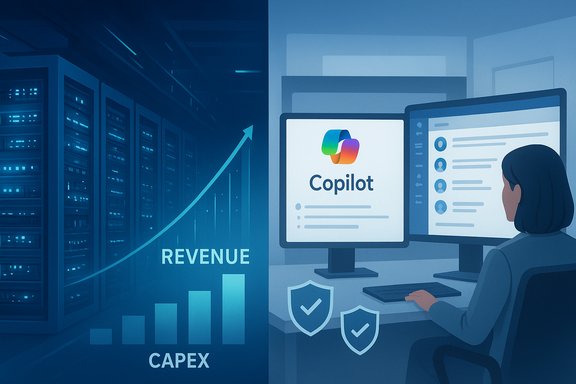
Microsoft’s latest results read like a study in contrast: record top‑line growth fuelled by AI adoption, an AI business already at a multi‑billion‑dollar run rate, and simultaneously skyrocketing capital and operating costs that have Wall Street nervously parsing every dollar of spend. The headline numbers—revenue of roughly $77.7 billion in the most recent quarter and an AI annualized run rate north of $13 billion—tell one story. The surge in capital expenditures, long‑range data‑center commitments and executive stock dispositions tell another. Together they pose a single, urgent question for investors, customers and IT leaders alike: is Microsoft’s all‑in bet on AI the foundation of a new durable growth chapter, or an expensive gamble that risks margin erosion and strategic overreach?
Microsoft has repositioned itself from a software‑and‑services company into what leadership calls an “intelligence engine”: Azure plus integrated Copilot experiences across Microsoft 365, GitHub, Dynamics and Windows. Management’s narrative is straightforward: own the compute layer, embed AI into productivity workflows, monetize agent‑style features, and defend enterprise relationships through scale, security and governance. Internal commentary and industry analysis inside the Windows community frame this as a deliberate and broad re‑engineering of product and go‑to‑market models.
Financially, the pivot has yielded strong revenue growth. Microsoft’s investor release for the quarter ended September 30 reported revenue of $77.673 billion—about a 17–18% year‑over‑year increase depending on the currency adjustment used. Management highlighted operating income and EPS expansion even while noting margin pressure tied to AI investments. Those company numbers are the canonical record. At the same time, Microsoft and many analysts have started to quantify the scale of the firm’s AI business. Management and market observers cited an AI‑related revenue run rate in the ballpark of $13 billion during 2025, a striking figure for what remains an early stage of enterprise AI monetization. Independent outlets and earnings summaries repeated that run‑rate number, which is the simplest proxy investors use to judge whether AI can substitute for other decelerating revenue drivers. Meanwhile, capital spending has surged. Reports and the company’s disclosures point to extraordinary near‑term capex as Microsoft expands AI‑optimized datacenters and scales GPU procurement—numbers in recent quarters approached the tens of billions, with one quarter’s capex reported at roughly $35 billion. That pace changes the company’s cash‑flow dynamics and investor calculus.
Concrete near‑term evidence: a recent quarter featured capex in the tens of billions (reports around $22–$35 billion in certain periods), much of it for data centers and specialized hardware. That pace of investment is compressing near‑term free cash flow and raising investor questions about payback timelines.
This is not a clean binary of “gamble” or “masterstroke.” It is a disciplined, high‑stakes transformation with credible upside and measurable risks. For enterprises and Windows users, the short‑term horizon is mixed: expect richer AI features, but also expect governance headaches and pricing decisions that will matter for procurement and IT budgets. For investors, the calculus comes down to patience and execution: can Microsoft convert its extraordinary scale and platform control into durable, margin‑accretive AI revenue before the market demands proof?
The next 12–24 months of capex reads, model economics, and customer monetization metrics will decide whether Microsoft’s bet is the archetypal strategic masterstroke of platform evolution—or a costly, instructive case study in how quickly technology economics can change.
Source: AD HOC NEWS Microsoft’s AI Ambition: A Costly Gamble or Strategic Masterstroke?
 Background / Overview
Microsoft has repositioned itself from a software‑and‑services company into what leadership calls an “intelligence engine”: Azure plus integrated Copilot experiences across Microsoft 365, GitHub, Dynamics and Windows. Management’s narrative is straightforward: own the compute layer, embed AI into productivity workflows, monetize agent‑style features, and defend enterprise relationships through scale, security and governance. Internal commentary and industry analysis inside the Windows community frame this as a deliberate and broad re‑engineering of product and go‑to‑market models.Financially, the pivot has yielded strong revenue growth. Microsoft’s investor release for the quarter ended September 30 reported revenue of $77.673 billion—about a 17–18% year‑over‑year increase depending on the currency adjustment used. Management highlighted operating income and EPS expansion even while noting margin pressure tied to AI investments. Those company numbers are the canonical record. At the same time, Microsoft and many analysts have started to quantify the scale of the firm’s AI business. Management and market observers cited an AI‑related revenue run rate in the ballpark of $13 billion during 2025, a striking figure for what remains an early stage of enterprise AI monetization. Independent outlets and earnings summaries repeated that run‑rate number, which is the simplest proxy investors use to judge whether AI can substitute for other decelerating revenue drivers. Meanwhile, capital spending has surged. Reports and the company’s disclosures point to extraordinary near‑term capex as Microsoft expands AI‑optimized datacenters and scales GPU procurement—numbers in recent quarters approached the tens of billions, with one quarter’s capex reported at roughly $35 billion. That pace changes the company’s cash‑flow dynamics and investor calculus.
Where the Money Is: Revenue, AI Run Rate and Margins
Revenue and operating performance
- Total reported revenue (recent quarter): ~$77.67 billion, up roughly 18% YoY as reported by the company.
- Operating income and net income also expanded, but gross margins and cloud segment margins showed pressure because AI workloads carry higher incremental cost per dollar of revenue than classic SaaS or license revenue. The company noted margin dilution attributable to AI compute and the growing share of service revenue.
The $13B AI run rate — what it means
“Annualized run rate” is a momentum metric, not audited trailing revenue. It extrapolates current AI‑linked sales into a 12‑month figure to show scale quickly. Multiple independent reporting outlets and analyst notes referenced Microsoft’s AI business reaching an annualized run rate around $13 billion after strong AI intake across Azure and Microsoft 365 Copilot. This is not trivial—if sustained and expanded, it converts to a meaningful, recurring revenue stream and validates the product‑market fit of Copilot and related services. Caveat: run‑rate estimates are sensitive to accounting classification, bundling and the degree to which Microsoft attributes legacy cloud revenue to “AI.” Analysts often use company commentary and segment disclosures to estimate this number; the methodology and precise boundaries vary, so treat the $13B figure as a directional scale metric rather than a GAAP line item.Margin dynamics and cash flow
- AI revenue is higher signal but lower short‑term margin due to GPU costs, colocation and energy.
- Elevated capex reduces free cash flow in the short run and can lead to investor scrutiny even if the long‑term ROI is favorable.
- Microsoft has said much of the spend is for long‑lived assets (data‑centers and network infrastructure) that will be monetized over many years; that amortization profile reduces the near‑term P&L shock but not near‑term cash requirements.
Strategy: Scale, Integration and the OpenAI Partnership
Owning the compute layer
Microsoft’s playbook is to own both the platform (Azure) and the application layer (Copilot in Office, GitHub Copilot, Dynamics Copilot). The rationale: customers prefer integrated stacks that reduce integration friction and provide enterprise governance and SLAs. Heavy capex and GPU purchases reflect that strategic choice: Microsoft wants to guarantee latency, throughput and security for enterprise AI workloads, which it believes becomes a sticky advantage. Several internal analyses and community discussions emphasize the importance of governance, explainability and admin controls as enterprise buying criteria—areas where Microsoft believes it can differentiate.The OpenAI relationship and diversification
Microsoft’s commercial relationship and strategic stake in OpenAI gave it priority access to frontier models and a strong launchpad for Copilot-style features. That relationship accelerates time‑to‑market for high‑value AI features, but it also creates concentration and partner‑dependency risks. Microsoft has been publicly diversifying model sources and investing in in‑house model teams to hedge that concentration, signaling a pragmatic mixed strategy rather than a single‑provider dependence.Product integration: Copilot as an anchor
Embedding Copilot into Microsoft 365 and developer tools is the visible commercial expression of the strategy: lock the productivity surface (Office and Windows) with differentiated AI features and monetize via subscription add‑ons or tiers. Early adoption metrics suggest enterprise uptake is meaningful; the big question is whether Microsoft can sustain adoption curves and extract higher average revenue per user without triggering substantial churn from price‑sensitive segments. Industry discussions in Windows forums and analyst notes highlight this tension between value and pricing.The Cost Side: Data Centers, GPUs and the $80B/35B Numbers
Capital intensity
Microsoft has signaled multi‑year capital commitments to scale AI compute. Industry reporting and internal documents cite a sweeping capex program—figures like an $80 billion investment plan over a multiyear horizon were discussed widely in press analysis and investor commentary. Whether that exact headline number is final or an articulation of discretionary capacity planning, the message is the same: Microsoft expects to sustain very large infrastructure investment to preserve scale economics in AI.Concrete near‑term evidence: a recent quarter featured capex in the tens of billions (reports around $22–$35 billion in certain periods), much of it for data centers and specialized hardware. That pace of investment is compressing near‑term free cash flow and raising investor questions about payback timelines.
The GPU supply and pricing dynamic
Microsoft depends on specialized accelerators (H100/H800 class and successors). Those chips and their supply chains create volatility: price swings and availability affect both cost and deployment timelines. Hyperscalers—including Microsoft, Amazon and Google—face the same constraint and are all negotiating capacity, long‑term supply and new accelerator architectures. That competitive procurement pressure explains why Microsoft is accelerating datacenter builds and pursuing software optimizations to lower cost per inference/training.Competition, Disruption and the DeepSeek Effect
New entrants and cost‑efficient models
The emergence of highly optimized models from smaller or foreign labs—publicly discussed examples include a firm referred to as “DeepSeek”—triggered market concern in 2025 because those claims suggested a much lower training price point for capable models. If cheaper model development is real and repeatable at scale, hyperscalers’ multi‑billion dollar investments could face margin compression or commoditization. That scenario explains short‑term market reactions and the urgency behind Microsoft’s continued push: even if model costs fall, demand could explode, and whoever controls scale and governance could win. But the cost‑claims for some challengers are contested and in many instances unverifiable; independent technical audits often show that published training‑cost figures omit research, infrastructure amortization or ancillary overheads. Treat those low‑cost claims with caution until independently verified.Hyperscaler and open‑source competition
Google, Amazon, Meta and a swarming ecosystem of startups all compete on price, model choice and deployment flexibility. Open‑source communities and effective model distillation can erode hyperscaler exclusivity. Microsoft’s defense is platform integration, enterprise trust, and long‑tenured relationships—advantages that can blunt, though not eliminate, pure cost competition. Community commentaries stress that Microsoft’s strength is not only in raw models but in governance, compliance and enterprise partner networks—hard to replicate quickly.Governance, Safety and Execution Risks
- Product governance: embedding generative AI into mission‑critical workflows requires auditing, explainability, and robust admin controls. Microsoft has invested in governance tooling, but delivering enterprise‑grade controls at scale remains difficult and costly.
- Regulatory risk: antitrust and data‑privacy scrutiny of large cloud‑model relationships could alter exclusive commercialization terms or force new compliance costs.
- Execution risk: large datacenter projects are complex—delays or overruns can change the ROI profile materially. Microsoft must align procurement, engineering and sales cycles to avoid stranded capacity.
- Partner concentration: OpenAI ties are strategic but create bargaining points and dependency that Microsoft appears to be hedging by expanding in‑house model capability.
Market Reaction and Insider Selling
The market response to Microsoft’s AI pivot has been mixed: strong topline growth but pronounced sensitivity to capex and free cash flow. That sensitivity was visible in post‑earnings stock moves and analyst commentary. A prominent public data point: CEO Satya Nadella executed a planned stock sale in September 2025 of about $75 million in Microsoft shares under a Rule 10b5‑1 plan—an ordinary executive liquidity action but one that markets watch closely. Executive sales do not indicate management’s view on the strategy’s correctness, but high‑visibility dispositions naturally amplify investor scrutiny when headline capex runs are large. Multiple filings and market trackers recorded the sale and the 10b5‑1 plan details. Important nuance: insider sales executed under pre‑arranged plans (10b5‑1) are legal and routine liquidity events. They are frequently set up to avoid allegations of opportunistic timing. Still, investors tend to read any high‑profile sale through a skeptical lens when margin pressures are material.What This Means for Windows Users, Enterprises and IT Leaders
For Windows and Office customers
- Expect deeper AI integration in Office, Outlook, Teams and Windows: Copilot‑style features will become more pervasive, offering potential time savings and new workflows.
- The delivery model may shift toward subscription tiers and AI‑enabled premium features; businesses should evaluate the ROI of seat‑based Copilot pricing versus productivity gains. Community threads point to mixed user sentiment about mandatory AI bundling and the importance of opt‑out controls.
For enterprise buyers and IT pros
- Plan for governance and data flows: deploying Copilot at scale requires policies, data classification and controls to keep IP and customer data safe.
- Budget for new cost centers: AI workload migration changes cloud hosting patterns—expect higher per‑unit compute costs even if total workload costs fall over time due to efficiencies.
- Build vendor‑agnostic evaluation pathways: multi‑cloud or hybrid approaches can preserve bargaining power and allow selective workloads to run where cost and latency align.
Weighing the Tradeoffs: Gamble or Masterstroke?
- Strengths and case for a masterstroke
- Microsoft has scale, enterprise trust and a distribution moat in Office and Azure. Embedding AI where customers already live creates frictionless adoption.
- The AI run rate milestone signals early monetization—$13 billion annualized is not trivial if it continues to grow and margin‑improves via software and efficiency gains.
- Owning both cloud and desktop endpoints creates cross‑sell synergies and long term customer retention advantages.
- Weaknesses and the gamble argument
- Near‑term capex and operating cost intensity press margins and free cash flow. If model costs fall or open‑source alternatives proliferate, returns could dilute and leave Microsoft with expensive infrastructure.
- Execution complexity is high—datacenter builds, procurement, software optimizations and enterprise sales must align; missteps could produce stranded capital or slower payback than investors expect.
- The pragmatic verdict
- The strategy is coherent and defensible: Microsoft is not speculating randomly; it’s building end‑to‑end capabilities that, if executed well, create durable value.
- However, the bet is expensive and time‑bounded in investor patience: payback must materialize as better margins, subscription monetization or sticky enterprise deals. If the economics of AI provision normalizes at much lower prices due to disruptive model architectures or new entrants, Microsoft will need to rely on integration, governance and volume rather than premium pricing.
Red Flags and Unverifiable Claims to Watch
- Claims about ultra‑low training costs from new entrants (e.g., the oft‑cited $6M figure for certain foreign models) are frequently overstated or incomplete. Many public narratives omit infrastructure amortization, R&D history and ancillary costs—treat such numbers with caution until independently audited. Industry coverage highlights both the headline shock and the subsequent skepticism around those cost claims.
- Media aggregations and forum posts amplify partial figures (capex commitments, run‑rate math, or aggregated investment totals). Always prefer primary filings—company press releases and SEC filings—when evaluating the magnitude and timing of investments. Microsoft’s investor release is the authoritative starting point for revenue and operating metrics.
Practical Signals to Monitor (for investors and IT leaders)
- Quarterly capex and free cash flow trends: a sustained multi‑quarter rise or drop will materially affect valuation and investment viability.
- Azure growth excluding AI: if non‑AI Azure weakens while AI is lumpy, it suggests concentration risk in a single growth vector.
- Copilot ARPU, enterprise renewal rates and churn: these customer‑level metrics determine whether AI features convert to sticky revenue.
- GPU supply and price direction: lower accelerator pricing helps Microsoft’s unit economics; persistent supply tightness keeps marginal costs elevated.
- Regulatory or antitrust developments affecting exclusive commercial terms with model providers (notably OpenAI).
Conclusion
Microsoft’s AI pivot is simultaneously the company’s greatest strategic promise and its most visible near‑term financial strain. The signs of success are real: revenue growth, a multi‑billion‑dollar AI run rate and deep product integration that change how users work. The signs of strain are equally real: heavy capital spending, margin pressure, and competitive disruptions that could compress returns.This is not a clean binary of “gamble” or “masterstroke.” It is a disciplined, high‑stakes transformation with credible upside and measurable risks. For enterprises and Windows users, the short‑term horizon is mixed: expect richer AI features, but also expect governance headaches and pricing decisions that will matter for procurement and IT budgets. For investors, the calculus comes down to patience and execution: can Microsoft convert its extraordinary scale and platform control into durable, margin‑accretive AI revenue before the market demands proof?
The next 12–24 months of capex reads, model economics, and customer monetization metrics will decide whether Microsoft’s bet is the archetypal strategic masterstroke of platform evolution—or a costly, instructive case study in how quickly technology economics can change.
Source: AD HOC NEWS Microsoft’s AI Ambition: A Costly Gamble or Strategic Masterstroke?
