

Microsoft’s AI moment is splintering into two parallel truths: the company has poured billions into a broad, platform-scale generative AI strategy—but real customers, enterprises and a growing chorus of users are voting with caution, skepticism, and sometimes outright rejection of many of the features Microsoft is shipping. The result is a visible strategic stress test: internal sales targets and public messaging are being squeezed by uneven product quality, mounting competition from Google and others, and operational realities that make AI features expensive and fragile in production.
Microsoft under CEO Satya Nadella made a decisive pivot to AI as the company’s next platform play: heavy investments in Azure infrastructure, a multi‑billion dollar partnership and stake in OpenAI, and a cross‑product “Copilot” branding that reaches from Microsoft 365 to Windows and certified Copilot+ PCs. That strategy has paid off in headline metrics—record capex and rapid Azure growth—but the company’s ability to convert capability into trust, predictable enterprise revenue and consumer delight is now being questioned. Independent reporting and internal signals indicate the rollout has been fast, high‑profile, and in many places, under‑polished.
This is not just marketing discomfort. Multiple outlets reported that some Azure sales units adjusted growth expectations for specific AI products after sales staff repeatedly missed aggressive targets; Microsoft publicly disputed the framing but the signal was clear: adoption is slower and stickier than internal plans assumed.
Key indicators: independent benchmarks improve; enterprise pilots convert to scaled deployments; Microsoft stabilizes marketing language and ships opt‑in defaults.
Key indicators: persistent demo failures, regulatory scrutiny increases, commercial churn or procurement hesitancy increases.
The company’s choice is clear. It can temper velocity with engineering rigor, clear governance, and customer‑first commercial models—practical moves that restore confidence and convert potential into recurring enterprise value. Or it can double down on rapid expansion, risking reputation and turning its enormous infrastructure investments into a commodity play that benefits customers who choose to assemble their own AI stacks elsewhere.
Microsoft still has the assets to win—scale, enterprise reach, and cloud capability—but victory will go to the company that demonstrates measurable, auditable value for customers, not the one that only wins the demo reel. The next chapters will be written in how Microsoft fixes the everyday, boring problems of reliability, controls and cost—not in marquee product launches alone.
Source: Windows Central https://www.windowscentral.com/arti...lem-nobody-wants-to-buy-or-use-its-shoddy-ai/
 Background
Microsoft under CEO Satya Nadella made a decisive pivot to AI as the company’s next platform play: heavy investments in Azure infrastructure, a multi‑billion dollar partnership and stake in OpenAI, and a cross‑product “Copilot” branding that reaches from Microsoft 365 to Windows and certified Copilot+ PCs. That strategy has paid off in headline metrics—record capex and rapid Azure growth—but the company’s ability to convert capability into trust, predictable enterprise revenue and consumer delight is now being questioned. Independent reporting and internal signals indicate the rollout has been fast, high‑profile, and in many places, under‑polished.This is not just marketing discomfort. Multiple outlets reported that some Azure sales units adjusted growth expectations for specific AI products after sales staff repeatedly missed aggressive targets; Microsoft publicly disputed the framing but the signal was clear: adoption is slower and stickier than internal plans assumed.
The evidence: what’s happening right now
1) Sales and adoption friction
Multiple reporting threads say certain Azure sales teams dialed back growth expectations for agent‑style products such as Foundry and Copilot Studio after many reps failed to hit steep targets. The Information’s reporting—that sales teams had their product‑level growth goals trimmed—was subsequently challenged by Microsoft’s public denial that company‑wide quotas were lowered. The nuance matters: Microsoft maintains its overall AI emphasis, but internal recalibrations for specific product lines betray a harder truth about customer readiness and integration costs. Why sales are tripping up:- Enterprise integrations are harder than pilots: reliable connectors, governance and maintenance for CRM/ERP/data sources are complex and expensive.
- Proof‑of‑value rarely translates linearly from pilot to scale; customers demand measurable KPIs and contractable SLAs before broad deployment.
- Unclear pricing and extra compute-driven billing make procurement nervous about long‑term TCO.
2) Competitive pressure and a "code red" at OpenAI
OpenAI’s internal posture has gotten urgent. Multiple outlets report a company-wide “code red” focused on improving ChatGPT’s day‑to‑day performance after Google’s Gemini (and its image model “Nano Banana” in recent coverage) made rapid, visible progress in benchmarks and user perception. That shift has downstream implications for Microsoft because of the deep commercial and technical entanglement between Azure, OpenAI, and Microsoft’s Copilot branding.3) Market share signs and the Gemini surge
Independent market monitoring firms have published trend reports showing Google Gemini gaining momentum in several usage metrics and product comparisons. A December market snapshot from analytics firm FirstPageSage highlights a narrowing gap between ChatGPT and other chat providers, with Gemini accelerating in user growth and feature capability, particularly in multimodal tasks. Those trends underpin the narrative that the AI market is moving fast and that early leadership does not guarantee permanence.4) Microsoft’s infrastructure and vendor dependence
The practical backbone for Microsoft’s AI services depends heavily on Nvidia’s GPUs and related stack. Recent announcements and partnerships—both public and commercial—show Microsoft building substantial capacity on Nvidia hardware and working with partners to host large AI models at scale. That leaves Azure’s economics and product cadence closely tied to third‑party hardware cycles, which matters strategically when rivals are investing to vertically integrate their stacks.Why users and enterprises are resisting: a breakdown
Reliability beats novelty
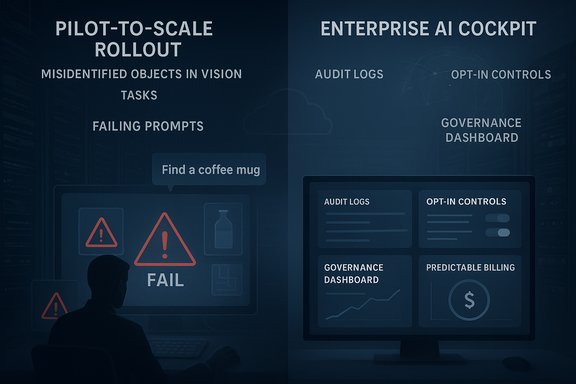
Independent hands‑on testing and community reproductions repeatedly report that many Copilot features fail to reproduce the “ad‑script” scenarios shown in marketing: misidentifying objects in vision tasks, failing to act when expected, or returning inconsistent answers in productivity workflows. Those failures are particularly damaging when the feature was positioned as a time‑saving replacement for established workflows.Integration overhead and the pilot‑to‑scale gap
Enterprise AI projects disproportionately stall during the scaling phase. Real deployments require:- Connectors to multiple data systems with mapped semantics and security policies.
- Continuous retraining and monitoring to adapt to changing data and drift.
- Governance, audit trails, and deterministic failure modes contractable into enterprise agreements.
Perceived coercion and privacy concerns
Many users perceive Microsoft’s AI push as “forced” into the OS and apps—features appearing as defaults or prominent prompts rather than opt‑in experiences. Recall-like features that index local screen content or route data to the cloud trigger visceral privacy concerns, even when Microsoft positions local processing and tenant‑isolation as safety measures. The optics of an “agentic OS” that acts on behalf of users without a simple consent story has widened the trust gap.Branding and expectation mismatch
The broad “Copilot” brand now spans many products and tiers, creating confusion about what customers get at which price. When the brand promises dramatic productivity gains but individual features fall short, brand dilution risks ripple through Microsoft’s entire product portfolio.Technical and commercial analysis
Product execution: ship‑fast vs. polish
Microsoft’s development rhythm has favored rapid deployment and iterative improvements—“ship now, fix later”—which can work for cloud services but is riskier for consumer-facing OS experiences and enterprise automation. Shipping half‑baked agentic features into users’ primary workflows increases the cost of rollback and damages credibility. That dynamic is reminiscent of past product missteps where aggressive timelines produced visible quality regressions.Economics: compute is expensive and brittle
Generative AI at scale has a simple arithmetic problem: model quality, latency and functionality are tied directly to GPU hours, memory and storage bandwidth. That makes AI features materially more expensive than traditional software features. Enterprises that can’t get a clear, measurable ROI on that incremental cost will hold back on adoption. Rising capex and forecasted compute shortfalls amplify the pressure to show rapid monetization—but customer willingness to pay still depends on demonstrable value and stability.Dependence on Nvidia—strategic risk and competitive asymmetry
Microsoft’s cloud relies on Nvidia GPUs for many AI workloads. Nvidia’s ongoing leadership in AI acceleration gives external vendors (including Microsoft) excellent performance, but it also creates vendor concentration risk. Competitors such as Google have made explicit moves to own more of the stack—hardware, software, model research—to tighten cost control and differentiation. Microsoft’s business therefore faces two related risks: supply/cost exposure to third‑party hardware cycles and diminished product differentiation if customers view Azure chiefly as an NVMe/GPU reseller.Financial and strategic implications
Short term: optics and investor sensitivity
The market responded quickly to The Information’s report and other coverage: modest share price dips and near‑term scrutiny of Microsoft’s willingness to convert AI hype into enterprise revenue. Microsoft’s run rate in Azure remains significant—revenue growth outpaced expectations last quarter—but the difference between infrastructure demand and product monetization is important to investors. Microsoft’s record capex—approaching tens of billions for AI capacity—is an intentional, long‑term bet; delivering a near‑term revenue narrative to justify that spend remains an urgent priority.Medium term: platform credibility and product stickiness
If Copilot features stabilize, deliver measurable productivity gains, and can be offered with clear governance and cost models, Microsoft can lock in enterprise customers who prefer a single integrated vendor for cloud, OS and productivity. If not, Microsoft risks commoditization: customers will buy raw compute elsewhere and create differentiated experiences with other models and vendor stacks.Long term: positioning in an AI‑native world
Two futures are plausible:- Microsoft becomes the dependable enterprise AI platform, coupling Azure compute with packaged, reliable AI services that scale across regulated industries.
- Microsoft becomes a more defensive infrastructure play—re-selling GPU-backed compute capacity—while rivals (Google, Anthropic, others) control more of the model innovation and end‑user experience.
Where Microsoft is strong (and why it still matters)
- Scale and enterprise relationships: Microsoft’s installed base across enterprises and its existing enterprise contracts provide a powerful adoption runway if it can close the trust and ROI gaps.
- Deep cloud investments: Microsoft’s willingness to spend on data center capacity, partnerships and certifications means it can deliver low‑latency, compliant deployments for regulated industries.
- Partner ecosystem: Integrations with GitHub, LinkedIn and Office create unique pathways for AI features that competitors will find hard to replicate at scale.
Where Microsoft must change: pragmatic steps
Product and UX fixes
- Prioritize reliability over novelty: delay surface‑level ads and add‑ons until modules pass reproducibility and third‑party test suites.
- Roll out agentic features as opt‑in with clear, discoverable controls and immediate, user‑visible audit logs for actions taken.
- Publish reproducible benchmarks and independent test programs for vision, multimodal and agentic features so enterprises can validate claims.
Commercial and sales alignment
- Reframe sales incentives around durable customer outcomes (measured KPIs) rather than aggressive upfront adoption quotas for immature features.
- Offer transparent, predictable billing for AI consumption and create contractable enterprise SLAs for availability, privacy and failure modes.
Governance and trust
- Ship privacy‑first defaults: local processing where feasible, tenant‑managed keys, and clear user consent for any screen‑capture or recall‑style features.
- Contractual controls for enterprise customers: region restriction, contractual no‑training clauses, and auditable logs.
Risks and caveats
- Some claims circulating on social channels and industry blogs are emergent and evolving; internal memos and executive social posts are sometimes paraphrased or reconstructed after deletion, so readers should treat precise quotes with caution. Multiple outlets corroborate the high‑level “code red” posture and sales friction, but granular internal quota numbers are sensitive and occasionally disputed.
- Market‑share snapshots from analytics firms can vary by methodology. FirstPageSage’s December snapshot shows Gemini gaining in usage trends, but different trackers weight app installs, web traffic, or active sessions differently—so percentages should be treated as directional rather than absolute.
- Dependency on third‑party hardware suppliers like Nvidia is a practical reality today, but strategic bets—partnerships, exclusive compute agreements, or custom hardware—can materially change economics over a three‑to‑five year horizon. Recent deals and public statements indicate Microsoft continues to scale GPU-backed capacity while also enabling partners like Anthropic to run on Azure.
Two scenarios that matter for Windows users and enterprise buyers
Scenario A — Fix, demonstrate, regain trust
Microsoft slows certain rollouts, focuses on reliability, provides enterprise‑grade governance and predictable pricing, and publishes third‑party validation. Copilot transitions from a flashy demo brand to a dependable productivity layer that IT teams can control. Windows retains its dominant position, now enhanced by trustworthy AI that is opt‑in and auditable.Key indicators: independent benchmarks improve; enterprise pilots convert to scaled deployments; Microsoft stabilizes marketing language and ships opt‑in defaults.
Scenario B — Continue at pace, risk broader erosion
Microsoft continues rapid commercialization, shipping features before they are stable and leaning on marketing to drive adoption. Public trust deteriorates, enterprises delay widescale rollouts, and Microsoft’s role polarizes toward cloud infrastructure and GPU reseller, leaving leadership in user experience to competitors that tightened the model and product stack.Key indicators: persistent demo failures, regulatory scrutiny increases, commercial churn or procurement hesitancy increases.
Conclusion
Microsoft’s AI strategy is large and consequential: it has already reshaped the company’s cost structure, product roadmap and partner network. But scale without dependable execution is not a guaranteed recipe for leadership. The recent flurry of reporting—sales‑team adjustments, OpenAI’s reported “code red,” and analytics showing Google’s rising momentum—tells a consistent story: the transition to AI‑first products is more demanding than many predicted.The company’s choice is clear. It can temper velocity with engineering rigor, clear governance, and customer‑first commercial models—practical moves that restore confidence and convert potential into recurring enterprise value. Or it can double down on rapid expansion, risking reputation and turning its enormous infrastructure investments into a commodity play that benefits customers who choose to assemble their own AI stacks elsewhere.
Microsoft still has the assets to win—scale, enterprise reach, and cloud capability—but victory will go to the company that demonstrates measurable, auditable value for customers, not the one that only wins the demo reel. The next chapters will be written in how Microsoft fixes the everyday, boring problems of reliability, controls and cost—not in marquee product launches alone.
Source: Windows Central https://www.windowscentral.com/arti...lem-nobody-wants-to-buy-or-use-its-shoddy-ai/
