

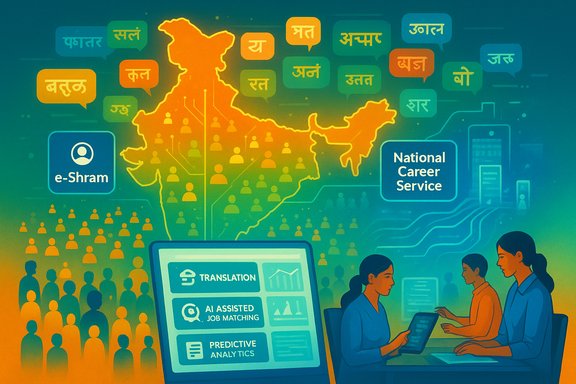
Microsoft’s pledge to embed advanced AI into India’s two flagship labour platforms — the e‑Shram national registry for informal workers and the National Career Service (NCS) portal — marks a deliberate push to turn digital public infrastructure into AI-enabled social infrastructure capable of reaching hundreds of millions of people at once. The announcement, made during Satya Nadella’s India visit as part of Microsoft’s wider US$17.5 billion investment pledge for cloud and AI capacity in India, promises multilingual access, AI‑assisted job matching, predictive skill analytics, automated résumé generation and personalized pathways from informal to formal work — all powered by Microsoft Azure and the Azure OpenAI Service.
Since its August 2021 launch, the e‑Shram portal has grown into one of the largest registries of informal workers in the world, with more than 310 million registrations recorded by 2025 and API integrations that link the registry to a range of welfare and skills systems. The portal was designed to provide a Universal Account Number for unorganised workers and to serve as a single point for channeling social protection benefits and job matching through integration with NCS and other government services. The broader context here is twofold. First, India’s progress on social protection has been dramatic in recent years: International Labour Organization (ILO) datasets and widely reported analyses place India’s social protection coverage at roughly 64.3% in 2025 — a substantial jump from the low twenties in the early 2010s — reflecting rapid scheme expansion and data pooling efforts. That shift is central to Microsoft’s framing of e‑Shram as a means of operationalizing social protection at scale. Second, the labour market itself remains predominantly informal. Independent employment analyses — notably the India Employment Report 2024 produced with the Institute for Human Development and the ILO — estimate that roughly 82% of India’s workforce operates in the informal economy, a scale that underscores why digital tools for identification, outreach and job matching are politically and socially consequential.
This raises two questions:
But the promise will only be realized if technical deployment is matched by a strong governance regime: enforceable privacy protections, independent audits, human oversight, and transparent reporting. Without those, population‑scale AI runs the risk of amplifying exclusion and locking public systems into opaque commercial stacks.
The next phase should be a public, measured rollout: preserve human decision‑making for high‑stakes outcomes, open the architecture to scrutiny, and measure social impact against clear KPIs. At that point, e‑Shram and NCS could become a template for responsible, AI‑enabled digital public infrastructure — not just in India, but across the world.
Source: YourStory.com https://yourstory.com/2025/12/micro...ures-in-welfare-schemes-for-informal-workers/
 Background / Overview
Since its August 2021 launch, the e‑Shram portal has grown into one of the largest registries of informal workers in the world, with more than 310 million registrations recorded by 2025 and API integrations that link the registry to a range of welfare and skills systems. The portal was designed to provide a Universal Account Number for unorganised workers and to serve as a single point for channeling social protection benefits and job matching through integration with NCS and other government services. The broader context here is twofold. First, India’s progress on social protection has been dramatic in recent years: International Labour Organization (ILO) datasets and widely reported analyses place India’s social protection coverage at roughly 64.3% in 2025 — a substantial jump from the low twenties in the early 2010s — reflecting rapid scheme expansion and data pooling efforts. That shift is central to Microsoft’s framing of e‑Shram as a means of operationalizing social protection at scale. Second, the labour market itself remains predominantly informal. Independent employment analyses — notably the India Employment Report 2024 produced with the Institute for Human Development and the ILO — estimate that roughly 82% of India’s workforce operates in the informal economy, a scale that underscores why digital tools for identification, outreach and job matching are politically and socially consequential. What Microsoft and the Ministry are promising
The technical pitch: Azure + Azure OpenAI Service for social platforms
Microsoft’s public materials and executive remarks describe a stack built on Azure with Azure OpenAI Service as the AI layer. The company says the integration will enable features such as:- Multilingual access, leveraging government language technologies like Bhashini to make portals usable in 22 scheduled Indian languages.
- AI‑assisted job matching that surfaces relevant opportunities on NCS by combining skill profiles, local labor demand and employer postings.
- Predictive analytics for skills and labor demand trends to inform skilling programs and policy.
- Automated résumé and application assistants to help low‑literacy or digitally inexperienced workers prepare standardized documents.
- Personalized formalization pathways to guide informal workers toward regulated employment and social security enrollment.
Scale claimed: “310 million” and a national welfare backbone
Microsoft and Indian officials repeatedly anchor the project to the scale of the problem and solution. The e‑Shram database is cited as containing over 310 million registered informal workers, and the company frames its effort as benefiting “over 310 million” people by extending AI capabilities to the registry and NCS. Across media reports, Microsoft’s message is consistent: AI + Azure will improve access to social protection and jobs at population scale.Interoperability and reuse: digital public infrastructure and public goods
Beyond domestic service delivery, officials and Microsoft have floated the idea of making the architecture and learnings available to other governments as digital public infrastructure (DPI) and possibly as digital public goods, suggesting a model where modular public platforms can be shared or adapted internationally. This turns e‑Shram and NCS into prototypes for “AI for public services” beyond India’s borders.Why this matters: potential benefits
1. Usability and inclusion at language scale
Making government portals usable in all major Indian languages is not a small feature — it is a condition of access. Multilingual AI assistants reduce entry barriers for workers who cannot use English or Hindi interfaces and can let frontline mediators help register and onboard workers more quickly. This is a concrete accessibility gain for marginalized workers.2. Faster, more targeted job matching
AI‑driven matching can surface local and sectoral opportunities faster than manual systems, and could help NCS move beyond passive job listings to proactive candidate outreach. For workers juggling daily wage work, this reduces search friction and the time lost in job hunting.3. Smarter skilling investments
Predictive analytics can shine light on where demand will grow and which skills will be needed — enabling the government and training providers to prioritize programs that actually meet market needs. In principle, this reduces wasted skilling budgets and shortens the time to employment.4. Administrative efficiency and fraud reduction
Structured identities and automated eligibility checks — when done properly — can speed transfers, cut leakage, and simplify the administrative burden of running hundreds of schemes across millions of beneficiaries.5. Demonstration effect for DPI + AI
If implemented well, this program could be a global showcase for how cloud providers and governments co‑design DPI and scale AI responsibly in low‑resource contexts, creating templates other countries can adapt. Microsoft and officials emphasize this reuse potential.The critical risks and trade‑offs
Scaling AI into core social systems is not only a technical challenge; it is a governance and rights challenge. Below are the primary areas where careful design, oversight and mitigation will be essential.1. Privacy and data protection at scale
e‑Shram is seeded with Aadhaar identifiers and stores sensitive personal and occupational data for hundreds of millions of people. Any AI‑driven service that improves outreach necessarily depends on large‑scale data flows between government systems and a cloud provider. That raises several concerns:- How are data minimization and purpose limitation enforced?
- Where is data stored and processed (in‑country vs cross‑border)?
- Who has access to raw or inferred data and for what administrative or commercial purposes?
2. Vendor lock‑in and operational dependence
Relying on a single commercial provider for both infrastructure and advanced AI layers creates operational and procurement risks for public services:- Long‑term dependencies can be costly and limit policy flexibility.
- Contractual details (who owns models, who maintains them, who pays for upgrades) determine whether the state retains control or becomes captive to vendor roadmaps.
Public institutions need clear exit, portability and audit provisions in any commercial engagement.
3. Algorithmic bias, fairness and exclusion
AI systems trained on historical labor data risk reproducing and amplifying existing inequalities:- Women, minorities, and informal sector occupations might be ranked lower by “fit” models that favor formal experience or particular education profiles.
- Automated résumé assistants could privilege certain formats and language styles that advantage urban, English‑literate jobseekers.
Robust fairness testing, human oversight, and targeted countermeasures (e.g., affirmative matching) will be necessary to prevent widening inequities.
4. Model accuracy and hallucination risk
Large language models can produce plausible but incorrect information. In the context of welfare entitlements and employment counseling, an incorrect answer about eligibility, scheme amounts or legal rights is harmful. Public deployments must therefore:- Use retrieval‑augmented, verified knowledge sources for factual outputs.
- Ensure human‑in‑the‑loop review for decisions with legal or financial implications.
5. The digital divide and front‑line capacity
AI assistants can make services more accessible — but only if physical touchpoints and mediators (CSCs, bank correspondents, post offices) are equipped and trained. The danger is an inverse digital inclusion effect where easier AI features primarily benefit those who are already digitally connected, leaving the most vulnerable behind.6. Misaligned incentives and commercialization risks
Microsoft’s deep commercial stake in India’s cloud future is plain: investment in hyperscale datacenters and sovereign offerings expands its market. Governments must ensure that public interest — not commercial growth — drives design choices for core welfare flows, including prohibitions on commercial reuse of beneficiary data and transparent procurement.7. Security and attack surface
Any centralized registry that becomes critical to program delivery is a high‑value target. Hardening systems against data breaches, denial‑of‑service attacks and insider threats is essential. This requires independent security audits and incident response commitments in contracts.How to design safeguards: practical steps and governance checklist
To reduce the risks above and preserve the potential benefits, governments, vendors and civil society should pursue a clear set of technical and governance controls.Minimum governance requirements (short list)
- Public data governance framework with clear purpose limitation, retention policies and redress channels.
- Independent algorithmic audit before any AI model is used for eligibility, recommendation, or automated decision‑making.
- Explainability and recourse: users must receive human‑readable explanations and a clear path to contest outcomes.
- Data localization and sovereignty SLAs that are verifiable with technical attestations (where required by law).
- Open APIs and portability to prevent vendor lock‑in and enable competition and local innovation.
- Human‑in‑the‑loop protocols for high‑risk interactions (e.g., benefit denial, job placement acceptance).
- Impact evaluation and public reporting on access, fairness, errors, and outcomes (disaggregated by gender, caste, geography).
- Capacity building and frontline training to ensure digital mediators can support the digitally excluded.
Operational checklist for an AI‑enabled DPI pilot
- Start with low‑risk features: put translation, search, and résumé formatting first; avoid automated eligibility denials.
- Implement A/B monitoring to measure changes in access, job placements and complaints.
- Build localized, light‑weight NLU models and integrate government‑verified content stores to reduce hallucinations.
- Mandate periodic third‑party audits (privacy, security, fairness) and publish executive summaries.
- Create an accessible feedback mechanism in every language supported by the portal.
Technical realities: what Azure and Azure OpenAI actually deliver (and what they don’t)
Microsoft’s Azure cloud delivers the infrastructure services and compliance tooling governments expect: regional availability zones, sovereign cloud offerings, and enterprise management capabilities. The Azure OpenAI Service provides access to foundation models for tasks such as translation, natural language understanding, summarization and retrieval‑augmented generation. These can be integrated into web portals and agent frameworks to provide the functionality Microsoft describes: multilingual interfaces, résumé assistants and recommendation engines. But the engineering gap between “access to a foundation model” and a robust, auditable production service is nontrivial:- Retrieval‑augmented setups, strict knowledge grounding and domain‑specific fine‑tuning must be implemented to avoid hallucinations.
- Latency, cost, and model versioning need to be managed; running large models at scale is expensive and requires capacity planning.
- Operationalizing fairness testing and human review workflows requires bespoke engineering and policy design — it is not provided out‑of‑the‑box.
The politics of scale: rights, consent and inclusion
Large population‑scale deployments of AI in welfare systems intersect with questions of consent, democratic oversight and political economy.- When a large government dataset is enhanced with predictive analytics, the outcomes shape lives: who gets training, who is nudged into formal work, where funds are allocated.
- Consent is complex for social service recipients: registration is often a precondition of access to benefits, and informed consent for algorithmic profiling is rarely meaningful when services are essential.
- Independent oversight by ombuds, statutory data protection authorities and parliamentary committees is therefore essential to preserve rights and legitimacy.
International implications: DPI, exportability and geopolitics
Microsoft and Indian officials have floated the idea of packaging e‑Shram/NCS as digital public infrastructure or digital public goods for other countries. If the model is exported, it would spread not just technology but governance norms: the standards embedded in code and contracts become templates for social protection elsewhere.This raises two questions:
- Will exported systems include the same governance safeguards, audits and portability commitments?
- How will recipient countries negotiate vendor terms and preserve sovereignty over sensitive worker data?
What success looks like: measurable KPIs
To evaluate whether AI integration has delivered social value — not merely digital novelty — policymakers should track a short set of measurable KPIs:- Net change in time‑to‑job placement for registrants (disaggregated).
- Uptake of formal sector jobs among previously informal workers (cohort analysis).
- Rate of accurate eligibility determinations vs. appeals and reversals.
- User satisfaction scores across languages and literacy levels.
- Number and impact of model errors, hallucinations, and data breaches.
- Cost per successful job placement or benefit payout (including cloud and operational costs).
Verdict: a high‑impact experiment that must be governed like a public service
Embedding Azure and Azure OpenAI Service capabilities into e‑Shram and NCS is a high‑stakes, high‑reach experiment. The potential benefits — easier access to benefits, more effective job matching, smarter skilling — are real and meaningful at the scale of India’s labour market. Microsoft’s investment in hyperscale infrastructure and in‑country processing capacity lowers some technical barriers to delivering these features. Yet the downsides are also structural. Privacy risks, potential for algorithmic exclusion, vendor lock‑in, and the risk of swapping human judgment for opaque machine recommendations demand robust public governance, transparency and independent oversight. The program should therefore proceed as a staged, auditable, and reversible set of pilots rather than an immediate, wholesale switch to automated decision‑making.Recommendations for policymakers and implementers
- Treat AI as policy infrastructure, not a product. Embed procurement clauses that protect data, ensure portability and require independent audits.
- Limit the first wave of automation to assistive features (translation, résumé formatting, job search ranking) and keep eligibility and critical welfare decisions strictly human‑mediated until audits demonstrate reliability.
- Publish model card summaries, data flows and privacy notices in all supported languages; create simple opt‑out mechanisms where possible.
- Commission independent third‑party audits for privacy, security and fairness before scaling critical features.
- Invest in local capacity: open APIs, fund local developers and civil society to build complementary apps and audits so the ecosystem remains plural and contestable.
- Maintain open, time‑bound pilot evaluations with publicly available KPIs.
Conclusion
The Microsoft–India initiative to introduce Azure OpenAI Service capabilities into e‑Shram and the National Career Service is a signal moment for AI in public service delivery. It demonstrates how cloud providers and governments can partner to bring advanced language, matching and analytics capabilities to very large populations — and how fast the boundaries between private AI product stacks and public welfare systems are blurring. The promise is substantial: better access, more targeted skilling and a path for millions from precarious informal work toward regulated forms of employment.But the promise will only be realized if technical deployment is matched by a strong governance regime: enforceable privacy protections, independent audits, human oversight, and transparent reporting. Without those, population‑scale AI runs the risk of amplifying exclusion and locking public systems into opaque commercial stacks.
The next phase should be a public, measured rollout: preserve human decision‑making for high‑stakes outcomes, open the architecture to scrutiny, and measure social impact against clear KPIs. At that point, e‑Shram and NCS could become a template for responsible, AI‑enabled digital public infrastructure — not just in India, but across the world.
Source: YourStory.com https://yourstory.com/2025/12/micro...ures-in-welfare-schemes-for-informal-workers/
