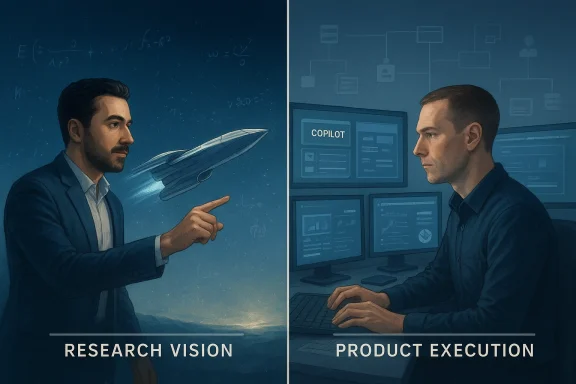
Microsoft’s internal reshuffle that moves pieces of the Copilot organization around and formally frees Microsoft AI chief Mustafa Suleyman to concentrate on a newly elevated “superintelligence” effort is more than an HR story — it’s a strategic pivot that signals how Microsoft intends to compete at the very frontier of AI while rebalancing product execution across a sprawling product portfolio.
In a March 17, 2026 report sourcing Reuters, Microsoft shifted reporting lines and responsibilities across groups that build Copilot experiences, a move described inside the company as intended to “free up” Mustafa Suleyman to focus squarely on developing next‑generation AI models and frontier research. This follows a string of high‑profile organizational changes across 2024–2026 that steadily concentrated model building, product integration, and hardware investments in ways that increase Microsoft’s independence from external model vendors.
Suleyman — a co‑founder of DeepMind and later Inflection AI — joined Microsoft on March 19, 2024 to lead its consumer AI organization. Since then, his remit expanded from product and consumer Copilot experiences into a broader mandate that now includes leading a dedicated MAI (Microsoft AI) Superintelligence Team created in late 2025. The company’s pivot to own more of the frontier stack — models, tooling, and now first‑party silicon — is tangible: Microsoft announced its Maia 200 inference accelerator in January 2026 and has publicly tied that asset to work for its superintelligence effort.
This article traces the context for the reorganization, explains what Microsoft is restructuring and why, analyzes technical and business implications for Copilot and the broader Windows and Microsoft 365 ecosystems, and outlines the safety, market and regulatory risks of a big‑bet push toward so‑called superintelligence.
By moving some business‑focused Copilot teams under the Office/Experiences umbrella (and keeping consumer Copilot under Suleyman until now), Microsoft leaders signaled an intent to untangle ownership problems so each leader can focus on execution in their domain. Freeing Suleyman from day‑to‑day product reporting — while elevating him to push frontier models and research — lets product owners inside other businesses take responsibility for delivery while Microsoft’s AI research leadership pushes the frontier.
Owning more of the model stack can:
Key aspects of Microsoft’s framing:
Implications:
This structure yields benefits:
For Windows users, IT administrators, and enterprise customers, the immediate takeaway is to expect more capability iteration: some judged on product metrics and usability, and some — riskiest and most ambitious — judged on research breakthroughs and domain performance. Microsoft’s balanced talk of “humanist superintelligence,” along with investments in Maia 200 and a dedicated research team, sets a high bar. The success of this strategy will hinge on sober execution, transparent governance, and measurable product value that reduces friction for users while protecting safety and trust.
The company’s next milestones — concrete benchmark releases, audited pilots in regulated sectors, broader Maia 200 availability, and tight alignment across product owners — will determine whether this restructuring was a decisive move toward differentiated, responsible AI leadership or a high‑profile gamble in a fast‑moving arms race.
Source: Deccan Herald Microsoft Copilot teams: Suleyman freed to focus on superintelligence push
 Background / Overview
In a March 17, 2026 report sourcing Reuters, Microsoft shifted reporting lines and responsibilities across groups that build Copilot experiences, a move described inside the company as intended to “free up” Mustafa Suleyman to focus squarely on developing next‑generation AI models and frontier research. This follows a string of high‑profile organizational changes across 2024–2026 that steadily concentrated model building, product integration, and hardware investments in ways that increase Microsoft’s independence from external model vendors.Suleyman — a co‑founder of DeepMind and later Inflection AI — joined Microsoft on March 19, 2024 to lead its consumer AI organization. Since then, his remit expanded from product and consumer Copilot experiences into a broader mandate that now includes leading a dedicated MAI (Microsoft AI) Superintelligence Team created in late 2025. The company’s pivot to own more of the frontier stack — models, tooling, and now first‑party silicon — is tangible: Microsoft announced its Maia 200 inference accelerator in January 2026 and has publicly tied that asset to work for its superintelligence effort.
This article traces the context for the reorganization, explains what Microsoft is restructuring and why, analyzes technical and business implications for Copilot and the broader Windows and Microsoft 365 ecosystems, and outlines the safety, market and regulatory risks of a big‑bet push toward so‑called superintelligence.
Why this matters: the strategic logic behind the reshuffle
Solving a long‑running coordination problem
Microsoft’s product footprint — Windows, Office/Microsoft 365, Azure, LinkedIn, GitHub, Dynamics — is vast. For two years the company has wrestled with a classic matrix problem: multiple Copilot efforts (consumer Copilot tied to Microsoft AI; Microsoft 365 Copilot and Business & Industry Copilot tied to other business units) meant fragmented ownership and inconsistent execution. The practical result was mixed product progress, integration gaps, and duplication of effort.By moving some business‑focused Copilot teams under the Office/Experiences umbrella (and keeping consumer Copilot under Suleyman until now), Microsoft leaders signaled an intent to untangle ownership problems so each leader can focus on execution in their domain. Freeing Suleyman from day‑to‑day product reporting — while elevating him to push frontier models and research — lets product owners inside other businesses take responsibility for delivery while Microsoft’s AI research leadership pushes the frontier.
A bet on independence and differentiation
The reorg must be read against the backdrop of Microsoft’s evolving relationship with OpenAI. In late 2025 Microsoft and OpenAI restructured their partnership, clarifying rights and opening new flexibility for both parties. That environment reduces Microsoft’s strategic dependence on any one external model vendor and increases incentives to build in‑house models, tooling, and infrastructure that create unique value across Microsoft products.Owning more of the model stack can:
- Reduce latency and cost for Azure‑hosted services;
- Allow tighter product integration with Windows and Microsoft 365;
- Let Microsoft build models tuned to its enterprise datasets and regulatory needs;
- Provide negotiating leverage in a competitive landscape that includes Google, Anthropic, and OpenAI.
Timeline: from hiring to hardware to superintelligence
March 19, 2024 — Suleyman joins Microsoft
Microsoft publicly announced Mustafa Suleyman’s appointment to lead a new Microsoft AI organization focused on Copilot products. His background — co‑founder of DeepMind, a stint at Inflection AI — gave him credentials both in research and in building conversational, humanist AI.June 2025 — Internal product reporting changes
A larger June 2025 leadership reorganization consolidated Office and parts of Microsoft 365 and Business & Industry Copilot under different reporting lines. These moves aimed to give individual product leaders clearer ownership of Copilot experiences in their verticals.November 2025 — MAI Superintelligence Team announced
Microsoft formally unveiled an MAI Superintelligence Team, defining a research agenda described internally and externally as “humanist superintelligence” — models built to solve hard, high‑impact problems (medical diagnostics, materials and energy modeling, deep scientific reasoning) while stressing controllability and human oversight.January 26, 2026 — Maia 200 chip unveiled
Microsoft announced Maia 200, a next‑generation inference accelerator built for cloud‑scale token generation and inference. Company statements positioned Maia 200 as a core piece of the infrastructure for Microsoft’s frontier model work, and indicated the Superintelligence Team would be an early internal customer.March 17, 2026 — Copilot teams rejig frees Suleyman
A Reuters‑sourced memo and reporting framed the latest changes as a practical step to let Suleyman concentrate on model and research priorities, while the day‑to‑day custody of Copilot features and product rollouts moves into the hands of product execs closer to Windows, Office and enterprise customers.What “superintelligence” means for Microsoft — and why the word matters
“Superintelligence” is an emotionally charged term. In academic usage it typically refers to systems that outperform humans across a wide range of intellectual tasks. Microsoft’s public framing — and Suleyman’s repeated emphasis — has been more tactical: the company describes a goal of building highly capable, domain‑specific systems that exceed human performance at particular tasks (medical diagnosis, scientific discovery, complex engineering) while deliberately rejecting the trope of personified AI assistants.Key aspects of Microsoft’s framing:
- Humanist Superintelligence: emphasis on systems engineered to serve clear human goals and remain controllable.
- Domain first: focusing initial superintelligence efforts on measurable, high‑value verticals rather than an abstract generality.
- Safety & control: stated commitment to containment, testing, and rigorous safety gates before scaling outputs into products.
Technical and product implications
Maia 200 and the hardware inflection point
Designing first‑party silicon is a major strategic shift for a cloud provider. Maia 200 — promoted as an inference‑first accelerator — indicates Microsoft intends to close the economics gap on model serving and to optimize for the cost structures of continuous, large‑scale token generation.Implications:
- Lower inference costs at scale can make high‑quality Copilot experiences economically viable across consumer and enterprise tiers.
- First‑party chips let Microsoft tune memory, interconnect, and precision formats to its models and dataflows, potentially improving throughput and reducing power consumption.
- Controlled deployment of Maia 200 across Azure regions gives Microsoft leverage to offer differentiated performance SLAs and to keep sensitive workloads on infrastructure tailored for safety and compliance.
Product architecture: separating model R&D from product ops
Splitting strategic model research from product execution can accelerate both. Researchers can focus on architecture, data, and safety research, while product teams concentrate on UX, integration, and adoption metrics.This structure yields benefits:
- Faster iteration on model prototypes without destabilizing production product SLAs.
- Clearer KPIs: research metrics (benchmarks, domain gains, safety passes) versus product metrics (DAUs, retention, enterprise ROI).
- Better alignment of release discipline for high‑risk features (e.g., medical diagnostic outputs).
Business and market effects
For Copilot and Windows users
Consumers and enterprises should expect more capability investment in Copilot experiences that leverage Microsoft’s own models and hardware. That could mean:- Faster, lower‑latency Windows and Edge Copilot responses that depend less on external model APIs.
- New premium features for Microsoft 365 users when superintelligence components deliver measurable business impact (e.g., clinical assistance for healthcare customers or advanced materials simulations for R&D teams).
- Potential variability in which Copilot features use OpenAI‑powered models versus Microsoft’s in‑house models; this will be visible to enterprise IT teams through vendor choices and compliance controls.
Competitive dynamics: Google, OpenAI, Anthropic, and beyond
Microsoft’s move is both defensive and offensive. It reduces single‑source dependency on OpenAI and signals to Google (Gemini), Anthropic, and other players that Microsoft will compete on both model capabilities and infrastructure economics.- Google continues to push Gemini at scale via Android, Search, and Workspace integrations.
- OpenAI remains a major model maker and partner, but the October 2025 partnership rework created more latitude on both sides and made it strategic for Microsoft to build in‑house capabilities.
- Smaller rivals and open‑source communities create pressure to drive accessible, composable model stacks — an opportunity and a threat for Microsoft depending on how it balances openness with enterprise SLAs.
Safety, ethics and governance: real challenges
The containment vs. alignment debate
Suleyman and Microsoft frame their superintelligence work as controllable and human‑first. In practice, the industry faces two types of challenges:- Containment — technical approaches to ensure systems cannot act outside designed interfaces and perform only validated outputs.
- Alignment — ensuring systems’ goals and reasoning processes reflect acceptable human values and operational constraints.
Data governance and model provenance
Building large models requires massive datasets, often containing proprietary enterprise inputs and sensitive personal data. Microsoft must solve:- Data lineage and consent for training and fine‑tuning;
- Differential privacy and model watermarking to limit misuse;
- Clear SLAs for enterprise customers over model updates and rollback mechanisms.
Institutional safeguards and third‑party oversight
Given the scale and potential reach of superintelligent systems, independent verification, rigorous red‑teaming, third‑party audits, and transparent incident reporting become essential. Microsoft’s commitment to independent safety review panels or partnerships with regulators will be scrutinized closely.Risks and open questions
Execution risk: talent, scale, and cost
Designing and deploying frontier models and first‑party silicon simultaneously strains organizational capacity. Risks include:- Recruiting and retaining top research talent amid fierce competition;
- Managing multi‑year chip design and datacenter rollouts with predictable performance gains;
- Achieving cost reductions that outweigh capital and operating expenditures.
Product risk: adoption and trust
Copilot adoption still lags some competing chat assistants in consumer mindshare. Even with superior models, Microsoft must solve product friction, privacy concerns, and monetization strategy to translate R&D into revenue.Regulatory and antitrust scrutiny
As Microsoft deepens vertical integration — chips, cloud, models, apps — regulators will likely examine the competitive effects of bundling and potential lock‑in. Microsoft’s large Azure commitments tied to partnership agreements (publicly discussed in late 2025 updates) remain material to policy debates and enterprise procurement.What “superintelligence” actually achieves
A central, unanswered question is whether the term becomes a productizable advantage or a reputational risk. If Microsoft produces superior domain specialists (medical diagnostics that beat human specialists on narrow tasks), the business case is clear. If the effort remains abstract research that fails to produce reliable product outcomes, the PR and regulatory costs could outweigh returns.What to watch next: milestones and indicators
- Model releases and benchmark results
- Watch for Microsoft publishing peer‑reviewed results or benchmark performance (medical reasoning, coding, multi‑modal reasoning) that demonstrate clear, repeatable gains.
- Enterprise pilots in regulated domains
- Public pilots with hospitals, drug‑discovery labs, or material science institutions with independent audit trails would be strong signals of productization.
- Maia 200 rollouts and pricing
- How rapidly Microsoft deploys Maia 200 across core Azure regions and whether the company offers Maia‑backed tiers to customers will indicate how aggressively it plans to commercialize first‑party silicon.
- Governance commitments
- Independent audits, third‑party red‑teams’ findings, and public documentation around safety gates and rollback processes will be critical for trust.
- Product ownership clarity
- Observe whether the Copilot experience across Windows, Edge, and M365 becomes more consistent and reliable under the new product ownership model.
Practical takeaways for Windows and enterprise administrators
- Prepare for variability in model sources: Microsoft’s Copilot experiences may run some features on OpenAI models and others on Microsoft’s in‑house models. Enterprises should update procurement and compliance checklists accordingly.
- Revisit contractual protections: If you rely on Copilot in regulated contexts, demand clear SLAs about model provenance, data residency, and update/rollback mechanisms.
- Test for behavioral drift: When Microsoft introduces new underlying models, administrators and security teams should validate outputs against domain‑specific test suites before enabling broad rollout.
Critical assessment: strengths and vulnerabilities of Microsoft’s approach
Strengths
- Full‑stack approach: Combining models, first‑party silicon, and deep product distribution gives Microsoft rare leverage to optimize end‑to‑end economics and performance.
- Clear governance framing: Public emphasis on “humanist” principles, containment, and domain‑specific wins helps Microsoft engage regulators and enterprise customers.
- Execution muscle: Microsoft has the engineering scale, capital, and enterprise relationships needed to attempt long‑term bets.
Vulnerabilities
- Complex integration risk: Managing multiple high‑risk programs (chip design, frontier model research, product delivery) at once increases failure modes.
- Trust and responsibility gap: Promising “superintelligence” invites heightened scrutiny; any early misstep in medical or safety‑critical domains could cause reputational and legal fallout.
- Competitive arms race: Rivals such as Google and specialist labs remain formidable. Microsoft must produce materially better or cheaper outcomes to justify the investments.
Conclusion
Microsoft’s March 2026 rejig of Copilot teams and the formal release of Mustafa Suleyman to pursue a superintelligence agenda are both symbolic and practical. Symbolic, because the company is sending a public signal that it intends to own more of the frontier AI stack; practical, because separating operational product responsibilities from long‑range model research can accelerate both the development of highly capable models and the reliability of everyday Copilot features.For Windows users, IT administrators, and enterprise customers, the immediate takeaway is to expect more capability iteration: some judged on product metrics and usability, and some — riskiest and most ambitious — judged on research breakthroughs and domain performance. Microsoft’s balanced talk of “humanist superintelligence,” along with investments in Maia 200 and a dedicated research team, sets a high bar. The success of this strategy will hinge on sober execution, transparent governance, and measurable product value that reduces friction for users while protecting safety and trust.
The company’s next milestones — concrete benchmark releases, audited pilots in regulated sectors, broader Maia 200 availability, and tight alignment across product owners — will determine whether this restructuring was a decisive move toward differentiated, responsible AI leadership or a high‑profile gamble in a fast‑moving arms race.
Source: Deccan Herald Microsoft Copilot teams: Suleyman freed to focus on superintelligence push