

Microsoft just flipped the script again: AI everywhere, Xbox doubling down on subscriptions, Windows folding Copilot into the OS, and MSFT trading at headline-making levels — but beneath the hype there’s a straightforward strategic thesis and a set of concrete execution risks that every Windows user, gamer, and investor should understand. rview
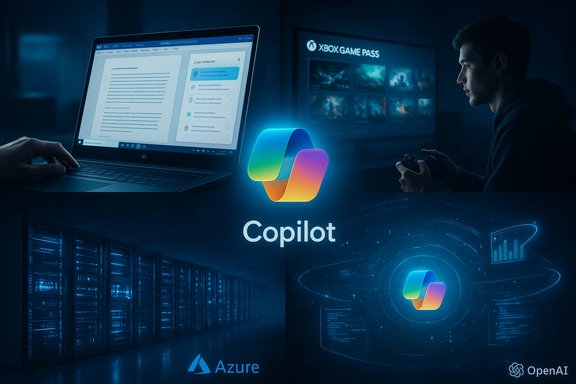
For most of its life Microsoft was the quiet backbone of business computing: Windows on the desktop, Office in the corporate suite, Azure quietly running enterprise workloads. That changed visibly over the last two years as Microsoft re‑positioned itself as an AI-first platform company—pairing hyperscale cloud capacity with seat-based productivity monetization (Copilot), consumer gaming via Xbox and Game Pass, and a deeper commercial tie to frontier AI through OpenAI. The resulting narrative — Microsoft as the bridge between enterprise AI demand and the cloud compute that powers it — is what’s driving attention on social feeds and capital markets alike. This article breaks down what’s real, what’s marketing, and what matters for users and investors: product and monetization moves, hard financial anchors, competitive context, and the plausibility of Microsoft’s big bets.
But this is not a no‑risk, no‑thinking buy. Key execution risks remain:
Microsoft is not a bubble in the textbook sense: it sells essential products, generates enormous cash flow, and has a plausible, measurable path to monetize AI at scale. That’s why everyone is suddenly obsessed. The practical takeaway is straightforward: pay attention, test the new tools if they fit your workflow, and — if you’re investing — buy discipline, not fandom.
Source: AD HOC NEWS The Truth About Microsoft Corp: Why Everyone Is Suddenly Obsessed With MSFT
For most of its life Microsoft was the quiet backbone of business computing: Windows on the desktop, Office in the corporate suite, Azure quietly running enterprise workloads. That changed visibly over the last two years as Microsoft re‑positioned itself as an AI-first platform company—pairing hyperscale cloud capacity with seat-based productivity monetization (Copilot), consumer gaming via Xbox and Game Pass, and a deeper commercial tie to frontier AI through OpenAI. The resulting narrative — Microsoft as the bridge between enterprise AI demand and the cloud compute that powers it — is what’s driving attention on social feeds and capital markets alike. This article breaks down what’s real, what’s marketing, and what matters for users and investors: product and monetization moves, hard financial anchors, competitive context, and the plausibility of Microsoft’s big bets.
 Microsoft’s Product Playbook: Copilot Everywhere
What Copilot actually is
Copilot is not a single product; it’s a product family — a set of AI assistants and agents embedded across Microsoft 365 (Word, Excel, PowerPoint, Outlook), Windows, GitHub, Teams, and Azure services. The commercial shift is simple: convert previously included or “nice-to-have” features into explicit paid seats and attach metered cloud consumption to those seats via Azure inference and agent workloads. That two‑pronged monetization path (seat revenue + metered inference) is central to the bullish thesis.Pricing and commercialization — the math that matters
Microsoft published clear enterprise pricing: Microsoft 365 Copilot is offered at a formal enterprise price anchor of $30 per user per month (paid annually) for many commercial customers, with a “Copilot Chat” free tier and lower-cost business options for smaller customer blocks. That explicit per‑seat price is what allows analysts to model Copilot ARR and forecast the revenue lift from seat conversions. Why this matters in practice:- Seat revenue gives Microsoft predictable recurring top‑line — easy to model for enterprise finance teams.
- Metered inference (GPU hours, agent calls, specialized model hosting) drives variable Azure consumption and rapid revenue scaling if customers move from pilots to production.
- The presence of Copilot in core user workflows (Excel formulas, legal summaries in Word, automated meeting notes in Teams) increases stickiness and switching costs for enterprises.
Limits and realities
Copilot helps the mundane tasks massively — summarization, draft generation, formula suggestion — but it is not perfect: hallucinations, context errors, and governance issues persist. Enterprises also treat Copilot deployments as procurement and governance projects, not flip‑of‑a‑switch upgrades. That cadence — measured pilot → governance → production — constrains how fast seat monetization and Azure consumption can ramp. This is visible in field checks and surveys that show strong interest but uneven speed from pilots to full deployments.Azure and the AI Infrastructure Bet
The hard number: massive capex
Microsoft signaled an audacious infrastructure commitment: more than $80 billion of capital spending targeted at AI‑capable datacenters in the fiscal year window surrounding 2025. That number has been widely reported and reiterated by Microsoft spokespeople; it represents the physical side of the company’s AI supply‑chain strategy — GPUs, custom accelerators, new data center builds and leases. Analysts treat this as both a moat (scale) and a risk (capital intensity).What the capex buys — and the timing problem
The capital buildout is meant to solve two problems:- Supply: Microsoft needs GPU capacity to train and serve large models and to host enterprise inference workloads.
- Economics: The goal is to own or lease enough capacity at scale so inference unit economics improve over time (higher utilization + custom silicon = margin recovery).
Azure performance anchors
Microsoft’s fiscal Q1 FY26 results (quarter ended September 30, 2025) provide the empirical anchor: revenue of $77.7 billion for the quarter, with Intelligent Cloud and Microsoft 365 showing meaningful contributions to growth. Analysts use these disclosed numbers to model how much of Azure growth can be attributed to AI workloads and to estimate the potential revenue per Copilot seat and per inference-hour. The company’s disclosures make it clear: Azure is big and AI is visible in its growth mix.The OpenAI Relationship — Strategic Partner or Single-Point Risk?
What changed in 2025
OpenAI’s October 2025 restructuring recast the relationship into a more conventional equity and commercial arrangement: Microsoft emerged with a meaningful equity stake (market press widely reports roughly 27%) in the newly structured OpenAI entity, while OpenAI committed to long‑term Azure compute purchases cited in coverage at scale figures that the market has discussed broadly (reported commitments figure into the hundreds of billions across a long horizon). This transaction reshaped the commercial balance — Microsoft gained a durable commercial partner for frontier models, but exclusivity and governance mechanics were nuanced in the final deal.Implications for Microsoft and Azure
- Strategic upside: preferential model access and an anchor customer for Azure inference workloads materially de-risks demand for Microsoft’s AI datacenters.
- Accounting and disclosure complexity: a large equity stake with complex terms creates questions about how Microsoft discloses this exposure and how investors should treat the economic value on the balance sheet.
- Competitive nuance: Microsoft’s preferential access does not translate into permanent exclusivity; the terms allow OpenAI more independence over time, so the relationship is powerful but not an unassailable moat.
Caution flag
Some headline numbers circulating in commentary — e.g., exact Azure‑purchase totals and valuation marks for the restructured OpenAI — are anchored to company statements and media aggregations but include forward‑looking assumptions. These should be considered directional and verified against regulatory or company filings when making financial decisions. Where public filings exist, they are the authoritative source.Xbox, Game Pass and Microsoft’s Consumer Gambit
Game Pass as a cultural and commercial lever
Xbox Game Pass has become Microsoft’s consumer‑facing growth engine: a subscription that packages new releases, legacy titles, and cloud streaming. Microsoft restructured Game Pass plans in 2025 (Essential, Premium, Ultimate), and revised pricing for the top tier: Ultimate is now $29.99/month as of Microsoft’s October 2025 plan update — a material uplift that brought better perks but also lit up social media and community debate. That higher price signals Microsoft’s intent to extract more value from its gaming ecosystem while cross‑selling Xbox content and cloud services.Studio acquisitions and content strategy
Microsoft’s prior blockbuster acquisitions (ZeniMax/Bethesda, Activision Blizzard) fundamentally altered the company’s content roadmap. The Activision Blizzard acquisition began as a $68.7 billion announcement and closed in the autumn of 2023 after regulatory negotiation; some reporting aggregates the total cost differently, producing headlines that cite ~$75 billion in total transaction value when factoring adjustments — the key fact is this: Microsoft spent historic sums to control top franchises and folded them into Game Pass strategy. Those titles provide Game Pass with first‑party exclusives and day‑one releases that materially increase subscription value for heavy gamers.The channel and cloud angle
Microsoft’s gaming strategy is tightly linked to Azure: cloud streaming, cross‑platform multiplayer back ends, and developer tools that can migrate production and live services to Azure. The play here is subtle: make Game Pass great, keep franchises multi‑platform where necessary for regulatory comfort, but use first‑party and subscription economics to improve lifetime value — and thereby steadily grow the consumer side’s contribution to recurring revenue.Financials, Valuation and the Market Reaction
Stock context
Microsoft’s stock (MSFT) has spent much of late 2024–2025 trading as a premium mega‑cap: investors pay up for scale, recurring revenue, and optionality into AI. In mid‑January 2026 the share price was trading in the ~$460–$480 range on major market feeds as the company continued to hit growth and margin targets while absorbing higher capex — a level that places it among the largest U.S. market‑cap companies. Short‑term swings still occur around earnings and AI headlines, but volatility is relatively muted compared with small caps.Why the market prices Microsoft like a leader
- Diversified recurring revenue: Microsoft mixes seat‑based subscriptions (Microsoft 365), platform consumption (Azure), advertising and LinkedIn income, and subscription gaming revenue.
- AI monetization runway: explicit Copilot seat pricing enables revenue modeling; Azure usage adds variable upside.
- Balance‑sheet optionality: strong free cash flow supports buybacks and capex without existential funding risk.
The valuation tradeoff
The price already bakes in optimistic assumptions about AI monetization and Azure utilization. That means upside requires continued execution (seat conversions, enterprise agent adoption, Azure inference growth) and downside is significant if those outcomes slip. For long‑term investors the tradeoff is straightforward: Microsoft is a high‑quality platform and a plausible structural allocator of AI spend, but it is priced like one — not a discount.Competitive Landscape: Google, Apple, AWS and Others
Microsoft vs. Google (Alphabet)
- Search & consumer AI: Google still dominates classic search and many consumer AI experiences, but Microsoft has been pushing Bing with Copilot‑style answers and deeper OS integrations.
- Productivity: Microsoft 365 remains the enterprise standard; Google Workspace is strong in education and lightweight collaboration.
- Cloud: Azure sits behind AWS in share but is a top-tier hyperscaler; both Microsoft and Google are aggressively investing in AI infrastructure. The competition centers on price, performance and enterprise trust.
Microsoft vs. Apple
- Apple controls hardware aesthetics and a premium consumer ecosystem; Microsoft owns the enterprise productivity layer and is shifting Windows toward AI‑driven experiences.
- For creators and tight hardware/software integration, Apple still leads. For broad enterprise penetration and cross‑device workflows where AI is centrally hosted, Microsoft’s reach is deeper today.
Cloud competition
AWS, Google Cloud, and Microsoft Azure are racing on capacity, custom silicon, and enterprise features. Microsoft’s uniqueness is the seat-to-consumption distribution funnel: Entra/Azure AD → Microsoft 365 → Dynamics → Azure, which gives Microsoft commercial touchpoints that many peers can’t match in the same integrated way. That distribution is why analysts describe an “enterprise AI flywheel” anchored on Microsoft products.Regulation, Governance and Risk
Antitrust and security scrutiny
Big Tech remains a regulatory focus. Microsoft’s bundling, cloud relationships, and high profile acquisitions have drawn scrutiny in multiple jurisdictions. Ongoing regulatory attention — whether in the EU, UK, or the U.S. — is a live risk that could force operational or contractual changes with material implications for product bundling and pricing.AI safety, governance, and product risk
AI features introduce new responsibility burdens: hallucinations, biased outputs, data residency, and IP issues. Enterprises will demand contract terms, governance, and the ability to audit models and data flows. Failures here create reputational and contractual risk that can slow adoption and increase churn. Microsoft has invested in enterprise controls, but governance is operationally hard and expensive to deliver well across millions of seats.Capital intensity and margin sensitivity
Large capex programs create operating leverage that only pays off with high utilization. If inference economics are worse than expected, margin recovery could be delayed, pressuring multiples and share price. This is the fundamental execution risk: spending to build a capacity moat, and needing customers to fill it.What Microsoft’s Hype Means for Different People
For everyday users
- If you live in Office, Teams, or GitHub, Copilot features will likely make your day‑to‑day work faster. Expect incremental productivity gains and new features that feel genuinely useful.
- If you’re a gamer, Game Pass continues to offer high value if you play frequently; price increases will sting for casual players but are less consequential for heavy users who get day‑one titles.
For IT leaders and developers
- Treat Copilot as a procurement and governance initiative: pilot conservatively, measure inference costs, enforce data residency, and build FinOps for AI.
- Plan for hybrid models: sensitive workloads may need on‑prem inference while less sensitive automations run in Azure.
For investors
- Long‑term buy‑and‑hold: Microsoft remains a credible core holding if you accept paying for quality and position sizing to account for valuation risk.
- Growth seekers: the stock’s large market cap and premium valuation limit asymmetric upside unless AI monetization materially outperforms expectations.
- Traders: earnings and AI product news will create opportunities, but the stock is broad and moves with mega‑cap dynamics.
Final Verdict — Cop or Drop?
Microsoft’s recent moves are not marketing smoke; they are cohereCopilot gives Microsoft a direct, observable way to monetize AI via seats and usage.- Azure is the supply layer; Microsoft’s capex aims to own enough capacity to competitively host inference and model workloads.
- OpenAI is a force multiplier: preferential access to leading models and commercial commitments de‑risk demand.
- Xbox/Game Pass converts gaming content into recurring consumer revenue and serves as a cultural touchpoint.
But this is not a no‑risk, no‑thinking buy. Key execution risks remain:
- Capex utilization and margin recovery timing.
- Successful conversion of pilot Copilot seats into enterprise scale deployments.
- Regulatory and governance landmines that can limit product bundling or impose structural remedies.
Actionable watchlist (how to monitor the thesis)
- Copilot monetization: per‑seat ARPU, paid-seat growth, and churn.
- Azure AI growth: percent of Azure growth attributable to AI services and sequential gross‑margin trend.
- CapEx cadence: quarterly capex vs. guidance and lease conversions.
- OpenAI disclosures: any financial terms clarified in filings and how Azure commitments are recognized.
- Regulatory filings: antitrust developments and contractual remedies that could affect gaming or cloud bundling.
Microsoft is not a bubble in the textbook sense: it sells essential products, generates enormous cash flow, and has a plausible, measurable path to monetize AI at scale. That’s why everyone is suddenly obsessed. The practical takeaway is straightforward: pay attention, test the new tools if they fit your workflow, and — if you’re investing — buy discipline, not fandom.
Source: AD HOC NEWS The Truth About Microsoft Corp: Why Everyone Is Suddenly Obsessed With MSFT
