

Microsoft brought its global AI Tour to Bangkok on June 9, 2026, gathering Thai business leaders, public-sector officials, partners, and developers to promote what it calls Thailand’s “Frontier Transformation” through new AI partnerships, Build 2026 platform updates, and local customer case studies. The event was not merely another regional roadshow. It was Microsoft’s clearest attempt yet to turn Thailand from a fast-adopting AI market into a showcase for enterprise-scale AI deployment. The wager is that cloud infrastructure, Copilot adoption, developer tooling, and national skilling can move together quickly enough to make AI feel less like a pilot project and more like economic plumbing.
The Bangkok stop matters because Microsoft is trying to make a very specific argument about AI adoption: the next phase will not be won by the company with the flashiest chatbot, but by the company that can embed agents into the ordinary machinery of work. That is why the announcements leaned so heavily on Microsoft 365 Copilot, Azure OpenAI Service, Azure AI Foundry, Copilot Studio, Microsoft Fabric, GitHub, and Teams. Microsoft wants customers to see those as pieces of one operating model, not disconnected products.
Thailand is a useful stage for that argument. According to Microsoft’s own Global AI Diffusion Report, the share of Thailand’s working-age population actively using AI rose from 9.1 percent in the first half of 2025 to 12.4 percent in the first quarter of 2026. Microsoft says that places Thailand second globally in AI growth momentum, behind only South Korea.
The company’s Work Trend Index 2026 claims an even stronger signal inside the country’s white-collar workforce. Microsoft says 32 percent of surveyed Thai information workers qualify as “Frontier Professionals,” meaning advanced AI users in the company’s terminology, compared with a global figure of 16 percent. It also says 51 percent of Thai workers report clear and consistent leadership alignment around AI, roughly double the global figure.
Those numbers deserve the normal caution applied to vendor-sponsored workforce research. Microsoft is not a neutral observer of AI adoption; it is selling the platforms through which much of that adoption is supposed to happen. Still, the numbers explain why Bangkok is being framed as more than a tour stop. Microsoft sees Thailand as a market where the executive narrative, workforce appetite, and government modernization agenda are already pointing in the same direction.
The central product idea is that companies should be able to build agents in familiar developer environments, deploy them through Microsoft Foundry, and surface them inside Microsoft 365 and Teams. In Microsoft’s framing, the agent is not a standalone app. It is a worker-like software component that can understand business context, use approved tools, act inside governed workflows, and show up where employees already spend their day.
That is where Microsoft IQ becomes important. Microsoft describes it as an intelligence layer that brings together enterprise knowledge, work context, business data, and external web knowledge across GitHub Copilot, Microsoft Foundry, and Copilot Studio. The pitch is straightforward: agents become more useful when they are grounded in the organization’s data and rules, and less dangerous when that grounding is subject to identity, permissions, observability, and compliance controls.
For WindowsForum readers, the Windows angle is not incidental. Microsoft’s Build messaging increasingly treats Windows as part of a local AI development and execution environment, not just the client surface for cloud services. The company is trying to make Windows more “agent-ready,” with local development capabilities, model support, and a path for developers building AI-assisted or AI-native applications.
The larger implication is that Microsoft is assembling a stack in which Windows, GitHub, Azure, Microsoft 365, Teams, Fabric, and security controls reinforce one another. That is powerful for organizations already standardized on Microsoft. It is also exactly why some IT leaders will worry about lock-in, data gravity, and the long-term difficulty of separating business process from platform vendor.
That matters because national AI strategies often sound grand but fail at the small-business layer. Large banks, energy companies, and conglomerates can hire consultants, negotiate cloud agreements, and staff internal AI teams. Smaller firms usually cannot. If AI remains a technology for large enterprises, then “frontier transformation” becomes another name for productivity gains captured by incumbents.
The Microsoft-AIS effort tries to solve that through bundled packages that include AIS connectivity and Microsoft 365 Copilot, a national AI skilling roadshow, and vertical AI solution development. In plain English, Microsoft wants to lower the friction from “I’ve heard about Copilot” to “my sales, accounting, support, or operations team has a deployable workflow.”
This is also a distribution play. Microsoft brings the software platform, but AIS brings local infrastructure, customer relationships, and operational credibility in a market where connectivity and cloud readiness are unevenly distributed. For SMEs, the trust question is often not whether Microsoft has advanced AI models. It is whether the solution can be bought, supported, paid for, trained on, and governed without creating a second IT department.
If the program works, it could become a template for other ASEAN markets. If it fails, it will likely fail for familiar reasons: unclear return on investment, poor change management, weak data readiness, fragmented support, or employees who simply route around tools that do not fit the way they actually work.
LH Bank’s GENIE AI is the most consumer-facing example. Built on Azure OpenAI Service and Microsoft Speech Studio, the assistant operates in the LHB You mobile app and supports voice and text interactions in Thai, English, and Mandarin. Microsoft describes it as Thailand’s first voice-enabled banking assistant, designed to help customers manage transactions and access financial guidance while following responsible AI and data-security practices.
That is an important use case because banking is where AI convenience collides with trust. A voice interface can reduce friction for customers, especially in multilingual markets and mobile-first banking environments. But it also raises hard questions about authentication, mistake handling, accessibility, fraud, and the line between guidance and regulated advice.
AutoX, a vehicle title loan provider and SCBX Group member, offered a more operational example. The company now uses Azure OpenAI Service to monitor 100 percent of contact center calls for regulatory compliance, up from a manual sampling rate of 5 to 10 percent. It is also using an AI coaching agent for field loan officers and Azure AI Vision for document classification, signature verification, and vehicle collateral valuation.
That is the kind of claim enterprise AI vendors love because it sounds concrete and measurable. Full-call monitoring is a dramatic jump from sampling, and it points to one of AI’s most immediate business uses: turning previously unreviewable operational exhaust into searchable, auditable signal. But it also reveals why governance cannot be treated as an appendix. When every call is monitored by AI, organizations need clear policies for employee surveillance, customer consent, model error, escalation, and regulatory defensibility.
SCGC’s story was framed around scale. Microsoft says the chemicals business has been building AI capability across more than 5,000 employees in Thailand and Vietnam since 2024. The company reportedly moved from personal assistant use cases into process transformation, including more than 2 million document pages processed, more than 4,000 hours saved, and external-data analysis time cut by more than 80 percent.
Those figures are eye-catching, though “100 percent accuracy” claims in document processing should always be read carefully unless the evaluation method is disclosed. In the real world, accuracy depends on document quality, language, template consistency, exception handling, and whether humans are still validating edge cases. Still, the direction is credible: document-heavy enterprises are among the earliest places where AI can convert time savings into visible operational improvement.
GPSC, the power and smart energy flagship of PTT Group, represents another enterprise pattern: using AI to monitor equipment and recommend interventions before failures become expensive. Microsoft says GPSC is using Copilot Studio, Azure AI Foundry, and Microsoft Fabric to monitor real-time operational data, map fault patterns to ISO 14224 standards, and generate repair recommendations. That is not a novelty chatbot; it is AI being wired into asset reliability and maintenance workflows.
The through line is that Microsoft is trying to pull AI out of the browser tab and into the process layer. The promise is productivity, compliance, uptime, and better decisions. The risk is that organizations automate around imperfect data, oversell model confidence, or build systems employees do not fully understand but are expected to trust.
The SCBX partnership illustrates this logic. Microsoft and SCBX are extending a collaboration delivered with Trainocate Thailand and supported by the Microsoft Organizational Skilling Program. The program has already trained more than 15,171 SCBX employees across two structured phases, from foundational AI literacy to role-based use of Microsoft 365 Copilot, Power Platform, and Azure AI.
That progression matters. Basic AI literacy can create enthusiasm, but role-based training is where adoption becomes operational. A relationship manager, compliance analyst, software developer, and HR specialist do not need the same AI curriculum. They need different prompts, controls, templates, workflows, and escalation rules.
Microsoft says the SCBX program achieved a learner satisfaction score of 4.5 out of 5. Satisfaction is not the same as productivity, but it is not meaningless. Low satisfaction often signals that workers see AI as surveillance, extra work, or executive theater. Higher satisfaction suggests at least some alignment between training content and day-to-day needs.
The broader Microsoft Elevate numbers are more ambitious. Microsoft says that in the past ten months, Microsoft Elevate has helped skill more than 780,000 learners in Thailand and awarded more than 350,000 credentials. The company plans to continue AI skills development in fiscal 2027 through Microsoft Elevate for Educators and Microsoft Elevate for Changemakers.
This is how platform companies build ecosystems in 2026. They do not only sell software licenses. They train users, certify skills, court nonprofits, shape curricula, and create a labor market that knows their tools by default. That may genuinely expand opportunity, especially if training reaches educators, community organizations, and workers outside elite firms. It also makes Microsoft’s stack part of the country’s institutional muscle memory.
Infrastructure is the unglamorous part of AI strategy, but it is also the part that determines who can actually deploy at scale. Enterprises need compute capacity, data residency options, network performance, security assurances, and predictable operations. Governments need confidence that strategic workloads are not entirely dependent on distant facilities and opaque supply chains.
The phrase “digital sovereignty” is doing a lot of work here. Across Asia and Europe, governments want the economic upside of hyperscale cloud and AI without surrendering too much control over data, infrastructure, and regulatory enforcement. Microsoft is positioning itself as a partner that can bring global technology while respecting local sovereignty concerns.
That balance is hard. Hyperscalers operate through global architectures, global engineering teams, and global commercial incentives. National policymakers want local control, local skills, and local resilience. The tension does not disappear because a press release says “sovereignty”; it has to be worked out in contracts, architecture, audit rights, compliance regimes, incident response, and procurement rules.
For Thailand, Microsoft’s investment also lands in a competitive regional context. ASEAN economies are racing to attract cloud regions, AI infrastructure, semiconductor investment, data center capacity, and digital talent. Thailand does not want to be merely a consumption market for AI products built elsewhere. The frontier transformation narrative is partly about moving up the value chain.
The exhausting part is that the current one is already complex. Every new AI capability brings questions about licensing, identity permissions, data classification, audit logs, retention, eDiscovery, endpoint readiness, user training, model behavior, and support boundaries. The agent era adds action-taking systems to environments that many organizations still struggle to govern at the file-sharing level.
Microsoft knows this, which is why its platform story emphasizes governance, observability, and enterprise context. The company is not pitching pure experimentation anymore. It is pitching production AI with controls. That is a necessary shift, because executives who once asked “Can we use ChatGPT?” are now asking “Can we prove what this agent did, why it did it, and whether it was allowed to do it?”
The practical burden will fall on IT. Someone has to decide which data sources agents can reach, which workflows they can trigger, which users can publish them, and how failures are investigated. Someone has to explain to the board why AI adoption is moving slower than a demo suggested, or to employees why a tool that promises to save time now requires new training and review steps.
There is also a Windows endpoint story lurking underneath the cloud narrative. If Windows becomes a more capable local AI runtime, endpoint management gets more interesting and more complicated. Devices may need more memory, newer NPUs or GPUs, tighter patching, better policy enforcement, and clearer separation between local inference, cloud inference, and corporate data access.
That is not a criticism. In fact, it is where the value usually lives. The most successful AI deployments may not look like science fiction. They may look like a loan officer getting better coaching, a call center catching compliance issues earlier, an engineer finding fault patterns faster, or a bank customer getting service in the language and modality they prefer.
Microsoft’s Bangkok examples point in that direction. They are less about replacing entire job categories overnight and more about compressing tedious work, widening monitoring coverage, and making expert systems easier to use. That is a more plausible enterprise AI story than the more theatrical claims that dominated the early generative AI boom.
But boring operations also expose the limits of vendor demos. A tool that works in a curated scenario may struggle with messy documents, ambiguous customer intent, incomplete maintenance data, or employees who distrust the recommendation engine. A compliance monitor that flags more issues may also create more review workload. A multilingual banking assistant may need continuous tuning as customers phrase requests in unexpected ways.
The strongest organizations will treat AI as a process redesign discipline, not a plug-in. They will measure not just usage, but error rates, escalation rates, employee satisfaction, customer outcomes, security incidents, and cost per transaction. They will also keep humans in the loop where stakes are high and make it clear who is accountable when AI-assisted decisions go wrong.
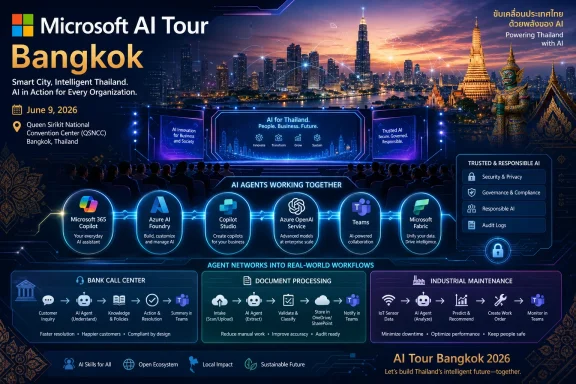 Microsoft Turns Bangkok Into a Proof Point for the Agent Era
The Bangkok stop matters because Microsoft is trying to make a very specific argument about AI adoption: the next phase will not be won by the company with the flashiest chatbot, but by the company that can embed agents into the ordinary machinery of work. That is why the announcements leaned so heavily on Microsoft 365 Copilot, Azure OpenAI Service, Azure AI Foundry, Copilot Studio, Microsoft Fabric, GitHub, and Teams. Microsoft wants customers to see those as pieces of one operating model, not disconnected products.Thailand is a useful stage for that argument. According to Microsoft’s own Global AI Diffusion Report, the share of Thailand’s working-age population actively using AI rose from 9.1 percent in the first half of 2025 to 12.4 percent in the first quarter of 2026. Microsoft says that places Thailand second globally in AI growth momentum, behind only South Korea.
The company’s Work Trend Index 2026 claims an even stronger signal inside the country’s white-collar workforce. Microsoft says 32 percent of surveyed Thai information workers qualify as “Frontier Professionals,” meaning advanced AI users in the company’s terminology, compared with a global figure of 16 percent. It also says 51 percent of Thai workers report clear and consistent leadership alignment around AI, roughly double the global figure.
Those numbers deserve the normal caution applied to vendor-sponsored workforce research. Microsoft is not a neutral observer of AI adoption; it is selling the platforms through which much of that adoption is supposed to happen. Still, the numbers explain why Bangkok is being framed as more than a tour stop. Microsoft sees Thailand as a market where the executive narrative, workforce appetite, and government modernization agenda are already pointing in the same direction.
Build 2026 Was the Product Key; Bangkok Was the Sales Floor
The timing was deliberate. AI Tour Bangkok arrived one week after Microsoft Build 2026, held June 2–3, where Microsoft pushed a broad “agent platform” story aimed at developers and enterprise technology buyers. Build supplied the technical vocabulary. Bangkok supplied the regional business case.The central product idea is that companies should be able to build agents in familiar developer environments, deploy them through Microsoft Foundry, and surface them inside Microsoft 365 and Teams. In Microsoft’s framing, the agent is not a standalone app. It is a worker-like software component that can understand business context, use approved tools, act inside governed workflows, and show up where employees already spend their day.
That is where Microsoft IQ becomes important. Microsoft describes it as an intelligence layer that brings together enterprise knowledge, work context, business data, and external web knowledge across GitHub Copilot, Microsoft Foundry, and Copilot Studio. The pitch is straightforward: agents become more useful when they are grounded in the organization’s data and rules, and less dangerous when that grounding is subject to identity, permissions, observability, and compliance controls.
For WindowsForum readers, the Windows angle is not incidental. Microsoft’s Build messaging increasingly treats Windows as part of a local AI development and execution environment, not just the client surface for cloud services. The company is trying to make Windows more “agent-ready,” with local development capabilities, model support, and a path for developers building AI-assisted or AI-native applications.
The larger implication is that Microsoft is assembling a stack in which Windows, GitHub, Azure, Microsoft 365, Teams, Fabric, and security controls reinforce one another. That is powerful for organizations already standardized on Microsoft. It is also exactly why some IT leaders will worry about lock-in, data gravity, and the long-term difficulty of separating business process from platform vendor.
Thailand’s AI Story Is Really an SME Story
The most strategically important announcement in Bangkok may not have been the flashiest one. Microsoft and AIS Business announced “AI Ready for SMEs,” an initiative intended to combine Microsoft AI tools with AIS connectivity, distribution, and local market reach. The stated goal is to make AI packages affordable and practical for businesses that have previously found adoption too expensive or too complex.That matters because national AI strategies often sound grand but fail at the small-business layer. Large banks, energy companies, and conglomerates can hire consultants, negotiate cloud agreements, and staff internal AI teams. Smaller firms usually cannot. If AI remains a technology for large enterprises, then “frontier transformation” becomes another name for productivity gains captured by incumbents.
The Microsoft-AIS effort tries to solve that through bundled packages that include AIS connectivity and Microsoft 365 Copilot, a national AI skilling roadshow, and vertical AI solution development. In plain English, Microsoft wants to lower the friction from “I’ve heard about Copilot” to “my sales, accounting, support, or operations team has a deployable workflow.”
This is also a distribution play. Microsoft brings the software platform, but AIS brings local infrastructure, customer relationships, and operational credibility in a market where connectivity and cloud readiness are unevenly distributed. For SMEs, the trust question is often not whether Microsoft has advanced AI models. It is whether the solution can be bought, supported, paid for, trained on, and governed without creating a second IT department.
If the program works, it could become a template for other ASEAN markets. If it fails, it will likely fail for familiar reasons: unclear return on investment, poor change management, weak data readiness, fragmented support, or employees who simply route around tools that do not fit the way they actually work.
The Customer Stories Are Microsoft’s Strongest Evidence and Its Riskiest Promise
The Bangkok event leaned heavily on Thai organizations already using Microsoft’s AI stack. That was the right move. The AI market is saturated with abstractions, and enterprise buyers are tired of being told that agents will transform everything someday. They want to know what changed in a call center, a bank app, a power plant, or a loan office.LH Bank’s GENIE AI is the most consumer-facing example. Built on Azure OpenAI Service and Microsoft Speech Studio, the assistant operates in the LHB You mobile app and supports voice and text interactions in Thai, English, and Mandarin. Microsoft describes it as Thailand’s first voice-enabled banking assistant, designed to help customers manage transactions and access financial guidance while following responsible AI and data-security practices.
That is an important use case because banking is where AI convenience collides with trust. A voice interface can reduce friction for customers, especially in multilingual markets and mobile-first banking environments. But it also raises hard questions about authentication, mistake handling, accessibility, fraud, and the line between guidance and regulated advice.
AutoX, a vehicle title loan provider and SCBX Group member, offered a more operational example. The company now uses Azure OpenAI Service to monitor 100 percent of contact center calls for regulatory compliance, up from a manual sampling rate of 5 to 10 percent. It is also using an AI coaching agent for field loan officers and Azure AI Vision for document classification, signature verification, and vehicle collateral valuation.
That is the kind of claim enterprise AI vendors love because it sounds concrete and measurable. Full-call monitoring is a dramatic jump from sampling, and it points to one of AI’s most immediate business uses: turning previously unreviewable operational exhaust into searchable, auditable signal. But it also reveals why governance cannot be treated as an appendix. When every call is monitored by AI, organizations need clear policies for employee surveillance, customer consent, model error, escalation, and regulatory defensibility.
SCGC’s story was framed around scale. Microsoft says the chemicals business has been building AI capability across more than 5,000 employees in Thailand and Vietnam since 2024. The company reportedly moved from personal assistant use cases into process transformation, including more than 2 million document pages processed, more than 4,000 hours saved, and external-data analysis time cut by more than 80 percent.
Those figures are eye-catching, though “100 percent accuracy” claims in document processing should always be read carefully unless the evaluation method is disclosed. In the real world, accuracy depends on document quality, language, template consistency, exception handling, and whether humans are still validating edge cases. Still, the direction is credible: document-heavy enterprises are among the earliest places where AI can convert time savings into visible operational improvement.
GPSC, the power and smart energy flagship of PTT Group, represents another enterprise pattern: using AI to monitor equipment and recommend interventions before failures become expensive. Microsoft says GPSC is using Copilot Studio, Azure AI Foundry, and Microsoft Fabric to monitor real-time operational data, map fault patterns to ISO 14224 standards, and generate repair recommendations. That is not a novelty chatbot; it is AI being wired into asset reliability and maintenance workflows.
The through line is that Microsoft is trying to pull AI out of the browser tab and into the process layer. The promise is productivity, compliance, uptime, and better decisions. The risk is that organizations automate around imperfect data, oversell model confidence, or build systems employees do not fully understand but are expected to trust.
Skilling Is the Quiet Battleground Behind the Platform War
Microsoft’s skilling announcements in Bangkok were not charitable side notes. They were part of the product strategy. AI tools only become sticky when workers know how to use them, managers know how to measure them, and organizations know how to redesign processes around them.The SCBX partnership illustrates this logic. Microsoft and SCBX are extending a collaboration delivered with Trainocate Thailand and supported by the Microsoft Organizational Skilling Program. The program has already trained more than 15,171 SCBX employees across two structured phases, from foundational AI literacy to role-based use of Microsoft 365 Copilot, Power Platform, and Azure AI.
That progression matters. Basic AI literacy can create enthusiasm, but role-based training is where adoption becomes operational. A relationship manager, compliance analyst, software developer, and HR specialist do not need the same AI curriculum. They need different prompts, controls, templates, workflows, and escalation rules.
Microsoft says the SCBX program achieved a learner satisfaction score of 4.5 out of 5. Satisfaction is not the same as productivity, but it is not meaningless. Low satisfaction often signals that workers see AI as surveillance, extra work, or executive theater. Higher satisfaction suggests at least some alignment between training content and day-to-day needs.
The broader Microsoft Elevate numbers are more ambitious. Microsoft says that in the past ten months, Microsoft Elevate has helped skill more than 780,000 learners in Thailand and awarded more than 350,000 credentials. The company plans to continue AI skills development in fiscal 2027 through Microsoft Elevate for Educators and Microsoft Elevate for Changemakers.
This is how platform companies build ecosystems in 2026. They do not only sell software licenses. They train users, certify skills, court nonprofits, shape curricula, and create a labor market that knows their tools by default. That may genuinely expand opportunity, especially if training reaches educators, community organizations, and workers outside elite firms. It also makes Microsoft’s stack part of the country’s institutional muscle memory.
The $1 Billion Investment Gives the Tour Its Real Weight
AI Tour Bangkok would have been easier to dismiss as marketing if it were not sitting on top of a larger infrastructure commitment. In March 2026, Microsoft announced plans to invest more than $1 billion in Thailand from 2026 to 2028, spanning cloud and AI infrastructure, operations, digital sovereignty, and workforce skilling. That is the backdrop that makes the June event more consequential.Infrastructure is the unglamorous part of AI strategy, but it is also the part that determines who can actually deploy at scale. Enterprises need compute capacity, data residency options, network performance, security assurances, and predictable operations. Governments need confidence that strategic workloads are not entirely dependent on distant facilities and opaque supply chains.
The phrase “digital sovereignty” is doing a lot of work here. Across Asia and Europe, governments want the economic upside of hyperscale cloud and AI without surrendering too much control over data, infrastructure, and regulatory enforcement. Microsoft is positioning itself as a partner that can bring global technology while respecting local sovereignty concerns.
That balance is hard. Hyperscalers operate through global architectures, global engineering teams, and global commercial incentives. National policymakers want local control, local skills, and local resilience. The tension does not disappear because a press release says “sovereignty”; it has to be worked out in contracts, architecture, audit rights, compliance regimes, incident response, and procurement rules.
For Thailand, Microsoft’s investment also lands in a competitive regional context. ASEAN economies are racing to attract cloud regions, AI infrastructure, semiconductor investment, data center capacity, and digital talent. Thailand does not want to be merely a consumption market for AI products built elsewhere. The frontier transformation narrative is partly about moving up the value chain.
Enterprise IT Will Hear Both Opportunity and Alarm Bells
For sysadmins and IT leaders, Microsoft’s Bangkok message is both enticing and exhausting. The enticing part is obvious: many organizations already live inside Microsoft 365, Azure Active Directory, Teams, SharePoint, Windows, and endpoint management. If AI agents can be built and governed across that estate, adoption becomes less like introducing a foreign platform and more like extending the current one.The exhausting part is that the current one is already complex. Every new AI capability brings questions about licensing, identity permissions, data classification, audit logs, retention, eDiscovery, endpoint readiness, user training, model behavior, and support boundaries. The agent era adds action-taking systems to environments that many organizations still struggle to govern at the file-sharing level.
Microsoft knows this, which is why its platform story emphasizes governance, observability, and enterprise context. The company is not pitching pure experimentation anymore. It is pitching production AI with controls. That is a necessary shift, because executives who once asked “Can we use ChatGPT?” are now asking “Can we prove what this agent did, why it did it, and whether it was allowed to do it?”
The practical burden will fall on IT. Someone has to decide which data sources agents can reach, which workflows they can trigger, which users can publish them, and how failures are investigated. Someone has to explain to the board why AI adoption is moving slower than a demo suggested, or to employees why a tool that promises to save time now requires new training and review steps.
There is also a Windows endpoint story lurking underneath the cloud narrative. If Windows becomes a more capable local AI runtime, endpoint management gets more interesting and more complicated. Devices may need more memory, newer NPUs or GPUs, tighter patching, better policy enforcement, and clearer separation between local inference, cloud inference, and corporate data access.
Microsoft’s Favorite Word Is “Frontier,” but the Real Test Is Boring Operations
“Frontier Transformation” is effective branding because it makes AI adoption sound historic, national, and inevitable. It also risks making the hard parts sound easier than they are. Most AI transformation is not frontier-like in the cinematic sense. It is spreadsheet cleanup, document permissions, data mapping, workflow redesign, help desk tickets, legal review, and repeated employee training.That is not a criticism. In fact, it is where the value usually lives. The most successful AI deployments may not look like science fiction. They may look like a loan officer getting better coaching, a call center catching compliance issues earlier, an engineer finding fault patterns faster, or a bank customer getting service in the language and modality they prefer.
Microsoft’s Bangkok examples point in that direction. They are less about replacing entire job categories overnight and more about compressing tedious work, widening monitoring coverage, and making expert systems easier to use. That is a more plausible enterprise AI story than the more theatrical claims that dominated the early generative AI boom.
But boring operations also expose the limits of vendor demos. A tool that works in a curated scenario may struggle with messy documents, ambiguous customer intent, incomplete maintenance data, or employees who distrust the recommendation engine. A compliance monitor that flags more issues may also create more review workload. A multilingual banking assistant may need continuous tuning as customers phrase requests in unexpected ways.
The strongest organizations will treat AI as a process redesign discipline, not a plug-in. They will measure not just usage, but error rates, escalation rates, employee satisfaction, customer outcomes, security incidents, and cost per transaction. They will also keep humans in the loop where stakes are high and make it clear who is accountable when AI-assisted decisions go wrong.
The Bangkok Message Windows Shops Should Carry Back to the Office
For all the national ambition around Thailand’s AI acceleration, the immediate lesson for Windows-heavy organizations is practical: Microsoft is integrating AI deeper into the stack, and waiting for the dust to settle is no longer a neutral strategy. The platform is moving from assistant features toward agents that can interact with data, tools, users, and workflows.- Microsoft is treating Thailand as a high-momentum AI market where workforce adoption, executive alignment, and infrastructure investment can reinforce one another.
- The Build 2026 announcements matter because they connect agent development in GitHub, deployment in Microsoft Foundry, and user access through Teams and Microsoft 365.
- The AIS Business partnership is a signal that Microsoft wants SME adoption, not just large-enterprise AI showcases.
- The Thai customer examples show AI moving into compliance monitoring, banking interfaces, document processing, industrial maintenance, and employee coaching.
- The skilling numbers are strategically important because Microsoft’s AI platform becomes more durable when workers and educators learn it as the default toolkit.
- IT teams should focus less on demo magic and more on permissions, auditability, data quality, endpoint readiness, licensing, and human accountability.
References
- Primary source: Microsoft Source
Published: 2026-06-09T11:42:07.569473
Loading…
news.microsoft.com - Related coverage: tomshardware.com

Microsoft unveils Project Solara AI, a chip-to-cloud platform built to power a new generation of 'agent-first' enterprise devices — hardware designed to run AI agents instead of traditional apps
Microsoft ditches Windows to build OS on Androidwww.tomshardware.com
- Related coverage: windowscentral.com
Loading…
www.windowscentral.com - Related coverage: techradar.com

Microsoft Build 2026 — all the news and updates as it happened
Everything we saw at Microsoft Build 2026www.techradar.com
- Official source: devblogs.microsoft.com

What's new in Microsoft Foundry | Build Edition | Microsoft Foundry Blog
Microsoft Build 2026 brings a major set of Microsoft Foundry updates for developers building agents: hosted runtimes, Toolboxes, memory, Voice Live, Foundry IQ, new models, managed compute, and trust, evaluation, and observability tools. devblogs.microsoft.com
- Related coverage: fptsoftware.com
Loading…
fptsoftware.com
- Related coverage: tomsguide.com
Loading…
www.tomsguide.com
