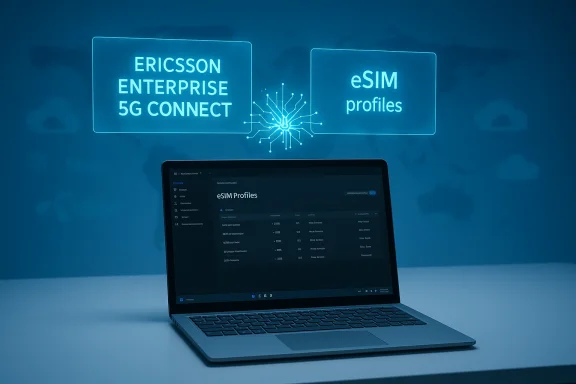
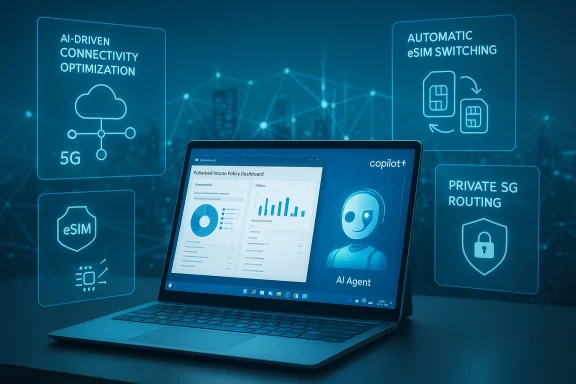
Microsoft and Ericsson’s new deal folds AI‑driven 5G connectivity directly into Windows 11, promising to make cellular the sensible default for many enterprise laptops and to turn Wi‑Fi into the fallback for scenarios where a local access point is the only option.
On February 17, 2026, Ericsson published a joint announcement with Microsoft that formalizes a long‑running set of pilots into a commercial solution: Microsoft Intune will integrate with Ericsson Enterprise 5G Connect so IT teams can provision, manage, and enforce enterprise connectivity policies for 5G‑enabled Windows 11 laptops at scale. The offering is being packaged as enterprise bundles—Surface Copilot+ hardware, Microsoft 365 and Intune, plus Ericsson’s connectivity orchestration—tied to local communications service provider (CSP) partners for delivery in multiple markets.
This is not a cosmetic update. The joint package combines three distinct layers of capability:
Microsoft and Ericsson also named Surface Copilot+ PCs as the first hardware to be offered in bundles (examples cited in coverage included Surface Laptop 7 and Surface Pro 11), positioning AI‑ready, always‑connected Surface devices as the first mainstream endpoint for this managed 5G experience.
Important caveat: full feature parity depends on the stack being ready at all levels—Windows host support, modem firmware, driver/MBIM implementation, and carrier network capabilities. Advanced slice or URSP use cases require carrier network support and validated modem firmware. Enterprises should treat sophisticated slice scenarios as pilotable features rather than universal assumptions.
That change will be visible in three ways:
That said, the real test will be in the field: hardware, modem drivers, carrier networks, and enterprise governance must all align. The offering is promising—it can make 5G the practical “default” for business traffic and relegate Wi‑Fi to the backup role in many scenarios—but success depends on careful pilots, security due diligence, and realistic expectations about regional capabilities.
For IT leaders, the immediate takeaway is simple: start planning pilots now, insist on empirical metrics, and treat connectivity orchestration as a strategic procurement item. For end users, the promise is tangible: fewer connection headaches and more time focused on work instead of networks. The enterprise future Microsoft and Ericsson outline is not a revolution that happens overnight; it’s an operational evolution that, if executed properly, can finally unlock the “always‑connected” promise of 5G for business laptops.
Source: Windows Central https://www.windowscentral.com/microsoft/windows-11/microsoft-ericsson-5g-enterprise-ai/
 Background
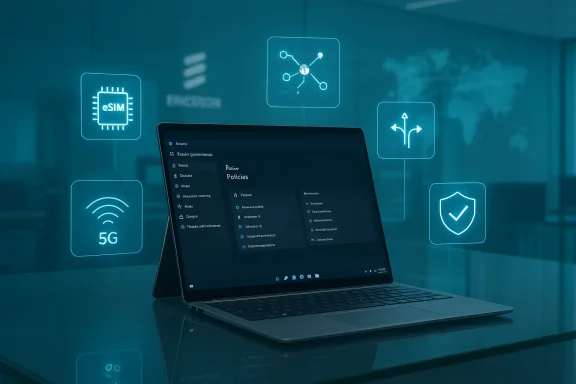
On February 17, 2026, Ericsson published a joint announcement with Microsoft that formalizes a long‑running set of pilots into a commercial solution: Microsoft Intune will integrate with Ericsson Enterprise 5G Connect so IT teams can provision, manage, and enforce enterprise connectivity policies for 5G‑enabled Windows 11 laptops at scale. The offering is being packaged as enterprise bundles—Surface Copilot+ hardware, Microsoft 365 and Intune, plus Ericsson’s connectivity orchestration—tied to local communications service provider (CSP) partners for delivery in multiple markets.This is not a cosmetic update. The joint package combines three distinct layers of capability:
- The Windows 11 host which exposes management hooks and runs a small, local decision agent.
- Microsoft Intune, which provides zero‑touch provisioning, policy distribution, and device compliance management.
- Ericsson Enterprise 5G Connect, a cloud orchestration layer that handles eSIM lifecycle, multi‑CSP policy enforcement, telemetry collection, performance analytics and automated network actions driven by AI.
What the announcement actually says
The joint solution emphasizes three headline capabilities:- Automated eSIM provisioning and switching — enterprises can provision eSIM profiles at scale and have devices automatically select the best CSP profile according to policy and measured network quality.
- AI‑driven connectivity intelligence — Ericsson’s platform continuously monitors end‑to‑end network quality and, when combined with a local Windows agent, can make real‑time connectivity decisions for performance, latency, cost, and security.
- Unified policy enforcement via Intune — connectivity is treated as a managed resource: IT can prioritize 5G for business traffic, enforce corporate data limits, route traffic through enterprise security stacks (SASE/VPN), and ensure devices meet compliance checks before accessing sensitive resources.
Microsoft and Ericsson also named Surface Copilot+ PCs as the first hardware to be offered in bundles (examples cited in coverage included Surface Laptop 7 and Surface Pro 11), positioning AI‑ready, always‑connected Surface devices as the first mainstream endpoint for this managed 5G experience.
Why this matters: the enterprise connectivity problem
For years, enterprises have treated Wi‑Fi, VPN, and corporate networking gear as the default for office and remote connectivity. Cellular laptops—devices with built‑in LTE or 5G modems—have always promised a simpler, always‑connected user experience, but adoption stalled for practical reasons:- eSIM provisioning at scale was awkward or manual.
- Carrier agreements, roaming costs, and device CSP bindings created procurement headaches.
- IT lacked centralized tools to apply consistent connectivity security policies across carriers and regions.
- Network selection and quality control were often left to end users, creating support tickets and inconsistent performance for latency‑sensitive apps like video conferencing or remote desktop.
Technical deep dive: how the pieces work together
eSIM provisioning and management
Windows 11 already includes eSIM support and Microsoft Intune has had evolving capabilities for eSIM orchestration. The practical mechanism most enterprises will use is the SM‑DP+ / SM‑DS model:- IT or the OEM provides device EIDs (embedded UICC identifiers) as part of procurement manifests.
- The mobile operator or its provisioning server (SM‑DP+) holds eSIM profiles tied to those EIDs.
- Intune (or Ericsson’s orchestration plane working with Intune) points devices at the correct SM‑DP+ server and triggers profile downloads automatically, avoiding manual activation codes or SIM swaps.
Local device intelligence and MBIM hooks
A small local agent running on Windows 11 devices evaluates telemetry—signal strength, round‑trip latency, throughput, battery level, app priorities and corporate policy—to choose the best network or to instruct the device to switch eSIM profiles. These decisions use existing host/modem interfaces (Mobile Broadband Interface Model or MBIM and the newer MBIM extensions for 5G) and rely on modem firmware and driver support for advanced features such as URSP (User Equipment Route Selection Policy) and network slice awareness.Important caveat: full feature parity depends on the stack being ready at all levels—Windows host support, modem firmware, driver/MBIM implementation, and carrier network capabilities. Advanced slice or URSP use cases require carrier network support and validated modem firmware. Enterprises should treat sophisticated slice scenarios as pilotable features rather than universal assumptions.
Cloud orchestration and AI
Ericsson Enterprise 5G Connect provides the orchestration layer that:- Maintains multi‑carrier profiles and orchestrates when/where each profile is available.
- Aggregates device and network telemetry to create a centralized view of fleet performance.
- Feeds AI models that can recommend or carry out automated actions—e.g., promoting a particular CSP for a region, or switching a particular device to a different eSIM to avoid packet loss detected at the network edge.
Immediate benefits for IT and end users
- Fewer help‑desk tickets: automated provisioning and policy enforcement remove common support scenarios such as “my laptop won’t connect” or “I need a new SIM.”
- Policy consistency everywhere: Intune‑driven rules mean the same security posture applies whether a worker is on a home Wi‑Fi, 5G, or a hotel network.
- Better performance for critical workflows: per‑app or per‑flow prioritization, combined with local device intelligence, can reduce call drops and jitter for Teams, remote desktop, and real‑time collaboration apps.
- Operational predictability: telemetry and operator SLAs can be monitored centrally, enabling capacity planning and cost controls.
- Simpler global mobility: automatic eSIM switching makes roaming and cross‑market device usage more practical for global teams—no more shipping physical SIMs or manual carrier activations.
Security and privacy considerations
Treat the promised security enhancements and the new attack surface as two sides of the same coin.- Positive side: Ericsson advertises end‑to‑end encrypted tunnels from device to a Secure Access Service Edge (SASE) in the cloud, and Intune can require device compliance before network or app access. These controls can reduce the reliance on fragile Wi‑Fi and public hotspots.
- Risk side: centralized eSIM orchestration and automatic CSP switching concentrate trust in the orchestration plane. If that plane is compromised, an attacker could theoretically manipulate connectivity policies or redirect traffic. Enterprises must demand strong authentication, logging, and role‑based access controls for the orchestration interface.
- Telemetry collection is necessary for AI optimization—IT leaders must define retention, access controls and acceptable telemetry granularity to avoid collecting unnecessary user data.
- Carrier relationships and cross‑border data flows may raise compliance issues for regulated industries (finance, healthcare, government). Legal and privacy teams should validate data residency and lawful‑access policies before large rollouts.
Business implications: carriers, OEMs, and vendor dynamics
This initiative is as much about business models as it is about technology.- CSPs gain new enterprise channels: Ericsson’s platform is a gateway for carriers to monetize enterprise laptop connectivity beyond consumer SIM sales—network slices, prioritized business profiles, and SLA‑backed services.
- OEM differentiation: Surface Copilot+ PCs are positioned as the first OEM hardware for the bundles. But Ericsson has stated that the eventual objective is broader endpoint support. Today’s launch with Surface is a sensible commercial first step, not a permanent hardware tie.
- Potential vendor lock‑in: Enterprises should be aware that an end‑to‑end managed solution involving Microsoft Intune, Ericsson Connect, and CSP bundles can create operational dependencies. IT procurement should negotiate exit terms, data exportability, and transitional support to avoid being locked into a single orchestration provider.
Where and when: availability and scope
- The official Ericsson announcement is dated February 17, 2026.
- Initial availability was declared for the United States (T‑Mobile), Sweden (Telenor), Singapore (Singtel) and Japan (SoftBank).
- Additional launches were listed for other 2026 rollouts, including Spain (MasOrange), Germany (O2 Telefónica Germany) and Finland (Elisa).
- Ericsson and Microsoft said commercial bundles would be offered with Surface Copilot+ PCs and Microsoft 365 + Intune, with broader operator partners involved in early launch programs.
Limitations, technical caveats, and open questions
- Device/modem/driver dependencies
- Advanced capabilities like network slicing and URSP rely on modem firmware and driver support. Not all modems or OEM implementations will expose every 5G native capability to Windows.
- Carrier readiness varies by market
- Slicing and certain SLA features remain a work in progress across many networks. Expect feature parity to lag by region.
- Battery and thermal implications
- Continuous multi‑radio monitoring and frequent carrier switches have non‑zero power costs. IT must account for potential battery life trade‑offs for remote or field teams.
- Cost and billing complexity
- Multi‑CSP eSIM profiles simplify logistics but add complexity to billing—who pays for which sessions, and how are roaming or slice premiums billed? Expect negotiations with carriers for predictable enterprise pricing.
- Governance and data residency
- Centralized telemetry and orchestration may cross borders. Compliance teams must review data flows, retention rules, and lawful‑access scenarios.
- Vendor claims vs. independent validation
- Some of the performance and adoption figures cited in vendor materials are projections or pilot outcomes. Enterprises should insist on independent trials and empirical telemetry from pilot deployments to validate vendor claims.
Practical rollout checklist for IT leaders
If you’re an IT leader considering a pilot or rollout, use this checklist to manage risk and measure impact:- Select a representative pilot group
- Choose teams that are mobility‑heavy (field sales, executive assistants, hybrid developers) and have a mix of geography.
- Confirm hardware compatibility
- Validate modem chipset, vendor driver MBIM support, and that Surface or other Copilot+ units have the necessary firmware and Windows builds.
- Define telemetry and success metrics
- Decide what to measure (call/meeting drop rate, remote desktop latency, support ticket volume, data cost per user) and instrument devices centrally.
- Validate security posture and orbits
- Obtain vendor security documentation, review SASE/Security tunnel operation, and test failure modes (for example, how the device behaves when orchestration is offline).
- Negotiate carrier SLAs and cost model
- Ensure predictable billing, clear roaming terms, and escalation paths for network incidents.
- Pilot with time‑boxed objectives
- Set a 60–90 day pilot window, collect empirical data, and publish a decision memo with TCO and productivity estimates.
The user experience: will Wi‑Fi become the backup?
The most intriguing end‑user implication is cultural: when the network stack can make smart, policy‑driven choices automatically, many employees will stop thinking about which network they’re using. For critical work—video calls, remote desktop, cloud inference jobs—5G can become the default, and Wi‑Fi the fallback where local networks are available and acceptable.That change will be visible in three ways:
- Fewer manual toggles by users; connectivity "just works."
- Reduced troubleshooting for intermittent Wi‑Fi or hotel hotspots that used to break calls.
- A smoother experience for remote collaboration and cloud‑heavy workflows.
Strategic recommendations
- Pilot before you buy: test with a cross‑section of users, applications, and geographies to gather real metrics.
- Treat connectivity like an application: include 5G policy and cost control in the same governance cycles as SaaS procurement and endpoint protection.
- Demand transparency: negotiate contractual terms that guarantee access to orchestration logs, data export, and a clear off‑ramp in case you need to move providers.
- Include legal and privacy early: centralized telemetry and international carrier relationships create compliance dependencies that must be solved up front.
- Don’t ignore power: verify battery and thermal behavior on candidate hardware, especially for heavy mobile users.
Conclusion
Microsoft and Ericsson’s integration of Enterprise 5G Connect into Windows 11 via Intune represents a substantive evolution in how enterprises can manage connectivity for hybrid and mobile workforces. By automating eSIM provisioning, enabling carrier switching, and folding connectivity into the policy layer enterprises already use, the solution addresses the operational frictions that have kept cellular laptop adoption modest.That said, the real test will be in the field: hardware, modem drivers, carrier networks, and enterprise governance must all align. The offering is promising—it can make 5G the practical “default” for business traffic and relegate Wi‑Fi to the backup role in many scenarios—but success depends on careful pilots, security due diligence, and realistic expectations about regional capabilities.
For IT leaders, the immediate takeaway is simple: start planning pilots now, insist on empirical metrics, and treat connectivity orchestration as a strategic procurement item. For end users, the promise is tangible: fewer connection headaches and more time focused on work instead of networks. The enterprise future Microsoft and Ericsson outline is not a revolution that happens overnight; it’s an operational evolution that, if executed properly, can finally unlock the “always‑connected” promise of 5G for business laptops.
Source: Windows Central https://www.windowscentral.com/microsoft/windows-11/microsoft-ericsson-5g-enterprise-ai/