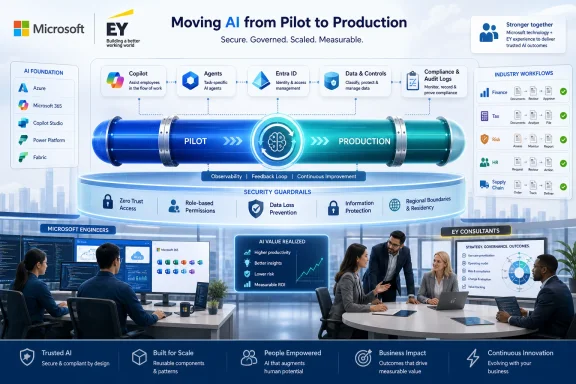
On Thursday, May 21, 2026, Microsoft and EY announced a $1 billion partnership that will pair Microsoft Forward Deployed Engineers with EY industry professionals to help large organizations move artificial intelligence projects from pilots into production across core business functions. The announcement is less about another consulting alliance than about Microsoft’s next enterprise AI sales motion: selling adoption, governance, and business redesign as a package. EY gets to present itself as proof that Copilot can scale inside a sprawling professional-services firm; Microsoft gets a services channel aimed directly at the place where AI pilots often go to die. For WindowsForum readers, the signal is clear: corporate AI is becoming less of an optional app rollout and more of an operating model.
Microsoft has spent the past two years trying to make Copilot feel inevitable. It has put the brand into Windows, Microsoft 365, Edge, GitHub, Security, Dynamics, and Azure, often faster than customers could form a coherent plan for using it. The EY deal shows the next phase: Microsoft is no longer merely shipping AI features and waiting for enterprises to discover value on their own.
That matters because the first wave of enterprise AI adoption exposed a basic mismatch. Vendors sold assistants; companies needed redesigned workflows. A chatbot in Outlook can summarize a thread, but it does not automatically rebuild a tax close, a claims process, a procurement approval chain, or a regulated audit trail.
The new partnership is built around that gap. Microsoft brings platforms, models, engineering teams, and its increasingly important Forward Deployed Engineer model. EY brings industry process knowledge, change management, and access to the executive committees that decide whether AI becomes a line-item experiment or a board-level transformation program.
This is not a subtle move. The companies are explicitly targeting finance, tax, risk, HR, and supply chain work in financial services, industrial and energy firms, consumer and retail, government, and healthcare. These are not side workflows. They are the systems where AI mistakes can become compliance problems, labor disputes, bad forecasts, or broken customer commitments.
Microsoft’s use of the model is revealing. It is an admission that AI adoption is not following the classic SaaS path, where a vendor sells seats, activates licenses, and lets departments organically discover use cases. Enterprise AI is messier. It touches permissions, data quality, identity, security policy, document sprawl, process ownership, labor expectations, and executive anxiety.
That is why the engineer matters. A deployed AI agent that can touch business systems is not just a feature. It is a small software actor moving through an organization’s data, APIs, approvals, and records. Someone has to define what it can see, what it can change, when it needs human approval, and how its actions are logged.
For Microsoft, the Forward Deployed Engineer also solves a perception problem. Copilot has often been judged by individual productivity anecdotes: faster meeting notes, cleaner drafts, easier spreadsheet work. Those are useful, but they are not enough to justify a billion-dollar enterprise transformation narrative. Engineers embedded with EY teams can chase higher-value workflows where Microsoft can claim measurable outcomes rather than merely more convenient office work.
That “Client Zero” framing is clever because it answers the question every large customer asks privately: did the consultancy actually do this to itself, or is it just selling transformation decks? EY can argue that it has wrestled with the practical issues of deployment at scale: training, measurement, governance, cultural resistance, data access, and the uncomfortable business of deciding which tasks should change.
Still, the claim deserves scrutiny. Productivity percentages in AI announcements often compress a complicated reality into a clean headline number. A 15 percent gain may mean faster document handling, fewer administrative hours, better knowledge retrieval, or simply time saved in specific workflows rather than a uniform improvement across the whole firm.
That does not make the number meaningless. It makes it a starting point. The deeper question for customers is whether saved time becomes economic value. If employees spend less time drafting, searching, or summarizing, does the organization sell more, serve clients faster, reduce risk, lower costs, or improve retention? Microsoft and EY are betting that the answer becomes more persuasive when AI is tied to process redesign rather than left as a general-purpose assistant.
That is the real commercial strategy behind the rhetoric. Microsoft already owns much of the productivity estate inside large companies. Windows endpoints, Office documents, Teams chats, SharePoint libraries, Exchange mailboxes, Entra identities, Defender alerts, Intune policies, and Purview compliance controls form a dense map of corporate work. AI is the layer Microsoft can use to make that map more valuable — and harder to leave.
E7 is not just a license bundle; it is a statement about where Microsoft believes enterprise IT is heading. The company is arguing that AI adoption cannot be separated from identity, endpoint management, data governance, and security operations. That argument will resonate with administrators who have already seen what happens when departments experiment with unmanaged AI tools using sensitive documents.
But it also raises the familiar Microsoft concern: consolidation by convenience. If the answer to AI governance is another higher-tier Microsoft license, customers may gain integration while losing leverage. The more Copilot agents, permissions, and business workflows depend on Microsoft’s stack, the more future procurement debates shift from “Which tool is best?” to “How disruptive would it be to leave?”
This is where the Microsoft-EY pairing makes sense. EY’s consultants can translate executive ambition into process maps, operating models, training plans, and compliance guardrails. Microsoft’s engineers can push the technology closer to the actual environment where work happens. Together, they can tell customers that AI adoption is not a tool-selection exercise but a deployment discipline.
There is an obvious market need for that discipline. Many organizations bought or piloted AI tools before they knew how to measure value. Some employees use AI daily, while others are either blocked by policy or left to improvise with little training. A gap has opened between corporate messaging — AI will transform everything — and worker reality, where many people are expected to adapt without enough instruction or clarity.
That gap is dangerous. Poorly trained AI users do not just underuse expensive software; they create risk. They may paste sensitive data into the wrong system, rely on flawed summaries, automate steps they do not understand, or produce work that looks polished but lacks judgment. If Microsoft and EY are serious about enterprise execution, training and governance cannot be the afterthoughts that follow the licensing deal.
Administrators will need to think less like software deployers and more like supervisors of digital labor. Which agents exist? Who created them? What data can they access? Which users can delegate tasks to them? What actions require approval? How are outputs reviewed? What happens when an agent follows instructions correctly but the instructions were poorly designed?
Microsoft’s Agent 365 is meant to address that emerging governance problem, and its inclusion in the E7 story is important. Microsoft is trying to reassure enterprises that the same identity, compliance, and security logic that governs users can extend to AI agents. That is an attractive proposition for organizations already invested in Entra, Defender, Intune, and Purview.
Yet governance tooling will not remove the hard organizational questions. If an HR agent screens policy documents and recommends employee actions, who owns the decision? If a supply chain agent proposes vendor substitutions, who verifies contractual and geopolitical risk? If a finance agent accelerates month-end close, who signs off when its assumptions are wrong? The technical control plane is necessary, but accountability still belongs to humans.
That gives Microsoft an incentive to lock in premium alliances before customers standardize around rival stacks. EY has deep relationships in heavily regulated sectors, which are precisely the places where Microsoft wants Copilot and Azure AI to be seen as safe choices. The partnership gives Microsoft a route into boardroom conversations framed around business performance, not just IT modernization.
It also helps Microsoft defend against the growing fragmentation of the AI market. Large customers increasingly want model choice, multi-cloud leverage, and protection from betting everything on a single vendor’s roadmap. Microsoft’s response is to bundle AI into the environment companies already use and surround it with governance, consulting, and engineering support.
That approach is powerful because it meets enterprises where they are. It is also risky because it asks them to accept Microsoft as both platform vendor and transformation partner. For some customers, that will feel efficient. For others, especially those wary of vendor lock-in, it will feel like the old Microsoft playbook rewritten for the AI era.
Training, however, is usually less exciting than deployment. Executives announce AI rollouts; employees receive tool access, a webinar, and vague encouragement to “experiment.” That may work for low-risk productivity features, but it is insufficient for workflows involving finance, healthcare, government records, risk analysis, tax positions, or personnel decisions.
EY’s own “Client Zero” story is valuable only if it includes this human side. Productivity gains are not produced by models alone. They come from changing habits, redesigning processes, and giving workers permission to stop doing low-value work in old ways. If saved time merely becomes more meetings or more output pressure, the transformation story curdles into surveillance-era productivity theater.
This is where IT pros should pay close attention. AI adoption will increasingly arrive wrapped in business language, but the operational burden will fall on administrators, security teams, compliance officers, and help desks. They will be asked to enable tools, restrict risky behaviors, explain new policies, investigate strange outputs, and support users who are simultaneously excited, skeptical, and undertrained.
Windows endpoints still matter because they are where much of the work happens. Copilot may live in Microsoft 365, Teams, Edge, and business applications, but the endpoint remains the user’s daily control room. Policies set through Intune, authentication through Entra, protection through Defender, and compliance through Purview all shape whether AI can be deployed safely.
That integration is Microsoft’s advantage. It can tell enterprises that AI is not a separate system to bolt onto the environment. It is a capability woven through the stack they already run. For organizations struggling with shadow AI, that message will be persuasive.
But the desktop also becomes a battleground for trust. Users will want to know when AI is observing context, using work data, summarizing communications, or acting on their behalf. Administrators will need clear controls and auditability, not just marketing assurances. If AI becomes ambient in the workplace, transparency becomes a feature, not a courtesy.
That combination makes them ideal and dangerous AI territory. AI can help professionals find patterns, draft analyses, reconcile information, and compress administrative cycles. It can also create confident errors, hide assumptions, and encourage leaders to mistake automation for understanding.
The most successful deployments will probably not be the ones that replace entire roles overnight. They will be the ones that remove friction from specific workflows while preserving human accountability at the points where judgment matters. That is less dramatic than the “AI will run the company” storyline, but it is far more plausible.
Microsoft and EY appear to understand this, at least in their public framing. The focus on measurable impact, enterprise execution, and industry-specific transformation is a move away from generic AI enthusiasm. The unanswered question is whether the economics of a billion-dollar partnership push customers toward careful redesign or toward faster, broader rollouts than their organizations can absorb.
For IT leaders, the roadshow version of this partnership will likely sound polished. It will feature productivity numbers, agentic workflows, secure platforms, and transformation language. The harder work is translating that into procurement terms, risk controls, and operational readiness.
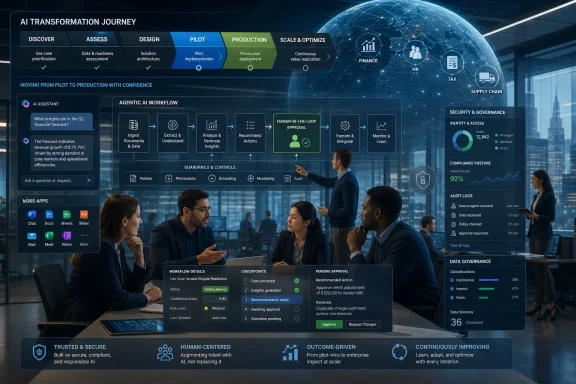 Microsoft Turns AI From Software Into Deployment Theater
Microsoft has spent the past two years trying to make Copilot feel inevitable. It has put the brand into Windows, Microsoft 365, Edge, GitHub, Security, Dynamics, and Azure, often faster than customers could form a coherent plan for using it. The EY deal shows the next phase: Microsoft is no longer merely shipping AI features and waiting for enterprises to discover value on their own.That matters because the first wave of enterprise AI adoption exposed a basic mismatch. Vendors sold assistants; companies needed redesigned workflows. A chatbot in Outlook can summarize a thread, but it does not automatically rebuild a tax close, a claims process, a procurement approval chain, or a regulated audit trail.
The new partnership is built around that gap. Microsoft brings platforms, models, engineering teams, and its increasingly important Forward Deployed Engineer model. EY brings industry process knowledge, change management, and access to the executive committees that decide whether AI becomes a line-item experiment or a board-level transformation program.
This is not a subtle move. The companies are explicitly targeting finance, tax, risk, HR, and supply chain work in financial services, industrial and energy firms, consumer and retail, government, and healthcare. These are not side workflows. They are the systems where AI mistakes can become compliance problems, labor disputes, bad forecasts, or broken customer commitments.
The Forward Deployed Engineer Becomes Microsoft’s New Salesperson
The phrase Forward Deployed Engineer has escaped its Palantir origins and become one of the defining job titles of the enterprise AI boom. The idea is simple enough: rather than hand customers a platform and wait for internal teams to figure it out, embed engineers close to the business problem. They sit with users, wire systems together, adjust models and agents, and turn demos into working machinery.Microsoft’s use of the model is revealing. It is an admission that AI adoption is not following the classic SaaS path, where a vendor sells seats, activates licenses, and lets departments organically discover use cases. Enterprise AI is messier. It touches permissions, data quality, identity, security policy, document sprawl, process ownership, labor expectations, and executive anxiety.
That is why the engineer matters. A deployed AI agent that can touch business systems is not just a feature. It is a small software actor moving through an organization’s data, APIs, approvals, and records. Someone has to define what it can see, what it can change, when it needs human approval, and how its actions are logged.
For Microsoft, the Forward Deployed Engineer also solves a perception problem. Copilot has often been judged by individual productivity anecdotes: faster meeting notes, cleaner drafts, easier spreadsheet work. Those are useful, but they are not enough to justify a billion-dollar enterprise transformation narrative. Engineers embedded with EY teams can chase higher-value workflows where Microsoft can claim measurable outcomes rather than merely more convenient office work.
EY’s “Client Zero” Story Is the Pitch
EY’s most important role in this partnership may not be as a consultant. It is as a case study. The companies say EY deployed Microsoft’s Copilot AI assistant to 150,000 users and saw a 15 percent productivity improvement that was reinvested into client delivery and learning. EY is now scaling Copilot through Microsoft 365 E7: The Frontier Suite to more than 400,000 employees worldwide.That “Client Zero” framing is clever because it answers the question every large customer asks privately: did the consultancy actually do this to itself, or is it just selling transformation decks? EY can argue that it has wrestled with the practical issues of deployment at scale: training, measurement, governance, cultural resistance, data access, and the uncomfortable business of deciding which tasks should change.
Still, the claim deserves scrutiny. Productivity percentages in AI announcements often compress a complicated reality into a clean headline number. A 15 percent gain may mean faster document handling, fewer administrative hours, better knowledge retrieval, or simply time saved in specific workflows rather than a uniform improvement across the whole firm.
That does not make the number meaningless. It makes it a starting point. The deeper question for customers is whether saved time becomes economic value. If employees spend less time drafting, searching, or summarizing, does the organization sell more, serve clients faster, reduce risk, lower costs, or improve retention? Microsoft and EY are betting that the answer becomes more persuasive when AI is tied to process redesign rather than left as a general-purpose assistant.
Microsoft 365 E7 Is the Commercial Engine Under the Partnership
The EY announcement also lands neatly beside Microsoft’s broader push for Microsoft 365 E7: The Frontier Suite. E7 bundles Microsoft 365 E5, Microsoft 365 Copilot, Microsoft Entra Suite, and Agent 365 into a premium enterprise package intended to combine productivity, security, identity, compliance, and AI agent governance. In plain terms, Microsoft wants customers to stop thinking of Copilot as an add-on and start thinking of AI as part of the enterprise control plane.That is the real commercial strategy behind the rhetoric. Microsoft already owns much of the productivity estate inside large companies. Windows endpoints, Office documents, Teams chats, SharePoint libraries, Exchange mailboxes, Entra identities, Defender alerts, Intune policies, and Purview compliance controls form a dense map of corporate work. AI is the layer Microsoft can use to make that map more valuable — and harder to leave.
E7 is not just a license bundle; it is a statement about where Microsoft believes enterprise IT is heading. The company is arguing that AI adoption cannot be separated from identity, endpoint management, data governance, and security operations. That argument will resonate with administrators who have already seen what happens when departments experiment with unmanaged AI tools using sensitive documents.
But it also raises the familiar Microsoft concern: consolidation by convenience. If the answer to AI governance is another higher-tier Microsoft license, customers may gain integration while losing leverage. The more Copilot agents, permissions, and business workflows depend on Microsoft’s stack, the more future procurement debates shift from “Which tool is best?” to “How disruptive would it be to leave?”
The Pilot Problem Is Real, and Microsoft Knows It
The companies’ language about moving “beyond pilots” is not accidental. The enterprise AI market is crowded with proof-of-concepts that impressed executives in controlled demos and then stalled when exposed to real business systems. The reasons are rarely glamorous. Data is messy. Access rights are inconsistent. Legacy applications lack clean APIs. Legal teams worry about retention and disclosure. Employees do not know when to trust the output.This is where the Microsoft-EY pairing makes sense. EY’s consultants can translate executive ambition into process maps, operating models, training plans, and compliance guardrails. Microsoft’s engineers can push the technology closer to the actual environment where work happens. Together, they can tell customers that AI adoption is not a tool-selection exercise but a deployment discipline.
There is an obvious market need for that discipline. Many organizations bought or piloted AI tools before they knew how to measure value. Some employees use AI daily, while others are either blocked by policy or left to improvise with little training. A gap has opened between corporate messaging — AI will transform everything — and worker reality, where many people are expected to adapt without enough instruction or clarity.
That gap is dangerous. Poorly trained AI users do not just underuse expensive software; they create risk. They may paste sensitive data into the wrong system, rely on flawed summaries, automate steps they do not understand, or produce work that looks polished but lacks judgment. If Microsoft and EY are serious about enterprise execution, training and governance cannot be the afterthoughts that follow the licensing deal.
Agentic AI Raises the Stakes for Administrators
The most consequential word in the announcement is not Copilot. It is agentic. An assistant that drafts text is one thing; an agent that can pursue goals across systems is another. Once AI moves from answering questions to taking actions, IT’s job changes.Administrators will need to think less like software deployers and more like supervisors of digital labor. Which agents exist? Who created them? What data can they access? Which users can delegate tasks to them? What actions require approval? How are outputs reviewed? What happens when an agent follows instructions correctly but the instructions were poorly designed?
Microsoft’s Agent 365 is meant to address that emerging governance problem, and its inclusion in the E7 story is important. Microsoft is trying to reassure enterprises that the same identity, compliance, and security logic that governs users can extend to AI agents. That is an attractive proposition for organizations already invested in Entra, Defender, Intune, and Purview.
Yet governance tooling will not remove the hard organizational questions. If an HR agent screens policy documents and recommends employee actions, who owns the decision? If a supply chain agent proposes vendor substitutions, who verifies contractual and geopolitical risk? If a finance agent accelerates month-end close, who signs off when its assumptions are wrong? The technical control plane is necessary, but accountability still belongs to humans.
The Partnership Is Also a Competitive Signal
Microsoft is not alone in realizing that AI deployment requires bodies on the ground. OpenAI has moved toward its own deployment-company model, major consultancies are building AI engineering practices, and systems integrators are racing to turn the AI boom into services revenue. Accenture, PwC, EY, and others understand that the most lucrative enterprise AI work is not a license resale. It is the redesign of operating processes around new machine capabilities.That gives Microsoft an incentive to lock in premium alliances before customers standardize around rival stacks. EY has deep relationships in heavily regulated sectors, which are precisely the places where Microsoft wants Copilot and Azure AI to be seen as safe choices. The partnership gives Microsoft a route into boardroom conversations framed around business performance, not just IT modernization.
It also helps Microsoft defend against the growing fragmentation of the AI market. Large customers increasingly want model choice, multi-cloud leverage, and protection from betting everything on a single vendor’s roadmap. Microsoft’s response is to bundle AI into the environment companies already use and surround it with governance, consulting, and engineering support.
That approach is powerful because it meets enterprises where they are. It is also risky because it asks them to accept Microsoft as both platform vendor and transformation partner. For some customers, that will feel efficient. For others, especially those wary of vendor lock-in, it will feel like the old Microsoft playbook rewritten for the AI era.
Workers Are Being Asked to Cross the Gap Faster Than Companies Can Train Them
The PYMNTS research cited around the announcement points to a tension that enterprise leaders cannot ignore: many professional workers are encountering AI tools they are not prepared to use effectively. This is not a soft concern. The usefulness of Copilot depends heavily on the user’s ability to frame tasks, evaluate outputs, understand limitations, and know when not to automate.Training, however, is usually less exciting than deployment. Executives announce AI rollouts; employees receive tool access, a webinar, and vague encouragement to “experiment.” That may work for low-risk productivity features, but it is insufficient for workflows involving finance, healthcare, government records, risk analysis, tax positions, or personnel decisions.
EY’s own “Client Zero” story is valuable only if it includes this human side. Productivity gains are not produced by models alone. They come from changing habits, redesigning processes, and giving workers permission to stop doing low-value work in old ways. If saved time merely becomes more meetings or more output pressure, the transformation story curdles into surveillance-era productivity theater.
This is where IT pros should pay close attention. AI adoption will increasingly arrive wrapped in business language, but the operational burden will fall on administrators, security teams, compliance officers, and help desks. They will be asked to enable tools, restrict risky behaviors, explain new policies, investigate strange outputs, and support users who are simultaneously excited, skeptical, and undertrained.
The Windows Angle Is the Enterprise Desktop Becoming an AI Surface
For the Windows ecosystem, this partnership is another reminder that the desktop is no longer just a place where applications run. It is becoming an AI surface connected to identity, cloud policy, local context, productivity data, and security telemetry. Microsoft’s enterprise AI strategy makes the most sense when viewed across that whole estate.Windows endpoints still matter because they are where much of the work happens. Copilot may live in Microsoft 365, Teams, Edge, and business applications, but the endpoint remains the user’s daily control room. Policies set through Intune, authentication through Entra, protection through Defender, and compliance through Purview all shape whether AI can be deployed safely.
That integration is Microsoft’s advantage. It can tell enterprises that AI is not a separate system to bolt onto the environment. It is a capability woven through the stack they already run. For organizations struggling with shadow AI, that message will be persuasive.
But the desktop also becomes a battleground for trust. Users will want to know when AI is observing context, using work data, summarizing communications, or acting on their behalf. Administrators will need clear controls and auditability, not just marketing assurances. If AI becomes ambient in the workplace, transparency becomes a feature, not a courtesy.
The Real Test Is Measurable Business Change
The Microsoft-EY partnership will be judged by whether it produces repeatable outcomes rather than impressive announcements. The target functions — finance, tax, risk, HR, and supply chain — are full of repetitive work, document-heavy decisions, and fragmented knowledge. They are also full of exceptions, judgment calls, regulatory constraints, and institutional memory that does not live neatly in a database.That combination makes them ideal and dangerous AI territory. AI can help professionals find patterns, draft analyses, reconcile information, and compress administrative cycles. It can also create confident errors, hide assumptions, and encourage leaders to mistake automation for understanding.
The most successful deployments will probably not be the ones that replace entire roles overnight. They will be the ones that remove friction from specific workflows while preserving human accountability at the points where judgment matters. That is less dramatic than the “AI will run the company” storyline, but it is far more plausible.
Microsoft and EY appear to understand this, at least in their public framing. The focus on measurable impact, enterprise execution, and industry-specific transformation is a move away from generic AI enthusiasm. The unanswered question is whether the economics of a billion-dollar partnership push customers toward careful redesign or toward faster, broader rollouts than their organizations can absorb.
The Fine Print IT Leaders Should Read Before the Roadshow Arrives
The useful way to read this announcement is not as a promise that Microsoft and EY have solved enterprise AI. They have identified where the money is: the messy middle between demo and deployment. That middle is where governance, training, integration, and business ownership determine whether AI becomes infrastructure or shelfware.For IT leaders, the roadshow version of this partnership will likely sound polished. It will feature productivity numbers, agentic workflows, secure platforms, and transformation language. The harder work is translating that into procurement terms, risk controls, and operational readiness.
- Organizations should demand workflow-level business cases rather than broad promises about productivity.
- AI agents should be inventoried, permissioned, monitored, and retired with the same seriousness applied to privileged applications.
- Worker training should be funded as part of deployment, not treated as a communications task after licenses are assigned.
- Security and compliance teams should be involved before pilots become production systems, especially in regulated functions.
- Customers should evaluate whether Microsoft 365 E7 simplifies governance enough to justify deeper platform dependence.
- Productivity claims should be tied to measurable outcomes such as cycle-time reduction, error reduction, revenue impact, or improved service quality.
References
- Primary source: pymnts.com
Published: 2026-05-21T16:25:10.188629
PYMNTS | Microsoft and EY Team to Promote Corporate AI Adoption
Microsoft is working with professional services network EY to promote corporate adoption of artificial intelligence (AI). www.pymnts.com
- Official source: blogs.microsoft.com
Introducing the First Frontier Suite built on Intelligence + Trust - The Official Microsoft Blog
Today Microsoft is announcing: Wave 3 of Microsoft 365 Copilot Expanded model diversity with Claude and next-gen OpenAI models available today General availability of Agent 365 on May 1 for $15 per user General availability of the new Microsoft 365 E7: The Frontier Suite on May 1 for $99 per...blogs.microsoft.com - Official source: microsoft.com
Powering Frontier Transformation with Copilot and agents | Microsoft 365 Blog
Wave 3 of Microsoft 365 Copilot introduces Copilot Cowork, multi‑model intelligence, and enterprise‑ready AI—built to get real work done.www.microsoft.com - Official source: learn.microsoft.com
May 2026 announcements - Partner Center announcements | Microsoft Learn
May 2026 announcements for Microsoft Partner Center including new capabilities, promotions, offers, markets, or changes to existing offers.learn.microsoft.com - Official source: partner.microsoft.com
Leading Frontier Firm transformation with Microsoft 365 E7: The partner opportunity
Guide customers through Frontier transformation—moving them from AI pilots to secure, governed scale with Microsoft 365 E7 and Microsoft Agent 365.partner.microsoft.com
- Official source: news.microsoft.com
Microsoft presenta la primera suite pionera, construida sobre Inteligencia y Confianza - Source EMEA
La compañía presenta Microsoft 365 E7, una suite que unifica Microsoft 365 E5, Microsoft 365 Copilot y Agent 365 en una única soluciónnews.microsoft.com
- Official source: techcommunity.microsoft.com
Partner Blog | Introducing Microsoft 365 E7: The Frontier Suite | Microsoft Community Hub
Frontier Firms—those who adopt an AI-first approach as a core part of their business strategy—are shaping the future of work, which is increasingly... techcommunity.microsoft.com
- Related coverage: windowscentral.com
Microsoft 365 premium E7 tier is "the First Frontier Suite" | Windows Central
Microsoft’s latest subscription tier promises AI power at $99/month, but analysts are skeptical about its benefits compared to existing plans.www.windowscentral.com - Related coverage: ey.com
logo-microsoft-col-white-rgb
Enhancing customer experience with virtual assistant. Concept of artificial intelligence technology. AI chatbot service.www.ey.com
- Related coverage: pwc.com
- Official source: wwps.microsoft.com
- Related coverage: investing.com
Microsoft and EY partner on $1 billion AI initiative for clients By Investing.com
Microsoft and EY partner on $1 billion AI initiative for clientswww.investing.com - Related coverage: arstechnica.com
OpenAI ends its exclusive partnership with Microsoft - Ars Technica
Amended agreement clears the way for OpenAI models to run on Amazon Bedrock.arstechnica.com - Related coverage: nasdaq.com
Accenture Launches Microsoft Forward Deployed Engineering Practice to Help Organizations Scale AI Across the Enterprise | Nasdaq
Accenture is collaborating with Microsoft to launch a forward deployed engineering practice, designed to help organizations more rapidly design, build, and operationalize AI across the enterprise. "AI value does not come from technology access but from the ability to convert it into...www.nasdaq.com