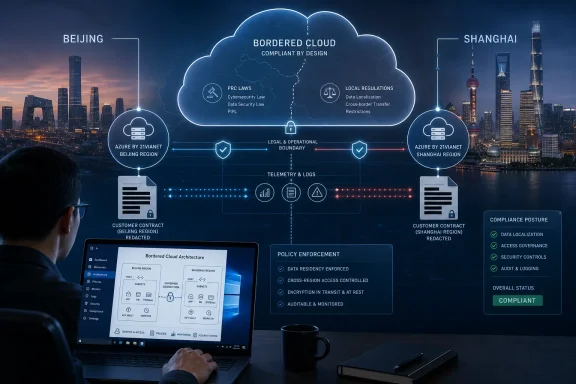
Microsoft is cutting hundreds of Azure-related jobs in Beijing and Shanghai, with affected employees reportedly told last week that their roles will end on July 6 as the company reassesses its mainland China cloud footprint amid tighter US and Chinese data rules. The reported cuts are not a collapse of Microsoft’s China business, nor are they just another generic Big Tech layoff. They are a sign that the world’s most valuable cloud platforms are being forced to behave less like global utilities and more like jurisdiction-by-jurisdiction infrastructure companies. For WindowsForum readers, the story matters because Azure is no longer just a developer platform; it is the identity layer, management plane, AI backend, and compliance headache behind a growing share of modern Windows estates.
The first mistake is to treat this as if Microsoft simply trimmed a normal regional sales office. Azure in mainland China has never been a normal Azure region in the way that West Europe, East US, or Southeast Asia are normal Azure regions. It is a physically and legally separated cloud instance operated by 21Vianet, not by Microsoft in the same direct manner as its global commercial cloud.
That distinction is not cosmetic. Customers using Azure in China deal with different contracts, different endpoints, different service availability, different operational assumptions, and a regulatory model built around Chinese data sovereignty requirements. Microsoft supplies the technology and brand gravity, but the mainland service exists behind a local operating structure designed to satisfy Beijing’s rules.
That model once looked like a clever compromise. It let Microsoft participate in the Chinese cloud market without pretending that a US hyperscaler could simply drop its standard global cloud into mainland China. It also gave multinationals a Microsoft-flavored option for workloads that had to serve Chinese users with acceptable latency and local compliance posture.
But the compromise has become harder to maintain. China’s data security, cybersecurity, and personal information rules have grown more demanding, while Washington has become more suspicious of how advanced cloud, AI, and data infrastructure intersect with national security. The pressure is no longer only about where a server sits. It is about who can touch the system, where engineering knowledge resides, what telemetry crosses borders, and whether cloud capacity can indirectly support strategic technologies.
That is why a few hundred Azure jobs in Beijing and Shanghai can matter more than the headcount number suggests. In the cloud business, engineering location is not merely an HR line item. It is part of the trust architecture.
Microsoft’s public line is carefully narrow. The company said it had shared an optional internal transfer opportunity with eligible employees and remained focused on serving customers and growing globally. That is not a denial of role eliminations, but it is also not a sweeping admission that geopolitical risk is the only cause.
The specificity of the affected group is what makes the story interesting. The report says other Microsoft units, including DevDiv, Microsoft Software Technology Centre Asia, and Microsoft AI teams across Shanghai and Suzhou, were not affected. If accurate, that points away from a simple “China is being cut” narrative and toward a more targeted reshaping of cloud-related work.
Cloud jobs are different from application development jobs because cloud operations sit closer to regulated infrastructure. Azure engineers may work on services that depend on cross-border coordination, security-sensitive tooling, platform reliability, identity systems, or operational practices that regulators increasingly scrutinize. Even when employees never see customer data, the surrounding control plane can become politically sensitive.
The relocation-to-Canada detail also deserves attention. It suggests Microsoft may want to retain some talent while moving certain roles outside mainland China. That is exactly the kind of corporate maneuver one would expect when a company still values the people and their expertise but no longer wants every function anchored in the same jurisdiction.
For administrators, this is the practical lesson: sovereignty is not just a checkbox in a compliance portal. It changes staffing, support paths, engineering velocity, incident response, and the long-term shape of cloud services.
But hyperscale cloud has entered a stranger phase. Microsoft is pouring enormous capital into data centers, GPUs, networking, power, and AI capacity. That spending competes directly with payroll, especially in teams that leadership believes can be consolidated, automated, relocated, or reorganized around new priorities.
This is the paradox of the current AI-and-cloud economy: revenue can rise, margins can remain impressive, and jobs can still disappear. Big Tech executives now speak about efficiency almost as often as they speak about innovation. The industry has learned to present layoffs not as distress but as portfolio management.
Microsoft has already gone through major workforce reductions in recent years, including broad cuts in 2025 that affected thousands of workers. The company has also been under constant investor pressure to prove that its AI spending will translate into durable profits rather than simply larger capital expenditure lines. In that environment, even Azure is not immune.
The China cuts, if reported accurately, sit at the intersection of two pressures. One is the familiar Microsoft-wide search for efficiency. The other is the less familiar but more strategically important rebalancing of where cloud engineering work can safely and legally happen.
For years, that structure gave Microsoft a defensible answer to a difficult market. Azure operated by 21Vianet could support Chinese business requirements while remaining distinct from Microsoft’s global cloud. Microsoft 365, Dynamics 365, Power Platform, and related services followed similar localized logic.
The problem is that cloud has become more deeply integrated since that model matured. Azure is no longer mostly virtual machines, storage accounts, and databases. It is identity, endpoint management, security analytics, developer workflows, AI model access, data governance, and policy enforcement. A modern enterprise might use Azure not only to host applications, but to decide who can log in, what devices are compliant, which data can be classified, and how incidents are detected.
That integration makes separation harder. A “China cloud” that is truly separate must still interoperate with global corporate systems in some cases, but every bridge becomes a compliance and security question. A global tenant model may be convenient for IT. It may also be legally or operationally awkward when users, data, logs, and administrative authority cross boundaries.
This is where Windows administrators feel the pain. A multinational with offices in Shanghai, Munich, Seattle, and Singapore may want one identity architecture, one endpoint policy, one SIEM strategy, and one procurement motion. Reality often says otherwise. China may require a separate tenant, separate contracts, different service availability, and additional network planning.
That does not mean Azure in China is broken. It means it is not a mirror. Treating it as one is how projects run late.
China has built a sweeping framework around cybersecurity, data security, and personal information protection. The practical result is that companies operating in China must think carefully about what data leaves the country, what systems count as critical, and how personal information is handled. For foreign companies, the safest path often involves local cloud instances and local partners.
The US has moved in the other direction but with a similar strategic instinct. Washington is increasingly focused on preventing sensitive technology, AI capability, semiconductor know-how, and cloud resources from strengthening geopolitical rivals. That concern has already reshaped export controls around chips and advanced computing. Cloud access is a logical next frontier because AI capability is increasingly rented rather than owned.
Cloud providers are stuck in the middle. Their business model is global scale, standardized platforms, and centralized engineering leverage. Governments are asking for local accountability, national control, and sometimes strategic denial. Those demands do not coexist neatly.
This is why the Microsoft report should not be read as a one-off employment item. It is a data-sovereignty signal. The cloud era began with the promise that location would matter less. The next phase is proving that location matters more than ever, just at a different layer of the stack.
The more realistic risk is drift. Service parity may widen or narrow unevenly. Support escalation paths may change. Roadmaps may become harder to read. Cross-border architecture decisions may require more legal review and less assumption-driven engineering. Teams that once relied on informal Microsoft relationships in China may find those channels thinner.
Drift is especially dangerous because it rarely announces itself. An identity feature is missing here. A security product arrives later there. A networking pattern that works globally needs rework in China. A compliance review blocks a design that looked technically sound. None of these is dramatic by itself, but together they can turn a cloud strategy into a patchwork.
For Windows-heavy enterprises, the areas to watch are identity, device management, security telemetry, and developer platform dependencies. Microsoft’s ecosystem encourages deep coupling between Windows clients, Entra ID, Intune, Defender, Azure Monitor, GitHub, Visual Studio tooling, and Azure-hosted application backends. In a single jurisdiction, that coupling is a strength. Across regulatory borders, it can become a design constraint.
The right response is not to abandon Microsoft’s cloud in China. The right response is to document assumptions that were previously left implicit. Which tenant owns which users? Where are logs stored? Who can administer production? Which support organization has access? Which services are unavailable or delayed in the China instance? Those are not procurement details. They are architecture.
But corporate action often speaks more clearly than corporate language. If some employees are offered relocation, Microsoft is preserving optionality. If the cuts are concentrated in Azure while other China-based engineering groups remain unaffected, Microsoft is segmenting risk. If this is at least the third downsizing in China in two years, as the report says, then the company is not merely making a quarterly adjustment.
Optionality is the watchword of the moment. Microsoft wants access to China’s market without overexposing sensitive cloud work to China’s jurisdiction. It wants to satisfy US policymakers without abandoning global customers. It wants AI-scale infrastructure growth without letting operating expense outrun investor patience. It wants local presence and strategic distance at the same time.
That is not hypocrisy; it is the operating condition of a hyperscaler in 2026. The old idea of a borderless cloud is giving way to a managed fragmentation model. Microsoft, Amazon, Google, Oracle, and regional providers will all have to decide which pieces of their stack can be global, which must be local, and which should not be offered everywhere.
The winners will not necessarily be the companies with the most regions on a map. They will be the ones that can explain, contract, support, and secure the differences between those regions without leaving customers to discover the gaps mid-migration.
That shift changes the job. A sysadmin supporting Chinese offices cannot simply ask whether Teams works or whether a VM can be deployed. They need to understand whether the organization is using global Microsoft 365, Microsoft 365 operated by 21Vianet, Azure operated by 21Vianet, local identity synchronization, separate endpoints, or some hybrid arrangement that grew organically because nobody wanted to fund a clean design.
The ugliest environments are usually the ones built through exception. A small China office gets a workaround. Then it grows. A local application needs better latency. Then it gets a local cloud account. A compliance officer asks about data transfers. Then IT discovers that the architecture diagram was never updated. By the time the issue reaches the CIO, the company has two versions of Microsoft cloud reality and no shared vocabulary for them.
The reported Microsoft cuts should be a trigger for inventory. Not because they prove a service failure is coming, but because they remind customers that cloud architecture depends on provider strategy. If Microsoft is reassessing where Azure work is done, customers should reassess where their own Microsoft-dependent work is done.
That inventory should include contracts, tenants, identity flows, administrative roles, logging pipelines, backup locations, support arrangements, and application dependencies. It should also include people. Many global Microsoft environments depend on a small number of administrators who understand the China exception. If those people leave, the documentation often leaves with them.
AI systems are hungry for data, compute, telemetry, and model access. They also raise sharper regulatory concerns than conventional cloud workloads. Governments care not only where data is stored but how models are trained, what outputs they generate, whether sensitive information can leak, and who can use compute capacity for advanced research or military-adjacent work.
This creates a difficult split for Microsoft. The company wants Azure to be the platform for enterprise AI everywhere it can operate. But the most advanced AI infrastructure is also the part of the cloud stack most likely to attract export controls, national security review, and local regulatory scrutiny. A separated China cloud can offer some services, but it cannot erase the strategic sensitivity around AI.
For enterprise customers, the implication is straightforward: do not assume the AI roadmap in one Microsoft cloud maps cleanly to another. A Copilot feature, Azure AI service, model hosting pattern, or security integration that looks standard in the global cloud may have different availability, data handling, or compliance implications in China. The gap may be technical, legal, commercial, or all three.
That is frustrating, but it is better discovered during design than during deployment. The companies that get this right will treat China-facing AI projects as separate programs with their own legal review, architecture review, and operational model. The companies that get it wrong will treat them as regional rollouts of a global template and then wonder why the template breaks.
Azure is Microsoft’s central platform business. China is the world’s most consequential contested technology market. Data law is becoming one of the main ways governments project power into software architecture. Put those together and a targeted Azure downsizing in Beijing and Shanghai becomes a proxy for a much larger industry turn.
It also punctures a comforting myth about cloud inevitability. For years, the major cloud providers sold a story of ever-expanding regions, ever-improving parity, and ever-deeper integration. That story is still partly true. But it now sits beside another story: selective withdrawal, controlled access, localized compliance, and geopolitical segmentation.
There is a temptation to make this a morality play about China, the US, or Microsoft. That is too simple. China wants control over data and infrastructure inside its borders. The US wants to prevent strategic technology leakage. Microsoft wants profitable global scale without being crushed between incompatible legal regimes. Customers want services that work. Every actor is behaving according to incentives that are unlikely to soften soon.
The result is not deglobalization in the crude sense. It is re-bordered globalization. The cloud remains global as a business, but less global as an operating reality.
The deeper story is that cloud platforms are being pulled away from their founding abstraction. The cloud promised to hide infrastructure behind APIs. Regulation is forcing the infrastructure back into view. The location of engineers, operators, data centers, encryption controls, support teams, and legal entities now matters in ways that a portal dashboard cannot fully express.
For Microsoft, this is a test of whether it can keep Azure coherent while making it more compartmentalized. For customers, it is a test of whether they can keep Microsoft-centric environments manageable while accepting that not every tenant, region, or service belongs to the same legal universe. For WindowsForum’s audience, the message is blunt: the Microsoft cloud is still the default gravity well for much of enterprise IT, but gravity now bends around borders.
The July 6 cuts may pass with little visible disruption. The larger shift will not. The next decade of cloud architecture will be shaped less by who can spin up the most regions and more by who can prove where control begins, where it ends, and who is allowed to stand in the middle.
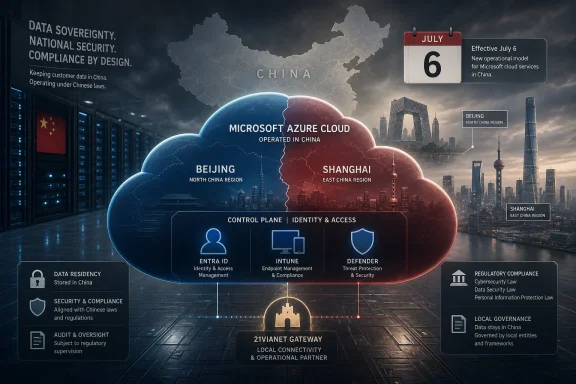 Microsoft’s China Cloud Was Always a Special Case
The first mistake is to treat this as if Microsoft simply trimmed a normal regional sales office. Azure in mainland China has never been a normal Azure region in the way that West Europe, East US, or Southeast Asia are normal Azure regions. It is a physically and legally separated cloud instance operated by 21Vianet, not by Microsoft in the same direct manner as its global commercial cloud.That distinction is not cosmetic. Customers using Azure in China deal with different contracts, different endpoints, different service availability, different operational assumptions, and a regulatory model built around Chinese data sovereignty requirements. Microsoft supplies the technology and brand gravity, but the mainland service exists behind a local operating structure designed to satisfy Beijing’s rules.
That model once looked like a clever compromise. It let Microsoft participate in the Chinese cloud market without pretending that a US hyperscaler could simply drop its standard global cloud into mainland China. It also gave multinationals a Microsoft-flavored option for workloads that had to serve Chinese users with acceptable latency and local compliance posture.
But the compromise has become harder to maintain. China’s data security, cybersecurity, and personal information rules have grown more demanding, while Washington has become more suspicious of how advanced cloud, AI, and data infrastructure intersect with national security. The pressure is no longer only about where a server sits. It is about who can touch the system, where engineering knowledge resides, what telemetry crosses borders, and whether cloud capacity can indirectly support strategic technologies.
That is why a few hundred Azure jobs in Beijing and Shanghai can matter more than the headcount number suggests. In the cloud business, engineering location is not merely an HR line item. It is part of the trust architecture.
The Layoffs Land Where Cloud Sovereignty Is Getting Real
According to the South China Morning Post report, affected Azure employees in Beijing and Shanghai received notices last week, with estimates from sources putting the impact between 200 and 400 workers. The report says employment would cease at Azure on July 6, with severance tied to tenure and up to seven months’ pay. Some employees were reportedly offered an option to relocate to Canada.Microsoft’s public line is carefully narrow. The company said it had shared an optional internal transfer opportunity with eligible employees and remained focused on serving customers and growing globally. That is not a denial of role eliminations, but it is also not a sweeping admission that geopolitical risk is the only cause.
The specificity of the affected group is what makes the story interesting. The report says other Microsoft units, including DevDiv, Microsoft Software Technology Centre Asia, and Microsoft AI teams across Shanghai and Suzhou, were not affected. If accurate, that points away from a simple “China is being cut” narrative and toward a more targeted reshaping of cloud-related work.
Cloud jobs are different from application development jobs because cloud operations sit closer to regulated infrastructure. Azure engineers may work on services that depend on cross-border coordination, security-sensitive tooling, platform reliability, identity systems, or operational practices that regulators increasingly scrutinize. Even when employees never see customer data, the surrounding control plane can become politically sensitive.
The relocation-to-Canada detail also deserves attention. It suggests Microsoft may want to retain some talent while moving certain roles outside mainland China. That is exactly the kind of corporate maneuver one would expect when a company still values the people and their expertise but no longer wants every function anchored in the same jurisdiction.
For administrators, this is the practical lesson: sovereignty is not just a checkbox in a compliance portal. It changes staffing, support paths, engineering velocity, incident response, and the long-term shape of cloud services.
Azure Is Growing, but Growth No Longer Protects Every Azure Job
The awkward backdrop is that Azure remains one of Microsoft’s strongest businesses. Microsoft’s fiscal 2025 results showed Azure surpassing $75 billion in annual revenue for the first time, with growth tied to enterprise cloud demand and the AI infrastructure boom. In ordinary corporate logic, a fast-growing unit should be hiring, not shrinking.But hyperscale cloud has entered a stranger phase. Microsoft is pouring enormous capital into data centers, GPUs, networking, power, and AI capacity. That spending competes directly with payroll, especially in teams that leadership believes can be consolidated, automated, relocated, or reorganized around new priorities.
This is the paradox of the current AI-and-cloud economy: revenue can rise, margins can remain impressive, and jobs can still disappear. Big Tech executives now speak about efficiency almost as often as they speak about innovation. The industry has learned to present layoffs not as distress but as portfolio management.
Microsoft has already gone through major workforce reductions in recent years, including broad cuts in 2025 that affected thousands of workers. The company has also been under constant investor pressure to prove that its AI spending will translate into durable profits rather than simply larger capital expenditure lines. In that environment, even Azure is not immune.
The China cuts, if reported accurately, sit at the intersection of two pressures. One is the familiar Microsoft-wide search for efficiency. The other is the less familiar but more strategically important rebalancing of where cloud engineering work can safely and legally happen.
The 21Vianet Model Solved Yesterday’s Problem
Microsoft’s partnership model in China was built for an earlier era of cloud globalization. The assumption was that a hyperscaler could localize operations, license technology to a Chinese partner, keep data in-country, and preserve enough product similarity that multinational customers would recognize the platform. It was never seamless, but it was workable.For years, that structure gave Microsoft a defensible answer to a difficult market. Azure operated by 21Vianet could support Chinese business requirements while remaining distinct from Microsoft’s global cloud. Microsoft 365, Dynamics 365, Power Platform, and related services followed similar localized logic.
The problem is that cloud has become more deeply integrated since that model matured. Azure is no longer mostly virtual machines, storage accounts, and databases. It is identity, endpoint management, security analytics, developer workflows, AI model access, data governance, and policy enforcement. A modern enterprise might use Azure not only to host applications, but to decide who can log in, what devices are compliant, which data can be classified, and how incidents are detected.
That integration makes separation harder. A “China cloud” that is truly separate must still interoperate with global corporate systems in some cases, but every bridge becomes a compliance and security question. A global tenant model may be convenient for IT. It may also be legally or operationally awkward when users, data, logs, and administrative authority cross boundaries.
This is where Windows administrators feel the pain. A multinational with offices in Shanghai, Munich, Seattle, and Singapore may want one identity architecture, one endpoint policy, one SIEM strategy, and one procurement motion. Reality often says otherwise. China may require a separate tenant, separate contracts, different service availability, and additional network planning.
That does not mean Azure in China is broken. It means it is not a mirror. Treating it as one is how projects run late.
Data Laws Are Turning Cloud Regions Into Policy Borders
The public phrase “data residency” understates what governments now want from cloud providers. Residency sounds like storage location: put the bits in a local data center and move on. Modern data regulation is broader. It touches access, processing, metadata, operational control, encryption, incident disclosure, algorithmic systems, and the legal authority under which a provider can be compelled to act.China has built a sweeping framework around cybersecurity, data security, and personal information protection. The practical result is that companies operating in China must think carefully about what data leaves the country, what systems count as critical, and how personal information is handled. For foreign companies, the safest path often involves local cloud instances and local partners.
The US has moved in the other direction but with a similar strategic instinct. Washington is increasingly focused on preventing sensitive technology, AI capability, semiconductor know-how, and cloud resources from strengthening geopolitical rivals. That concern has already reshaped export controls around chips and advanced computing. Cloud access is a logical next frontier because AI capability is increasingly rented rather than owned.
Cloud providers are stuck in the middle. Their business model is global scale, standardized platforms, and centralized engineering leverage. Governments are asking for local accountability, national control, and sometimes strategic denial. Those demands do not coexist neatly.
This is why the Microsoft report should not be read as a one-off employment item. It is a data-sovereignty signal. The cloud era began with the promise that location would matter less. The next phase is proving that location matters more than ever, just at a different layer of the stack.
The Customer Risk Is Not an Outage; It Is Drift
For most customers, the immediate risk from these reported cuts is probably not that Azure services in China suddenly stop working. Hyperscale platforms are built with layers of operational redundancy, and Azure in China’s local operator model means service continuity does not depend solely on a handful of Microsoft employees in Beijing or Shanghai. Panic would be the wrong reaction.The more realistic risk is drift. Service parity may widen or narrow unevenly. Support escalation paths may change. Roadmaps may become harder to read. Cross-border architecture decisions may require more legal review and less assumption-driven engineering. Teams that once relied on informal Microsoft relationships in China may find those channels thinner.
Drift is especially dangerous because it rarely announces itself. An identity feature is missing here. A security product arrives later there. A networking pattern that works globally needs rework in China. A compliance review blocks a design that looked technically sound. None of these is dramatic by itself, but together they can turn a cloud strategy into a patchwork.
For Windows-heavy enterprises, the areas to watch are identity, device management, security telemetry, and developer platform dependencies. Microsoft’s ecosystem encourages deep coupling between Windows clients, Entra ID, Intune, Defender, Azure Monitor, GitHub, Visual Studio tooling, and Azure-hosted application backends. In a single jurisdiction, that coupling is a strength. Across regulatory borders, it can become a design constraint.
The right response is not to abandon Microsoft’s cloud in China. The right response is to document assumptions that were previously left implicit. Which tenant owns which users? Where are logs stored? Who can administer production? Which support organization has access? Which services are unavailable or delayed in the China instance? Those are not procurement details. They are architecture.
Microsoft’s Message Is Stability, but Its Actions Say Optionality
Microsoft’s statement to the SCMP is a model of corporate containment. It emphasizes internal transfer opportunities and global growth, avoiding any direct framing around geopolitical tension. That is unsurprising. No multinational wants to say it is moving cloud roles because two governments are making its operating model harder.But corporate action often speaks more clearly than corporate language. If some employees are offered relocation, Microsoft is preserving optionality. If the cuts are concentrated in Azure while other China-based engineering groups remain unaffected, Microsoft is segmenting risk. If this is at least the third downsizing in China in two years, as the report says, then the company is not merely making a quarterly adjustment.
Optionality is the watchword of the moment. Microsoft wants access to China’s market without overexposing sensitive cloud work to China’s jurisdiction. It wants to satisfy US policymakers without abandoning global customers. It wants AI-scale infrastructure growth without letting operating expense outrun investor patience. It wants local presence and strategic distance at the same time.
That is not hypocrisy; it is the operating condition of a hyperscaler in 2026. The old idea of a borderless cloud is giving way to a managed fragmentation model. Microsoft, Amazon, Google, Oracle, and regional providers will all have to decide which pieces of their stack can be global, which must be local, and which should not be offered everywhere.
The winners will not necessarily be the companies with the most regions on a map. They will be the ones that can explain, contract, support, and secure the differences between those regions without leaving customers to discover the gaps mid-migration.
Windows Shops Need to Relearn Geography
The Windows ecosystem trained a generation of administrators to think in domains, forests, tenants, subscriptions, and policies. Geography mattered, but it often mattered as latency, language, or licensing. Now geography is becoming a first-class security and compliance boundary.That shift changes the job. A sysadmin supporting Chinese offices cannot simply ask whether Teams works or whether a VM can be deployed. They need to understand whether the organization is using global Microsoft 365, Microsoft 365 operated by 21Vianet, Azure operated by 21Vianet, local identity synchronization, separate endpoints, or some hybrid arrangement that grew organically because nobody wanted to fund a clean design.
The ugliest environments are usually the ones built through exception. A small China office gets a workaround. Then it grows. A local application needs better latency. Then it gets a local cloud account. A compliance officer asks about data transfers. Then IT discovers that the architecture diagram was never updated. By the time the issue reaches the CIO, the company has two versions of Microsoft cloud reality and no shared vocabulary for them.
The reported Microsoft cuts should be a trigger for inventory. Not because they prove a service failure is coming, but because they remind customers that cloud architecture depends on provider strategy. If Microsoft is reassessing where Azure work is done, customers should reassess where their own Microsoft-dependent work is done.
That inventory should include contracts, tenants, identity flows, administrative roles, logging pipelines, backup locations, support arrangements, and application dependencies. It should also include people. Many global Microsoft environments depend on a small number of administrators who understand the China exception. If those people leave, the documentation often leaves with them.
The AI Layer Makes the China Question Harder
Five years ago, a conversation about Azure in China would have focused on hosting, connectivity, and compliance. Today, it inevitably turns to AI. Microsoft has tied Azure’s growth story to AI infrastructure, model services, Copilot, developer tools, and enterprise automation. That makes China more complicated.AI systems are hungry for data, compute, telemetry, and model access. They also raise sharper regulatory concerns than conventional cloud workloads. Governments care not only where data is stored but how models are trained, what outputs they generate, whether sensitive information can leak, and who can use compute capacity for advanced research or military-adjacent work.
This creates a difficult split for Microsoft. The company wants Azure to be the platform for enterprise AI everywhere it can operate. But the most advanced AI infrastructure is also the part of the cloud stack most likely to attract export controls, national security review, and local regulatory scrutiny. A separated China cloud can offer some services, but it cannot erase the strategic sensitivity around AI.
For enterprise customers, the implication is straightforward: do not assume the AI roadmap in one Microsoft cloud maps cleanly to another. A Copilot feature, Azure AI service, model hosting pattern, or security integration that looks standard in the global cloud may have different availability, data handling, or compliance implications in China. The gap may be technical, legal, commercial, or all three.
That is frustrating, but it is better discovered during design than during deployment. The companies that get this right will treat China-facing AI projects as separate programs with their own legal review, architecture review, and operational model. The companies that get it wrong will treat them as regional rollouts of a global template and then wonder why the template breaks.
The Cuts Are Small Beside the Strategic Message
The reported number, 200 to 400 workers, is small by Microsoft standards. The company employs well over 200,000 people globally, and its recent layoff rounds have involved far larger totals. But strategic importance is not measured only by headcount.Azure is Microsoft’s central platform business. China is the world’s most consequential contested technology market. Data law is becoming one of the main ways governments project power into software architecture. Put those together and a targeted Azure downsizing in Beijing and Shanghai becomes a proxy for a much larger industry turn.
It also punctures a comforting myth about cloud inevitability. For years, the major cloud providers sold a story of ever-expanding regions, ever-improving parity, and ever-deeper integration. That story is still partly true. But it now sits beside another story: selective withdrawal, controlled access, localized compliance, and geopolitical segmentation.
There is a temptation to make this a morality play about China, the US, or Microsoft. That is too simple. China wants control over data and infrastructure inside its borders. The US wants to prevent strategic technology leakage. Microsoft wants profitable global scale without being crushed between incompatible legal regimes. Customers want services that work. Every actor is behaving according to incentives that are unlikely to soften soon.
The result is not deglobalization in the crude sense. It is re-bordered globalization. The cloud remains global as a business, but less global as an operating reality.
The July 6 Date Should Put Architects on Notice
There are several concrete lessons buried inside this otherwise familiar layoff story.- Microsoft’s reported Azure cuts in Beijing and Shanghai are best read as a targeted cloud-sovereignty adjustment, not a broad retreat from China.
- Azure in mainland China remains a separate service operated by 21Vianet, and customers should not assume feature, contract, identity, or support parity with global Azure.
- The reported July 6 employment end date gives enterprises a useful prompt to review China-related Microsoft dependencies before assumptions harden into operational risk.
- Windows and Microsoft 365 administrators should map tenant boundaries, logging locations, administrator access, and support paths for any China-facing environment.
- AI services will make cross-border cloud planning more complex because compute access, data handling, and model governance are now regulatory issues as much as technical ones.
- The safest enterprise posture is to design China workloads explicitly rather than treating them as a regional extension of a standard global Azure pattern.
The Cloud’s Next Battle Is Control, Not Capacity
Microsoft can absorb a few hundred job cuts. Azure can continue growing. Customers can keep running production workloads in China through the 21Vianet-operated model. None of that makes the SCMP report trivial.The deeper story is that cloud platforms are being pulled away from their founding abstraction. The cloud promised to hide infrastructure behind APIs. Regulation is forcing the infrastructure back into view. The location of engineers, operators, data centers, encryption controls, support teams, and legal entities now matters in ways that a portal dashboard cannot fully express.
For Microsoft, this is a test of whether it can keep Azure coherent while making it more compartmentalized. For customers, it is a test of whether they can keep Microsoft-centric environments manageable while accepting that not every tenant, region, or service belongs to the same legal universe. For WindowsForum’s audience, the message is blunt: the Microsoft cloud is still the default gravity well for much of enterprise IT, but gravity now bends around borders.
The July 6 cuts may pass with little visible disruption. The larger shift will not. The next decade of cloud architecture will be shaped less by who can spin up the most regions and more by who can prove where control begins, where it ends, and who is allowed to stand in the middle.
References
- Primary source: South China Morning Post
Published: Tue, 09 Jun 2026 08:58:43 GMT

Microsoft cuts hundreds of mainland cloud jobs, as China, US tighten data laws
The firm is laying off some employees at its cloud unit amid ongoing restrictions on cross-border data flows between the two countries. www.scmp.com
- Official source: azure.microsoft.com
Microsoft Azure Legal Information | Microsoft Azure
Access legal information about Azure. Get links to service level agreements, privacy statements, terms of use, and the Microsoft Trust Center.azure.microsoft.com
- Official source: learn.microsoft.com

Microsoft Azure in China
Azure in China cloud computing services are operated by 21Vianet in compliance with Chinese regulations, using datacenters located within China.learn.microsoft.com - Official source: azure-int.microsoft.com
Sign in to your account
azure-int.microsoft.com
- Related coverage: jetservices.com.cn
Azure China Operated by 21Vianet: Official Guide
Official guide to Microsoft Azure China operated by 21Vianet. Learn how it differs from global Azure and what foreign companies should check. www.jetservices.com.cn
- Related coverage: appinchina.co

The Complete Guide to Microsoft Azure China
Learn how to deploy and manage Microsoft Azure cloud services within Mainland China, including licensing requirements, compliance regulations, and performance optimisation. appinchina.co
- Related coverage: docs.azure.cn
Microsoft Entra ID and data residency
Use residency data to manage access, achieve mobility scenarios, and secure your organization.docs.azure.cn - Related coverage: axios.com
- Related coverage: netk5.com.cn

Microsoft 365 in China | 21Vianet Guide
How Microsoft 365 works in China through 21Vianet. Differences, limitations, and what international businesses need to know. netk5.com.cn
- Official source: news.microsoft.com
- Related coverage: tectura-china.com
- Official source: microsoft.com
Microsoft 2025 Annual Report
 www.microsoft.com
- Related coverage: techcrunch.com

Cloudflare says AI made 1,100 jobs obsolete, even as revenue hit a record high | TechCrunch
Cloudflare announced its first large-scale layoff. CEO Matthew Prince says because of AI efficiency gains, the company doesn't need as many support roles. techcrunch.com
- Related coverage: tomshardware.com

Microsoft follows Nvidia's lead, surpasses $4 trillion market capitalization on soaring demand for cloud services, multi-front AI endeavors
AI and Azure drive Microsoft's market cap.www.tomshardware.com
- Related coverage: techspot.com

Microsoft offers voluntary buyouts to thousands of US workers as AI spending takes priority
The buyout program will open to around 7% of Microsoft's US employees, according to CNBC, which cites a person familiar with the plans who can't be named. www.techspot.com
- Official source: blogs.microsoft.com

Microsoft and OpenAI joint statement on continuing partnership - The Official Microsoft Blog
Since 2019, Microsoft and OpenAI have worked together to advance artificial intelligence responsibly and make its benefits broadly accessible. What began as a research partnership has grown into one of the most consequential collaborations in technology — grounded in mutual trust, deep technical... blogs.microsoft.com
- Related coverage: seczine.com
- Related coverage: mungomash.com
Microsoft Financials — revenue, segment split, Azure growth, AI capex, and capital returns
Microsoft's annual revenue (live from SEC EDGAR XBRL) plus per-FY three-segment split (Productivity & Business Processes / Intelligent Cloud / More Personal Computing), Azure YoY growth rate, AI capex trajectory, R&D, buybacks and dividends, and the major-acquisitions roster — every chart point... mungomash.com
- Related coverage: advancedai.com

Meta and Microsoft Cut 16,500 Jobs to Fund AI | Advanced AI
Meta is eliminating 10% of its workforce (8,000 jobs) and Microsoft launched its first-ever voluntary buyout. Both companies named AI spending as the direct cause.advancedai.com
- Related coverage: gamespot.com

Microsoft Exec Dismisses Mass Layoff Report: "100% Made Up"
The company's chief communications officer Frank X. Shaw said the layoff reports are just wrong. www.gamespot.com
- Related coverage: livemint.com

Microsoft layoffs: What CEO Satya Nadella told employees in town hall on layoffs that left 6,000 jobless | Mint
Microsoft CEO Satya Nadella addressed job cuts affecting 6,000 employees, stating it was due to internal restructuring rather than performance issues. The layoffs primarily impacted engineering roles. www.livemint.com
- Related coverage: techtarget.com

Microsoft Q4 earnings surge on cloud results; AI gains steam | TechTarget
Microsoft earnings beat expectations with cloud growth.www.techtarget.com
- Related coverage: tech-insider.org

Microsoft Buyouts April 2026: 8,750 Cuts, $80B AI Pivot
Microsoft offered 8,750 voluntary buyouts on April 23, 2026 (7% of US staff) in a Rule-of-70 program tied to $80B AI capex. Full details inside. tech-insider.org
- Related coverage: annualreports.ai