

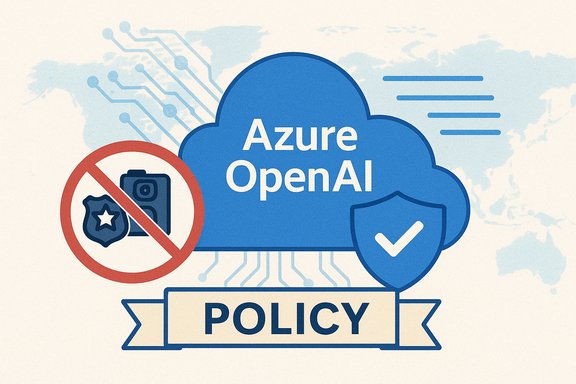
Microsoft has updated its Azure AI rules to explicitly bar U.S. police departments from using the Azure OpenAI Service for facial recognition, and the change tightens global restrictions on real‑time, mobile camera identification by law enforcement using body‑worn or dash‑mounted cameras.
Background
Microsoft’s move is the latest refinement in a multi‑year effort to limit how its cloud and AI tools can be applied to biometric surveillance. The company’s enterprise AI Code of Conduct now makes clear that Azure OpenAI Service may not be used “for facial recognition purposes by or for a police department in the United States.” The same set of conduct rules also prohibits the integration of Azure OpenAI with real‑time facial recognition on mobile cameras used by law enforcement globally in uncontrolled, “in the wild” environments. The policy explicitly calls out attempts by officers on patrol to match faces from body‑worn or dash cameras against databases of suspects or prior inmates.Those additions build on existing Microsoft product limits that already restricted face‑based identification in some Azure services. Microsoft has previously constrained its Azure Face API and other biometric features through eligibility gates and explicit policy language — a stance that dates back to company statements and product pages that linked facial recognition use with human‑rights considerations and the need for robust regulation.
At the same time, Microsoft has rapidly expanded the multimodal capabilities available through Azure OpenAI — including models that process images and video, such as GPT‑4 Turbo with Vision and other multimodal offerings — creating potential vectors for misuse that the new conduct language seeks to close off for law enforcement in specific, high‑risk scenarios.
What changed — the policy in plain terms
- U.S. police departments are prohibited from using Azure OpenAI for facial recognition purposes.
- Global prohibition for mobile, real‑time identification: Any law enforcement agency worldwide may not use Azure OpenAI to identify individuals from mobile cameras (body cams, dash cams) when operating in uncontrolled, “in the wild” environments.
- Matching against suspect or prior‑inmate databases is disallowed when conducted via mobile cameras or officer patrol workflows.
- The Code of Conduct reaffirms broader constraints already in place: applications must incorporate meaningful human oversight and must not be used for non‑consensual persistent surveillance or to infer sensitive attributes from biometric data.
Why Microsoft tightened the rules
Several forces are converging that explain the change:- Accuracy and bias concerns: Facial recognition algorithms still show uneven performance across demographic groups, and law enforcement reliance on imperfect matching risks wrongful identification, arrests, or worse. The public and regulators have repeatedly flagged these systemic bias issues.
- Reputational and legal risks: High‑profile misidentifications and the regulatory uncertainty around biometric surveillance create material risk for a cloud provider that lends infrastructure and models to downstream users — particularly police agencies with coercive authority.
- Policy and public pressure: Activists, civil‑liberties organizations, and investigative reporting have spotlighted widespread use of machine‑learning tools in policing (including large footage‑analysis projects and secretive vendor arrangements), prompting vendors to narrow acceptable use for their platforms.
- Rapidly expanding capabilities: As Azure began offering multimodal models and “vision” capabilities that can analyze images and video at scale, Microsoft moved to make its platform policy explicit so those technical capabilities are not applied in law enforcement scenarios deemed high‑risk.
- Regulatory headwinds: Governments and oversight bodies — including federal AI guidance and civil‑rights‑focused inquiries — are increasingly emphasizing transparency, opt‑outs, and human oversight for biometric systems. Provider policy updates reflect both compliance preparation and risk mitigation.
The practical landscape: what this does and does not do
What the ban accomplishes
- It prevents U.S. law enforcement customers from building facial‑recognition pipelines that run on Azure OpenAI models and infrastructure.
- It closes a specific loophole by banning mobile, real‑time matching using body‑worn and dash cameras worldwide, a particularly contentious scenario because of its potential for pervasive, uncontrolled surveillance.
- It signals a vendor‑level principle that biometric identification via its generative and vision models is a disallowed application for police in the U.S.
What the ban does not do
- It does not ban U.S. police from using all facial recognition technologies. Agencies can still procure other vendors’ systems, operate in‑house algorithms, or use cloud services from other providers — subject to those vendors’ policies and applicable law.
- It does not remove the underlying technical capability from the public domain. Open‑source models, private‑cloud deployments, or on‑device algorithms remain available paths for jurisdictions or contractors seeking facial recognition.
- It does not render all forms of facial image analysis forbidden — Microsoft’s policies still permit carefully scoped uses (for example, some narrow accessibility or medical scenarios) under limited access regimes, or the use of Azure “Face” resources when eligibility and human‑rights safeguards are in place.
Technical note: why vision models create risk
Modern multimodal models combine text and image understanding. When you pair a large image‑capable model with vast access to camera feeds and a matching database of faces, the technical stack can:- Extract facial templates (numeric representations of a face) that make matching efficient.
- Produce rapid matches and probabilistic scores that human operators may interpret as definitive.
- Operate at scale across millions of frames, creating persistent surveillance webs.
- Amplify systemic errors: small biases in training data can lead to disproportionate misidentification rates for certain demographics.
The enforcement challenge
Policy language is essential, but enforcement is difficult in distributed cloud ecosystems. Key enforcement questions include:- How will Microsoft detect violations? Customers can build pipelines that obfuscate the prohibited use, and vendors can embed third‑party models into systems without naming Azure OpenAI explicitly.
- What are the consequences for violations? Microsoft retains the right to suspend or terminate access for customers who breach the Code of Conduct, but practical detection and proof thresholds are high.
- How effective are contractual controls? Procurement contracts, cloud terms, and API keys offer contractual levers, but enforcement requires telemetry, audits, or external whistleblowers.
- Will governments compel access anyway? Subpoenas, lawful access orders, or contractual obligations may create pressure points; Microsoft’s policy may not prevent compelled disclosures in all jurisdictions.
Who this affects
- Municipal and state police: Agencies that rely on vendor ecosystems for body‑cam storage and analytics must re‑examine vendor contracts and technical architectures.
- Public safety vendors: Companies that provide body cameras, cloud evidence storage, or analytics (including transcription or summarization features) must clarify their data flows and model dependencies to avoid inadvertent policy violations or reputational fallout.
- Developers and system integrators: Teams building AI copilots, evidence analysis tools, or analytics pipelines need to check the Microsoft Code of Conduct and Azure product terms to ensure prohibited use cases are not implemented.
- Privacy advocates and researchers: Group monitoring and auditing will remain crucial to ensure that the ban is effective and not circumvented through vendor stacking or opaque subcontracting.
- Windows and enterprise admins: IT leaders deploying Azure components should update governance frameworks, revise acceptable‑use policies, and ensure procurement teams flag prohibited scenarios.
Broader policy implications and the vendor arms race
Microsoft’s explicit ban is one response in a market where different cloud and AI providers take diverging stances. Some vendors have adopted restrictive policies around law‑enforcement use of biometrics; others provide specialized “gov” offerings or integrations intended for public‑sector use under strict controls.- The effect can be uneven: a policy at one major provider may simply shift demand to a supplier with looser rules, or push agencies to develop in‑house or open‑source solutions.
- A patchwork regulatory environment — with different city, state, and national rules — amplifies the chance of inconsistent practices and legal gray zones.
- Procurement and certification frameworks (e.g., government security and privacy authorizations) will increasingly shape which vendors can participate in public‑sector deployments.
Possible strengths of Microsoft’s approach
- Clear, proactive restraint reduces the chance a major cloud vendor will be implicated in discriminatory or abusive surveillance.
- Encourages better vendor governance by forcing integrators and camera vendors to rethink whether real‑time matching on mobile feeds is appropriate.
- Aligns with wider public policy moves that demand opt‑outs, transparency, and human oversight in government uses of AI.
- Signals to customers that Microsoft is attempting to manage legal and reputational risk while offering advanced capabilities to safer enterprise scenarios.
Potential weaknesses and risks
- Circumvention risk: Agencies can still use other platforms, or combine separate services in a way that recreates the forbidden functionality.
- Operational friction for legitimate use cases: Some legitimate public‑safety scenarios (e.g., identifying a child in immediate danger from a video clip with consent, or searching a database for a missing person) could be harder to implement even with safeguards.
- Enforcement opacity: Without transparent auditing mechanisms, the ban could be more symbolic than practical.
- Market arbitrage: Smaller vendors, less exposed to public scrutiny, might accept risky contracts — shifting the problem rather than solving it.
- Dependence on definitions: The policy uses phrases like “in the wild” and “identification,” which can be interpreted narrowly or broadly; legal and operational definitions will matter.
A responsible path forward — recommendations
For policy makers, vendors, and IT leaders, the following steps reduce harm while preserving legitimate innovation:- For vendors and cloud providers:
- Make prohibitions explicit in API contracts and implement telemetry and audit hooks to detect prohibited pipelines.
- Publish clear examples and definitions so customers understand exactly what is disallowed (and how to design compliant alternatives).
- Offer controlled, auditable alternatives for high‑risk public‑sector uses with strict oversight, transparency, and legal review.
- For police and public‑safety agencies:
- Audit all vendor contracts and system architectures for any flow that routes camera footage into facial‑matching pipelines.
- Prioritize human‑in‑the‑loop verification and limit automated decision‑making.
- Seek legal and civil‑rights review before piloting any biometric identification system.
- Explore non‑biometric alternatives that reduce privacy and bias risks (e.g., metadata, contextual clues, voluntary ID checks).
- For enterprise IT and developers:
- Implement governance controls in development lifecycles to ensure model usage is logged and complies with vendor code of conduct.
- Integrate privacy‑by‑design measures, minimize biometric data retention, and enable explicit consent flows where required.
- Use model access patterns that separate sensitive processing from generative or multimodal capabilities when possible.
- For regulators:
- Close procurement loopholes by setting baseline standards for biometric deployments, including public reporting and independent audits.
- Mandate transparent opt‑outs and redress mechanisms for affected individuals.
What Windows users and developers should do today
- If your organization uses Azure OpenAI, run a rapid compliance scan: identify any services that process camera streams, link those services to model endpoints, and determine if any workflows could be interpreted as facial‑recognition.
- Update security and acceptable‑use documentation to reflect prohibited uses and inform procurement teams to include vendor code‑of‑conduct checks as part of vendor selection.
- For developers building apps that include image processing: design for image understanding that does not link to identity verification. Focus on non‑identifying analytics (scene descriptions, object detection, accessibility tasks) rather than any matching against person registries.
- Ensure that any use of third‑party tools that summarize or transcribe body‑cam audio/video is transparent and compliant; confirm whether those vendors rely on Azure OpenAI or other cloud AI stacks.
The larger civil‑liberties context
Investigative reporting has revealed how many jurisdictions use AI and machine learning to analyze hours of video, traffic stops, and other interactions — often without public transparency or oversight. NDA‑bound vendor arrangements and proprietary analytics can lock communities out of understanding how surveillance data is used.Microsoft’s ban addresses one vector — Azure OpenAI — but the challenge remains systemic: the combination of inexpensive cameras, cloud storage, powerful vision models, and private contracts can replicate surveillance ecosystems outside any single vendor’s policies. Effective protection of civil liberties will require coordinated policy, technical safeguards, and public oversight.
What remains unclear or unverified
A number of public reports referenced related activity — for example, claims that Microsoft “submitted its generative AI services for use by federal agencies” in a particular month — are less straightforward to verify in a single authoritative public disclosure. Microsoft has ongoing engagement with government customers and has pursued certifications and compliance processes for cloud services, while federal agencies have been publishing AI safeguard guidance and procurement frameworks. However, exact timelines and the characterization of specific “submissions” to agencies require confirmation through official government or company documentation for a precise claim.Where precise dates, formal approvals, or procurement milestones are asserted, those items should be treated as verifiable only after consulting the relevant government procurement notices, Microsoft procurement announcements, or public contract records.
Conclusion
Microsoft’s decision to bar U.S. police departments from using Azure OpenAI for facial recognition and to prohibit global real‑time identification via mobile cameras is a consequential vendor‑level intervention in the debate over AI and policing. It narrows the paths by which powerful multimodal models can be used for biometric surveillance and sets expectations for developers, integrators, and public‑safety vendors who depend on cloud AI building blocks.The change is a pragmatic attempt to balance innovation with risk management: it preserves image and multimodal capabilities for many enterprise scenarios while drawing a firm line around a set of applications that carry disproportionate civil‑liberties and safety risks. Yet policy language alone will not eliminate harm. Effective protection requires transparent enforcement, complementary regulation, widespread vendor responsibility, and vigilant public scrutiny to prevent circumvention and to ensure that technology serves public safety without undermining fundamental rights.
Source: Mashable Microsoft bans U.S. police from using Azure OpenAI for facial recognition
