

Microsoft’s latest internal shuffle — freeing Mustafa Suleyman to concentrate on a newly elevated “superintelligence” effort while consolidating Copilot engineering around assistant products — is both a strategic pivot and a public signal about how the company intends to split its bets between productization and frontier model development.
Mustafa Suleyman is not a random hire: he co‑founded DeepMind, played a visible role in building one of the world’s most influential AI labs, and then went on to lead Inflection AI — a startup that raised headline funding and that Microsoft later folded into its AI organization. Suleyman joined Microsoft in March 2024 as the head of the newly formed Microsoft AI (MAI) unit, bringing with him both reputation and a team of engineers from Inflection.
Across 2024–2025 Microsoft publicly reorganized sizable parts of its AI stack. The company created a developer- and infrastructure-focused engineering umbrella (often discussed under names like CoreAI or Core AI — Platform and Tools) while also centralizing consumer and assistant experiences under the Microsoft AI leadership that Suleyman runs. Those moves were designed to make Microsoft both an AI infrastructure provider and a differentiated application vendor for Copilot‑style assistants.
Two business pressures drove the restructuring. First, Microsoft needs practical, monetizable AI products — the Copilot family is the clearest example — to justify investment in cloud compute and accelerate enterprise adoption. Second, it believes long‑term strategic advantage accrues from owning foundational model capability rather than outsourcing frontier research completely to partners. The new arrangement signals Microsoft intends to pursue both paths in parallel.
On the infrastructure front Microsoft is obviously not idle: the company continues to expand datacenter capacity and develop specialized partnerships to secure GPU supply and optimized inference hosting. Reported investments in new "AI super factory" buildouts and datacenter expansions are consistent with a belief that long‑lived infrastructure will decide winners in the next phase of model competition. That infrastructure is expensive, slow to build and exposes Microsoft to long‑term capacity planning risk.
Caveat: precise dollar‑for‑dollar predictions about “how much AGI will cost” are inherently speculative. Public statements about “hundreds of billions” should be read as posture and risk framing rather than an audited corporate plan.
But optionality is not destiny. The next 24 months will be decisive: Microsoft must demonstrate that MAI models bring measurable, differentiated value to enterprise scenarios, that Copilot remains a dependable and governable platform, and that the company can sustain the capital and talent needed to compete on the frontier. If Microsoft pulls those threads together, it will be a far more self‑sufficient AI company; if it stumbles, the reorganization will read as a costly attempt to do too many things at once in an already hyper‑competitive market.
Source: The Tech Buzz https://www.techbuzz.ai/articles/microsoft-frees-suleyman-to-build-superintelligence-models/
 Background / Overview
Mustafa Suleyman is not a random hire: he co‑founded DeepMind, played a visible role in building one of the world’s most influential AI labs, and then went on to lead Inflection AI — a startup that raised headline funding and that Microsoft later folded into its AI organization. Suleyman joined Microsoft in March 2024 as the head of the newly formed Microsoft AI (MAI) unit, bringing with him both reputation and a team of engineers from Inflection.Across 2024–2025 Microsoft publicly reorganized sizable parts of its AI stack. The company created a developer- and infrastructure-focused engineering umbrella (often discussed under names like CoreAI or Core AI — Platform and Tools) while also centralizing consumer and assistant experiences under the Microsoft AI leadership that Suleyman runs. Those moves were designed to make Microsoft both an AI infrastructure provider and a differentiated application vendor for Copilot‑style assistants.
Two business pressures drove the restructuring. First, Microsoft needs practical, monetizable AI products — the Copilot family is the clearest example — to justify investment in cloud compute and accelerate enterprise adoption. Second, it believes long‑term strategic advantage accrues from owning foundational model capability rather than outsourcing frontier research completely to partners. The new arrangement signals Microsoft intends to pursue both paths in parallel.
What changed — the organizational facts
Suleyman and the MAI Superintelligence Team
Microsoft has elevated a focused research and engineering effort — described publicly as a "Superintelligence" or "Humanist Superintelligence" initiative — with Mustafa Suleyman given primary responsibility to lead work on advanced, frontier models inside Microsoft. The announcement and subsequent reporting say the team will concentrate on building foundational models of varying sizes, with an explicit emphasis on safety, auditability and aligning capabilities to human‑centered outcomes. The public framing uses the phrase “humanist superintelligence” to signal an emphasis on guardrails and controllability.- Date check: coverage of the elevated MAI superintelligence initiative and Suleyman’s leadership ran prominently in November 2025; Suleyman joined Microsoft in March 2024. Those are fixed, verifiable anchors for this reorganization.
Consolidation of Copilot engineering
At the same time Microsoft has moved to consolidate engineering work on Copilot and assistant products under an engineering and product stack designed to accelerate product releases and enterprise integrations. This includes bringing together developer tooling, agent runtimes, Copilot Studio, and orchestration layers — effectively separating “product engineering” (Copilot assistants across Windows, Mie workloads) from the MAI team’s model‑building remit. The explicit intention is to let product teams ship faster while a focused research team pursues higher‑risk, higher‑return foundation models.- Internal community and forum analysis of Microsoft’s cadence — including early references to agentic Copilot products like “Copilot Cowork” — reinforce the view that product and engineering consolidation is under way and that it is being paired with a separate frontier research track.
Why Microsoft would do this: the strategic logic
Microsoft is essentially making a two‑track bet:- Ship pragmatic, integrated assistants that drive enterprise adoption, revenue and retention — the Copilot family is the primary vehicle here.
- Build independent foundational model capability that reduces long‑term dependency on any single external partner and positions Microsoft to compete at or near the frontier when necessary.
- Cost containment. Training the very largest frontier models is astronomically expensive and duplicative in many casculated an “off‑frontier” strategy — deliberately building models that trail the bleeding edge by a measured window (typically three to six months) and then tailoring those models to Microsoft’s product needs. This avoids some of the duplication and expenses of always being first to publish the frontier model.
- Product velocity. Putting Copilot engineering on a consolidated product track enables faster integration across Windows, Office and Teams, letting the company squeeze more commercial value from the Copilot brand while MAI pursues long‑horizon research.
- Strategic independence. A renegotiated relationship with OpenAI (reported in coverage surrounding this reorganization) and Microsoft’s own investments in model development mean the company now believes it can pursue frontier capabilities in‑house when it chooses to, giving it leverage and optionality.
Suleyman’s credentials and the Inflection background — verified facts
- Suleyman co‑founded DeepMind and helped grow it into a leading AI lab prior to the Google acquisition; that history is central to the credibility he brings to Microsoft’s AI organization.
- Inflection AI, the company Suleyman helped build after leaving DeepMind, raised major venture rounds (widely reported as a $1.3 billion Series B) before most of its engineering staff and core founders moved to Microsoft in 2024. Those funding and staffing details are backed by reporting in outlets including Forbes, Bloomberg and TechCrunch.
- Coverage at the time also reported that Microsoft’s deal to acquire people and technology from Inflection involved a significant licensing or path‑to‑hire payment (figures reported in the press ranged around mid‑hundreds of millions in the initial accounts), though exact terms varied in reporting and some numbers remain subject to differing accounts. Treat headline payment numbers with caution unless Microsoft files a definitive public accounting.
Technical posture: off‑frontier, model diversity and product fit
Microsoft’s technical posture, as described publicly by Suleyman and corroborated by reporting, is not to blindly replicate every frontier model immediately. Instead, the public posture emphasizes three interlocking ideas:- Off‑frontier cadence. Building models that intentionally trail by months to learn from field tests and avoid duplicative cost. Suleyman used the language “three or six months behind” when describing that approach.
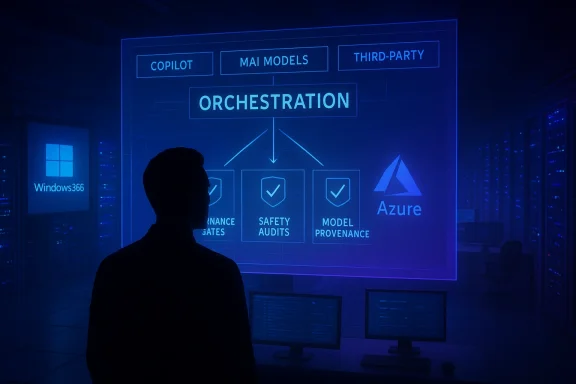
- Model diversity and orchestration. Microsoft is not betting on a single model provider for Copilot; instead it is instrumenting the Copilot product family to orchestrate multiple models (internal MAI models, OpenAI models, and third‑party providers such as Anthropic or others) depending on scenario, cost and compliance needs. That approach reduces single‑vendor dependency and gives enterprises model choice.
- Safety and human centricity. The MAI team’s public framing carries the adjective humanist — an explicit attempt to foreground safety, auditing and human control as core design constraints for any higher‑capability model. That emphasis is part policy posture and part product requirement.
Business implications and competitive positioning
- For Microsoft: owning both product and model capability gives optionality. Microsoft can route high‑value enterprise workloads to bespoke MAI models, buy capacity from partners, or offer multi‑model orchestration in Copilot to optimize for cost or accuracy per use case. This reduces lock‑in to any single supplier and aligns with Microsoft’s enterprise‑first sales motion.
- For OpenAI: Microsoft’s move signals a more competitive posture. The relationship between Microsoft and OpenAI has always been strategic and commercially important, but a Microsoft that is building in‑house frontier capability — or is able to run credible alternatives — will have more negotiating leverage and potentially divergent product roadmaps. Coverage suggests Microsoft has been given more latitude to pursue its own AGI ambitions than was previously the case under the earliest versions of the partnership.
- For Google, Anthropic and others: Microsoft’s doubling down escalates the competition for top‑tier research talent, custom data center capacity and enterprise model adoption. Several of Microsoft’s competitors are themselves investing heavily in frontier models and productization, so the field is crowded and capital‑intensive.
The hard accounting: compute, data centers and the cost question
Suleyman has publicly warned that staying competitive at the top end of the frontier will require massive capital commitment; he has used language in public appearances estimating that “hundreds of billions” of dollars may be required over the next five to ten years for the largest frontier efforts. Whether that precise phrasing becomes the canonical estimate for industry spend is debatable; it functions more as a directional warning about scale rather than a precise budgetary line item. Still, the implication is clear: cutting‑edge model training and infrastructure at scale are hyperscalers‑level capital projects.On the infrastructure front Microsoft is obviously not idle: the company continues to expand datacenter capacity and develop specialized partnerships to secure GPU supply and optimized inference hosting. Reported investments in new "AI super factory" buildouts and datacenter expansions are consistent with a belief that long‑lived infrastructure will decide winners in the next phase of model competition. That infrastructure is expensive, slow to build and exposes Microsoft to long‑term capacity planning risk.
Caveat: precise dollar‑for‑dollar predictions about “how much AGI will cost” are inherently speculative. Public statements about “hundreds of billions” should be read as posture and risk framing rather than an audited corporate plan.
Governance, safety and the public messaging of “humanist superintelligence”
Microsoft’s rhetorical emphasis on “humanist” or “human‑centered” superintelligence is consequential — both technically and politically. It serves three purposes:- Internally: it provides researchers and product teams with a constraint set that makes safety, auditability and human control first‑class requirements for model architecture and deployment.
- Externally: it’s a public signal to regulators, customers and partners that Microsoft intends its highest‑capability work to be accompanied by governance measures rather than pure performance maximization.
- Competitive differentiation: it tries to carve a niche between a purely performance‑first frontier race and a safety‑only approach that might abandon competition.
Risks and blind spots
- Execution risk at scale. Building credible frontier models — with the training data, compute, engineering talent and safe— is very hard. Microsoft has world‑class resources, but the margin for error is small when rivals have first‑mover advantages. Failure modes include missed delivery targets, poor model generalization in enterprise scenarios, or unexpected emergent behaviors.
- Cost and capital allocation. The company must justify billions in ongoing CAPEX and R&D to investors and customers. If revenue uplift from Copilot and enterprise AI stalls, Microsoft will face difficult tradeoffs between infrastructure spending and near‑term margins. Suleyman’s “hundreds of billions” comment is a sobering acknowledgment of that tradeoff; corporate fiscal discipline will matter.
- Talent and cultural friction. Buying or hiring high‑velocity research teams is one thing; integrating them into a product‑driven company is another. Historically, acquisitions of research teams can generate cultural mismatch, attrition and blurred incentives between “open research”uct development. Suleyman’s move to Microsoft brought Inflection talent in bulk — successful integration is not guaranteed.
- Regulatory and competitive scrutiny. As Microsoft expands in both software products and cloud infrastructure, antitrust and national security regulators will be watching. A move toward owning frontier models could invite regulatory attention on competitive leverage or export control concerns. Past reporting indicates the relationship between Microsoft and OpenAI has already been the subject of scrutiny; the next phase will likely involve more regulatory interest.
- Trust, bias and enterprise governance. Enterprises will buy AI assistants only when they can control data flows, verify outputs and meet compliance frameworks. Creating “humanist” models is necessary but not sufficient; Microsoft must deliver the tools (fine‑tuning, watermarking, audit trails, model provenance) that enterprises demand. Failure to do this will slow adoption and reduce the commercial value of Copilot.
What IT leaders, CISOs and product teams should watch next
- Model choice and vendor options inside Copilot. Expect Microsoft to broaden Copilot’s model palette: you’ll likely see options to run enterprise workloads on MAI models, OpenAI models, and third‑party models orchestrated through Microsoft‑managed controls. That means procurement teams must evaluate not just feature parity but governance and data residency for each model choice.
- Contracting and pricing changes. As Microsoft invests more in infrastructure, licensing and pricing will evolve. IT leaders should re‑examine long‑term contracts, pilot pricing models, and total cost of ownership when negotiating Copilot rollouts.
- Safety tooling and audit controls. Microsoft will need to ship robust enterprise‑grade safety and audit tooling (model card metadata, explicit provenance, retraining logs, internal red‑team results). Security and compliance teams should put these controls into procurement checklists now.
- Skills and processes. Expect Microsoft to tie Copilot adoption to new workflows: prompt engineering, human‑in‑the‑loop verification, model governance committees and change management. Teams that build those capabilities early will capture the most value.
Short‑term outlook and timelines
- Near term (months): Continued consolidation of Copilot engineering; expanded Copilot features and multi‑model orchestration; public previews (or research previews) of agentic Copilot products. Product velocity will be prioritized to show ROI on enterprise deployments.
- Medium term (12–36 months): Gradual rollout of homegrown MAI family models for selected scenarios (voice, enterprise search, vertical assistants). The timeline depends heavily on compute availability and regulatory posture. Microsoft’s “off‑frontier” posture suggests many MAI releases will trail the absolute bleeding edge but aim to be more tailored and governable.
- Long term (3–10 years): If Microsoft successfully scales MAI’s capabilities and demonstrates safety controls, it could enter direct competition with other frontier model builders on multiple fronts: model capability, custom enterprise verticals (healthcare, finance), and integration with Azure. The prize is owning next‑generation foundation models that power massive enterprise workloads — but the cost and competition are both enormous.
Balanced verdict: strong rationale, equally large execution bar
Microsoft’s leadership reshuffle and the decision to free Mustafa Suleyman to focus on superintelligence represent a clear strategic signal: the company refuses to choose only short‑term product wins or only long‑term research. Instead, it is betting on both.- Strengths: Microsoft has enterprise distribution, an installed base for Copilot, Azure infrastructure, and now a visible research lead with Suleyman. Its capacity to integrate models into OS and productivity tooling is unparalleled among hyperscalers. These are durable advantages that make its two‑track approach plausible.
- Risks: The pace and scale of frontier competition, the enormous capital required, regulatory friction, and the perennial difficulty of converting research wins into deployable, trusted enterprise systems all create high execution risk. “Humanist” framing is promising, but it will only matter if Microsoft institutionalizes safety into engineering practice and responds transparently to incidents.
Practical checklist for enterprise buyers right now
- Audit your data flows: know where prompts, attachments and logs will live when Copilot is used across Windows and Microsoft 365.
- Require model provenance: insist on model cards, versioning and retraining histories as part of procurement.
- Pilot with human‑in‑the‑loop controls: give decision authority to workers rather than letting agents run autonomously in production without supervision.
- Reserve contractual flexibility: get exit clauses and pilot pricing terms so you can switch models or providers if the technical roadmap shifts.
- Invest in skills: build a “prompt engineering + model governance” competency inside your teams now.
Final assessment
Microsoft’s two‑track reorganization — freeing Mustafa Suleyman to drive the MAI superintelligence effort while consolidating Copilot engineering — is a logical response to the conflicting demands of product revenue and frontier research. It buys the company optionality: product teams get speed, research teams get focus.But optionality is not destiny. The next 24 months will be decisive: Microsoft must demonstrate that MAI models bring measurable, differentiated value to enterprise scenarios, that Copilot remains a dependable and governable platform, and that the company can sustain the capital and talent needed to compete on the frontier. If Microsoft pulls those threads together, it will be a far more self‑sufficient AI company; if it stumbles, the reorganization will read as a costly attempt to do too many things at once in an already hyper‑competitive market.
Source: The Tech Buzz https://www.techbuzz.ai/articles/microsoft-frees-suleyman-to-build-superintelligence-models/
