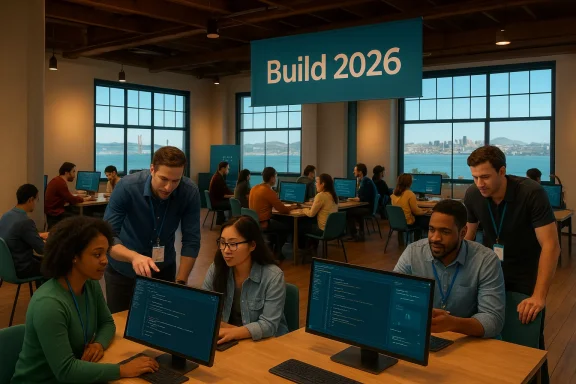
Microsoft’s Build developer conference appears poised to return to San Francisco this June, with leaked assets pointing to a two-day event at Fort Mason on June 2–3 — but the plan remains unconfirmed by Microsoft and several important details are still in flux.
Microsoft Build is the company’s flagship developer conference, a long-running forum where Microsoft traditionally unveils new tools, platform plans, and roadmap signals for Windows, Azure, Microsoft 365, GitHub, and the broader AI and cloud ecosystem. The event has shifted locations over its history — from Anaheim (its first iteration) to San Francisco, to Redmond campus events, and then a longer run in Seattle beginning in 2017 — and it has toggled between large in-person gatherings and robust digital programming during pandemic years.
In mid‑2025 Microsoft announced it would not hold Build in Seattle in 2026, removing holds on the Seattle Convention Center and saying only that “our plans for Build 2026 have changed,” while affirming its intention to host a major developer event next year. That corporate wording — thin on specifics — opened the door to speculation about where, when, and in what form Build would return. Multiple outlets reported internal memos and emails suggesting attendee experience in downtown Seattle — including concerns about cleanliness and safety — played a role in the decision. Microsoft’s official public statement was notably circumspect.
Key factual points that multiple outlets currently report or that the discovered marketing materials imply:
Strengths
If you are a developer, partner, or journalist:
Microsoft’s Build remains a vital bellwether for the company’s technical priorities — and for developers, the coming weeks will answer whether Build 2026’s new format will truly be a tighter, more meaningful developer gathering, or a signpost of larger changes to how major tech events are staged in a post‑pandemic, politically sensitive era.
Source: Windows Central Microsoft Build looks to be heading to San Francisco in June this year
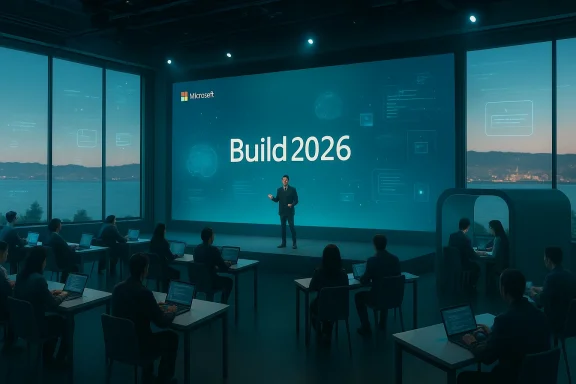 Background
Microsoft Build is the company’s flagship developer conference, a long-running forum where Microsoft traditionally unveils new tools, platform plans, and roadmap signals for Windows, Azure, Microsoft 365, GitHub, and the broader AI and cloud ecosystem. The event has shifted locations over its history — from Anaheim (its first iteration) to San Francisco, to Redmond campus events, and then a longer run in Seattle beginning in 2017 — and it has toggled between large in-person gatherings and robust digital programming during pandemic years.In mid‑2025 Microsoft announced it would not hold Build in Seattle in 2026, removing holds on the Seattle Convention Center and saying only that “our plans for Build 2026 have changed,” while affirming its intention to host a major developer event next year. That corporate wording — thin on specifics — opened the door to speculation about where, when, and in what form Build would return. Multiple outlets reported internal memos and emails suggesting attendee experience in downtown Seattle — including concerns about cleanliness and safety — played a role in the decision. Microsoft’s official public statement was notably circumspect.
What we now know — the June 2–3 Fort Mason rumor
Recent asset captures shared by watchers of Microsoft marketing materials — notably flagged by the leaker account WalkingCat and picked up by outlets — indicate a Build event dated June 2–3, 2026, with Fort Mason listed as the venue. The Verge describes Fort Mason as the planned site and reports the company is creating more intimate, developer‑centric programming there. These assets appear to be marketing creatives and event listings rather than a formal Microsoft press release.Key factual points that multiple outlets currently report or that the discovered marketing materials imply:
- Dates: June 2–3, 2026 (two days).
- Venue: Fort Mason, San Francisco (a waterfront cultural and conference space adjacent to the Marina/Crissy Field area).
- Format and size: early reporting suggests a deliberately smaller, more intimate in‑person footprint and a tighter attendee cap than some prior years — The Verge notes attendee caps around the low thousands for this iteration, signaling a shift toward depth over scale. This has not been confirmed by Microsoft.
Why San Francisco — strategic context
San Francisco as a Build host makes strategic sense for several reasons:- Proximity to the Bay Area AI and cloud ecosystem: San Francisco and the surrounding Bay Area continue to concentrate startups, AI research labs, VC firms, and complementary developer communities. A Build staged in San Francisco puts Microsoft’s developer messaging — especially on AI, Azure, and integrations with GitHub and GitHub Copilot — squarely inside that ecosystem. The city’s tech density offers content, collaborators, and potential partners who are often central to the technical conversations Build aims to host.
- Venue fit: Fort Mason is a compact, flexible complex favored for culturally oriented conferences and intimate tech events. Its waterfront location offers a different attendee experience than a convention center: better sightlines, smaller session rooms, and more curated networking opportunities. The National Park Service and Fort Mason’s own programming notes highlight its mix of indoor and outdoor spaces and the logistical constraints — weather, transport, and capacity — that come with a peninsula‑side venue. Those characteristics align with the notion of a smaller, immersive Build rather than a sprawling trade‑show floor.
- Microsoft’s event portfolio: Microsoft has already committed to bringing other major events back to San Francisco (for example, Ignite), signaling a renewed interest in the city as a conference hub after pandemic disruption and venue availability shifts. That pattern makes a San Francisco Build plausible from a corporate logistics perspective.
What this likely means for attendees and partners
If Build is indeed June 2–3 at Fort Mason, the shift carries concrete implications for who attends, how content is delivered, and how partners and press plan travel.- Smaller audience, deeper interaction: A reduced cap and a two‑day schedule implies curated sessions, more hands‑on labs, and fewer showroom booths. For developers, that could mean better access to product teams and more focused workshops. For large partners and sponsors, it means rethinking exhibit strategy toward targeted demos and private briefings.
- Hybrid expectations still apply: Even with a tighter in‑person footprint, Microsoft has a long precedent of live streaming and heavy digital outreach during Build. Expect a robust online program — livestreamed keynotes, on‑demand sessions, and remote Q&A — to preserve global reach while prioritizing a smaller in‑person experience. That hybrid model is now Microsoft’s default playbook post‑pandemic.
- Travel and lodging logistics: Fort Mason is close to downtown San Francisco and many neighborhoods with hotel inventory, but major tech events frequently compress rates and availability. Attendees should plan early, verify registration windows, and watch for Microsoft’s official registration announcement before booking non-refundable travel. The venue’s waterfront location also means variable weather and microclimates — layers and outdoor meeting plans should be part of attendee packing decisions.
What Microsoft is likely to announce (editorial expectations)
Build is Microsoft’s developer showcase; historically and recently, the most prominent themes have been:- AI and Copilot expansions: announcements and deeper dives into Copilot integrations across Microsoft 365, Windows, and Azure developer tooling. Expect sessions focused on agent frameworks, responsible AI patterns, and partner integrations.
- Azure developer platform and tooling: enhancements to Azure AI Foundry, developer SDKs, and cloud infrastructure optimizations aimed at making AI training and inference more accessible for enterprise and independent developers.
- Windows and platform-level developer tooling: while Build increasingly centers on AI and cloud, Microsoft consistently preserves Windows‑developer content — new APIs, WinUI updates, WebView/Edge enhancements, and tooling for hybrid apps. Expect at least a handful of Windows‑specific technical sessions.
- GitHub and open-source developer services: deeper GitHub/DevOps integrations, security toolchain updates, and GitHub Copilot advances are typical Build fare and will likely feature prominently.
Tensions and risks: what the venue change reveals
The move away from Seattle and toward a potential San Francisco Build both reflects and magnifies several risks and organizational considerations:- Public perception and city-level friction: Multiple reports indicate Microsoft’s decision to withdraw from Seattle was at least influenced by attendee feedback about downtown conditions. That has political and PR implications for both Microsoft and the host cities involved. Seattle stands to lose a long-standing economic injection from Build, while any new host (including San Francisco) will be scrutinized for similar issues. Microsoft’s public statement framed the change as programmatic rather than a rebuke of the city, but local reporting and internal emails paint a more complex picture. Expect civic leaders and tourism officials to address potential economic fallout and to court Microsoft diplomatically.
- Brand optics and community reaction: Moving a major developer event carries optics: Microsoft must balance an image of inclusivity and global developer support with choices about safety, accessibility, and cost. A smaller Build could alienate some developers and partners who value larger networking opportunities or rely on exhibit booths to reach customers. Conversely, a more intimate Build could be praised for being more developer‑centric. The company is navigating a tradeoff between broad access and curated quality.
- Operational risk: Fort Mason is fundamentally a different logistical proposition than a convention center. Weather exposure, limited loading docks, and smaller breakout rooms introduce risk to exhibitors and to Microsoft’s ability to scale sessions on short notice. That matters if demand overshoots early assumptions or if partner needs require larger footprint allocations. The National Park Service and Fort Mason operators publish guidance for outdoor venues and operational constraints that reinforce this point.
Economic and civic impacts — Seattle, San Francisco, and the conference ecosystem
Build’s relocation — if sustained — has measurable implications:- Seattle: Build brought a predictable stream of attendees, hotel nights, and business for downtown restaurants and services. Industry analysts and local reporting estimated thousands of room nights and significant economic inputs that will now be dispersed. Visit Seattle and city tourism partners will likely respond with outreach and potentially incentives to retain or replace the lost revenue.
- San Francisco: Microsoft’s other events, notably Ignite, have recently returned to San Francisco with positive economic outcomes, and the city has an established convention infrastructure. But San Francisco also faces similar urban‑management challenges to Seattle, which raises questions about whether Microsoft’s move is a long‑term shift or a tactical carryover from existing relationships with Bay Area stakeholders. Local officials and tourism stakeholders will likely emphasize the economic upside while managing community concerns.
- Broader trend: The Build shift fits a pattern of major conferences reassessing city relationships and formats in a post‑pandemic world. Some organizers are opting for smaller, hybrid, or regionalized events to reduce risk and increase content quality, while others pursue traditional scale. Microsoft’s choice will be watched as a bellwether for how large tech firms balance scale, safety, and return on engagement.
Practical guidance for prospective attendees and partners
If you’re planning to attend, present, sponsor, or cover Build 2026, here’s a checklist to help navigate the uncertain planning window:- Wait for official Microsoft confirmation before booking non‑refundable travel. Microsoft’s statement about Build’s plans has been terse; the assets in circulation are likely accurate but unconfirmed. Book refundable fares and flexible hotel rates when possible.
- Register immediately when registration opens. If Build intentionally limits in‑person capacity, tickets could sell out quickly. Historically, Build registration windows open only weeks before the event, and Microsoft may prioritize community members, MVPs, and partner allocations.
- Prepare a hybrid presence. If you’re a sponsor, reconfigure plans for more curated demos, closed‑door briefings, and virtual touchpoints rather than a standard expo booth. The smaller footprint will reward targeted, high‑value interactions.
- Pack for microclimates. Fort Mason’s waterfront location can be windy and cool; plan outdoor networking attire accordingly. Venue guidance emphasizes layered clothing and logistical foresight for outdoor transitions.
- Plan accessibility and security logistics: Fort Mason’s layout and National Park Service oversight may introduce different access controls and security processes than a convention center; plan staffing and arrival times accordingly.
Critical analysis — strengths, blind spots, and risks
This venue-and-format pivot carries both notable strengths and tangible risks.Strengths
- Focus on developer outcomes: A smaller, workshop‑heavy Build could return the event to deep technical content and pragmatic labs, an approach many developers favor over broadcast spectacles. This could strengthen Microsoft’s relationship with serious platform engineers.
- Alignment with AI ecosystem: Placing Build in the Bay Area dovetails with Microsoft’s strategic priorities around AI, partnerships, and developer adoption of Azure AI tooling. It makes partner activation and local talent engagement more immediate.
- Logistical agility: A smaller event reduces logistical complexity in some ways and allows Microsoft to iterate rapidly on session formats and hands‑on content without the scale overhead of a convention‑center trade show.
- Political and civic optics: Even if Microsoft frames the move as programmatic, the narrative around leaving Seattle because of downtown conditions will linger. That raises questions about corporate responsibility, municipal partnerships, and how tech companies engage with urban policy issues. Seattle civic leaders and residents are likely to view the move as a rebuke, even if Microsoft emphasizes other factors.
- Capacity limits vs. demand: If Microsoft underestimates demand, Fort Mason’s footprint could constrain access and create frustration among developers who expect to attend in person. A poorly communicated ticketing or selection process would harm trust.
- Operational constraints of the venue: Waterfront and NPS‑managed venues come with different permitting, load‑in, weather, and public‑space constraints that can complicate production, accessibility, and exhibitor needs. These operational constraints are non‑trivial and must be managed tightly.
- Community scrutiny in the new host city: San Francisco is not immune to the downtown issues cited in Seattle; holding Build there invites similar scrutiny. Microsoft will be judged not just on where it hosts Build, but on how it engages with local authorities and community stakeholders to ensure attendee safety and a positive civic impact.
The verification gap — what remains unconfirmed
Several high‑impact facts remain unverified by Microsoft:- The company has not issued an official press release confirming the June 2–3 Fort Mason dates and full agenda. The materials in circulation are marketing assets and credible leak material, but they have not been endorsed by Microsoft in a formal way. Treat the date and location as probable but pending formal announcement.
- Exact attendance caps, sponsor packages, and the physical layout of the event (session rooms vs. lab spaces) have not been publicly published in Microsoft materials. Early reporting suggests a smaller cap and a different sponsorship model, but those are not yet definitive.
- Whether the Build shift represents a one‑off tactical move or the start of a longer relocation strategy for Microsoft events is an open question. Microsoft has committed Ignite to San Francisco for multiple years, which suggests stronger ties to the city, but corporate strategy may continue to evolve.
Bottom line and recommendations
Microsoft appears to be preparing a smaller, San Francisco–based Build at Fort Mason on June 2–3, 2026, oriented toward an intimate, workshop‑heavy developer experience. The reporting and leaked assets — including those highlighted by WalkingCat and covered by outlets such as The Verge and Windows Central — make the scenario plausible and operationally coherent with Microsoft’s recent event choices. However, Microsoft has not issued the definitive confirmation that would finalize registration windows, sponsorship terms, and travel logistics, so stakeholders should proceed cautiously.If you are a developer, partner, or journalist:
- Monitor Microsoft’s official channels for confirmation and registration announcements.
- Favor refundable travel and flexible hotel reservations until the event is formally confirmed.
- Prepare to engage with Build in hybrid mode; expect deep technical labs and remote content for those who cannot attend in person.
- If your organization depends on exhibit space and large floors, begin contingency planning for alternative outreach strategies if the in‑person footprint is small.
Microsoft’s Build remains a vital bellwether for the company’s technical priorities — and for developers, the coming weeks will answer whether Build 2026’s new format will truly be a tighter, more meaningful developer gathering, or a signpost of larger changes to how major tech events are staged in a post‑pandemic, politically sensitive era.
Source: Windows Central Microsoft Build looks to be heading to San Francisco in June this year