

Microsoft quietly backed away from a planned per‑mailbox external recipient cap for Exchange Online after sustained customer pushback, saying the proposed Mailbox External Recipient Rate Limit (often described as a 2,000‑external‑recipients per mailbox in a 24‑hour sliding window policy) will not be enforced as announced while the Exchange team pursues “smarter, more adaptive” protections.
Microsoft’s outbound‑throttling overhaul for Exchange Online was designed to reduce abuse—spam, account compromise and bulk sends from compromised mailboxes—by adding more granular controls on how many external recipients a tenant or individual mailbox could contact in a rolling 24‑hour period. The program combined a Tenant External Recipient Rate Limit (TERRL) that scales with license count and a proposed Mailbox External Recipient Rate Limit (MERRL / ERR) intended to act as a per‑mailbox sublimit.
The plan provoked fast, broad feedback from administrators, ISVs and operations teams who warned that a strict per‑mailbox external cap would break real business use cases—ticketing systems, CRM workflows, monitoring alerts and line‑of‑business (LOB) applications that legitimately send many external messages from a mailbox identity. Microsoft’s Exchange team has responded by indefinitely cancelling enforcement of the mailbox‑level ERR while retaining tenant‑level controls and the classic per‑mailbox recipient rate. Administrators should treat the cancellation as operationally significant but verify tenant‑specific notices in the Microsoft 365 admin center Message Center.
Operational priorities for the next 90–180 days:
For now, organizations should move fast on discovery and architecture: assume tenant‑level limits and legacy recipient ceilings still apply, identify and migrate high‑volume flows to purpose‑built email services, and insist on measurable telemetry from Microsoft before embracing any new adaptive enforcement. The choice is simple: design systems that survive an era of tighter outbound controls, or risk being surprised by them.
Source: Computing UK https://www.computing.co.uk/news/2026/microsoft-drops-exchange-changes/
 Background / Overview
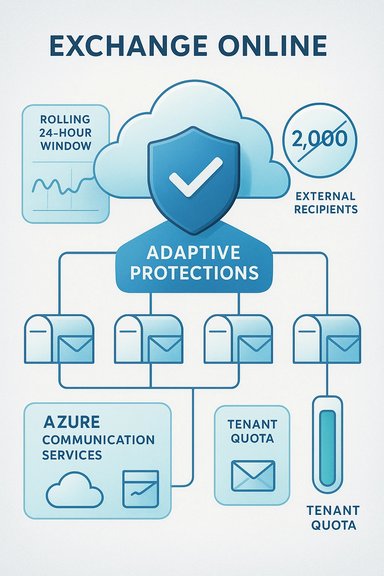
Microsoft’s outbound‑throttling overhaul for Exchange Online was designed to reduce abuse—spam, account compromise and bulk sends from compromised mailboxes—by adding more granular controls on how many external recipients a tenant or individual mailbox could contact in a rolling 24‑hour period. The program combined a Tenant External Recipient Rate Limit (TERRL) that scales with license count and a proposed Mailbox External Recipient Rate Limit (MERRL / ERR) intended to act as a per‑mailbox sublimit.The plan provoked fast, broad feedback from administrators, ISVs and operations teams who warned that a strict per‑mailbox external cap would break real business use cases—ticketing systems, CRM workflows, monitoring alerts and line‑of‑business (LOB) applications that legitimately send many external messages from a mailbox identity. Microsoft’s Exchange team has responded by indefinitely cancelling enforcement of the mailbox‑level ERR while retaining tenant‑level controls and the classic per‑mailbox recipient rate. Administrators should treat the cancellation as operationally significant but verify tenant‑specific notices in the Microsoft 365 admin center Message Center.
What Microsoft proposed — the technical mechanics
The ERR / MERRL concept, in plain terms
- The ERR was described as a per‑mailbox sublimit inside the existing, broader recipient budget: a mailbox could be limited to roughly 2,000 external recipients in a 24‑hour sliding window even while the overall per‑mailbox recipient budget (historically cited around 10,000 recipients per 24 hours in many SKUs) remained in place.
- The ERR counted per recipient instance, not unique addresses. That means repeated sends to the same external address (retries, follow‑ups, automated sequences) would increment the count each time, potentially multiplying totals in surprising ways.
- The Tenant External Recipient Rate Limit (TERRL) is a tenant‑level quota that scales with purchased email licenses and was already rolling into enforcement phases; it is separate from any mailbox sublimit and was meant to protect the tenant and the service from extremely high outbound volumes.
The operational rationale Microsoft gave
Microsoft framed the ERR as a blunt but simple mechanism to prevent misuse of Exchange Online for bulk sending and to reduce the risk surface created by compromised accounts. The company also advised migrating legitimate high‑volume transactional or marketing email workloads to dedicated platforms—Microsoft suggested Azure Communication Services (ACS) for Email or third‑party Email Service Providers (ESPs)—which are designed for large volume, reputation‑managed delivery.Why customers pushed back — concrete, operational objections
Administrators identified multiple real‑world failure modes for a mailbox‑level external cap:- LOB integrations often use a mailbox identity for automated notifications (invoices, alerts, ticket updates). Those workflows are legitimate but can look like bulk sending to a blunt cap.
- The per‑recipient counting model multiplies counts because retries, connector hops and signature processing can all add to the tally, producing unexpected limit triggers even for small audiences.
- Administrative tooling to detect and remediate high‑sending mailboxes arrived late or lacked granularity. Microsoft’s promised Exchange Admin Center reports to surface per‑mailbox senders were not universally available or mature when customers needed them.
- The policy was deterministic but inflexible: it blocked abuse efficiently but risked blocking legitimate but bursty business traffic. The community argued this tradeoff favored protection at the cost of operational reliability.
Timeline — how we got here
- April 2024: Microsoft publicly described the ERR concept and initial timelines for phased rollout, including trialing on new tenants.
- 2024–2025: Timelines shifted repeatedly; Message Center posts delayed enforcement while Microsoft worked on tooling and sought customer feedback.
- Administrators and partners raised operational concerns: lack of granular reports, double‑counting semantics, and incompatibility with LOB patterns made adoption risky.
- Early January 2026: Microsoft posted that the Mailbox External Recipient Rate Limit is canceled indefinitely, while tenant‑level limits and the classic per‑mailbox recipient rate remain in force; the Exchange team said it will pursue less disruptive, smarter protections. Administrators were urged to check tenant Message Center posts for confirmation.
What was canceled — and what still matters
Canceled (for now)
- The Mailbox External Recipient Rate Limit (MERRL / ERR) enforcement as a hard 2,000 external recipients per mailbox in a 24‑hour sliding window. Microsoft’s Exchange team communicated that this enforcement is paused/canceled while alternative approaches are explored.
Still in force
- The classic Recipient Rate Limit remains applicable (the longstanding per‑mailbox recipient ceilings in Microsoft’s service descriptions), historically cited at about 10,000 recipients per mailbox in 24 hours for many commercial SKUs.
- The Tenant External Recipient Rate Limit (TERRL) continues to roll out and remains an enforcement mechanism intended to protect tenant and platform health. Admins must still design flows that respect tenant‑level quotas.
Alternatives and recommended architectures for high‑volume sending
Microsoft and the community pointed to several robust alternatives for legitimate high‑volume outbound messaging:- Azure Communication Services (ACS) for Email — Microsoft’s purpose‑built email offering for transactional messages; designed for volume, deliverability and separate commercial terms.
- High‑Volume Email offerings from Microsoft 365 — preview or paid add‑ons that may exempt certain flows from standard limits; availability and terms vary by plan.
- Third‑party ESPs (SendGrid, Amazon SES, Mailgun, etc. — platforms that handle reputation management, feedback loops, bounces and large‑scale delivery.
- Better deliverability and reputation controls.
- Scalable, SLA'd delivery pipelines built for bulk transactional and marketing traffic.
- Clear separation of application notifications from human inboxes, simplifying troubleshooting and governance.
- Integration effort to migrate DKIM/SPF/DMARC, bounce handling and monitoring.
- Additional operational complexity and potential licensing costs.
- Need to update auditing, retention and eDiscovery processes if messages no longer pass through Exchange mailboxes in the same way.
Practical next steps for Exchange administrators (a checklist)
- Verify the current state of limits for your tenant in the Microsoft 365 admin center Message Center and Exchange Admin Center reports; do not rely on secondary summaries for final operational decisions.
- Identify heavy‑sending mailboxes and LOB mailflows using EAC reporting and logs. Classify whether the sends are transactional, marketing, or user‑initiated.
- Prioritize migration of true high‑volume transactional and marketing flows to a dedicated platform (ACS Email or an ESP). Document deliverability controls (DKIM/SPF/DMARC) and update monitoring.
- Where mailbox sending is necessary, design retries, batching and connector logic to avoid per‑recipient amplification from retries and signature processing.
- Update runbooks: include steps for rate‑limit alerts, escalation paths, and fallback channels for critical alerts (pager, SMS, webhook) to avoid single‑point email failures.
Risk analysis — strengths of Microsoft’s pivot and remaining concerns
Strengths / positives
- The reversal shows Microsoft is listening to administrators and willing to iterate when a proposed control would disrupt legitimate business functions. That responsiveness reduces the risk of operational outages caused by well‑intended but poorly timed enforcement.
- Keeping tenant‑level limits and classic recipient rate ceilings preserves platform protection while allowing Microsoft time to build more targeted, adaptive throttles. Adaptive controls (if well‑designed) can focus on behavioral signals that distinguish abuse from legitimate bursts.
Concerns and open questions
- The cancellation messaging appears to exist in admin‑circulated posts and community copies; the exact canonical text and long‑term policy direction may not be fully reflected in all public Microsoft Message Center posts at the same moment. Administrators must check tenant‑scoped messages for authoritative confirmation. Treat the cancellation as important but verify it inside your tenant.
- Adaptive protections can be complex to design and opaque to admins. Without clear telemetry, admins may still struggle to understand why a mailbox was throttled or how to remediate false positives. Microsoft must deliver granular, timely reporting and APIs if adaptive controls are to be operationally viable.
- Moving heavy senders off Exchange can create governance and discovery gaps. Legal, security and compliance teams need guidance on eDiscovery and retention when messages are routed through external ESPs or ACS rather than inbox mailboxes.
How to evaluate Microsoft’s next moves — what to watch for
- Release of detailed EAC reporting that pinpoints offending senders by mailbox, connector or application; these reports must be timely and machine‑readable (API) for automation.
- Transparent technical documentation about how adaptive rules will classify behavioral indicators (sudden spikes, message content patterns, authentication anomalies) vs. blunt numeric caps.
- Pilot programs or opt‑in previews allowing tenants to test adaptive protections in non‑blocking mode so false positives can be tuned before enforcement.
- Clear enterprise pathways for exceptions or paid high‑volume options where business needs justify higher per‑mailbox thresholds under managed conditions.
Verdict — what this means for organizations and administrators
Microsoft’s withdrawal of the strict per‑mailbox external recipient cap is a pragmatic retreat from an approach that risked heavily disrupting legitimate business processes. It reflects a broader lesson: platform protections must be balanced with operational realities. Administrators should treat the change as a pause in enforcement, not a permanent removal of outbound controls.Operational priorities for the next 90–180 days:
- Audit and classify mailbox send patterns now.
- Migrate true bulk transactional and marketing flows to dedicated services.
- Demand and validate Microsoft’s promised reporting and adaptive controls before relying on them in production.
- Maintain clear runbooks and fallbacks for critical notifications.
Conclusion
The cancellation of the Mailbox External Recipient Rate Limit is a notable victory for administrators who raised operationally concrete objections, but it is also a reminder that the drive to harden cloud platforms against abuse will continue. Microsoft’s pivot toward smarter, more adaptive protections is the right conceptual direction—but it raises new expectations: detailed reporting, transparent classification logic, and enterprise tooling to manage exceptions.For now, organizations should move fast on discovery and architecture: assume tenant‑level limits and legacy recipient ceilings still apply, identify and migrate high‑volume flows to purpose‑built email services, and insist on measurable telemetry from Microsoft before embracing any new adaptive enforcement. The choice is simple: design systems that survive an era of tighter outbound controls, or risk being surprised by them.
Source: Computing UK https://www.computing.co.uk/news/2026/microsoft-drops-exchange-changes/
