

Microsoft certifications remain one of the clearest, most portable ways for IT professionals to prove up-to-date skills in cloud computing, security, data, and modern application development—provided you understand what each credential actually measures, how Microsoft now keeps them current, and how hiring managers evaluate them in 2026.
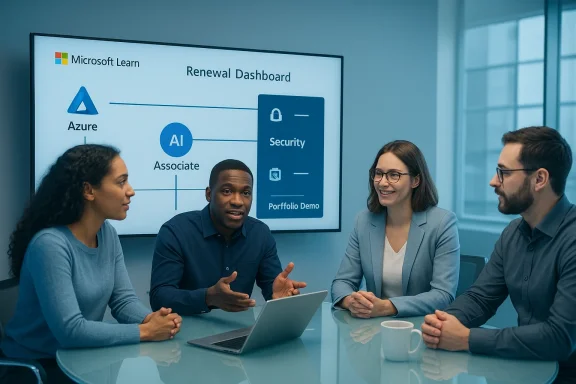
In the last half‑decade Microsoft reorganized its certification program to be role‑focused, continuously updated, and renewable through short online assessments rather than full retakes. That shift turned exams into living credentials that reflect the rapid cadence of platform changes, especially across Azure and Microsoft 365. The practical result: certifications are now easier to keep current, but they require an ongoing commitment to maintain currency. This change to renewal-by-assessment and focused role-based exams is documented in Microsoft’s Certification Renewal guidance and FAQs.
Community reporting and certification roadmaps published across Windows and Azure‑focused forums echo the same practical advice: start at the fundamentals, pick a job role, and plan a certification ladder that combines foundational knowledge with progressively specialized associate and expert credentials. Discussions in community threads outline concrete paths from AZ‑900 and AI‑900 to role-focused certs such as AZ‑104 and AZ‑305.
Practical implications:
Why AZ‑104 matters:
Another strength is role alignment: the most useful Microsoft certs map directly to job descriptions—this makes them practical hiring signals when combined with demonstrable work.
The limitations are structural and candid:
Source: Breaking AC Microsoft Certifications: Unlocking Professional Opportunities in IT | Breaking AC
 Background / Overview
In the last half‑decade Microsoft reorganized its certification program to be role‑focused, continuously updated, and renewable through short online assessments rather than full retakes. That shift turned exams into living credentials that reflect the rapid cadence of platform changes, especially across Azure and Microsoft 365. The practical result: certifications are now easier to keep current, but they require an ongoing commitment to maintain currency. This change to renewal-by-assessment and focused role-based exams is documented in Microsoft’s Certification Renewal guidance and FAQs.Community reporting and certification roadmaps published across Windows and Azure‑focused forums echo the same practical advice: start at the fundamentals, pick a job role, and plan a certification ladder that combines foundational knowledge with progressively specialized associate and expert credentials. Discussions in community threads outline concrete paths from AZ‑900 and AI‑900 to role-focused certs such as AZ‑104 and AZ‑305.
Why Microsoft certifications still matter
Microsoft certifications deliver three distinct kinds of value:- Technical signal — They document specific, role‑aligned skills (for example, Azure administration or Microsoft 365 security) rather than a generic IT résumé bullet.
- Recency signal — The renewal model means employers can assume certified candidates have at least recently engaged with current platform capabilities.
- Market signal — For hiring and compensation decisions, certifications remain a measurable input when combined with demonstrable experience and project evidence.
The modern Microsoft certification taxonomy — what you need to know
Microsoft groups credentials into obvious, career‑staged buckets. Understanding the differences lets you plan efficient learning and avoid wasting time on low‑value or redundant exams.Fundamentals
- Purpose: Introduce concepts and vendor basics.
- Typical exams: AZ‑900 (Azure Fundamentals), AI‑900 (Azure AI Fundamentals), DP‑900 (Azure Data Fundamentals), MS‑900 (Microsoft 365 Fundamentals).
- Who they’re for: Students, career changers, non‑technical managers needing a platform primer.
- Value: High utility as an entry point; fundamentals show intent and baseline knowledge but rarely move salary needles alone.
Associate
- Purpose: Validate job‑ready operational and development skills.
- Typical exams: AZ‑104 (Azure Administrator Associate), DP‑203 (Data Engineering or successor), MS‑500/SC‑200 family for security roles.
- Who they’re for: Practitioners with some on‑the‑job experience who perform day‑to‑day operational tasks.
- Value: These certificates are the workhorses for career mobility—valuable for promotions into hands‑on roles and often referenced in job descriptions. The AZ‑104, for example, is marketed and maintained as the core Azure admin credential and has an official study guide and skills‑measured update history.
Expert / Specialty
- Purpose: Show design, architecture, and leadership capabilities.
- Typical exams: AZ‑305 (Solutions Architect), AI‑102/AI‑200 family, SC‑100/SC‑300 for security architecture and identity.
- Who they’re for: Senior engineers, architects, and technical leads.
- Value: Expert credentials are a differentiator for high‑level roles and are strongly associated with higher salary bands, but they carry higher expectations for demonstrable experience.
What changed: renewal, cadence, and the implications for candidates
Microsoft moved from long‑lived, exam‑based recertifications to a renewal assessment model hosted on Microsoft Learn. Key operational facts you must know:- The renewal assessment becomes available six months before a certification expires; passing extends the certification by one year from the previous expiration date.
- Renewal content is oriented to recent product changes and is paired with free, bite‑sized Microsoft Learn modules targeted to the assessment.
- The policy emphasizes continuous currency: Microsoft expects certified professionals to re‑engage annually rather than retake a full proctored exam every few years.
Practical implications:
- Keep a calendar of expiration dates in UTC (Microsoft’s system uses UTC for expiration times).
- Begin renewal preparation in the six‑month eligibility window; waiting until the last week is a known trap.
- Track Microsoft Learn renewal collections for your certs so you can close knowledge gaps quickly.
Deep dive: Azure certifications (what hiring managers look for)
Azure continues to be the single largest product family in Microsoft’s certification ecosystem. Employers usually categorize Azure needs into three buckets: operations (administration and platform maintenance), architecture and design (infrastructure and app design), and data + AI (analytics, ML, and AI services).AZ‑104 and the Administrator pathway
AZ‑104 sits at the center of the operations track. Microsoft documents the skills measured and periodically updates the exam to reflect service changes; the AZ‑104 study guide and skills matrix posts are explicit about what’s tested and when updates took effect (for example, an April 18, 2025 update cycle). The exam tests core administration tasks: identity, governance, virtual networking, compute, storage, and monitoring.Why AZ‑104 matters:
- It’s the canonical credential cited in many “Azure administrator” job descriptions.
- Passing signals operational competence with the day‑to‑day tooling and patterns used to keep cloud workloads running.
- It pairs naturally with specialist associate certs (networking, security) and an eventual move to AZ‑305 for architecture roles.
Architecture, Data, and AI tracks
- AZ‑305 (Solutions Architect) validates design patterns and tradeoffs for enterprise workloads.
- DP and AI‑family exams (DP‑203/DP‑100, AI‑102) validate engineering and model development skills; these are growing in market value as organizations operationalize AI.
- Security track certs are increasingly in demand given regulatory and supply‑chain pressures; security credentials (SC‑100/SC‑200/SC‑300 families) are now close companions for both admin and architect roles.
Return on investment: the data behind certification value
Hard numbers vary by geography, seniority, and role, but three consistent findings emerge from recent industry surveys:- A large proportion of IT professionals report improved career outcomes after certification—some studies put promotion or pay‑increase rates in the 30–60% range depending on certification and region. Global Knowledge’s annual report and similar surveys show that many certified professionals report salary or career benefits after certification.
- The salary premium for certification is concentrated: specialist and architect credentials show the strongest dollar impact; fundamentals rarely move salary alone. Skill reports and Microsoft‑sponsored research put the average certification salary uplift in the single digits to low‑teens percent for many certs, with elite architecture and security certs commanding higher premiums.
- Market nuance matters: as the job market matures, employers increasingly weigh project evidence, GitHub portfolios, and practical demonstrations alongside credentials. Recent industry commentary notes that while certification premiums have softened for some roles, certifications remain part of hiring and promotion calculus—especially when paired with demonstrable outcomes.
Preparing effectively — a practical study playbook
Getting certified is part study pattern, part hands‑on practice, part exam strategy. Below is a pragmatic, sequential plan I recommend for most candidates:- Define your target role and the cert(s) that map to it (e.g., Azure Administrator → AZ‑104).
- Audit the official skills‑measured document on Microsoft Learn and identify weak areas. Use the Microsoft exam pages and study guides to outline the target skills.
- Follow the Microsoft Learn learning path(s) for the exam; supplement with hands‑on labs (sandbox subscriptions, Azure free tier, or workplace practice).
- Take practice assessments and time‑boxed mock exams to build stamina; treat practice results as a diagnostic roadmap, not a final judgment.
- Schedule the renewal cadence: add an annual reminder and note the six‑month eligibility window for Microsoft’s renewal assessment.
- Document a small project or portfolio item tied to the certification domain (e.g., deploy a multi‑tier app in Azure, automate backups, or build a monitored data pipeline) and add it to your public portfolio or résumé.
- Microsoft Learn modules and curated renewal collections for specific certs.
- Official Microsoft exam study guides and skills measured pages.
- Community study groups and forums for practical tips—but treat dumps and unethical shortcuts as career risks.
Risks, traps, and ethical pitfalls
No credential is risk‑free. Several practical hazards deserve explicit attention:- Overreliance on credentials without projects. Employers increasingly ask for practical evidence—Git repos, production experience, or demonstrable outcomes—alongside certifications.
- Exam‑dump and cheating risks. Using leaked questions or “dumps” can lead to invalidation of your credential and permanent bans from Microsoft’s program. Community moderation and Microsoft’s exam integrity rules are strict; follow official guidance.
- Recency and renewal compliance. Because Microsoft shifted to an annual renewal cadence for many certs, letting a certification lapse can remove the market signal and require retaking exams in some cases; plan renewals proactively.
- Market volatility. Demand for specific skills shifts with platform changes and macroeconomic cycles; the certifications with the highest “buzz” may not match your local job market demand. Cross‑check job boards and recruiter reports before investing heavily in a cert path. Industry salary and skills reports emphasize this nuance.
Employer perspective — how hiring managers read certifications in 2026
Hiring managers typically use certifications as a filter and a conversation starter. They rarely hire on certification alone. What matters in interviews:- Can you explain how you used the technology to solve a business problem?
- Can you demonstrate troubleshooting, instrumentation, and operational judgment—often through scenario questions or take‑home exercises?
- Do you show continuous learning habits? Managers value candidates who keep certificates current and can cite recent changes or features.
Roadmap examples: targeted certification journeys
Below are three practical certification roadmaps depending on where you are in your career. Each roadmap lists priority certs and recommended sequencing.1) Beginner to Cloud Operator (6–12 months)
- AZ‑900 (Azure Fundamentals)
- AZ‑104 (Azure Administrator Associate)
- Optional: AZ‑500 (Azure Security Engineer Associate) for security focus
2) Data & AI path (6–18 months)
- DP‑900 (Data Fundamentals)
- DP‑203 (Data Engineer) or DP‑100 (Data Scientist) depending on focus
- AI‑102 (Azure AI Engineer) for applied AI workloads
3) Security & Enterprise Architecture (12–24 months)
- MS‑900 (Microsoft 365 Fundamentals)
- SC‑200/SC‑300 intermediate security certs
- AZ‑305 (Solutions Architect) or SC‑100 for enterprise security architecture
- Start with a fundamentals exam only if you need conceptual grounding; otherwise begin at the associate level if you already have experience.
- Build a 12‑week study plan for associate exams that pairs Microsoft Learn modules with hands‑on labs and weekly mock tests.
Costs, time investment, and realistic expectations
- Exam fees vary by region and exam type; Microsoft updated exam prices in late 2024, and regional price adjustments are in effect—budget for the exam fee plus optional paid practice tests or instructor‑led courses if needed.
- Time estimates: fundamentals ~20–40 hours; associate ~80–150 hours; expert ~200+ hours depending on previous experience.
- Renewal is free for eligible certs via the Microsoft Learn assessment during the six‑month window, which lowers long‑term total cost if you maintain currency.
Final analysis: strengths, limits, and practical advice
Microsoft certifications in 2026 are stronger in one central respect: currency. Microsoft’s renewal model aligns certification status much more closely to platform knowledge than earlier multi‑year recertification cycles did. That’s a clear strength for employers and candidates who keep learning.Another strength is role alignment: the most useful Microsoft certs map directly to job descriptions—this makes them practical hiring signals when combined with demonstrable work.
The limitations are structural and candid:
- The labor market increasingly prizes demonstrable outputs (projects, deployments, incident handling) alongside credentials.
- Certification value varies by geography, sector, and seniority. Certification is one lever in a broader career strategy.
- Recency requirements mean the workload is continuous; for some candidates the annual renewal cadence is an unwelcome commitment.
- Choose certs only after verifying regional job demand (scan job listings and recruiter postings).
- Pair certification with a small but visible portfolio project that shows business impact.
- Maintain a renewal calendar and use Microsoft Learn’s free renewal collections to stay current and avoid last‑minute scrambling.
Conclusion
Microsoft certifications remain a high‑utility tool for IT career progress when used strategically: pick the right cert for the role you want, document practical outcomes, commit to the renewal cadence, and avoid shortcuts that risk your credential or reputation. The program’s move to annual renewal assessments and role‑based exams makes certifications more reflective of modern platform reality—but it also shifts the effort from a one‑off exam to an ongoing practice of continuous learning. For professionals serious about cloud, security, data, or modern application development, Microsoft certifications are still a valuable piece of the career puzzle—most effective when combined with demonstrable experience and a clear, market‑driven roadmap.Source: Breaking AC Microsoft Certifications: Unlocking Professional Opportunities in IT | Breaking AC
