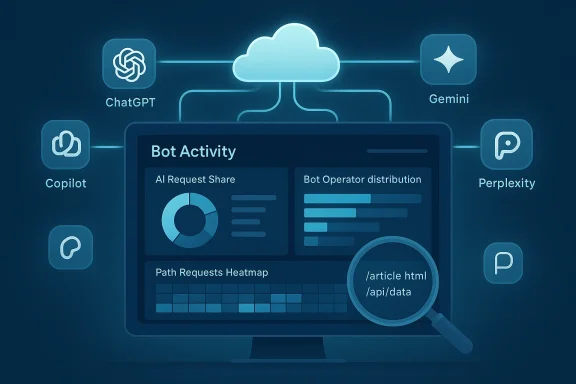
Microsoft’s new Clarity “Bot Activity” dashboardard turns what publishers long treated as background noise into measurable intelligence, and that shift matters: by surfacing verified AI crawler activity from server-side logs, Clarity gives site owners an early, actionable signal about how automated systems are reading, indexing, and potentially harvesting their content — days, weeks, or months before any citation, referral, or visible downstream traffic appears.
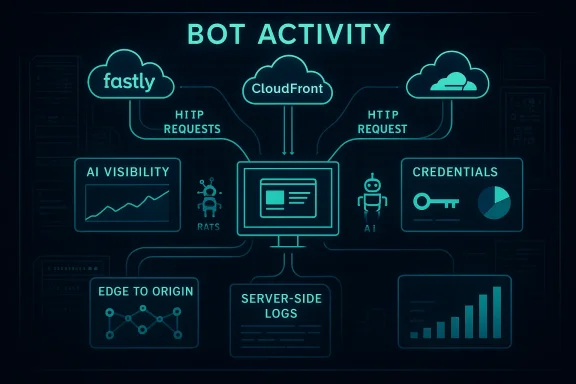
Microsoft Clarity’s AI Visibility suite has expanded beyond client-side behavioral recordings into a server-log driven view of automated access. The new Bot Activity dashboard ingests request-level logs from supported CDN and server integrations — Fastly, Amazon CloudFront, Cloudflare, or via the WordPress plugin — to classify and quantify bot and AI crawler behavior at the infrastructure level. This is not inferred behavior: it’s what actually hit your edge and origin. That ground-level visibility responds to an industry problem publishers and platforms have wrestled with for the last 18 months: AI-driven crawlers and retrieval agents are reading the web at volumes and cadences that traditional analytics tools do not capture. Third-party analyses and news investigations show substantial increases in retrieval-type bot traffic, and publishers are increasingly pressured to decide whether to block, meter, or monetize that access. Clarity’s feature enters that debate by offering a way to measure the phenomenon early in the AI content lifecycle.
Source: MediaPost Microsoft Exposes AI Bot Site Traffic
 Background
Microsoft Clarity’s AI Visibility suite has expanded beyond client-side behavioral recordings into a server-log driven view of automated access. The new Bot Activity dashboard ingests request-level logs from supported CDN and server integrations — Fastly, Amazon CloudFront, Cloudflare, or via the WordPress plugin — to classify and quantify bot and AI crawler behavior at the infrastructure level. This is not inferred behavior: it’s what actually hit your edge and origin. That ground-level visibility responds to an industry problem publishers and platforms have wrestled with for the last 18 months: AI-driven crawlers and retrieval agents are reading the web at volumes and cadences that traditional analytics tools do not capture. Third-party analyses and news investigations show substantial increases in retrieval-type bot traffic, and publishers are increasingly pressured to decide whether to block, meter, or monetize that access. Clarity’s feature enters that debate by offering a way to measure the phenomenon early in the AI content lifecycle. What Bot Activity measures — the dashboard and its metrics
Microsoft frames Bot Activity as an upstream, earliest observable signal in the AI content chain. The dashboard exposes several distinct metrics and views that are specifically useful to operations, editorial, and analytics teams:- Bot operator — identifies which platforms and organizations generate automated requests to your site and shows their proportion of total requests. This view defaults to AI-related operators but can show all identified bots.
- AI request share — the percentage of total page requests that originated from AI bots, measured against overall traffic to give context on impact.
- Bot activity metric — categorizes automated requests by purpose (search/indexing, retrieval for assistants, embedding generation, developer/data services), helping distinguish why bots crawl, not just how often.
- Path requests — aggregates requests at the path level (HTML, images, JSON endpoints, XML files, other assets) so site teams can see which specific pages or resources receive the most automated attention.
Why server-side logs matter (and what client-side analytics miss)
Client-side analytics — the JavaScript tags embedded in pages — are blind to a large class of automated activity because many AI retrieval systems issue requests from server-side agents that never execute page scripts. That means client-only analytics will undercount or entirely miss high-volume retrieval activity that nonetheless consumes infrastructure and may eventually be used to generate downstream answers that supplant direct visits. Clarity’s Bot Activity relies on CDN/server log forwarding to fill that blind spot. This architectural difference has three practical consequences:- Measurement fidelity: server logs capture raw HTTP events (requests, headers, status codes) and richer metadata available at the edge — enabling more accurate bot identification.
- Cost visibility: because the data flow comes from your CDN or hosting, Clarity warns that enabling the feature may have cost implications depending on provider pricing, traffic volume, and regional configuration. Those costs are billed by the CDN/cloud provider, not by Clarity.
- Actionability: knowing which paths are being scraped lets teams implement surgical countermeasures (edge rules, IP policies, API key gating) and, crucially, evaluate whether a given crawler is productiveversions) or purely extractive (creates cost without value).
What this means for publishers: measurement, economics, and content strategy
Microsoft’s broader analysis — and Microsoft’s Clarity dataset specifically — has already fed industry debate. In Clarity’s sample of more than 1,200 publisher and news domains, AI-driven referrals were reported to have grown roughly +155% over, although they still represented less than 1% of total sessions during the measured period. Clarity also found higher per-visit conversion rates for AI-referred visitors in that sample, particularly for sign-ups and subscription flows — a pattern that emphasizes quality over quantity in some verticals. Those numbers are sample-dependent and should not be generalized to every site or business model without testing. Why that nuance matters:- Conversion profile matters: publishers that rely on membership, subscriptions, or gated content may see a small number of AI-driven visits produce outsized downstream value. Clarity’s publisher sample shows higher sign-up and subscription lift for AI referrals relative to search in some cases — but that effect is context-specific and sensitive to sample selection and short time windows. Treat these figures as directional signals, not universal laws.
- The invisible web problem: many AI interactions are “zero-click” — users receive synthesized answers directly without clicking. That influence is invisible to pageview-based monetization, creating an attribution gap that can depress measured traffic while the consumption of content may be increasing via non-human agents. Clarity’s Bot Activity aims to make at least the upstream consumption visible so publishers can quantify what was previously dark.
- Monetization choices: publishers must choose whether to block, meter, or monetize crawlers. Some newsrooms have used third‑party telemetry to negotiate retrieval licenses, while others opt to throttle or deny access to protect revenue and infrastructure. The right path depends on your business model and the proportion of bot access that converts or creates commercial value. External reports show that publishers are increasingly reopening the debate about whether blocking is the optimal strategy when some crawlers can be legitimate downstream partners.
Industry context: retrieval bots, scale, and risk
Independent reporting and vendor telemetry confirm the directionality Clarity describes: retrieval-style bots and AI crawlers grew dramatically in 2024–2025. For example, industry analysis cited in major outlets found retrieval bot traffic increased substantially in early 2025, and security/anti-fraud vendors observed rapid rises in LLM-driven crawler requests across customer bases. These trends create both opportunity and risk for publishers: more automated access can mean greater eventual visibility in AI answers, but it can also mean infrastructure costs, intellectual property exposure, and revenue displacement when synthesized answers replace direct visits. Two practical industry takeaways emerge from cross-vendor data:- There is real growth in automated retrieval and assistant-oriented crawling that differs from historical search-engine crawling in cadence, depth, and targeting.
- The legal and commercial frameworks for compensating publishers for retrieval-based use are immature; some publishers are negotiating deals, but a majority still see uncompensated scraping combined with declining human visits as an unresolved business problem.
How to use Bot Activity: operational playbook
Clarity’s dashboard is not a silver bullet, but itractical toolkit for site owners. The following steps outline a basic, prioritized playbook for teams adopting Bot Activity:- Connect logs selectively. Start with a small-scope integration (a staging site or limited domain set) to validate data quality and estimate CDN logging costs. Microsoft documentation and the onboarding flow list supported providers and include WordPress plugin specifics.
- Baseline bot load. Use the Bot operator and AI request share metrics to establish a 30–90 day baseline of automated request volume and the top operators accessing your content. Capture both absolute and relative metrics (requests per minute, percent of total requests).
- Map impact by path. Use Path requests to identify specific pages and endpoints with high automated access. Prioritize investigation on paths that are expensive to render (large images, heavy API endpoints) or that contain high-value content.
- Evaluate value. Cross-reference path-level bot activity w (referrals, conversion events, subscription sign-ups) to determine which operators are producing tangible value. For many publishers, only a small subset of crawlers will show any downstream ROI.
- Decide controls. If activity is extractive and costly, implement tiered responses: rate limits at the CDN, robots.txt for naive crawlers, authenticated API access for structured data, or legal/commercial outreach for licensing discussions. Conversely, if a crawler produces measurable value, consider whitelisting and building partnership terms.
- Monitor and iterate. Bot behavior evolves rapidly. Keep Bot Activity enabled while running periodic reviews of operators, request profiles, and costs. Use alerts for sudden increases in AI reqators appearing in your logs.
Risks, limits, and things Clarity doesn’t (yet) solve
Clarity’s Bot Activity is a major step, but it has limits and trade-offs that teams must understand before relying on it as a single truth source.- Sample bias and external validity. Clarity’s growth and conversion statistics derive from instrumented publisher samples. Percentage growth figures (for example, the often-cited +155% growth) are accurate for Clarity’s sample but can be misleading when applied broadly — high percentage growth from a tiny base can look dramatic while representing modest absolute volume.s directional benchmarks, not universal expectations.
- Server-side integration required. The feature depends on CDN/server forwarding. Some operators may lack access to their CDN configurations or fear the marginal costs of log forwarding. Clarity explicitly warns of potential provider costs; teams must budget and test accordingly.
- No automatic blocking or enforcement. Bot Activity is observational; it doesn’t block or manage crawlers for you. Action still needs to be taken through CDN rules, firewall policies, or commercial/legal channels.
- Attribution gaps remain. Even with upstream bot visibility, “zero-click” AI consumption (where the assistant answers a user without exposing a referrer) can still produce invisible influence. That means Bot Act not eliminate, publisher uncertainty about AI-driven consumption.
- Operator identification is probabilistic. Attributing an automated request to a specific AI operator often requires header patterns, IP ranges, and other heuristics. While Clarity integrates multiple signals, edge cases and false positives remain possible; decisions should be corroborated with other logs and vendor intelligence.
The security and policy angle
Bot Activity also has implications for security teams. High-volume automated access can amplify exposure to scraping, content theft, or even reconnaissance for fraud campaigns. Visibility into which systems access what content can feed SOC triage: distinguishing benign indexing from suspicious chains that probe for high-value artifacts or API endpoints. Conversely, publishing teams must balance detection with privacy and legal constraints when logging and analyzing request-level data. Industry observers also warn that AI crawlers are not monolithic. Some operate to support live assistants (retrieval), others to produce embeddings for model training, and some are outright malicious or opportunistic scraping operations. Clarity’s categorization of bot activity by purpose helps separate those behaviors, but security teams still need to pair Clarity’s outputs with UEBA/SIEM correlation and endpoint telemetry for a complete defensive posture.Practical examples: how publishers are responding
Several publisher strategies are emerging in response to rising bot activity:- Selective metering: Some sites gate high-value content endpoints behind API keys or subscription checks while keeping other content open to maintain visibility.
- Partner licensing: A handful of publishers leverage retrieval-traffic telemetry to negotiate compensation or access agreements with AI vendors that rely on their content.
- Surgical blocking: For extractive crawlers that show no downstream benefit and impose costs, teams have implemented CDN rate limiting or IP-based throttling.
- Experimentation: Others use Clarity and similar signals to A/B test whether specific crawlers provide referral lift or conversion improvements, treating those bots as experimental channels rather than threats.
Critical assessment: strengths and open risks
Microsoft’s Bot Activity offers important strengths:- Early signal detection. The upstream view provides an early look at how content is being accessed before downstream signals appear.
- Operational utility. Path-level insights help engineering and content teams prioritize remediation and optimization.
- Integration with existing analytics. When combined with Clarity’s session and heatmap tooling, Bot Activity can be used to correlate automated access with real-user behavior and conversion events.
- Cost and data governance. Server-side log forwarding can raise cloud/CDN bills and data retention considerations.
- Partial visibility. Bot Activity captures what hits the CDN/edge you forward; it won’t see every form of autonomous access (e.g., private tenant agent activity that never touches those endpoints).
- Commercial and legal friction. The policy and market frameworks for monetizing retrieval access are unsettled; more measurement may sharpen negotiating positions but won’t automatically resolve revenue sharing or copyright disputes.
Conclusion
Microsoft’s Clarity Bot Activity reframes bot traffic as first-class telemetry: server-side logs, CDN integrations, and new metrics give site owners the ability to see how AI agents and crawlers actually touch their infrastructure. That visibility is the practical distinction between guessing about extraction and making data-driven decisions about capacity, access control, and monetization. At the same time, the numbers reported so far — rapid percentage growth from a small base and elevated conversion rates in some publisher samples — are directional, sample-sensitive, and must be interpreted alongside independent datasets and your own A/B experiments. For publishers, the immediate priority is not to react to headlines but to instrument, measure, and run experiments: connect logs selectively, baseline bot load, map value by path, and then decide whether to block, meter, or partner — using Clarity’s Bot Activity to make those choices with evidence instead of intuition. The web is becoming agentic and programmatic; making automated consumption visible is now table stakes. Microsoft’s Bot Activity is a useful new tool in that effort — but transparency, careful interpretation, and cross‑vendor corroboration are necessary to turn those early signals into sustainable publisher outcomes.Source: MediaPost Microsoft Exposes AI Bot Site Traffic