

Microsoft’s decision to close its long‑running employee library and replace subscription access with “AI‑powered learning experiences” is both a literal and symbolic watershed for corporate learning—and it exposes a widening gulf between the promises of generative AI and the hard work of preserving knowledge, provenance, and trust.
Microsoft operates at a scale few companies can imagine: the firm employs roughly 220,000 people worldwide, a figure Microsoft itself cites in corporate communications and diversity reports. For decades, that workforce has had access to an onsite, curated employee library—complete with physical volumes, business‑book lending, and digital subscriptions to specialist publications—that acted as an internal learning commons for code, management, research, and culture. Recent reporting indicates the physical collection, housed in Microsoft’s “building 92” at the Redmond campus, is being shuttered and that some longstanding news and business subscriptions (reportedly including access to outlets such as The Information) are being cut in favour of a centralized “Skilling Hub” that promises a more modern, connected learning experience via AI. This move is being framed internally as an evolution from physical collections and recurring third‑party subscriptions toward a unified, AI‑driven learning platform. An internal FAQ quoted in coverage describes the change as the Library closing “as part of Microsoft’s move toward a more modern, connected learning experience through the Skilling Hub,” and acknowledges the space was valued by staff. At the same moment Microsoft is doubling down on Copilot and similar copilots across Office, Azure and Edge, a high‑profile operational failure has spotlighted a central weakness of generative systems: hallucination. A fabricated match reference generated by Microsoft Copilot found its way into intelligence used by West Midlands Police and helped justify a ban on visiting fans—an error that later prompted a scathing inspectorate review and a public loss of confidence from the Home Secretary. That episode has become a focal point for critics who warn that replacing human curation and primary sources with AI summaries can lead to serious, even rights‑affecting, mistakes.
But the Copilot hallucination that slipped into police intelligence is a stark counterpoint. It demonstrates that scale without provenance is brittle. Libraries and subscriptions are expensive; they are also slow, deep, and human‑shaped. The right corporate posture is not to ask whether we can replace books with AI, but whether we can combine the two in a design that preserves critical judgment, provenance, and the messy but necessary practice of disciplined verification.
Microsoft’s employees, procurement teams, and external partners should watch how the Skilling Hub is implemented, demand transparent sourcing and auditability, and push for a hybrid model that keeps human curation and publisher access alive where it matters most. The future of corporate knowledge should be AI‑augmented, not AI‑substituted—and the world will be safer and wiser if companies build that future deliberately.
Source: Kotaku Microsoft Boldly Asks 'Who Needs A Library When You've Got AI?'
 Background / Overview
Microsoft operates at a scale few companies can imagine: the firm employs roughly 220,000 people worldwide, a figure Microsoft itself cites in corporate communications and diversity reports. For decades, that workforce has had access to an onsite, curated employee library—complete with physical volumes, business‑book lending, and digital subscriptions to specialist publications—that acted as an internal learning commons for code, management, research, and culture. Recent reporting indicates the physical collection, housed in Microsoft’s “building 92” at the Redmond campus, is being shuttered and that some longstanding news and business subscriptions (reportedly including access to outlets such as The Information) are being cut in favour of a centralized “Skilling Hub” that promises a more modern, connected learning experience via AI. This move is being framed internally as an evolution from physical collections and recurring third‑party subscriptions toward a unified, AI‑driven learning platform. An internal FAQ quoted in coverage describes the change as the Library closing “as part of Microsoft’s move toward a more modern, connected learning experience through the Skilling Hub,” and acknowledges the space was valued by staff. At the same moment Microsoft is doubling down on Copilot and similar copilots across Office, Azure and Edge, a high‑profile operational failure has spotlighted a central weakness of generative systems: hallucination. A fabricated match reference generated by Microsoft Copilot found its way into intelligence used by West Midlands Police and helped justify a ban on visiting fans—an error that later prompted a scathing inspectorate review and a public loss of confidence from the Home Secretary. That episode has become a focal point for critics who warn that replacing human curation and primary sources with AI summaries can lead to serious, even rights‑affecting, mistakes. What changed, exactly?
The mechanics of the closure
- Microsoft informed staff the onsite Library (the present collection in building 92) is closing and that many employees will no longer have the same access to checking out business‑book digital copies or to some premium news subscriptions. The official reason given: consolidation into the company’s Skilling Hub and a shift toward “AI‑powered learning experiences.”
- The Skilling Hub is being presented as a centralized platform that offers curated learning experiences enhanced by AI, presumably including personalized learning pathways, aggregated summaries, and internal courses. The FAQ language circulated internally emphasizes modernization and connectivity rather than cost‑cutting as the primary rationale, although external coverage notes reduced third‑party spend as an obvious side effect.
Reported collateral effects
- Employees reportedly lost digital checkout access to certain business titles and lost institutional subscriptions to specialized news outlets. The reported effect is not only the removal of a physical space, but also a reduction in the variety and direct human curation previously available through subscriptions and librarianship.
- Anecdotes attached to the story—such as the library’s physical weight being blamed for structural damage to underground parking pillars—underscore the long history and physical presence of the collection. Whether apocryphal or accurate, these details help explain why staff experienced the closure as cultural loss rather than a mere logistical change.
Why this matters: promise versus provenance
The promise of AI‑powered learning
- Scale and personalization. AI systems can synthesize large corpora, tailor learning to individual pace and role, and surface relevant passages quickly—capabilities hard to match with a physical library alone. A Skilling Hub that leverages Copilot‑style technology can reduce friction for on‑demand learning and can push targeted micro‑learning to employees based on role, skill gaps, and business priorities.
- Lower recurring vendor spend and operational overhead. Subscriptions to dozens of specialized publications and a full onsite lending service carry recurring costs and administrative overhead that central platforms can reduce if executed correctly. Organizations scaling learning to tens or hundreds of thousands of employees find centralized models attractive from a budgeting and measurement standpoint.
- Faster content delivery. For fast‑moving technical topics (APIs, security advisories, platform changes), AI can quickly aggregate and summarize new information, potentially giving staff faster actionable knowledge than periodic book reads or weekly news digests.
The provenance problem: why human curation still matters
- Hallucination risk is real. Generative models can produce credible, succinct summaries that are nonetheless factually wrong. The West Midlands police incident—where a Copilot‑generated reference to a non‑existent West Ham vs Maccabi Tel Aviv match was used in official intelligence—offers an acute illustration of how an AI output can migrate from a draft to operational evidence and cause real harm. That case has prompted inspectorate reviews and high‑level political fallout.
- Loss of editorial depth and context. Books and longform journalism provide extended argumentation, nuanced context, and the author’s reasoning—qualities that a single AI summary can flatten or omit. Replacing curated collections with brief, algorithmic syntheses risks erasing how conclusions were reached and which perspectives were considered.
- Vendor and algorithmic bias. Centralizing learning through a single vendor platform increases dependence on its source selection, weighting algorithms, and contractual content decisions. If the Skilling Hub primarily surfaces corporate‑facing summarizations or selectively licensed materials, employees may see a narrower intellectual diet than before. That narrowing can affect critical thinking, product decisions, and institutional memory.
Critical analysis: strategic sense, cultural cost
What Microsoft gains
- Operational efficiency. Consolidating thousands of subscriptions and a physical lending operation into a single platform reduces duplicative procurement and simplifies reporting for HR and L&D teams.
- A single source of telemetry. A centralized learning platform enables the company to measure usage, completion, skill gaps, and ROI in a way disparate subscriptions never could—data that’s useful for reskilling at scale.
- Deeper integration with Copilot and Azure. Providing AI‑driven learning that hooks directly into Microsoft’s productivity stack and cloud infrastructure creates stickiness for internal tools—and externally, creates a stronger case study for enterprise customers.
What Microsoft risks
- Erosion of curiosity culture. Libraries and subscriptions are not just functional resources; they are cultural infrastructure. When employees are nudged away from reading full texts toward algorithmic synthesizers, institutions risk shrinking the intellectual serendipity and long‑form reflection that produce counterintuitive insights. Ray Bradbury’s aphorism about destroying culture by getting people to stop reading is quoted frequently in contemporary debates for a reason.
- Overreliance on imperfect models. The Copilot hallucination incident is an object lesson: if teams treat AI outputs as authoritative without layered verification, errors multiply. For high‑stakes domains—legal, safety, security, public policy—AI‑first policies require explicit human‑in‑the‑loop verification and audit trails, not simply curated dashboards.
- Reputational and legal exposure. Cutting third‑party subscriptions can antagonize publishers and journalists, especially when the vendor claims to “combine multiple web sources” but fails to show transparent sourcing or licensing. That tension may have commercial consequences and invite scrutiny from regulators and privacy advocates.
How to make AI learning actually better (recommendations)
For Microsoft (and other companies following this path)
- Adopt a hybrid model, not a replacement model. Keep a core of human‑curated, publisher‑licensed content and librarianship for depth, while using AI to augment discovery, summarize, and personalize pathways. The right design is augmentation, not substitution.
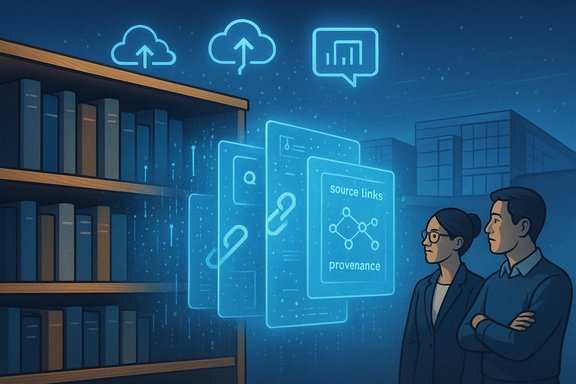
- Require provenance and audit trails. Any AI‑generated learning unit that asserts factual claims must include linked sources and a provenance chain that is human‑auditable. This should be non‑negotiable for workplace materials used in policy, compliance, or operational decisions.
- Retain subscription diversity. Maintain relationships with a diverse set of publishers and pay for licenses where possible. A healthy ecosystem of independent journalism and scholarship is also a hedge against algorithmic bias and echo chambers.
- Train staff in AI literacy. Equip employees with clear guidelines on how to verify AI outputs, how to check citations, and when to escalate for subject‑matter review. Human judgment remains the final arbiter.
For employees affected
- Ask L&D for transparency. Request a public roadmap for what the Skilling Hub will contain, how content selection is made, and what subscriptions will remain available. Transparency reduces surprises and builds trust.
- Preserve independent reading lists. If third‑party checkout options are removed, compile personal reading lists and seek institutional support for individual reimbursement or departmental access where needed.
- Document gaps. Keep a record of specialist materials or longform sources you find useful. These flagship items can be used in feedback to L&D to justify retention of certain subscriptions or licenses.
Fact‑checking and flagged claims
- The claim that Microsoft committed “over $100 billion of new investment toward AI last year” appears in some commentary and was repeated in coverage of the library closure. Reporting on big‑tech capital commitment varies by source and methodology: some outlets aggregate multiple capital plans and multiyear infrastructure commitments into larger tallies, while others report discrete announced budgets (for example, Azure capacity, regional investment pledges, and partner commitments). There are credible reports of Microsoft planning multibillion dollar investments in data‑center capacity and AI infrastructure, but an exact, single figure of “over $100 billion” as a discrete, publicized single‑year pledge is not consistently corroborated across primary Microsoft filings and major outlets at this time; readers should treat the round figure as contextually illustrative rather than a precise audited number. Flag: not fully verifiable as a single declarative fact in public filings.
- Microsoft’s employee count of roughly 220,000 is corroborated by Microsoft’s own reporting and investor materials and is a defensible, verifiable figure to contextualize the scale of any internal program change.
- The high‑profile policing incident — the Copilot hallucination that produced a fabricated match reference included in intelligence used by West Midlands Police — has been substantiated by multiple outlets and prompted an inspectorate review and a public statement from the Home Secretary. This is a clear, verifiable example of AI output migrating into operational decision‑making without adequate verification.
Broader implications for enterprises and IT leaders
What CIOs and L&D heads should do now
- Design learning systems with verification workflows. If AI summaries will be used in training or policy, ensure they are authored, reviewed, and stamped by named subject‑matter experts before they become enterprise canon.
- Balance cost savings with risk cost. Savings from subscription cuts must be weighed against the cost of misinformation, lowered staff morale, vendor friction, and potential liability. A simple procurement calculus that uses AI as a substitute for curated content often understates downstream risks.
- Define retention and archival policies. Libraries and subscriptions often hold institutional memory—white papers, vendor docs, and niche monographs that won’t be reproduced by a generative summary. Archival policies should preserve those assets in retrievable formats and retain librarian roles for knowledge governance.
What this means for Windows users and IT pros
- Expect more official training to route through vendor platforms (Skilling Hubs, Copilot‑based learning, Azure Learn modules), and test those experiences for depth, accuracy, and auditability before mandating them in compliance or certification pathways.
- For IT leaders managing vendor lock‑in risk, insist on exportable learning content and multi‑vendor licensing where possible; avoid centring corporate knowledge on a single proprietary pipeline without fallback plans.
Conclusion
Microsoft’s choice to shutter a physical employee library and concentrate learning inside an AI‑centred Skilling Hub is a meaningful signal. It reflects a broader industry pivot: companies want scalable, measurable, AI‑enabled learning at the lowest practical recurrent cost. That strategic orientation has real advantages—personalization at scale, lower friction, and measurable outcomes.But the Copilot hallucination that slipped into police intelligence is a stark counterpoint. It demonstrates that scale without provenance is brittle. Libraries and subscriptions are expensive; they are also slow, deep, and human‑shaped. The right corporate posture is not to ask whether we can replace books with AI, but whether we can combine the two in a design that preserves critical judgment, provenance, and the messy but necessary practice of disciplined verification.
Microsoft’s employees, procurement teams, and external partners should watch how the Skilling Hub is implemented, demand transparent sourcing and auditability, and push for a hybrid model that keeps human curation and publisher access alive where it matters most. The future of corporate knowledge should be AI‑augmented, not AI‑substituted—and the world will be safer and wiser if companies build that future deliberately.
Source: Kotaku Microsoft Boldly Asks 'Who Needs A Library When You've Got AI?'
