

Microsoft’s latest quarterly report delivered a familiar paradox: strong cloud growth and headline beats alongside a dramatic surge in AI-related spending that has investors asking whether scale will translate into sustainable returns.
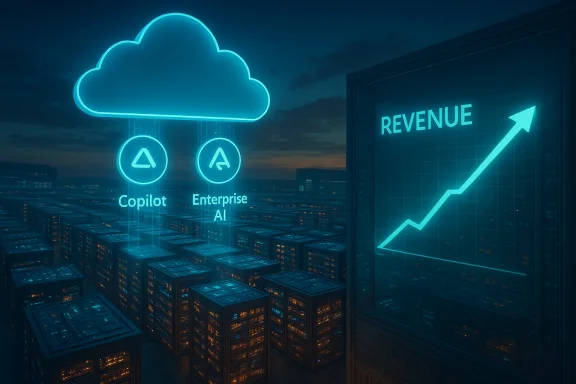
Microsoft reported fiscal second-quarter revenue of $81.3 billion, up 17% year-over-year, with operating income and GAAP net income showing sizable gains driven in part by an accounting impact linked to its strategic stake in OpenAI. The company’s Microsoft Cloud business crossed the $50 billion quarterly mark and Azure and other cloud services grew by roughly 39%, continuing to power the company’s topline.
At the same time, Microsoft’s capital expenditures jumped to $37.5 billion for the quarter — a 66% increase year-over-year —g roughly two-thirds of that spend went to short-lived compute inventory (GPUs and CPUs) to support AI training and inference workloads. This is the heart of the market’s unease: can hyper-scale, GPU-heavy spending be converted into margin-enhancing, recurring revenue fast enough to satisfy investors?
Scale also creates leverage. Once Microsoft amortizes datacenter shells, networking, and long-lived infrastructure across millions of customers and AI workloads, the math can swing from margin pressure to margin improvement — provided utilization, pricing, and feature monetization all cooperate. The RPO figure at $625 billion signals meaningful contracted demand ahead of revenue recognition.
Put succinctly: Microsoft has the early-mover advantage in AI infrastructure, but it is simultaneously front-loading enormous capital commitments in the hopes that enterprises — and third-party AI providers — will generate sustainable demand and predictable monetization. The market is asking: when, exactly, will the payback arrive?
Microsoft’s own earnings release and multiple independent reports also note that the company recorded an accounting gain tied to the OpenAI restructuring that influenced GAAP net income and earnings per share in the quarter. At the same time, Microsoft warned non-GAAP results strip out these OpenAI-related accounting effects to give a clearer view of organic operations.
Why that matters:
The critical counterpoint is timing and concentration. A $625 billion contracted backlog backed heavily by OpenAI is powerful — but it requires that those commitments convert into high-utilization, well-priced consumption over a long timeframe. The combination of heavy CapEx on short-lived compute and concentration in a single partner amplifies both potential upside and downside. Investors and enterprise customers should therefore separate the signal from the noise: the underlying demand for Azure AI services is real, but the path from infrastructure spending to margin accretion is neither linear nor guaranteed.
Microsoft has the pieces: platform reach, product integration, and a set of deep AI partnerships. The next several quarters will determine whether scale and monetization can outpace the rising line item called “AI capital expenditures.” Until then, watch the numbers closely, read management’s qualitative signals on utilization and pricing, and treat any single large contractual total as a probability-weighted future stream rather than immediate cash in hand.
Microsoft’s report is a reminder that we’re transitioning from a world where cloud growth simply meant more virtual machines to one where cloud economics are being re‑written by specialized compute, model economics, and large third‑party collaborations — opportunities with enormous upside and equally significant execution risk. The company’s strategic posture is clear; the market now wants to see the operational evidence that the bet pays off.
Source: WKZO Microsoft’s rising spending, slight cloud beat fan AI payoff worries
 Background
Microsoft reported fiscal second-quarter revenue of $81.3 billion, up 17% year-over-year, with operating income and GAAP net income showing sizable gains driven in part by an accounting impact linked to its strategic stake in OpenAI. The company’s Microsoft Cloud business crossed the $50 billion quarterly mark and Azure and other cloud services grew by roughly 39%, continuing to power the company’s topline. At the same time, Microsoft’s capital expenditures jumped to $37.5 billion for the quarter — a 66% increase year-over-year —g roughly two-thirds of that spend went to short-lived compute inventory (GPUs and CPUs) to support AI training and inference workloads. This is the heart of the market’s unease: can hyper-scale, GPU-heavy spending be converted into margin-enhancing, recurring revenue fast enough to satisfy investors?
What Microsoft actually reported: the numbers that matter
- Revenue: $81.3 billion, +17% year-over-year.
- Microsoft Cloud revenue: $51.5 billion, +26% year-over-year.
- Azure and other cloud services: +39% (38% constant currency).
- Capital expenditures (CapEx): $37.5 billion for the quarter (+66% YoY).
- Remaining performance obligations (RPO) / contracted backlog: $625 billion, up about 110% quarter-over-quarter; Microsoft says roughly 45% of that is from OpenAI.
- OpenAI-related accounting impact: Microsoft reported a net gain tied to its OpenAI investment that materially affected GAAP results (reported in the company’s reconciliation between GAAP and non-GAAP figures).
Overview: Why the market cheered — and why it worried
The upside: demand and scale are real
Microsoft’s cloud business remains the company’s engine for growth. Azure’s near-40% growth is not trivial: it reflects both traditional cloud adoption and large, AI-driven workloads that consume massive compute, storage, and networking resources. Microsoft’s integrated approach — bundling Azure with Microsoft 365, Dynamics, and vertical solutions — gives it multiple monetization levers if it can convert AI usage into paid, repeatable services.Scale also creates leverage. Once Microsoft amortizes datacenter shells, networking, and long-lived infrastructure across millions of customers and AI workloads, the math can swing from margin pressure to margin improvement — provided utilization, pricing, and feature monetization all cooperate. The RPO figure at $625 billion signals meaningful contracted demand ahead of revenue recognition.
The downside: near-term cash burn and concentration risk
Investors’ nervousness centers on two linked facts: (1) the near-term spike in CapEx and short-lived compute purchases depresses free cash flow and can compress gross margins while hardware costs stay high; and (2) a large portion of Microsoft’s forward bookings are concentrated in one partner: OpenAI. Microsoft disclosed that roughly 45% of the RPO was attributable to OpenAI, which raises concentration and counterparty risk if OpenAI’s plans or funding change.Put succinctly: Microsoft has the early-mover advantage in AI infrastructure, but it is simultaneously front-loading enormous capital commitments in the hopes that enterprises — and third-party AI providers — will generate sustainable demand and predictable monetization. The market is asking: when, exactly, will the payback arrive?
The OpenAI factor: partnership, restructuring, and accounting
What changed with OpenAI
OpenAI restructured into a public benefit corporation in late October 2025, and the terms of the new arrangement materially altered how Microsoft and OpenAI interact. OpenAI’s recapitalization included a large equity position for Microsoft and a contractual commitment by OpenAI to purchase substantial Azure services. Microsoft has disclosed an incremental Azure commitment from OpenAI in the range of $250 billion under the new arrangements — a commitment that shows up in the $625 billion RPO.Microsoft’s own earnings release and multiple independent reports also note that the company recorded an accounting gain tied to the OpenAI restructuring that influenced GAAP net income and earnings per share in the quarter. At the same time, Microsoft warned non-GAAP results strip out these OpenAI-related accounting effects to give a clearer view of organic operations.
Concentration and funding questions
The headline that “OpenAI accounts for about 45% of the RPO” is unambiguous from Microsoft’s disclosures, and it forces a series of value-creation questions:- How much of Microsoft’s future revenue is effectively pre-committed to a single partner versus broadly distributed among enterprise customers?
- How will OpenAI fund multi-hundred-billion-dollar commitments such as the $250 billion Azure commitment — through revenue, new capital, partner financing, or third-party deals? Public reporting confirms the contracts limited granularity on timing and funding sources. Independent reporting and Microsoft’s disclosures do not fully explain the pace and cash mechanics behind a multi-year, multi-billion Azure commitment. Caution is warranted where claims about precise funding mechanics are made.
Capital expenditures: what Microsoft is buying — and why it matters
Microsoft’s disclosure that roughly two-thirds of the $37.5 billion CapEx in the quarter was for short-lived assets — primarily GPUs and CPUs — shifts the economics of its cloud buildout. Short-lived compute inventory is treated closer to variable cost: it must be replenished and rapidly upgraded as models and demand evolve. The remainder of the spend is in long-lived datacenter shells, power, and network investments that have multi-year payback horizons.Why that matters:
- Short-lived compute purchases are expensive and can depress gross margins while they ramp. If utilization lags or competition drives down pricing, those purchases can become stranded or less profitable.
- Long-lived datacenter investments are sunk costs that require sustained revenue and high utilization to yield attractive returns. These assets can be highly profitable at scale, but the payback window is measured in years, not quarters.
Competition: Gemini, Claude, autonomous agents and the market structure
Microsoft’s early bet on OpenAI gave it a first-mover advantage across Copilot and many enterprise integrations. But the competitive landscape is shifting rapidly:- Google’s Gemini model and related product releases have strong enterprise and developer uptake, altering buyer choice in model selection and cloud compute procurement.
- Anthropic has signed large cloud commitments and announced collaborations with multiple cloud providers; the Claude family and Anthropic’s agent offerings challenge Microsoft on both model capability and developer adoption. Microsoft itself previously announced strategic commitments with Anthropic that add to its contracted future demand.
- New product categories such as autonomous agents (multi-agent orchestration and agent-as-a-service) are nascent but could disproportionately drive consumption if enterprises adopt them for automation, workflows, and vertical AI apps.
Accounting nuance: GAAP gains, non-GAAP clarity, and what to watch
Microsoft’s headline GAAP net income was materially influenced by the OpenAI restructuring. The company’s filings and press release walk investors through a reconciliation to non-GAAP results that exclude the OpenAI-related item to show what management views as underlying performance. Analysts should treat the OpenAI accounting impact carefully:- The OpenAI-related gain this quarter boosted GAAP earnings per share; future quarters could see the converse effect if OpenAI records losses or if payment schedules shift.
- Non-GAAP metrics provide a cleaner view of core operations but won’t capture potential future cash inflows tied to the Azure commitments that are recorded in RPO and recognized over time.
Risks, caveats, and unresolved questions
- Concentration risk in the RPO / backlog. Nearly half the RPO tied to OpenAI creates a bilateral dependency that amplifies downside if OpenAI changes behavior, funding, or competitive orientation. Microsoft is hedging by building relationships with other AI labs (Anthropic, etc.), but the concentration remains noteworthy.
- Funding mechanics for massive commitments. Public disclosures confirm the contract totals, but they do not fully explain the financing cadence and the practical timing of cash flows or compute consumption associated with commitments like $250 billion. Some reporting and management commentary indicate the numbers are multi-year and will recognize over time, but the pace matters for cash flow and utilization. Where precise funding sources or timings are asserted, exercise caution: the public record is incomplete.
- Margin pressure from GPU-heavy workloads. AI model training and inference have fundamentally different cost profiles from traditional cloud services. If pricing for inference or API access compresses faster than adoption grows, hyperscalers must either accept lower margins or shift pricing and packaging in ways that could slow adoption.
- Competition and commoditization. If model quality becomes commoditized and smaller players offer comparable value at lower cost, hyperscalers will need to win on integration, compliance, and platform services — not just raw model performance. That’s a different, longer sales cycle.
- Regulatory and geopolitical risk. The restructure of OpenAI and its new entity form brought regulatory scrutiny; ongoing regulatory and policy shifts around AI deployment, data governance, and national security customers could change the commercial landscape for cloud AI.
What this means for Windows users, enterprise customers, and investors
For Windows users and enterprise IT teams
- Expect deeper AI integration across Microsoft 365, Windows, and Azure services. Features like Copilot, Fabric, and Azure AI Foundry will be emphasized by Microsoft as the business case for migration. The company is clearly investing to make AI a platform-level differentiator.
- The practical impacts for end users should be incremental: better code assistance, smarter document workflows, and improved analytics. But those capabilities will increasingly run on cloud infrastructure that carries higher marginal costs for Microsoft — costs that may eventually shape pricing and packaging.
For enterprise customers and cloud procurement teams
- The competitive market means buyers should negotiate on total cost of ownership for AI workloads. Evaluate not only per-inference or per-token pricing but also integration, support, data residency, and compliance features that matter for production deployments.
- Consider multi-cloud or hybrid deployment strategies: the new OpenAI terms allow OpenAI to serve models across more providers, and Anthropic and others are multi-cloud oriented. That changes how enterprises should approach procurement and long-term vendor lock-in.
For investors
- Key metrics to watch in the coming quarters: Azure growth rate, CapEx run rate and mix (short-lived vs long-lived), RPO composition and concentration, and Copilot/AI monetization metrics (seat counts, usage-based revenue, ARPU). These will illuminate whether Microsoft’s AI spending is translating into durable, high-return revenue.
- Short-term volatility should be expected as the market digests CapEx cadence and re-assesses margin trajectories. Long-term return depends on Microsoft’s ability to monetize AI features, defend against model and cloud competition, and keep utilization high enough to amortize infrastructure cost.
Actionable timeline: what to look for next quarter
- Management commentary on CapEx pacing: will $37.5 billion be a new normal or an elevated-but-temporary spike? Watch guidance and qualitative language about supply, procurement, and amortization.
- Azure growth vs. AI consumption breakout: look for explicit metrics on AI service consumption, inference volumes, and whether Copilot-seat or usage-based revenue begins to show durable margin expansion.
- RPO composition updates: is OpenAI’s share of RPO declining as other customers sign large deals, or does the concentration persist? Quarterly changes will inform risk models.
- Any future OpenAI-related accounting events: the last quarter included an accounting gain; future quarters could involve different timing and recognition that impact GAAP vs. non-GAAP.
Final analysis: bold strategy, conditional payoff
Microsoft’s earnings release tells a compelling strategic story: the company is doubling down on AI infrastructure and capturing a disproportionate share of contracted future demand through deep partnerships with model developers. That is an intentionally aggressive, platform-first strategy — one that preserves Microsoft’s leadership bet on cloud computing as the backbone of enterprise AI adoption.The critical counterpoint is timing and concentration. A $625 billion contracted backlog backed heavily by OpenAI is powerful — but it requires that those commitments convert into high-utilization, well-priced consumption over a long timeframe. The combination of heavy CapEx on short-lived compute and concentration in a single partner amplifies both potential upside and downside. Investors and enterprise customers should therefore separate the signal from the noise: the underlying demand for Azure AI services is real, but the path from infrastructure spending to margin accretion is neither linear nor guaranteed.
Microsoft has the pieces: platform reach, product integration, and a set of deep AI partnerships. The next several quarters will determine whether scale and monetization can outpace the rising line item called “AI capital expenditures.” Until then, watch the numbers closely, read management’s qualitative signals on utilization and pricing, and treat any single large contractual total as a probability-weighted future stream rather than immediate cash in hand.
Microsoft’s report is a reminder that we’re transitioning from a world where cloud growth simply meant more virtual machines to one where cloud economics are being re‑written by specialized compute, model economics, and large third‑party collaborations — opportunities with enormous upside and equally significant execution risk. The company’s strategic posture is clear; the market now wants to see the operational evidence that the bet pays off.
Source: WKZO Microsoft’s rising spending, slight cloud beat fan AI payoff worries
