

Microsoft’s latest investor and product disclosures finally put hard numbers around the Copilot story — and those numbers tell two different, sometimes contradictory stories: sizable paid traction at the seat-and-subscription level, and a deliberately aggregated, opaque view of consumer reach that makes it hard to judge long-term user depth.
Microsoft has spent 2024–2026 aggressively wiring generative AI into its operating system, productivity suite, developer tools, and vertical products under the single Copilot brand. The goal is both strategic and financial: make AI the connective tissue that locks customers into Microsoft 365, Azure, GitHub, Edge/Windows, and industry-specific solutions, and monetize that engagement through per-seat licensing, subscriptions, and incremental cloud consumption. That strategy was the centerpiece of Microsoft’s fiscal Q2 FY2026 investor communications and follow-up commentary.
What Microsoft disclosed in late January 2026 and repeated across investor materials and interviews can be grouped into three headline buckets:
What those numbers imply materially:
Those facts coexist with equally real risks: a large, GPU-heavy capex cadence that has investors asking when and how scale will turn into margin expansion, and measurement gaps that make it hard to know which Copilot surfaces are delivering durable value versus fleeting experimentation. For IT leaders and investors alike, the prudent path is to center decisions on paid-seat economics, incremental cloud consumption, and well-instrumented retention cohorts — not on headline MAUs alone. Microsoft’s Copilot story is no longer hypothetical; it is unfolding in real, monetizable parts. The remaining question is whether the company can convert scale into sustained, high-margin growth before the bill for capacity comes due.
Source: intellectia.ai https://intellectia.ai/news/stock/microsoft-reveals-key-metrics-for-copilot-ai-assistant/
 Background / Overview
Microsoft has spent 2024–2026 aggressively wiring generative AI into its operating system, productivity suite, developer tools, and vertical products under the single Copilot brand. The goal is both strategic and financial: make AI the connective tissue that locks customers into Microsoft 365, Azure, GitHub, Edge/Windows, and industry-specific solutions, and monetize that engagement through per-seat licensing, subscriptions, and incremental cloud consumption. That strategy was the centerpiece of Microsoft’s fiscal Q2 FY2026 investor communications and follow-up commentary. What Microsoft disclosed in late January 2026 and repeated across investor materials and interviews can be grouped into three headline buckets:
- Paid, monetizable counts — concrete seat and paid-subscriber numbers (Microsoft 365 Copilot seats; GitHub Copilot paid subscribers).
- Aggregate reach and growth rates — family-wide monthly active user figures and year-over-year multipliers for daily usage across consumer surfaces. These are often aggregated across many Copilot surfaces and provided as percentage increases rather than absolute denominators.
- Infrastructure and cost disclosure — a major, visibly higher capital expenditure profile to scale AI compute and data centers, which investors flagged as a central risk.
What Microsoft disclosed — the headline metrics
Paid seats and subscriptions: the clearest facts
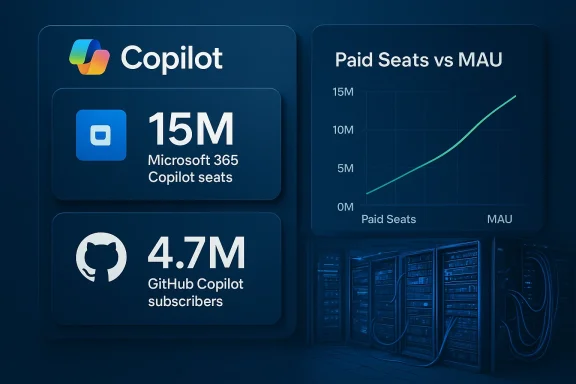
Microsoft gave its most unambiguous figures for products that directly map to recurring revenue:- Microsoft 365 Copilot: 15 million paid seats. Microsoft and multiple reporters confirmed the figure during the company’s Q2 FY26 remarks; executives emphasized seat growth and large deployments into enterprise customers.
- GitHub Copilot: ~4.7 million paid subscribers, which management said represented roughly a 75% year-over-year increase; Copilot Pro+ individual subscriptions also showed quarter-over-quarter acceleration. These are billed subscriptions that are relatively easy to verify in financial models.
Aggregate reach and relative growth: headline-grabbing but opaque
Alongside paid metrics, Microsoft also reiterated family-level measures:- The company previously reported that the Copilot family surpassed 100 million monthly active users; later commentary indicated that number has grown (TechCrunch reported Microsoft told it the aggregate had reached 150 million when including both commercial and consumer surfaces). Importantly, Microsoft’s public remarks emphasize aggregates or growth multipliers without always providing per-surface daily active user (DAU) denominators.
- Executives also framed adoption in relative terms on the earnings call: consumer Copilot daily users nearly tripled year-over-year and Microsoft 365 Copilot daily activity increased roughly 10x year-over-year in relevant breakouts. Those multipliers show explosive growth rates, but without absolute baseline DAU figures they are hard to interpret for durability and depth.
Infrastructure spending: the other headline investors can’t ignore
Microsoft’s Q2 FY26 briefing included an unusually large capital expenditures number: $37.5 billion in the quarter, with management stating roughly two-thirds of that capex went to short-lived assets such as GPUs and CPUs used for AI workloads. Executives described capacity constraints — demand outstripping supply — and positioned the spending as both necessary infrastructure and long-lived monetizable assets. This level of capital outlay, and its concentration on expensive GPU capacity, is now central to the debate about whether Microsoft’s AI investments will pay back in margin expansion or weigh on cash flow.Verifying the claims: what’s provable, what’s aggregated, and where the gaps lie
Paid seats/subscribers: verifiable and modelable
Paid-seat counts (15 million M365 Copilot seats) and paid-subscriber counts (4.7 million GitHub Copilot) are the most verifiable claims because they tie directly to seller-billed units. Multiple independent outlets transcribed and reported those numbers from the earnings commentary, and Microsoft’s investor slide package and prepared remarks reiterate those counts. Analysts can and will model these into ARPU and incremental Azure consumption.What those numbers imply materially:
- Microsoft 365 Copilot’s attach rate vs. Microsoft 365’s installed base remains modest; with a ~450 million paid-seat base, 15 million paid Copilot seats imply attach penetration of roughly 3–4% of seat inventory to date. That is a meaningful early commercial validation but leaves substantial runway for growth.
- GitHub Copilot’s 4.7 million paid subscribers are a strong signal in the developer tools market, but relative penetration is still small versus GitHub’s total user base, which means conversion economics and corporate rollouts will determine long-term revenue contribution.
Aggregate MAU and relative multipliers: directional, not precise
The 100M+ monthly active users claim (and the TechCrunch update to 150M) is real as an aggregated corporate metric, but it mixes machine-to-machine agent uses, embedded OS interactions, consumer app sessions, and commercial seat activity. Because Microsoft does not disclose detailed DAU or per-product MAU breakdowns for all surfaces, external verification of the depth of engagement — session length, tasks completed, retention cohorts — is limited. Independent telemetry firms that track web visits also show Copilot lagging on public web traffic; for example, Similarweb’s snapshot earlier in 2026 placed Copilot at ~1% of web traffic for AI chat platforms, largely because of Copilot’s heavy embed model rather than pure consumer web destination leadership. That underlines a core measurement mismatch: web traffic trackers capture only public web sessions, not in-app or OS-integrated interactions.Internal usage analysis: interesting signals, but sample- and scope-limited
Microsoft’s internal research products — notably a Copilot Usage Report that analyzed 37.5 million de-identified conversations — provide granular signals about device patterns, time-of-day behaviors, and topic shifts (for example, desktop sessions skewing to productivity tasks and mobile sessions leaning toward health and information-seeking). Those findings support Microsoft’s narrative that Copilot is becoming a “daylong companion.” However, because Microsoft excludes enterprise/education accounts from those consumer datasets and because the sample covers a defined window, the results are directional rather than definitive proof of enterprise monetization. Independent press coverage confirms the existence and broad findings of the sample analysis, but the dataset is not a substitute for standardized KPIs like per-product DAUs, retention by cohort, or monetized conversions.Product-level breakdown and strategic dynamics
Microsoft 365 Copilot: enterprise-first monetization
Microsoft 365 Copilot is being sold as a per-seat premium add-on to Microsoft 365. Its commercial case rests on:- Direct seat revenue (the 15 million paid seats figure).
- Incremental Azure consumption when customers run inference and retrieval operations against Microsoft’s cloud.
- Enterprise-specific ROI cases — e.g., saved time in document drafting, improved sales productivity, and knowledge retrieval tied to security/perimeter protections.
- Leveraging an installed base of hundreds of millions of seats gives Microsoft enormous distribution leverage.
- Enterprise procurement and procurement inertia favor bundled, supported add-ons that integrate with existing compliance and identity controls.
- Low attach rate to date (3–4%) suggests pricing, governance, or perceived ROI still limit universal adoption.
- Model inference costs, if borne by Microsoft as a subsidized offering or if priced too low, threaten margin dilution given heavy GPU costs.
GitHub Copilot: developer productivity and stickiness
GitHub Copilot’s paid subscriptions are a clearer, focused success story in the short term: developers who find immediate productivity gains are more likely to pay. The 4.7 million paid subscribers number demonstrates commercial viability in this vertical. But conversion at scale, enterprise deployment economics, and sustained net-new revenue are the next battlegrounds. Corporate rollouts (e.g., Siemens and other large customers) show enterprise uptake, but measuring sustained developer productivity gains at scale remains crucial for long-term defensibility.Consumer Copilot app and OS integrations: reach vs. depth
Consumer Copilot surfaces — the standalone Copilot app, Windows taskbar assistant, Edge integrations, and shopping/commerce agents — drive high-reach metrics but present structural monetization questions. These surfaces are excellent channels for discovery and experimentation, which can be valuable for brand and engagement, but:- Many consumer interactions are low-friction, low-monetization events (search queries, quick chats).
- A small percentage of consumers converting to paid seats or driving high-margin cloud consumption will determine whether consumer reach converts into durable economics.
The cost side of the ledger: why investors reacted
Microsoft’s accelerated capex build (the $37.5 billion quarterly number) forced markets to weigh growth vs. capital intensity. Management framed the spending as necessary to add GPU capacity and custom silicon, and said a large share of incoming capacity is already contractually booked. But the important trade-offs are:- Heavy front-loaded capital spending increases near-term cash intensity and can compress free cash flow until utilization and pricing scale. Microsoft reported a sequential dip in free cash flow and noted finance leases and cash paid for PP&E as substantial contributors to the cash footprint for the quarter.
- The ROI on GPU-heavy infrastructure depends on broad, sustained monetization across Microsoft’s AI surfaces and strategic partnerships (including ongoing OpenAI and Anthropic relationships). Investor nervousness is rational where capex growth outpaces visible profit recovery or where demand for Azure capacity is constrained by supply rather than market appetite.
Competition and market context
Microsoft’s Copilot is competing in multiple arenas at once:- Against Google’s Gemini and consumer products that dominate web-first chatbot traffic and increasingly enterprise workflows.
- Against Anthropic/Claude in the enterprise and safety-first model segment, particularly given Anthropic’s rising momentum and partner integrations.
- Against smaller but fast-moving players and vertical specialists that humanize domain knowledge into bespoke copilots.
Measurement, transparency, and product governance — the blind spots
Two measurement problems stand out:- Aggregation obscures product-level economics. A family-level “Copilot MAU” is useful for PR but masks which surfaces contribute revenue and which are exploratory. Analysts prefer per-product DAUs, retention cohorts, and monetization attach rates. Microsoft has provided more clarity on seats/subscribers but still relies on aggregate narratives for consumer reach.
- Different telemetry scopes. Web traffic trackers, app-store telemetry, and in-product telemetry capture different slices of activity — none are a perfect picture. Observers should triangulate across Microsoft’s paid metrics, internal usage reports (e.g., the 37.5M conversation sample), and independent third-party telemetry to build a more complete view. When those sources diverge, prioritize paid-seat and subscription numbers for financial modeling and use internal usage studies for product insight rather than financial proof.
Practical implications for Windows users and IT administrators
- For IT leaders evaluating Microsoft 365 Copilot: insist on pilot metrics that map to your procurement KPIs. Don’t accept “use is soaring” as sufficient evidence; ask for seat-level ROI studies, model inference consumption estimates (to forecast Azure bills), and governance controls for data residency and compliance. Microsoft’s Copilot Dashboard updates and admin telemetry features can help, but require disciplined cohort measurement.
- For Windows users and endpoint managers: Copilot integrations will increasingly shape day-to-day workflows on desktop and mobile. Expect features to proliferate, but also expect admins to need visibility into retention and usage intensity to justify seat purchases.
- For developers and engineering leaders: GitHub Copilot’s paid growth indicates clear developer demand, but evaluate enterprise deployments on productivity metrics (reduction in review cycles, faster onboarding) and licensing economics per developer.
Risks and red flags to watch
- CapEx-to-monetization timing risk: heavy front-loaded GPU investments require years of utilization to pay off. If enterprise seat adoption or incremental Azure consumption lags, margins could compress.
- Measurement opacity risk: aggregated MAUs without per-product DAUs make it easy for narrative-to-overstate durable behavior. Watch for more granular KPIs from Microsoft or third parties to validate consumer-to-paid conversion trends.
- Competition and habit formation: web-first assistants (ChatGPT, Gemini) may own consumer habitual attention, making it harder for embedded copilots to translate reach into stickier paid relationships without clear value-added features.
- Governance and safety: as Copilot becomes an advice engine in healthcare, legal, and finance, the need for provenance, auditability, and guardrails grows. Missteps here risk regulatory and reputational consequences. Microsoft has signaled governance priorities but the scale-up phase increases the stakes.
Three practical recommendations for stakeholders
- IT procurement: require pilot ROI and usage-to-seat conversion metrics. Make purchasing contingent on empiric measures (time saved per user, task completion improvement, retention at 30/90 days) and forecasted incremental Azure costs. Vendors can present seat counts, but you should insist on your own telemetry.
- Investors: focus your modeling on paid-seat ARPU and incremental cloud consumption, not aggregated MAUs. The two monetizable anchors (15M seats, 4.7M GitHub subscribers) are the reliable inputs; capex and RPO/backlog disclosures should be stress-tested against realistic utilization assumptions.
- Product teams and admins: instrument retention and depth-of-use from day one. Short sessions and curiosity-driven interactions are not equivalent to habit-forming productivity gains. Track repeat use in mission-critical workflows and identify where Copilot reduces multi-step human labor; those are the wins that justify expansion.
Conclusion
Microsoft’s Copilot disclosures mark a pivotal moment in the enterprise and consumer AI narrative. The company has produced concrete, verifiable wins — 15 million Microsoft 365 Copilot paid seats and ~4.7 million GitHub Copilot paid subscribers — which validate the monetization thesis at seat and subscription layers. Simultaneously, Microsoft’s use of aggregated family-wide MAU figures and relative growth multipliers (tripling or tenfold increases in daily usage across certain surfaces) paints a picture of rapid reach that is real but intentionally broad and sometimes opaque.Those facts coexist with equally real risks: a large, GPU-heavy capex cadence that has investors asking when and how scale will turn into margin expansion, and measurement gaps that make it hard to know which Copilot surfaces are delivering durable value versus fleeting experimentation. For IT leaders and investors alike, the prudent path is to center decisions on paid-seat economics, incremental cloud consumption, and well-instrumented retention cohorts — not on headline MAUs alone. Microsoft’s Copilot story is no longer hypothetical; it is unfolding in real, monetizable parts. The remaining question is whether the company can convert scale into sustained, high-margin growth before the bill for capacity comes due.
Source: intellectia.ai https://intellectia.ai/news/stock/microsoft-reveals-key-metrics-for-copilot-ai-assistant/
