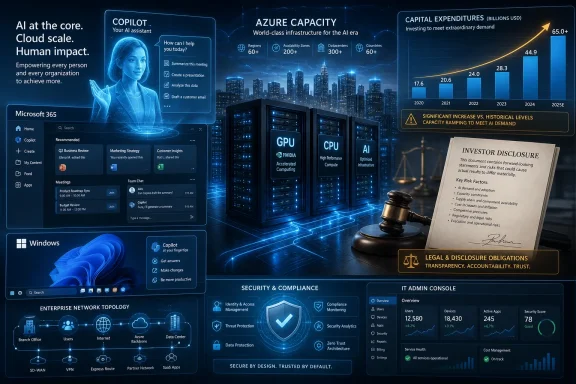
Bronstein, Gewirtz & Grossman said on June 28, 2026, that a securities class action has been filed against Microsoft and certain officers over alleged AI and Copilot disclosures affecting investors who bought Microsoft securities from May 1, 2025, through January 28, 2026. The lawsuit is not a verdict, and the allegations remain allegations. But the complaint lands in the middle of the most important debate around Microsoft: whether the company’s AI story is a compounding software advantage or a capital-hungry infrastructure trade wearing a productivity badge. For Windows users, Microsoft 365 administrators, Azure customers, and investors, the case matters less as courtroom drama than as a forced audit of what Copilot has become.
The claim at the center of the Microsoft suit is straightforward: investors were allegedly told a story about AI adoption, product momentum, and cloud leverage that did not fully reflect the operational mess underneath. The complaint, as described by the law firm notice, argues that Microsoft failed to disclose problems in Copilot’s positioning, user experience, usage, data silos, compute capacity, organizational execution, and interoperability.
That is a wide net, and securities complaints often cast wide nets by design. Still, the targets are revealing. This is not merely an allegation that Microsoft spent too much money on GPUs. It is an allegation that the company’s AI flagship was less commercially and technically mature than investors were led to believe.
The class period is also telling. It begins on May 1, 2025, a moment when Microsoft’s AI narrative had already hardened into market consensus, and ends on January 28, 2026, the date of Microsoft’s fiscal second-quarter earnings. That end date matters because Microsoft’s own numbers and commentary gave investors a clearer view of the cost side of the AI boom: heavy capital expenditures, constrained cloud capacity, and the need to decide where scarce chips should go.
The legal system will sort out whether Microsoft and its officers violated securities laws. The technology industry does not have to wait that long to see the underlying tension. Copilot is no longer just a feature, a chatbot, or a productivity pitch; it is now a test of whether Microsoft can convert its installed base into AI revenue fast enough to justify the infrastructure bill.
Generative AI has changed the texture of that story. The Copilot era asks Microsoft to behave less like a pure software company and more like an industrial-scale compute allocator. GPUs, CPUs, networking gear, power, cooling, and data center leases are no longer background machinery. They are the plot.
Microsoft’s January 28, 2026 earnings materials underscored the shift. The company reported strong revenue and cloud growth, but also disclosed enormous capital spending, with a large share tied to short-lived assets such as GPUs and CPUs. In plain English, the company is buying expensive machinery that becomes obsolete faster than the office towers and traditional server farms investors were once trained to model.
That does not mean the strategy is wrong. Microsoft may be right that demand for AI services is so large that every dollar of capacity will eventually be monetized. But the lawsuit points to the uncomfortable part: if some of that capacity must be diverted away from Azure services with clearer customer demand and toward improving Copilot’s competitive position, then the business is not simply harvesting AI demand. It is also subsidizing product repair.
That is why Copilot adoption is such a sensitive subject. The complaint alleges that Microsoft failed to convert a significant percentage of commercial Microsoft 365 users into paid Copilot subscribers. That allegation cuts directly against the bullish shorthand that Microsoft’s installed base makes AI monetization almost automatic.
The reality inside enterprises is more complicated. A $30-per-user-per-month style add-on is not a trivial uplift when multiplied across thousands or hundreds of thousands of employees. IT departments also have to justify the feature against governance, training, data hygiene, security review, and uncertain productivity measurement. Copilot may demo beautifully in a keynote and still face a budget committee that wants evidence, not vibes.
Microsoft has repeatedly argued that Copilot usage is growing and that AI is becoming a daily habit. The lawsuit does not need to prove that nobody is using Copilot. It targets a narrower and more dangerous question: whether the paid conversion curve, competitive position, and internal resource requirements were materially different from the picture investors received.
Microsoft’s pitch is that it owns the work graph. Emails, meetings, files, chats, calendars, documents, permissions, identities, and business applications can all become context for an assistant. That is powerful, but it is also fragile. If permissions are messy, SharePoint sites are stale, Teams sprawl is unmanaged, labels are inconsistent, or data lives outside Microsoft’s cloud, the assistant inherits the disorder.
This is where WindowsForum readers have a sharper instinct than Wall Street. Administrators know that “turning on AI” is not the same as making an organization’s information architecture usable. Copilot can expose bad data hygiene, not solve it. In some environments, the deployment project is less about AI and more about years of postponed governance work.
That matters for investor expectations because the sales cycle for Copilot is not just a licensing conversation. It can become a remediation project. The customer may need to clean permissions, rationalize file storage, adjust retention policies, educate users, update endpoint controls, and revisit compliance boundaries before the product delivers the promised value.
In the clean version of the story, Azure provides the infrastructure layer, Copilot provides the application layer, and both reinforce each other. Enterprises adopt Copilot, Azure demand rises, Microsoft captures value across the stack, and AI becomes a new growth engine for the whole company. That is the version investors love.
The messier version is an allocation problem. If AI infrastructure is scarce, Microsoft must decide whether compute goes to Azure customers, OpenAI workloads, internal model development, GitHub Copilot, Microsoft 365 Copilot, consumer Copilot, security products, or research teams. Every allocation choice has an opportunity cost.
That is why Microsoft’s earnings commentary around AI supply constraints mattered. When executives discuss balancing incoming supply against Azure demand, first-party AI usage, research and development, and equipment replacement, they are describing a company with more demand vectors than immediately available capacity. That can be a sign of strength. It can also become a margin and execution problem if the highest-return workloads are not the ones receiving the chips.
Still, benchmarks matter because they influence perception. CIOs, developers, analysts, and investors use them as shorthand for capability, even when they know the shorthand is incomplete. If Microsoft’s AI products are perceived as wrappers around models that lag rivals, the company has to lean harder on distribution, integration, compliance, and price.
That is not necessarily fatal. Microsoft’s history is full of products that won through bundling, platform control, and enterprise trust rather than technical elegance. Teams did not need to be the most beloved collaboration app in the world to become unavoidable. Defender did not need to win every security beauty contest to become central to Microsoft’s enterprise security story.
But generative AI may be less forgiving. Users can compare outputs quickly. Developers can test rival models with a few API calls. Knowledge workers can feel when an assistant is hallucinating, missing context, or wasting time. If the model layer feels second-tier, Microsoft’s bundling advantage still matters — but it no longer ends the argument.
For enthusiasts, this can be confusing. For enterprise buyers, it can be expensive confusion. The question is not simply “Do we want Copilot?” but which Copilot, in which tenant, under which license, with which data boundary, for which workflow, and with what measurable business outcome.
The complaint’s reference to “brand positioning” may sound like marketing fluff, but in enterprise software, naming and packaging affect adoption. A product that appears everywhere can paradoxically become harder to evaluate. Users may think they have Copilot because a sidebar appeared in Windows, while finance teams are considering a paid Microsoft 365 Copilot deployment that is entirely different in cost and governance.
Microsoft has been here before. The company’s licensing and product naming are legendarily dense, and customers often tolerate the complexity because the platform is unavoidable. The difference with AI is that Microsoft is trying to create a new spending category while the category itself is still being defined. Confusion is not just an annoyance; it can slow conversion.
That strategy has produced mixed reactions. Some users see convenience. Others see clutter, telemetry anxiety, forced integration, or another example of Microsoft using Windows real estate to advance a cloud strategy. For administrators, the issue is less emotional and more operational: whether AI features can be governed predictably across managed fleets.
The Windows PC is also where Microsoft’s AI ambitions meet hardware reality. Neural processing units, Copilot+ PCs, Recall-style features, local inference, and cloud-backed assistants are all pieces of the same puzzle. Microsoft wants AI to reshape the endpoint, but the value proposition is still uneven across consumer, commercial, and developer audiences.
That unevenness matters because Copilot’s brand is cross-surface. A weak experience in one place can contaminate perception elsewhere. If a user’s first Copilot encounter is a mediocre Windows sidebar or a confusing consumer assistant, that impression can travel into the workplace, even if Microsoft 365 Copilot is a more serious product.
Copilot also arrives in a period of platform fatigue. Enterprises have spent years absorbing Teams migrations, security hardening, cloud transitions, identity changes, endpoint management shifts, and compliance mandates. AI is exciting, but it is also another thing to govern. The more deeply it touches business data, the slower responsible organizations may move.
This does not mean Copilot is failing. It means the adoption curve for a high-priced, data-hungry assistant may look less like a viral software rollout and more like a staged enterprise transformation. Early adopters buy first, cautious departments test next, and broader deployment waits for clearer proof of value.
That is the gap the lawsuit exploits. Microsoft can truthfully say demand is real, usage is growing, and the product is improving. Investors can still argue that the company’s public optimism did not adequately capture friction in conversion, infrastructure allocation, and competitive positioning.
That structure can make business complexity look cleaner than it really was. If Microsoft’s stock reacted badly after January 28, 2026, plaintiffs can frame that moment as the market learning what had been concealed. Microsoft, for its part, can argue that it disclosed risks, that AI investment was well known, that demand remained strong, and that market disappointment over capex or Azure growth does not equal securities fraud.
The distinction matters. Companies are allowed to be optimistic. They are allowed to invest heavily. They are allowed to make products that need improvement. Securities law generally turns on whether statements were materially false or misleading when made, and whether omitted facts would have changed a reasonable investor’s view.
That is a high bar, especially for a company as heavily scrutinized as Microsoft. Analysts, journalists, customers, and competitors had been debating AI costs, Azure capacity, and Copilot adoption long before this complaint. The courtroom question will be whether Microsoft knew specific adverse facts and failed to tell investors. The industry question is broader: why did the market need a lawsuit to focus on the unit economics of AI?
It can also argue that Copilot is not one product but a family of products at different maturity levels. GitHub Copilot has a clearer developer workflow and a more established value proposition. Microsoft 365 Copilot is tied to organizational data readiness and change management. Security Copilot sits in a high-stakes operational niche. Consumer Copilot competes in a brutal attention market. Lumping all of that together may be rhetorically convenient, but it can obscure the differences.
There is another defense: AI products are improving quickly. A snapshot of benchmark rankings or adoption friction in 2025 may not predict the state of the product in late 2026 or beyond. Microsoft can ship, tune, integrate, reprice, bundle, and revise at a pace few competitors can match.
That defense may be true and still not fully satisfying. Investors are not merely buying the possibility that Microsoft will improve Copilot eventually. They are buying a claim about timing, margins, and competitive advantage. If the road to improvement requires more capital, more compute diversion, and slower paid conversion than expected, the valuation story changes.
The third phase is accounting. How much does inference cost? How quickly do GPUs depreciate? Which workloads produce revenue, and which merely increase engagement? How much capex is needed before supply catches demand? What gross margin should investors expect from AI-heavy software? How many users will pay extra rather than use bundled or lower-cost alternatives?
Microsoft is better positioned than almost anyone to answer those questions favorably. It owns the operating system, the productivity suite, the developer platform, the identity layer, the cloud, the security stack, and a major relationship with OpenAI. That is an extraordinary hand.
But extraordinary hands can still be overplayed. If Copilot is priced like premium software but consumed like expensive cloud infrastructure, Microsoft must prove the margin structure works. If AI features are bundled to protect the platform, investors must understand that some monetization may be defensive rather than additive. If Azure capacity is constrained, customers will care whether Microsoft’s internal AI ambitions compete with their own workloads.
In productivity software, rivals can attack from multiple angles. Google can integrate AI into Workspace. OpenAI can sell directly to enterprises. Anthropic can win developers and knowledge workers with model quality and safety positioning. Salesforce, ServiceNow, Atlassian, Adobe, and countless vertical SaaS vendors can embed AI into workflows where they already own the business process.
The danger for Microsoft is that Copilot becomes a horizontal assistant in a world where customers prefer vertical outcomes. A general assistant that drafts emails and summarizes meetings is useful. A workflow-specific agent that closes a ticket, updates a CRM record, audits a contract clause, or remediates a security alert may be easier to justify.
Microsoft understands this, which is why Copilot Studio and agentic workflows have become central to the pitch. But agents raise the complexity again. They need permissions, connectors, testing, monitoring, rollback, compliance, and governance. The more useful they become, the more they resemble software projects rather than simple seat upgrades.
Administrators should treat Copilot as a privileged data interface. That means reviewing permissions, sensitivity labels, retention rules, audit logs, tenant settings, and endpoint policies before broad rollout. It also means defining success metrics that go beyond “users tried it” or “licenses were assigned.”
The best pilots will be boring in the right ways. They will pick specific departments, workflows, and measurable outcomes. They will compare Copilot output against existing processes. They will document failure modes, user training needs, and data exposure risks. They will decide whether the product saves time, improves quality, reduces ticket volume, accelerates drafting, or simply creates another review burden.
That work is not glamorous, but it is exactly what separates durable enterprise software from keynote software. If Copilot succeeds, it will be because organizations find repeatable value in real workflows. If it disappoints, it will be because the assistant remained impressive in demos and ambiguous in production.
 The Lawsuit Puts Copilot’s Business Case on Trial
The claim at the center of the Microsoft suit is straightforward: investors were allegedly told a story about AI adoption, product momentum, and cloud leverage that did not fully reflect the operational mess underneath. The complaint, as described by the law firm notice, argues that Microsoft failed to disclose problems in Copilot’s positioning, user experience, usage, data silos, compute capacity, organizational execution, and interoperability.That is a wide net, and securities complaints often cast wide nets by design. Still, the targets are revealing. This is not merely an allegation that Microsoft spent too much money on GPUs. It is an allegation that the company’s AI flagship was less commercially and technically mature than investors were led to believe.
The class period is also telling. It begins on May 1, 2025, a moment when Microsoft’s AI narrative had already hardened into market consensus, and ends on January 28, 2026, the date of Microsoft’s fiscal second-quarter earnings. That end date matters because Microsoft’s own numbers and commentary gave investors a clearer view of the cost side of the AI boom: heavy capital expenditures, constrained cloud capacity, and the need to decide where scarce chips should go.
The legal system will sort out whether Microsoft and its officers violated securities laws. The technology industry does not have to wait that long to see the underlying tension. Copilot is no longer just a feature, a chatbot, or a productivity pitch; it is now a test of whether Microsoft can convert its installed base into AI revenue fast enough to justify the infrastructure bill.
Microsoft Sold AI as Software Leverage, but the Bill Looks Like Heavy Industry
For decades, Microsoft’s best businesses had a wonderful economic shape. Windows, Office, Server, and later Microsoft 365 scaled with the logic of software: high margins, subscription renewal, ecosystem lock-in, and distribution through corporate standardization. Azure complicated that picture by adding data centers and depreciation, but the cloud still promised operating leverage once utilization rose.Generative AI has changed the texture of that story. The Copilot era asks Microsoft to behave less like a pure software company and more like an industrial-scale compute allocator. GPUs, CPUs, networking gear, power, cooling, and data center leases are no longer background machinery. They are the plot.
Microsoft’s January 28, 2026 earnings materials underscored the shift. The company reported strong revenue and cloud growth, but also disclosed enormous capital spending, with a large share tied to short-lived assets such as GPUs and CPUs. In plain English, the company is buying expensive machinery that becomes obsolete faster than the office towers and traditional server farms investors were once trained to model.
That does not mean the strategy is wrong. Microsoft may be right that demand for AI services is so large that every dollar of capacity will eventually be monetized. But the lawsuit points to the uncomfortable part: if some of that capacity must be diverted away from Azure services with clearer customer demand and toward improving Copilot’s competitive position, then the business is not simply harvesting AI demand. It is also subsidizing product repair.
Copilot’s Problem Is Not Awareness; It Is Conversion
No enterprise software product in recent memory has enjoyed the distribution advantage Microsoft gave Copilot. It sits beside Word, Excel, PowerPoint, Outlook, Teams, Windows, Edge, GitHub, Security, Dynamics, and Azure. It benefits from Microsoft’s procurement relationships, identity stack, compliance story, and administrative tooling. If any company should be able to turn generative AI into a paid workplace utility, it is Microsoft.That is why Copilot adoption is such a sensitive subject. The complaint alleges that Microsoft failed to convert a significant percentage of commercial Microsoft 365 users into paid Copilot subscribers. That allegation cuts directly against the bullish shorthand that Microsoft’s installed base makes AI monetization almost automatic.
The reality inside enterprises is more complicated. A $30-per-user-per-month style add-on is not a trivial uplift when multiplied across thousands or hundreds of thousands of employees. IT departments also have to justify the feature against governance, training, data hygiene, security review, and uncertain productivity measurement. Copilot may demo beautifully in a keynote and still face a budget committee that wants evidence, not vibes.
Microsoft has repeatedly argued that Copilot usage is growing and that AI is becoming a daily habit. The lawsuit does not need to prove that nobody is using Copilot. It targets a narrower and more dangerous question: whether the paid conversion curve, competitive position, and internal resource requirements were materially different from the picture investors received.
The Data-Silo Problem Was Always the Enterprise Catch
The most believable part of the complaint is not that Copilot had “brand positioning” problems, though Microsoft’s naming strategy has done itself few favors. The most believable part is the allegation around data siloing and interoperability. Enterprise AI assistants are only as useful as the information they can safely, accurately, and contextually reach.Microsoft’s pitch is that it owns the work graph. Emails, meetings, files, chats, calendars, documents, permissions, identities, and business applications can all become context for an assistant. That is powerful, but it is also fragile. If permissions are messy, SharePoint sites are stale, Teams sprawl is unmanaged, labels are inconsistent, or data lives outside Microsoft’s cloud, the assistant inherits the disorder.
This is where WindowsForum readers have a sharper instinct than Wall Street. Administrators know that “turning on AI” is not the same as making an organization’s information architecture usable. Copilot can expose bad data hygiene, not solve it. In some environments, the deployment project is less about AI and more about years of postponed governance work.
That matters for investor expectations because the sales cycle for Copilot is not just a licensing conversation. It can become a remediation project. The customer may need to clean permissions, rationalize file storage, adjust retention policies, educate users, update endpoint controls, and revisit compliance boundaries before the product delivers the promised value.
Azure Became the Pressure Gauge for the Copilot Bet
The lawsuit’s most consequential allegation is that Microsoft had to increase capital expenditures by billions and divert GPU and CPU capacity away from profitable Azure services to improve Copilot’s competitive position. That claim connects two narratives Microsoft would rather keep aligned: Azure demand and Copilot expansion.In the clean version of the story, Azure provides the infrastructure layer, Copilot provides the application layer, and both reinforce each other. Enterprises adopt Copilot, Azure demand rises, Microsoft captures value across the stack, and AI becomes a new growth engine for the whole company. That is the version investors love.
The messier version is an allocation problem. If AI infrastructure is scarce, Microsoft must decide whether compute goes to Azure customers, OpenAI workloads, internal model development, GitHub Copilot, Microsoft 365 Copilot, consumer Copilot, security products, or research teams. Every allocation choice has an opportunity cost.
That is why Microsoft’s earnings commentary around AI supply constraints mattered. When executives discuss balancing incoming supply against Azure demand, first-party AI usage, research and development, and equipment replacement, they are describing a company with more demand vectors than immediately available capacity. That can be a sign of strength. It can also become a margin and execution problem if the highest-return workloads are not the ones receiving the chips.
Benchmarks Are a Crude Weapon, but They Still Shape the Narrative
The complaint also alleges that Microsoft’s flagship proprietary AI model ranked well below competitors on a number of benchmark tests. Benchmark claims should be handled carefully. Model rankings move quickly, test suites can be gamed, and a benchmark winner is not always the best product for a regulated enterprise workflow.Still, benchmarks matter because they influence perception. CIOs, developers, analysts, and investors use them as shorthand for capability, even when they know the shorthand is incomplete. If Microsoft’s AI products are perceived as wrappers around models that lag rivals, the company has to lean harder on distribution, integration, compliance, and price.
That is not necessarily fatal. Microsoft’s history is full of products that won through bundling, platform control, and enterprise trust rather than technical elegance. Teams did not need to be the most beloved collaboration app in the world to become unavoidable. Defender did not need to win every security beauty contest to become central to Microsoft’s enterprise security story.
But generative AI may be less forgiving. Users can compare outputs quickly. Developers can test rival models with a few API calls. Knowledge workers can feel when an assistant is hallucinating, missing context, or wasting time. If the model layer feels second-tier, Microsoft’s bundling advantage still matters — but it no longer ends the argument.
The Branding Maze Made a Hard Product Harder to Understand
Microsoft’s Copilot brand has been asked to carry too much. There is Microsoft 365 Copilot, Copilot in Windows, GitHub Copilot, Security Copilot, Copilot Studio, Copilot for consumers, Copilot in Edge, Copilot in Bing, Copilot for Sales, Copilot for Service, and a shifting cast of agentic features that blur the line between assistant, workflow engine, search box, and automation platform.For enthusiasts, this can be confusing. For enterprise buyers, it can be expensive confusion. The question is not simply “Do we want Copilot?” but which Copilot, in which tenant, under which license, with which data boundary, for which workflow, and with what measurable business outcome.
The complaint’s reference to “brand positioning” may sound like marketing fluff, but in enterprise software, naming and packaging affect adoption. A product that appears everywhere can paradoxically become harder to evaluate. Users may think they have Copilot because a sidebar appeared in Windows, while finance teams are considering a paid Microsoft 365 Copilot deployment that is entirely different in cost and governance.
Microsoft has been here before. The company’s licensing and product naming are legendarily dense, and customers often tolerate the complexity because the platform is unavoidable. The difference with AI is that Microsoft is trying to create a new spending category while the category itself is still being defined. Confusion is not just an annoyance; it can slow conversion.
The Windows Angle Is Subtle but Important
This lawsuit is mostly about investors, Azure, Microsoft 365, and Copilot economics. But Windows is part of the story because Microsoft has used the operating system as both distribution channel and symbolic proof that AI is becoming ambient. Copilot’s presence in Windows tells users that AI is not a separate application; it is supposed to be part of the PC experience.That strategy has produced mixed reactions. Some users see convenience. Others see clutter, telemetry anxiety, forced integration, or another example of Microsoft using Windows real estate to advance a cloud strategy. For administrators, the issue is less emotional and more operational: whether AI features can be governed predictably across managed fleets.
The Windows PC is also where Microsoft’s AI ambitions meet hardware reality. Neural processing units, Copilot+ PCs, Recall-style features, local inference, and cloud-backed assistants are all pieces of the same puzzle. Microsoft wants AI to reshape the endpoint, but the value proposition is still uneven across consumer, commercial, and developer audiences.
That unevenness matters because Copilot’s brand is cross-surface. A weak experience in one place can contaminate perception elsewhere. If a user’s first Copilot encounter is a mediocre Windows sidebar or a confusing consumer assistant, that impression can travel into the workplace, even if Microsoft 365 Copilot is a more serious product.
IT Departments Are the Reality Check Wall Street Often Misses
The investor narrative around Copilot often treats Microsoft 365 seats as a reservoir of inevitable upsell. IT professionals know better. Large organizations do not adopt new software merely because it appears in the admin center and has Microsoft’s logo on it. They pilot, restrict, negotiate, measure, and sometimes stall.Copilot also arrives in a period of platform fatigue. Enterprises have spent years absorbing Teams migrations, security hardening, cloud transitions, identity changes, endpoint management shifts, and compliance mandates. AI is exciting, but it is also another thing to govern. The more deeply it touches business data, the slower responsible organizations may move.
This does not mean Copilot is failing. It means the adoption curve for a high-priced, data-hungry assistant may look less like a viral software rollout and more like a staged enterprise transformation. Early adopters buy first, cautious departments test next, and broader deployment waits for clearer proof of value.
That is the gap the lawsuit exploits. Microsoft can truthfully say demand is real, usage is growing, and the product is improving. Investors can still argue that the company’s public optimism did not adequately capture friction in conversion, infrastructure allocation, and competitive positioning.
Securities Cases Are Written Backward from a Stock Drop
A class action complaint is not neutral industry analysis. It is a legal document built around a theory of loss. The plaintiff side identifies a class period, points to allegedly misleading statements or omissions, marks a corrective disclosure, and argues that investors were damaged when the truth emerged.That structure can make business complexity look cleaner than it really was. If Microsoft’s stock reacted badly after January 28, 2026, plaintiffs can frame that moment as the market learning what had been concealed. Microsoft, for its part, can argue that it disclosed risks, that AI investment was well known, that demand remained strong, and that market disappointment over capex or Azure growth does not equal securities fraud.
The distinction matters. Companies are allowed to be optimistic. They are allowed to invest heavily. They are allowed to make products that need improvement. Securities law generally turns on whether statements were materially false or misleading when made, and whether omitted facts would have changed a reasonable investor’s view.
That is a high bar, especially for a company as heavily scrutinized as Microsoft. Analysts, journalists, customers, and competitors had been debating AI costs, Azure capacity, and Copilot adoption long before this complaint. The courtroom question will be whether Microsoft knew specific adverse facts and failed to tell investors. The industry question is broader: why did the market need a lawsuit to focus on the unit economics of AI?
Microsoft’s Defense Is Hiding in Plain Sight
Microsoft’s likely defense is not hard to imagine. The company can point to strong revenue, continuing cloud growth, large remaining performance obligations, rising AI usage, and enterprise momentum across Microsoft 365, GitHub, security, and Azure. It can argue that capex is a rational response to demand, not evidence of concealed weakness.It can also argue that Copilot is not one product but a family of products at different maturity levels. GitHub Copilot has a clearer developer workflow and a more established value proposition. Microsoft 365 Copilot is tied to organizational data readiness and change management. Security Copilot sits in a high-stakes operational niche. Consumer Copilot competes in a brutal attention market. Lumping all of that together may be rhetorically convenient, but it can obscure the differences.
There is another defense: AI products are improving quickly. A snapshot of benchmark rankings or adoption friction in 2025 may not predict the state of the product in late 2026 or beyond. Microsoft can ship, tune, integrate, reprice, bundle, and revise at a pace few competitors can match.
That defense may be true and still not fully satisfying. Investors are not merely buying the possibility that Microsoft will improve Copilot eventually. They are buying a claim about timing, margins, and competitive advantage. If the road to improvement requires more capital, more compute diversion, and slower paid conversion than expected, the valuation story changes.
The AI Boom Is Becoming an Accounting Story
The first phase of the generative AI boom was theatrical. Chatbots wrote poems, generated images, summarized documents, and turned keynotes into magic shows. The second phase was strategic. Vendors positioned AI as the new interface for work, search, coding, security, and customer service.The third phase is accounting. How much does inference cost? How quickly do GPUs depreciate? Which workloads produce revenue, and which merely increase engagement? How much capex is needed before supply catches demand? What gross margin should investors expect from AI-heavy software? How many users will pay extra rather than use bundled or lower-cost alternatives?
Microsoft is better positioned than almost anyone to answer those questions favorably. It owns the operating system, the productivity suite, the developer platform, the identity layer, the cloud, the security stack, and a major relationship with OpenAI. That is an extraordinary hand.
But extraordinary hands can still be overplayed. If Copilot is priced like premium software but consumed like expensive cloud infrastructure, Microsoft must prove the margin structure works. If AI features are bundled to protect the platform, investors must understand that some monetization may be defensive rather than additive. If Azure capacity is constrained, customers will care whether Microsoft’s internal AI ambitions compete with their own workloads.
The Competitive Threat Is Not Just ChatGPT
The complaint says Copilot offerings allegedly lost market share to rival products. That phrase invites an obvious comparison with ChatGPT, Gemini, Claude, and other general-purpose assistants. But Microsoft’s competitive problem is more diffuse than a single chatbot leaderboard.In productivity software, rivals can attack from multiple angles. Google can integrate AI into Workspace. OpenAI can sell directly to enterprises. Anthropic can win developers and knowledge workers with model quality and safety positioning. Salesforce, ServiceNow, Atlassian, Adobe, and countless vertical SaaS vendors can embed AI into workflows where they already own the business process.
The danger for Microsoft is that Copilot becomes a horizontal assistant in a world where customers prefer vertical outcomes. A general assistant that drafts emails and summarizes meetings is useful. A workflow-specific agent that closes a ticket, updates a CRM record, audits a contract clause, or remediates a security alert may be easier to justify.
Microsoft understands this, which is why Copilot Studio and agentic workflows have become central to the pitch. But agents raise the complexity again. They need permissions, connectors, testing, monitoring, rollback, compliance, and governance. The more useful they become, the more they resemble software projects rather than simple seat upgrades.
For Admins, the Smart Move Is Measured Adoption, Not Cynicism
The lawsuit will tempt some Microsoft skeptics to declare Copilot a bubble. That is too easy. AI assistance is not going away, and Microsoft will remain one of the dominant vendors shaping how it enters the workplace. The more practical stance for IT is neither hype nor rejection, but controlled deployment.Administrators should treat Copilot as a privileged data interface. That means reviewing permissions, sensitivity labels, retention rules, audit logs, tenant settings, and endpoint policies before broad rollout. It also means defining success metrics that go beyond “users tried it” or “licenses were assigned.”
The best pilots will be boring in the right ways. They will pick specific departments, workflows, and measurable outcomes. They will compare Copilot output against existing processes. They will document failure modes, user training needs, and data exposure risks. They will decide whether the product saves time, improves quality, reduces ticket volume, accelerates drafting, or simply creates another review burden.
That work is not glamorous, but it is exactly what separates durable enterprise software from keynote software. If Copilot succeeds, it will be because organizations find repeatable value in real workflows. If it disappoints, it will be because the assistant remained impressive in demos and ambiguous in production.
The Copilot Case Turns AI Hype Into a Checklist for Buyers
The legal process will move slowly, but the operational lessons are immediate. Microsoft customers do not need to wait for a judge to decide whether the company’s disclosures were adequate before asking harder questions about AI value, governance, and cost. The lawsuit simply makes those questions harder for Microsoft to wave away.- Microsoft investors have until August 11, 2026, to seek lead-plaintiff status in the securities case described by Bronstein, Gewirtz & Grossman.
- The complaint focuses on alleged misstatements and omissions about Copilot adoption, competitive position, user experience, data silos, compute capacity, and AI-related capital spending.
- Microsoft’s January 28, 2026 earnings became the key inflection point because they highlighted both strong cloud demand and the scale of infrastructure spending required to support AI.
- IT departments should evaluate Copilot as a governed enterprise system, not as a casual productivity add-on.
- The central business question is whether Microsoft can turn AI usage into high-margin revenue quickly enough to justify the compute buildout.
- The central customer question is whether Copilot produces measurable workflow value after licensing, training, security review, and data cleanup are included.
References
- Primary source: GlobeNewswire
Published: Sun, 28 Jun 2026 16:00:00 GMT
Bronstein, Gewirtz & Grossman LLC Urges Microsoft
New class action for Microsoft (MSFT) urges investors to seek recovery for alleged securities fraud violations – lead plaintiff deadline of 8/11/2026...www.globenewswire.com - Official source: microsoft.com
Microsoft Fiscal Year 2026 Second Quarter Earnings Conference Call
www.microsoft.com
- Related coverage: prnewswire.com
Bronstein, Gewirtz & Grossman LLC Urges Microsoft Corporation Investors to Act: Class Action Filed Alleging Investor Harm
/PRNewswire/ -- Bronstein, Gewirtz & Grossman, LLC, a nationally recognized investor-rights law firm, announces that a class action lawsuit has been filed... www.prnewswire.com
- Related coverage: zlk.com
- Related coverage: marketbeat.com
Microsoft Q2 Earnings Call Highlights | MarketBeat
Microsoft (NASDAQ:MSFT) executives used the company’s fiscal 2026 second-quarter earnings call to highlight accelerating demand for cloud and artificial intelligence products, while also addressing investor questions about the pace of capital spending and the path from infrastructure investment to rwww.marketbeat.com
- Related coverage: fortune.com
Microsoft stock drops 5% as Azure growth slows amid capex surge | Fortune
Some worry that the tech giant is struggling to keep up with AI demand.fortune.com

- Related coverage: fool.com
Microsoft (MSFT) Q2 2026 Earnings Call Transcript | The Motley Fool
Microsoft (MSFT) Q2 2026 Earnings Call Transcriptwww.fool.com - Related coverage: windowscentral.com
CEO Satya Nadella insists Microsoft Copilot AI is widely used | Windows Central
Satya Nadella says Microsoft’s Copilot AI is seeing strong adoption, even as investors question the growth of Azure and Microsoft 365.www.windowscentral.com - Related coverage: tomsguide.com
Microsoft earnings — 'You can think of agents as the new apps,' CEO Satya Nadella | Tom's Guide
Will we finally learn whether Microsoft’s big bet on AI has paid off?www.tomsguide.com - Related coverage: techradar.com
Microsoft's AI spending spree is now facing a shareholder revolt after billions were poured into Copilot and cloud infrastructure | TechRadar
Microsoft's biggest AI bet yet has landed in courtwww.techradar.com - Related coverage: itpro.com
Microsoft sued over performance of Azure business | IT Pro
A class action lawsuit filed by a Michigan pension fund claims that the company failed to tell investors the full story about the costs of its AI expansionwww.itpro.com