

Microsoft’s move to fold Anthropic’s Claude models into Microsoft 365 Copilot marks a decisive shift: Copilot is no longer just a chat assistant that drafts and summarizes — it’s being positioned as an active, doing coworker capable of planning, executing and returning finished work across Outlook, Teams, Word, Excel, PowerPoint and shared files. erview
Microsoft launched Copilot to bring generative AI into the flow of office work — initially as a conversational, context-aware assistant that helped users draft text, summarize threads, and speed up common tasks. Over the last year that model has been quietly evolving into an orchestration layer that can route workloads to different model backends, manage approvals, and connect to enterprise content sources.
What changed this month is both tec Microsoft announced a research-preview experience called Copilot Cowork, built in collaboration with Anthropic, and broadened Copilot’s model bench to include the Claude family (Sonnet and Opus variants) alongside existing OpenAI-backed engines. That combination — agentic automation plus multi‑model choice — is intended to move Copilot from “help me write this” to “do this for me.”
This article synthesizes the announcement, verifies key claims against public materials and independent reporting, and offers operational guidance and critique for IT leaders deciding how — or whether — to adopt agentic Copilot in production environments.
Why Anthropic? In January 2026 Anthropic introduced consumer- and business-facing “Cowork”-style agents that demonstrated multi‑step workflows (reading files, editing spreadsheets, calling APIs). Mie that agent technology inside Microsoft 365, where contextual access to emails, calendars and files offers a unique advantage. This is both a product decision and a defensive move: keep agentic workloads inside Microsoft 365 rather than letting exteem off.
Two practical implications:
For Copilot Cowork specifically Microsoft says some usage will be included with Microsoft 365 Copilot and additional usage will be billable or metered. That “base plus overage” model makes intuitive sense because agent workflows can trigger many model calls and cross‑app operations. However, Microsoft has not published a full public rate card for agent use as of the announcement; early customers and Frontier participants are likely to negotiate terms.
Key takeaways:
But there are practical caveats:
Microsoft’s timing is notable. The com market re‑rating in late January 2026 after earnings that showed slower Azure growth and heavy AI infrastructure spending; Microsoft’s shares fell sharply, erasing an estimated $357 billion in market value on a single trading day iell‑off, and the heightened scrutiny of AI ROI, likely sharpened Microsoft’s urgency to show enterprise customers a controlled path to agentic AI inside the Microsoft ecosystem.
Put simply: Copilot Cowork is both a product push and a narrative reset. It signals to customers and investors that Microsoft is investing to own the agent layer of officill not be limited to a single model provider.
But the battle istside agent proves measurably faster, more accurate, and cheaper, enterprises will route certain workflows outside Microsoft 365. Microsoft’s commercial and technical effort here is designed to make that scenario unlikely for core office work, but it is not a foregone conclusion.
That said, the success of this initiative depends on execution in three domains:
Microsoft’s Copilot Cowork is a turning point: agents are moving from demo rooms into day‑to‑day work, and Microsoft has decided to stake its lead by combining model choice, enterprise controls, and tight integration with the systems people already use. The promise is big. So are the operational and governance responsibilities that come with it. The next months of pilots and early deployments will tell whether this becomes the default way people get work done — or another enterprise experiment that requires more time to mature.
Source: europe-infos.fr Microsoft pulls Anthropic’s Claude into Copilot as AI “agents” move from chat to doing the work | Europe Infos
Microsoft launched Copilot to bring generative AI into the flow of office work — initially as a conversational, context-aware assistant that helped users draft text, summarize threads, and speed up common tasks. Over the last year that model has been quietly evolving into an orchestration layer that can route workloads to different model backends, manage approvals, and connect to enterprise content sources.
What changed this month is both tec Microsoft announced a research-preview experience called Copilot Cowork, built in collaboration with Anthropic, and broadened Copilot’s model bench to include the Claude family (Sonnet and Opus variants) alongside existing OpenAI-backed engines. That combination — agentic automation plus multi‑model choice — is intended to move Copilot from “help me write this” to “do this for me.”
This article synthesizes the announcement, verifies key claims against public materials and independent reporting, and offers operational guidance and critique for IT leaders deciding how — or whether — to adopt agentic Copilot in production environments.
 What Microsoft actually announced
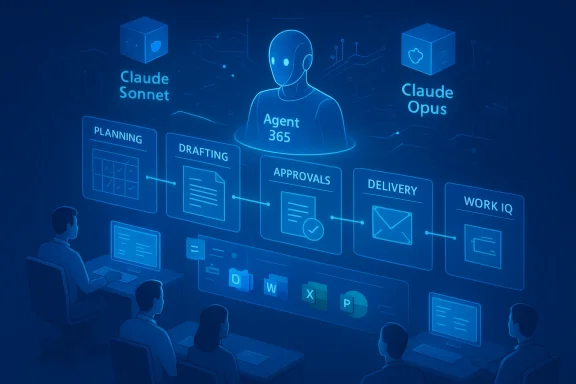
- A research-preview product named Copilot Cowork: a permissioned, ligned to plan, execute and return finished outputs across Microsoft 365 apps.
- Integration of Anthropic’s Claude Sonnet and Opus models into Microsoft 365 Copilot and Copilot Studio, giving administrators the option to route workloads to Anthropic models.
- A control plane and governance surface (referred to as Agent 365) plus a context intelligence layer (branded Work IQ) to manage agent and audit trails.
- A staged roll‑out via Microsoft’s Frontier early‑access program and enterprise preview channels; broader commercialization is tied to new enterprise SKU packaging.
Anthropic enters the tent — and why it matters
Anthropic’s Claude family is now a selectable backend inside Microsoft’s enterprise AI surfaces. That fact changes a few long‑standing narratives: Copilot is no longer perceived as only an OpenAI-powered experience, and Microsoft is signalling a multi‑vendor strategy. The Anthropic announcement and Microsoft messaging both emphasize choice and redundancy as reasons for the change.Why Anthropic? In January 2026 Anthropic introduced consumer- and business-facing “Cowork”-style agents that demonstrated multi‑step workflows (reading files, editing spreadsheets, calling APIs). Mie that agent technology inside Microsoft 365, where contextual access to emails, calendars and files offers a unique advantage. This is both a product decision and a defensive move: keep agentic workloads inside Microsoft 365 rather than letting exteem off.
Two practical implications:
- For CIOs and procurement teams: model diversity reduces single‑vendor lock‑in risk and creates commercial leverage when negotiating throughput or pricing.
- ng: routing “write” tasks, “research” tasks, or “multi‑step orchestration” to different models becomes an optrade-offs between latency, cost, accuracy, and hallucination risk must be managed explicitly.
Copiloant to work
From single‑turn chat to long‑running agents
The stated value of Copilot Cowork is that it can take a high-level instruction and manage it end‑to‑end. Example workflows Microsoft demonstrates include:- Preparing for a client meeting by pulling documents, extractibling a slide deck, and proposing an agenda.
- Building a simple app prototype by scaffolding code, creating sample data, and packaging deliverables.
- Cleaning and normalizing spreadsheets, triaging messy document folders, and producing summarized reports.
Architecture and integration points
Copilot Cowork is described as a composite of:- Model engines (OpenAI, Anthropic Sonnet/Opus, and Microsoft’s own reasoning stacks).
- A control plane (Agent 365) that manages agent policies, permission scopes and audit trails.
- An intelligence/context layer (Work IQ) that maps user context — calendar, mailbox, file access — into agent decisions.
Pricing and commercial model — what we can verify (and what’s still fuzzy)
Microsoft has historically positioned the baseline Microsoft 365 Copilot offering at roughly $30 per user per month for enterprise seats, with SMB-targeted price adjustments and new business SKUs announced across 2024–2025. Multiple Microsoft partner pages and earlier public statements reference a $30 baseline for Copilot, thoughxperimenting with SMB price points and usage-based options. (learn.microsoft.com)For Copilot Cowork specifically Microsoft says some usage will be included with Microsoft 365 Copilot and additional usage will be billable or metered. That “base plus overage” model makes intuitive sense because agent workflows can trigger many model calls and cross‑app operations. However, Microsoft has not published a full public rate card for agent use as of the announcement; early customers and Frontier participants are likely to negotiate terms.
Key takeaways:
- Expect per‑seat baseline charges plus consumption tiers for heavy agent activity.
- Anticipate enterprise tools to require quolicy controls to avoid runaway costs from always‑on agents.
Security, governance and the enterprise advantage
Microsoft’s central pitch to conservative IT teams is governance: an agent built into Microsoft 365 sho access controls — the agent “can’t read what you can’t read” — and events are ludit trails. That matters for customers who have strict data residency, compliance, and eDiscovery requirements.But there are practical caveats:
- Corporate permissions are often messy; automation amplifies misconfigurations. An agent that acts at scale can inadvertently propagate bad access or surface sensitive content to the wrong audience if role assignments aren’t hardened.
- Approval gating is necessary, but excessive gating kills automation. Microsoft must balance the two with granular policy knobs — per‑department delegation profiles, “can act unattended” vs “requires approval” flags, and robust logging.
- Audit and explainability: detailed logs that show which step an agent took and which model produced each output.
- Policy enforcement: RBAC controls, per‑agent scopes, and revocation flows.
- Isolation: ability to sandbox or tag outputs produced by third‑party models for additional human review before committing to authoritative documents.
Market context and investor reaction
Agentic AI has become a flashpoint. Anthropic’s early Cowork agents in January drove investor attention and showed that “agents” could be more than glorified text generators. The response has rippled across enterprise SaaS: could replace parts of traditional software value, and vendors race to embed agents rather than be displaced by them.Microsoft’s timing is notable. The com market re‑rating in late January 2026 after earnings that showed slower Azure growth and heavy AI infrastructure spending; Microsoft’s shares fell sharply, erasing an estimated $357 billion in market value on a single trading day iell‑off, and the heightened scrutiny of AI ROI, likely sharpened Microsoft’s urgency to show enterprise customers a controlled path to agentic AI inside the Microsoft ecosystem.
Put simply: Copilot Cowork is both a product push and a narrative reset. It signals to customers and investors that Microsoft is investing to own the agent layer of officill not be limited to a single model provider.
Notable strengths of Microsoft’s approach
- Deep contextual advantage: Microsoft 365 already knows calendars, mailboxes, file permissions, Teams memberships and org charts; agents that can safely use that context have a head start.
- Enterprise governance and audit surfaces: Agent 365, Work IQ and the Frontier preview model make clear Microsoft is designing for policy and auditing from daya primary concern for regulated industries.
- Multi‑model flexibility: Adding Anthropic’s Claude models reduces single‑vendor dependency and lets Microsoft route tasks to different models based on capability, price and latenc enterprise strategy.
Key risks, limitations and unanswered questions
- Model behavior and hallucinations: multi‑step agents that write, edit or move files raise the stakes for hallucination and error. Microsoft’s checkpointing is necessary but not sufficient; robust explainability and provenance tracking are nl unpredictability: without a published agent rate card, enterprises risk unanticipated costs from long‑running or always‑on agents. Expect heavy early negotiation and pilot agreements.
- Operational complexity: agents create new platform administration needs — quotas, monitoring dashboards, departmental policies, and nion will be slowed by the need to bake these into existing IT operational models.
- Data governance d acting across mailboxes and shared drives can surface data across boundaries unless tag‑and‑filter systems are rock solid. That is a classic insider‑risk vector amplified by automation.
- Vendor‑model risk: Anthropic and other model providers have had intermittent outages and quality regressions; enterprises must assume occasional model degradation and test failover behaviors. Recent elevated error rates reported for some Claude releases are a reminder.
Practical guidance for IT leaders and deployment teams
If you’re evaluating Copilot Cowork for pilots or production, use a staged, measured approach:- Start with high‑value, low‑risk workflows: scheduling, slide drafting, and basic document assembly are good first pilots.
- Define strict delegation templates by function: Finance = approve before commit; Marketing = draft and then review; Legal = read‑only unless explicitly authorized.
- Enable detailed logging and retention policies from day one so every agent action can be audited.
- Run dual‑mode validation for the first 90 days: let agents perform n sign‑off before the agent changes authoritative or shared artifacts.
- Negotiate consumption protections with Microsoft: quotas, spend alerts, and enterprise rate guarantees to avoid bill shocks.
- RBAC clean‑up and least‑privilege policy audit.
- eDiscovery and retention policy mapping for agent‑generated artifacts.
- Network and endpoint segmentation for agent connectors (e.g connectors).
- SRE & SOC runbooks for model outages and rollback procedures.
Where this fits in the broader competitive landscape
Agents are a new battleground for SaaS incumbents and specialist AI startups alike. Anthropic’s early consumer and enterprise agents demonstrated possibilities that vendors must now either integrate or risk losing daily workflows to third parties. Microsoft’s strategy — build agent governance into the productivity stack and offer model choice — targets the sweet spot: keep automation close to the systems of record.But the battle istside agent proves measurably faster, more accurate, and cheaper, enterprises will route certain workflows outside Microsoft 365. Microsoft’s commercial and technical effort here is designed to make that scenario unlikely for core office work, but it is not a foregone conclusion.
Final verdict — pragmatic optimism
Copilot Cowork is Microsoft’s most ambitious push yet to turn AI from an assistant into a delegated worker inside enterprise productivity suites. The combination of Anthropic’s agent tech with Microsoft’s contextual plumbing and governance tooling is a strong, pragmatic formula for enterprise uptake.That said, the success of this initiative depends on execution in three domains:
- Governance: policies, logs and explainability must be comprehensive and usable.
- Economics: predictable pricing and protections against runaway consumption are table stakes.
- Human workflows: agents must save time without creating a hidden verification tax that eliminates their value.
Recommended next steps for organizations
- Assemble a cross‑functional pilot team (IT, Security, Legal, Finance, and a few end‑user champions).
- Identify 3 pilot workflows with clear ROI hypotheses and low regulatory risk.
- Negotiate pilot terms with Microsoft that include consumption caps, data handling assurances, and escalation paths.
- Instrument, monitor and report weekly: accuracy, time saved, approvals invoked, and any security incidents.
- Iterate governance controls before expanding to additional departments.
Microsoft’s Copilot Cowork is a turning point: agents are moving from demo rooms into day‑to‑day work, and Microsoft has decided to stake its lead by combining model choice, enterprise controls, and tight integration with the systems people already use. The promise is big. So are the operational and governance responsibilities that come with it. The next months of pilots and early deployments will tell whether this becomes the default way people get work done — or another enterprise experiment that requires more time to mature.
Source: europe-infos.fr Microsoft pulls Anthropic’s Claude into Copilot as AI “agents” move from chat to doing the work | Europe Infos