

Satya Nadella’s recent push to tighten Microsoft’s Copilot roadmap has exposed both the company’s strategic urgency around AI and a candid internal reckoning: the tools Microsoft is selling as the future of productivity still struggle to deliver the seamless, context-rich integrations that customers and competitors now expect.
Microsoft’s family of Copilot products — spanning Microsoft 365 Copilot, the consumer Copilot app, and GitHub Copilot — is central to the company’s AI narrative. Over the last year Microsoft executives have repeatedly framed Copilot as the linchpin for an “AI-first” transition in enterprise productivity, promising to automate routine work and surface high-value insights across Word, Outlook, Excel, Teams and developer workflows.
That narrative has been accompanied by large investment: datacenter capacity, partnerships with model vendors (including OpenAI and Anthropic), a flood of product updates, and a public-facing claim that the Copilot family has crossed the 100 million monthly active user mark. At the same time, rivals — notably Google’s Gemini and OpenAI’s ChatGPT — have announced user counts and product improvements that complicate Microsoft’s march to market, creating a two‑front pressure: build better features, and get customers to actually use them.
Recently, the company’s CEO engaged directly. Internal communications and reporting indicate Satya Nadella has been pressing engineering leads over perceived gaps in Copilot’s consumer and productivity integrations — notably email and calendar workflows — while pushing teams to narrow the functionality gap with competitor features like Gemini’s tight Drive integration.
Two important caveats apply: the comments come from a reported internal email rather than a public company filing; and Microsoft did not confirm the content of that email to outside outlets. Still, the remarks align with other internal and external signals — from usage telemetry to customer feedback — about adoption friction and feature gaps.
The implication for Microsoft is stark: selling seats is one thing, driving habitual usage that justifies recurring fees is another. If customers buy a Copilot license but employees revert to traditional workflows or free alternatives, renewal economics and long-term ARPU degrade.
Because Gemini’s Drive integration is native to Google’s stack, it exemplifies an experience Microsoft wants to match: conversational intelligence that lives where the user already is.
Agentic approaches amplify both opportunity and risk: they promise real automation but multiply governance, auditing and failure modes. The companies that succeed will be those that combine strong grounding, identity and controls with simple, discoverable UX that non‑technical workers actually adopt.
This will require three things in tight succession:
In the near term, expect continued product reshuffling, deeper platform controls, and tighter product leadership as Microsoft pressures teams to ship reliable, source-grounded integrations. For customers and IT leaders, the right posture is pragmatic: pilot with measurable objectives, insist on governance and provenance, and treat agentic AI as a program of process redesign — not merely a set of new commands in a chat box.
The Copilot story is no longer only about models and marketing; it's about integration, trust and business outcomes. How Microsoft addresses those three dimensions will determine whether Copilot becomes the productivity backbone Nadella envisions — or another costly experiment in the fast-moving AI market.
Source: PYMNTS.com Microsoft CEO Pushes Staff on Copilot Ambitions | PYMNTS.com
 Background
Microsoft’s family of Copilot products — spanning Microsoft 365 Copilot, the consumer Copilot app, and GitHub Copilot — is central to the company’s AI narrative. Over the last year Microsoft executives have repeatedly framed Copilot as the linchpin for an “AI-first” transition in enterprise productivity, promising to automate routine work and surface high-value insights across Word, Outlook, Excel, Teams and developer workflows.That narrative has been accompanied by large investment: datacenter capacity, partnerships with model vendors (including OpenAI and Anthropic), a flood of product updates, and a public-facing claim that the Copilot family has crossed the 100 million monthly active user mark. At the same time, rivals — notably Google’s Gemini and OpenAI’s ChatGPT — have announced user counts and product improvements that complicate Microsoft’s march to market, creating a two‑front pressure: build better features, and get customers to actually use them.
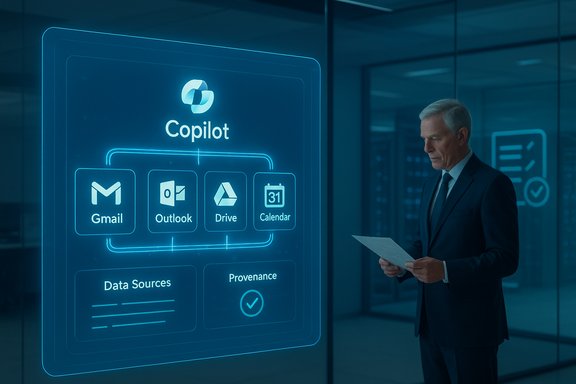
Recently, the company’s CEO engaged directly. Internal communications and reporting indicate Satya Nadella has been pressing engineering leads over perceived gaps in Copilot’s consumer and productivity integrations — notably email and calendar workflows — while pushing teams to narrow the functionality gap with competitor features like Gemini’s tight Drive integration.
What happened inside Microsoft
Nadella as product driver
Over the past months Satya Nadella has signaled a tighter personal focus on AI product delivery. Public remarks and internal reassignments show the CEO delegating broader corporate duties to concentrate on AI strategy, and he’s reportedly become unusually hands-on in product discussions.- He has participated in a private internal forum for senior technical staff and convenes weekly hour‑long meetings to drill into AI product progress.
- He has personally intervened on hiring and retention, authorizing exceptional compensation to recruit AI talent from leading labs.
- He has flagged specific product gaps to engineering groups and demanded faster timelines for prioritized features.
The email that set off headlines
According to reporting based on an internal email chain, Nadella reacted to a product comparison that highlighted Google Gemini’s new Drive integration. In the referenced exchange he described Microsoft’s programs that attempt to connect Copilot with Gmail and Outlook as, in his words, broadly failing: “for the most part don’t really work” and “not smart.” Those quotes were reported by journalists who had access to the internal message.Two important caveats apply: the comments come from a reported internal email rather than a public company filing; and Microsoft did not confirm the content of that email to outside outlets. Still, the remarks align with other internal and external signals — from usage telemetry to customer feedback — about adoption friction and feature gaps.
Why this matters: product, competition, and adoption
The user gap vs. competitors
The AI assistant market is increasingly a scale game and a quality game at once. Publicly stated user metrics — shared by major players this year — show a crowded field:- OpenAI’s ChatGPT reported hundreds of millions of weekly users after a sustained growth push.
- Google’s Gemini has seen rapid monthly active user growth and is being embedded across Workspace apps (Drive, Gmail, Docs) with features that let an assistant consume and summarize files your organization already stores.
- Microsoft reports the Copilot family at more than 100 million monthly active users across consumer and commercial experiences, but that figure bundles distinct products and use cases.
Adoption vs. activation: enterprise reality
Microsoft has sold large seat volumes of Copilot to major firms — multi‑seat purchases by financial institutions and large enterprises show commercial traction. However, reported usage intensity and renewal signals complicate the picture. Some organizations that bought seats have low daily active usage, prompting questions about where and how Copilot delivers material productivity gains.The implication for Microsoft is stark: selling seats is one thing, driving habitual usage that justifies recurring fees is another. If customers buy a Copilot license but employees revert to traditional workflows or free alternatives, renewal economics and long-term ARPU degrade.
The technical gap: why email, calendar and drive integrations are hard
The specific feature set Nadella flagged — integrations that let an AI assistant operate directly with a user’s email, calendar and file stores — is technically and legally sensitive.- Permissions and authorization: An AI agent that accesses Gmail, Outlook, Drive or OneDrive must negotiate OAuth scopes, consent, and enterprise policy controls. Enterprise admins demand granular identity management, audit trails, and the ability to revoke or constrain access.
- Data grounding and hallucinations: For accurate summaries and actions (e.g., “draft a reply to these five threads”), Copilot needs deterministic grounding into the user’s data. That requires robust grounding layers, content indexing, and mechanisms to verify outputs against sources — nontrivial engineering at enterprise scale.
- Privacy, compliance and residency: Finance, healthcare, and regulated sectors require strict governance: data residency, encryption in motion and at rest, access logs, and a demonstrable compliance posture. Any feature that reads or drafts emails is bound to trigger security and legal scrutiny.
- Interoperability complexity: Drive-like integrations look simple to users but demand nuanced parsing of heterogeneous file types (images, multi‑page PDFs, scanned docs), varied metadata, and permissioned collaboration contexts.
The competitive landscape: Gemini, ChatGPT, and the “agentic AI” race
Google’s advantage in Workspace
Google has been embedding Gemini into Workspace (Drive, Gmail, Docs) to let users “converse” with files directly. That reduces friction for everyday tasks like summarizing documents, extracting insights from spreadsheets, or composing an email draft with full access to attachments and contextual notes.Because Gemini’s Drive integration is native to Google’s stack, it exemplifies an experience Microsoft wants to match: conversational intelligence that lives where the user already is.
OpenAI’s breadth and ecosystem
OpenAI’s ChatGPT continues to attract a large consumer and developer audience and is pushing into workplace tooling via API, plugins and enterprise features. Its scale and community-driven innovations put pressure on every challenger to maintain model quality, latency and extensibility.The rise of “agentic AI”
Microsoft’s own ecosystem narrative is shifting toward agentic AI — systems that can plan, act and execute workflows across multiple steps and services. This is reflected in both internal strategy and Microsoft’s industry messaging (for example, guidance for financial services that emphasizes agentic workflows and five predictors for success).Agentic approaches amplify both opportunity and risk: they promise real automation but multiply governance, auditing and failure modes. The companies that succeed will be those that combine strong grounding, identity and controls with simple, discoverable UX that non‑technical workers actually adopt.
Business implications for Microsoft
Revenue and margins: the pressure to convert seats into value
Copilot is a premium add‑on to Microsoft 365 subscriptions. The unit economics depend on:- Seat pricing and renewal rates.
- Intensity of use (how often the Copilot APIs run).
- Model and inference costs (which drive gross margin on AI services).
- Up‑sell potential for adjacent services like Copilot Studio and agent management.
Platform, cloud and partner strategy
Microsoft’s cloud scale is an asset: Azure, Fabric and Foundry are positioned as the data and orchestration backbone for enterprise agents. Partnerships with Anthropic and continued ties to OpenAI aim to offer a diversified model portfolio. But platform moves must translate into tangible productivity gains that enterprise buyers can measure.Risks and operational concerns
1. Integration risk and vendor lock-in
Enterprises must weigh the cost of deep integration with any single vendor’s assistant. Choosing Gemini for Drive‑native experiences could make migration away from Google Workspace more costly; choosing Copilot could deepen Microsoft lock-in via identity and data platforms.2. Governance and auditability
Agentic systems need audit trails, approval gates and identity-based policies. An assistant that autonomously takes actions (scheduling meetings, sending emails, filing expense forms) requires human-in-the-loop controls and rigorous logging.3. Data privacy and third‑party access
Features that reach across Gmail, Drive, OneDrive and Exchange raise sensitive questions about cross‑tenant data flows, edge cases where personal and corporate data intermix, and the appropriate handling of PII or regulated information.4. Cost of scale
Running model inferences, storing token logs and providing low-latency responses across millions of users is expensive. Microsoft’s infrastructure investments are vast; the company needs sustained utilization to justify ongoing capex and operating expense.5. Product confusion and experience fragmentation
Microsoft’s multiple Copilot-branded experiences have created user confusion. When consumers and enterprise users can’t tell which Copilot to use for a given task, activation stalls. Consolidation of UX and clearer guidance are required.Where Microsoft can and likely will double down
Microsoft’s remedial playbook should be multi-pronged and decisive:- Prioritize high‑value integrations: deliver repeatable, reliable email and file-grounded user stories that save measurable time (e.g., automated meeting briefs, concise multi‑message summarization linked to sources).
- Improve grounding and explainability: show provenance for answers and make source tracing effortless for users and admins.
- Harden governance: expose enterprise controls (Agent 365-style governance), detailed audit logs, and admin policy templates for regulated industries.
- Streamline product families: reduce confusion across consumer and enterprise Copilot experiences by clarifying use cases and merging overlapping capabilities.
- Incentivize adoption: embed Copilot directly in common workflows (pre-populate templates, in-app “prompt starters”, role-based training) and pair licenses with guided onboarding and internal champions.
- Measure outcomes: instrument ROI across pilots with A/B testing and publicized case studies so buyers can see real revenue or time savings.
What IT leaders and procurement teams should do now
- Re-evaluate vendor promises against measurable KPIs: require pilots to define specific productivity metrics (time saved, tasks automated, reduction in manual steps).
- Emphasize governance and access controls: demand auditability and fine-grained permissioning before granting agents live access to mail, calendars or files.
- Pilot agentic workflows where value is clear: prioritize customer service automation, contract review summaries, or capital markets research automation where outcomes can be quantified.
- Invest in skilling: create short, role-based training to raise “AI fluency” and increase adoption by demonstrating practical daily gains.
- Avoid “feature-first” lock-in: ensure integration layers and APIs are designed so that knowledge artifacts can be ported or re-indexed if you change a vendor.
Strengths and strategic advantages Microsoft still holds
- Deep enterprise footprint and identity integration across Azure Active Directory, Microsoft Entra and Microsoft 365.
- Scale in enterprise sales and channel ecosystems to drive seat-based adoption at large institutions.
- A growing set of admin and governance controls aimed at making agents auditable and manageable.
- A diversified AI model strategy — Microsoft can combine OpenAI models with third-party models and in‑house capabilities to tune for latency, cost and safety.
Weaknesses and potential blind spots
- Perceived product quality mismatch in consumer and certain enterprise experiences compared with competitors’ native integrations.
- Ongoing confusion from overlapping Copilot products and branding.
- The operational burden of running high-volume inference infrastructure if usage doesn’t match investment.
- The political and compliance complexity of enabling cross‑platform integrations with non-Microsoft services and consumer apps.
Final analysis — balancing ambition with execution
Microsoft is at a pivotal juncture. The company has the engineering resources, enterprise relationships and cloud infrastructure to define what agentic productivity looks like for the next decade. Satya Nadella’s hands-on attention signals that leadership recognizes the urgency: the company must make Copilot not just powerful, but practically useful in the day-to-day flow of work.This will require three things in tight succession:
- Delivering seamless, trustworthy integrations where users already work (email, files, calendar, and line-of-business systems).
- Demonstrating quantifiable ROI that justifies paid seats and recurring spend.
- Providing governance and compliance primitives that remove adoption blockers for regulated industries.
In the near term, expect continued product reshuffling, deeper platform controls, and tighter product leadership as Microsoft pressures teams to ship reliable, source-grounded integrations. For customers and IT leaders, the right posture is pragmatic: pilot with measurable objectives, insist on governance and provenance, and treat agentic AI as a program of process redesign — not merely a set of new commands in a chat box.
The Copilot story is no longer only about models and marketing; it's about integration, trust and business outcomes. How Microsoft addresses those three dimensions will determine whether Copilot becomes the productivity backbone Nadella envisions — or another costly experiment in the fast-moving AI market.
Source: PYMNTS.com Microsoft CEO Pushes Staff on Copilot Ambitions | PYMNTS.com
