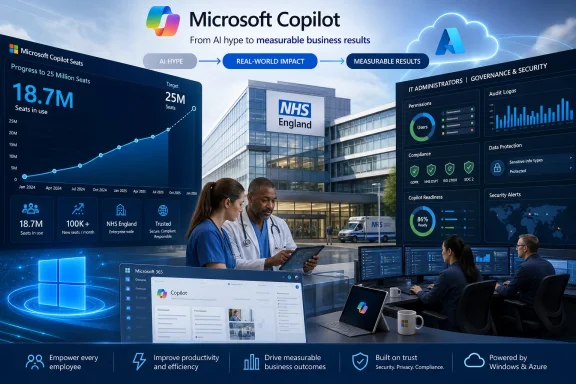
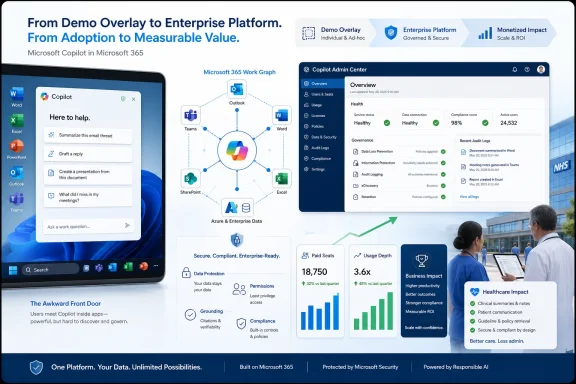
Microsoft’s Copilot is not clearly falling behind competitors as of June 2026: BNP Paribas argues that its enterprise capabilities have improved sharply over the past six to twelve months, while Microsoft’s new NHS England deployment gives the product a high-profile institutional proof point. The more interesting story is not whether Copilot can win a demo war against ChatGPT, Claude, Gemini, or Grok. It is whether Microsoft can turn AI from a bundled feature into a durable enterprise revenue engine without making customers feel as if every prompt has become a metered utility bill.
Microsoft has never had a distribution problem. Copilot has been pushed into Windows, Microsoft 365, GitHub, Edge, Azure, Teams, and the broader productivity stack with the kind of reach only Microsoft can command. If the AI race were judged by the number of surfaces where a chatbot icon appears, Redmond would have declared victory long ago.
The skepticism came from a different place. Early enterprise buyers often found that Copilot was useful but uneven, impressive in some workflows and underwhelming in others. It could summarize a meeting, draft a document, or search corporate content, but it also depended heavily on the quality of an organization’s data estate, permissions, habits, and tolerance for imperfect automation.
That made Copilot a frustrating product for investors to assess. Consumer AI products produce visible buzz: viral screenshots, public benchmarks, model leaderboards, and app-store chatter. Microsoft’s AI bet is quieter, more bureaucratic, and more expensive to validate because its success lives inside procurement cycles, compliance reviews, tenant configuration, and the daily routines of office workers.
BNP Paribas’ latest view cuts directly through that earlier uncertainty. The bank’s argument, as relayed by Moomoo and Zhitong Finance, is that judging Copilot by impressions formed six or twelve months ago risks missing the speed of Microsoft’s product iteration and the growing evidence of large-account traction.
For Microsoft, that matters because Copilot’s central pitch has always been institutional rather than merely individual. ChatGPT may win the “which bot do I open first?” contest among consumers and power users. Microsoft wants to win the “which AI system is allowed to touch regulated workflows, enterprise files, employee calendars, internal chats, and business processes?” contest.
Those are very different races. The first rewards model personality, benchmark performance, memory features, and consumer virality. The second rewards identity management, auditability, compliance, licensing familiarity, data boundaries, administrative controls, and the ability to sell into organizations that already spend millions on Microsoft software.
That is why the NHS deployment is more than a headline. It suggests Microsoft’s argument is landing with buyers who are not simply chasing the newest model. They are buying an AI layer that sits inside the software estate they already govern.
This is where the “falling behind” claim becomes too crude. Copilot can feel behind if the comparison is a clean-room model test against the latest version of Claude or Gemini. But Microsoft is not only selling raw model intelligence. It is selling AI bound to documents, calendars, emails, spreadsheets, code repositories, security policies, and business applications.
That distinction is not an excuse for weak output. If Copilot produces mediocre drafts or unreliable answers, users will not care how beautifully it integrates with SharePoint. But enterprise AI value is often created when the model has the right context, the right permissions, and the right workflow placement rather than when it wins a benchmark in isolation.
Microsoft’s best case is that Copilot becomes less like a chatbot and more like an invisible labor-saving layer across work. That is harder to demo, harder to price, and harder to explain. It is also much harder for a standalone rival to replicate.
That number matters because Copilot has been one of the cleanest ways for investors to model AI revenue inside Microsoft. A per-user add-on attached to Microsoft 365 is easy to understand. Multiply seats by price, assume some penetration rate, and the spreadsheet begins to look like a very large new software business.
But AI is not ordinary software. A user who asks Copilot to summarize two meetings per week does not cost Microsoft the same as a power user running complex agentic tasks across documents, spreadsheets, code, and business systems. Compute intensity varies wildly, and the cost of serving advanced models can be material.
That is why the pricing model is becoming the next battleground. BNP Paribas says Microsoft is exploring a shift away from purely traditional per-user pricing toward a hybrid model that also reflects actual usage. That would make Copilot look more like cloud consumption than a conventional Office license.
The logic is obvious. The politics are harder. Enterprises like predictable budgets, and Microsoft has spent decades training IT departments to think in seats, bundles, renewals, and enterprise agreements. Usage-based AI pricing can be more economically rational for Microsoft while feeling less comfortable for customers asked to forecast employee behavior one prompt at a time.
From Microsoft’s perspective, this is the unavoidable direction of travel. An AI assistant that can call increasingly powerful models, review code, produce long outputs, and operate in more agentic ways cannot be priced forever as if all requests are equal. Someone has to pay for the inference.
From a customer perspective, however, the shift can feel like the cloud bill problem arriving inside the IDE. Developers who thought they had bought a subscription can suddenly discover that the most useful parts of the product are governed by credits, limits, budgets, or overages. Even when the vendor’s economic case is sound, the user experience can feel like a downgrade.
This is the tension Microsoft must manage before extending similar ideas more aggressively across Microsoft 365 Copilot and adjacent products. A usage component may be inevitable. But if the pricing language becomes too opaque, Copilot risks moving from “AI productivity assistant” to “another thing finance wants locked down.”
Enterprise buyers can tolerate complexity when value is obvious. They are less forgiving when a tool is still proving itself. Microsoft’s challenge is to time the monetization shift so that customers feel the productivity gain before they feel the meter running.
BNP Paribas’ report says Microsoft management remains cautious about broad Azure price increases despite rising GPU costs. That restraint is strategically important. If Microsoft simply pushes higher infrastructure costs onto customers, it risks giving AWS and Google Cloud an opening to position themselves as the more predictable or more aggressive AI infrastructure partners.
The better Microsoft story is efficiency. If the company can improve utilization, optimize model routing, use smaller models where appropriate, and reserve frontier-class compute for tasks that justify it, Copilot margins become less frightening. That is the kind of operational advantage hyperscalers are built to exploit.
Still, investors should not pretend this is painless. AI capex is not a decorative line item. Microsoft is committing to data centers, accelerators, networking, power, and long-term supply arrangements at a scale that assumes demand will keep compounding. If Copilot adoption disappoints, the infrastructure buildout looks heavy. If Copilot adoption accelerates, the infrastructure buildout may still look heavy, just more defensible.
That is the paradox of the AI platform business in 2026. Success is expensive. Failure is also expensive.
Those arenas overlap, but they are not identical. A knowledge worker may use ChatGPT for brainstorming, Claude for long-document reasoning, Gemini inside Google Workspace, Copilot inside Teams, and Siri AI on an iPhone. The future may be less a single assistant monopoly than a messy stack of context-specific agents.
Microsoft’s advantage is that work context is already inside its walls. Outlook knows the calendar. Teams knows the meeting. Word knows the draft. Excel knows the model. SharePoint knows the files. Entra ID knows who should see what. Purview knows what needs governing. Defender and Sentinel know where security operations live.
The disadvantage is that integration can become bloat. Microsoft’s product history is full of features that were everywhere and loved nowhere. Copilot must avoid becoming another omnipresent panel that users close reflexively because the first few answers were generic.
That makes quality improvements essential. Distribution gets Copilot in front of users once. Usefulness decides whether they come back tomorrow.
Microsoft has leaned into that framing. The NHS deployment, like many enterprise AI announcements, emphasizes time saved from administrative work rather than magic. That is smart positioning because most large organizations do not need AI to be dazzling. They need it to remove enough friction from repetitive work to justify the spend.
But productivity claims are difficult to standardize. One team may save hours summarizing meetings and drafting documents. Another may barely use the tool. A third may spend more time checking AI output than it saves. Enterprise-wide averages can hide huge differences in value by role, workflow, and data maturity.
This is why BNP Paribas’ emphasis on customer usage is important. Paid seats alone can flatter adoption, especially when licenses are bundled or sold through broad agreements. Actual usage intensity tells a more meaningful story: whether Copilot is becoming part of the workday or merely part of the contract.
If Microsoft can show that usage deepens after deployment, the commercialization story becomes stronger. If usage plateaus after curiosity fades, the product remains vulnerable to budget scrutiny.
But the Windows surface is not where the near-term enterprise monetization thesis primarily lives. Microsoft 365 Copilot, GitHub Copilot, Azure AI, Copilot Studio, and role-based business workflows are far more important to the revenue story. Windows matters as distribution, identity, endpoint context, and habit formation, but it is not the whole product.
That distinction helps explain the disconnect between user sentiment and analyst optimism. A Windows enthusiast irritated by a Copilot button may see AI clutter. A CIO looking at Teams summaries, Outlook drafting, SharePoint-grounded search, and Copilot Studio agents may see a potential productivity platform. Both perspectives can be true.
Microsoft’s risk is that the weaker consumer and Windows experiences contaminate the brand. If “Copilot” means too many things, users may judge the entire family by its least useful incarnation. The company has spent enormous energy unifying the name; it now needs to unify the quality bar.
For Microsoft, that kind of environment plays to its strengths. The company can argue that Copilot inherits enterprise controls, identity boundaries, compliance tooling, and administrative oversight. Those capabilities are less exciting than model benchmarks, but they matter enormously when the data is clinical, personal, or operationally sensitive.
The trust question will not be settled by Microsoft’s assurances. Large deployments create real-world evidence, and that evidence can cut both ways. If staff report meaningful reductions in administrative load, Copilot gains credibility. If the tool produces errors, confusion, or uneven value, critics will have a concrete case study.
That is why the NHS announcement is not merely a sales win. It is a public test of Microsoft’s enterprise AI proposition at national scale. The company now has to prove that Copilot can be useful in one of the least forgiving environments imaginable.
That is especially important as competitors differentiate. Anthropic has built a strong reputation among developers and enterprise users for long-context reasoning and coding assistance. Google can pair Gemini with search, Android, Chrome, Workspace, and its own cloud stack. Apple can attack from the device and personal-context layer. OpenAI remains the consumer AI default for many users.
Microsoft’s counter is not purity. It is orchestration. The company can integrate multiple models, route tasks based on cost and capability, and package the result through familiar enterprise products. If it succeeds, customers may care less which model answered a prompt and more whether the workflow completed safely.
That is the classic Microsoft platform move. The company does not need to own every best component if it owns the place where components become business tools. But that strategy only works if Copilot feels like a coherent product, not a collection of AI features stitched together by branding.
But a strict cap would also be strange. If Microsoft genuinely believes AI will reshape productivity software, developer tools, cloud infrastructure, cybersecurity, and business applications, then underinvesting would be the more dangerous error. The company’s moat is not just Office or Windows; it is the ability to build and operate platforms at global scale.
The question is not whether Microsoft should spend. It is whether spending converts into defensible usage, pricing power, and workflow lock-in. Copilot is one of the clearest tests of that conversion.
If Copilot becomes a daily layer across work, the capex looks like infrastructure for the next software era. If it remains a premium add-on with uneven usage, the spending will invite harder questions about returns.
Copilot’s early stumbles were real. The product was expensive, the value proposition was sometimes fuzzy, and the brand became stretched across too many experiences. Competitors moved quickly, and in some categories they still produce more impressive standalone AI experiences.
But BNP Paribas’ argument is that the laggard narrative has not kept pace with the product. The NHS deal reinforces that view by showing a major institutional buyer willing to deploy at scale. GitHub’s pricing evolution shows Microsoft learning how to monetize compute-intensive AI, even if the lesson is uncomfortable for some users. Azure’s restraint on broad price hikes shows the company understands that infrastructure economics cannot be solved simply by passing every cost downstream.
The more precise verdict is this: Microsoft may not always lead the AI conversation, but it remains extremely well positioned to lead the enterprise AI commercialization cycle.
 The Copilot Doubt Was Always About Adoption, Not Awareness
Microsoft has never had a distribution problem. Copilot has been pushed into Windows, Microsoft 365, GitHub, Edge, Azure, Teams, and the broader productivity stack with the kind of reach only Microsoft can command. If the AI race were judged by the number of surfaces where a chatbot icon appears, Redmond would have declared victory long ago.The skepticism came from a different place. Early enterprise buyers often found that Copilot was useful but uneven, impressive in some workflows and underwhelming in others. It could summarize a meeting, draft a document, or search corporate content, but it also depended heavily on the quality of an organization’s data estate, permissions, habits, and tolerance for imperfect automation.
That made Copilot a frustrating product for investors to assess. Consumer AI products produce visible buzz: viral screenshots, public benchmarks, model leaderboards, and app-store chatter. Microsoft’s AI bet is quieter, more bureaucratic, and more expensive to validate because its success lives inside procurement cycles, compliance reviews, tenant configuration, and the daily routines of office workers.
BNP Paribas’ latest view cuts directly through that earlier uncertainty. The bank’s argument, as relayed by Moomoo and Zhitong Finance, is that judging Copilot by impressions formed six or twelve months ago risks missing the speed of Microsoft’s product iteration and the growing evidence of large-account traction.
Microsoft’s AI Strategy Looks Boring Until the Contract Is Half a Million Seats
The NHS England deal is precisely the kind of proof point Microsoft needed. NHS England announced plans to provide Microsoft 365 Copilot access to 505,000 clinicians and support staff, framing the deployment around service delivery, administrative efficiency, and freeing more time for care. That is not a hobbyist trial or a narrow developer pilot; it is a national-scale institutional deployment in one of the most scrutinized public-sector environments in the world.For Microsoft, that matters because Copilot’s central pitch has always been institutional rather than merely individual. ChatGPT may win the “which bot do I open first?” contest among consumers and power users. Microsoft wants to win the “which AI system is allowed to touch regulated workflows, enterprise files, employee calendars, internal chats, and business processes?” contest.
Those are very different races. The first rewards model personality, benchmark performance, memory features, and consumer virality. The second rewards identity management, auditability, compliance, licensing familiarity, data boundaries, administrative controls, and the ability to sell into organizations that already spend millions on Microsoft software.
That is why the NHS deployment is more than a headline. It suggests Microsoft’s argument is landing with buyers who are not simply chasing the newest model. They are buying an AI layer that sits inside the software estate they already govern.
Copilot’s Improvement Curve Is the Real Rebuttal to the Laggard Narrative
BNP Paribas analyst Stefan Slowinski reportedly told clients that Copilot’s capabilities now “far exceed” what the product offered six to twelve months earlier. That is a broad claim, but it fits the pattern across Microsoft’s AI portfolio. The company has been moving Copilot away from simple chat assistance and toward workflow-aware agents, richer app integration, and model choice in some markets.This is where the “falling behind” claim becomes too crude. Copilot can feel behind if the comparison is a clean-room model test against the latest version of Claude or Gemini. But Microsoft is not only selling raw model intelligence. It is selling AI bound to documents, calendars, emails, spreadsheets, code repositories, security policies, and business applications.
That distinction is not an excuse for weak output. If Copilot produces mediocre drafts or unreliable answers, users will not care how beautifully it integrates with SharePoint. But enterprise AI value is often created when the model has the right context, the right permissions, and the right workflow placement rather than when it wins a benchmark in isolation.
Microsoft’s best case is that Copilot becomes less like a chatbot and more like an invisible labor-saving layer across work. That is harder to demo, harder to price, and harder to explain. It is also much harder for a standalone rival to replicate.
The Revenue Question Has Moved From Seats to Intensity
The most investor-sensitive part of the BNP Paribas note is not the product praise. It is the suggestion that paid Copilot adoption could exceed the market’s expectations by Microsoft’s fiscal fourth quarter of 2026. The report cites a market expectation of roughly 25 million paying users by that point, with BNP Paribas arguing there may be room for upside.That number matters because Copilot has been one of the cleanest ways for investors to model AI revenue inside Microsoft. A per-user add-on attached to Microsoft 365 is easy to understand. Multiply seats by price, assume some penetration rate, and the spreadsheet begins to look like a very large new software business.
But AI is not ordinary software. A user who asks Copilot to summarize two meetings per week does not cost Microsoft the same as a power user running complex agentic tasks across documents, spreadsheets, code, and business systems. Compute intensity varies wildly, and the cost of serving advanced models can be material.
That is why the pricing model is becoming the next battleground. BNP Paribas says Microsoft is exploring a shift away from purely traditional per-user pricing toward a hybrid model that also reflects actual usage. That would make Copilot look more like cloud consumption than a conventional Office license.
The logic is obvious. The politics are harder. Enterprises like predictable budgets, and Microsoft has spent decades training IT departments to think in seats, bundles, renewals, and enterprise agreements. Usage-based AI pricing can be more economically rational for Microsoft while feeling less comfortable for customers asked to forecast employee behavior one prompt at a time.
GitHub Copilot Is the Warning Label Attached to the Strategy
Microsoft does not have to imagine how usage-based AI billing might land. GitHub Copilot has already become the laboratory. GitHub has moved toward AI Credits and usage-based billing, replacing simpler premium-request structures with a model that more directly reflects consumption, model selection, and token-heavy work.From Microsoft’s perspective, this is the unavoidable direction of travel. An AI assistant that can call increasingly powerful models, review code, produce long outputs, and operate in more agentic ways cannot be priced forever as if all requests are equal. Someone has to pay for the inference.
From a customer perspective, however, the shift can feel like the cloud bill problem arriving inside the IDE. Developers who thought they had bought a subscription can suddenly discover that the most useful parts of the product are governed by credits, limits, budgets, or overages. Even when the vendor’s economic case is sound, the user experience can feel like a downgrade.
This is the tension Microsoft must manage before extending similar ideas more aggressively across Microsoft 365 Copilot and adjacent products. A usage component may be inevitable. But if the pricing language becomes too opaque, Copilot risks moving from “AI productivity assistant” to “another thing finance wants locked down.”
Enterprise buyers can tolerate complexity when value is obvious. They are less forgiving when a tool is still proving itself. Microsoft’s challenge is to time the monetization shift so that customers feel the productivity gain before they feel the meter running.
Azure Gives Microsoft Leverage, but Not Immunity
The Copilot debate cannot be separated from Azure. Every Copilot prompt ultimately lands somewhere in Microsoft’s infrastructure and partner model ecosystem. The user sees a sidebar in Word or Teams; Microsoft sees capacity planning, GPU procurement, data-center power, model routing, latency targets, and gross-margin pressure.BNP Paribas’ report says Microsoft management remains cautious about broad Azure price increases despite rising GPU costs. That restraint is strategically important. If Microsoft simply pushes higher infrastructure costs onto customers, it risks giving AWS and Google Cloud an opening to position themselves as the more predictable or more aggressive AI infrastructure partners.
The better Microsoft story is efficiency. If the company can improve utilization, optimize model routing, use smaller models where appropriate, and reserve frontier-class compute for tasks that justify it, Copilot margins become less frightening. That is the kind of operational advantage hyperscalers are built to exploit.
Still, investors should not pretend this is painless. AI capex is not a decorative line item. Microsoft is committing to data centers, accelerators, networking, power, and long-term supply arrangements at a scale that assumes demand will keep compounding. If Copilot adoption disappoints, the infrastructure buildout looks heavy. If Copilot adoption accelerates, the infrastructure buildout may still look heavy, just more defensible.
That is the paradox of the AI platform business in 2026. Success is expensive. Failure is also expensive.
The Competitive Map Is Wider Than Chatbot Rankings Suggest
The Moomoo piece frames Copilot against ChatGPT, Claude, Grok, Gemini, and Apple’s new Siri AI. That is directionally fair, but it compresses several different markets into one race. OpenAI and Anthropic are fighting for frontier model credibility and developer mindshare. Google is fighting with both Gemini and its cloud productivity footprint. Apple is fighting to make AI feel native to personal devices. Microsoft is fighting to make AI native to work.Those arenas overlap, but they are not identical. A knowledge worker may use ChatGPT for brainstorming, Claude for long-document reasoning, Gemini inside Google Workspace, Copilot inside Teams, and Siri AI on an iPhone. The future may be less a single assistant monopoly than a messy stack of context-specific agents.
Microsoft’s advantage is that work context is already inside its walls. Outlook knows the calendar. Teams knows the meeting. Word knows the draft. Excel knows the model. SharePoint knows the files. Entra ID knows who should see what. Purview knows what needs governing. Defender and Sentinel know where security operations live.
The disadvantage is that integration can become bloat. Microsoft’s product history is full of features that were everywhere and loved nowhere. Copilot must avoid becoming another omnipresent panel that users close reflexively because the first few answers were generic.
That makes quality improvements essential. Distribution gets Copilot in front of users once. Usefulness decides whether they come back tomorrow.
Enterprise AI Is Being Sold to CFOs, Not Just CIOs
The next phase of Copilot adoption will be fought in finance departments. CIO enthusiasm can open the door, but a broad deployment needs measurable productivity, defensible security, and a budget story that survives renewal season. In that sense, Copilot is less like a new app and more like a labor-efficiency thesis.Microsoft has leaned into that framing. The NHS deployment, like many enterprise AI announcements, emphasizes time saved from administrative work rather than magic. That is smart positioning because most large organizations do not need AI to be dazzling. They need it to remove enough friction from repetitive work to justify the spend.
But productivity claims are difficult to standardize. One team may save hours summarizing meetings and drafting documents. Another may barely use the tool. A third may spend more time checking AI output than it saves. Enterprise-wide averages can hide huge differences in value by role, workflow, and data maturity.
This is why BNP Paribas’ emphasis on customer usage is important. Paid seats alone can flatter adoption, especially when licenses are bundled or sold through broad agreements. Actual usage intensity tells a more meaningful story: whether Copilot is becoming part of the workday or merely part of the contract.
If Microsoft can show that usage deepens after deployment, the commercialization story becomes stronger. If usage plateaus after curiosity fades, the product remains vulnerable to budget scrutiny.
Windows Is the Most Visible Copilot Surface and the Least Important One for the Revenue Story
For many WindowsForum readers, Copilot is most visible as a Windows feature. It has appeared, disappeared, moved, changed form, and been rebranded often enough to make even attentive users wonder what exactly Microsoft wants the Windows version to be. That consumer-facing churn has contributed to the perception that Copilot is strategically confused.But the Windows surface is not where the near-term enterprise monetization thesis primarily lives. Microsoft 365 Copilot, GitHub Copilot, Azure AI, Copilot Studio, and role-based business workflows are far more important to the revenue story. Windows matters as distribution, identity, endpoint context, and habit formation, but it is not the whole product.
That distinction helps explain the disconnect between user sentiment and analyst optimism. A Windows enthusiast irritated by a Copilot button may see AI clutter. A CIO looking at Teams summaries, Outlook drafting, SharePoint-grounded search, and Copilot Studio agents may see a potential productivity platform. Both perspectives can be true.
Microsoft’s risk is that the weaker consumer and Windows experiences contaminate the brand. If “Copilot” means too many things, users may judge the entire family by its least useful incarnation. The company has spent enormous energy unifying the name; it now needs to unify the quality bar.
The NHS Deal Raises the Stakes on Trust
Healthcare is a particularly revealing test bed. It is information-heavy, document-heavy, and administratively burdened, but it is also sensitive, regulated, and politically exposed. An AI deployment in that setting has to be framed around augmentation, governance, and human control rather than replacement.For Microsoft, that kind of environment plays to its strengths. The company can argue that Copilot inherits enterprise controls, identity boundaries, compliance tooling, and administrative oversight. Those capabilities are less exciting than model benchmarks, but they matter enormously when the data is clinical, personal, or operationally sensitive.
The trust question will not be settled by Microsoft’s assurances. Large deployments create real-world evidence, and that evidence can cut both ways. If staff report meaningful reductions in administrative load, Copilot gains credibility. If the tool produces errors, confusion, or uneven value, critics will have a concrete case study.
That is why the NHS announcement is not merely a sales win. It is a public test of Microsoft’s enterprise AI proposition at national scale. The company now has to prove that Copilot can be useful in one of the least forgiving environments imaginable.
The OpenAI Relationship Is Still an Asset, but Microsoft Is Hedging Like a Platform Company
Microsoft’s AI story is intertwined with OpenAI, but Copilot is increasingly larger than any single model supplier. The company has reason to keep the OpenAI partnership central, yet it also has reason to offer model choice, optimize for cost, and prevent its enterprise AI platform from being perceived as a wrapper around one lab’s roadmap.That is especially important as competitors differentiate. Anthropic has built a strong reputation among developers and enterprise users for long-context reasoning and coding assistance. Google can pair Gemini with search, Android, Chrome, Workspace, and its own cloud stack. Apple can attack from the device and personal-context layer. OpenAI remains the consumer AI default for many users.
Microsoft’s counter is not purity. It is orchestration. The company can integrate multiple models, route tasks based on cost and capability, and package the result through familiar enterprise products. If it succeeds, customers may care less which model answered a prompt and more whether the workflow completed safely.
That is the classic Microsoft platform move. The company does not need to own every best component if it owns the place where components become business tools. But that strategy only works if Copilot feels like a coherent product, not a collection of AI features stitched together by branding.
Investors Are Right to Watch Capex, but Wrong to Treat It as a Simple Red Flag
Microsoft management reportedly sees the current AI wave as a once-in-several-decades opportunity and has not set a rigid free-cash-flow threshold that would cap AI investment. That posture will make some investors nervous, and it should. Unlimited-sounding ambition has a way of turning into undisciplined spending when markets get euphoric.But a strict cap would also be strange. If Microsoft genuinely believes AI will reshape productivity software, developer tools, cloud infrastructure, cybersecurity, and business applications, then underinvesting would be the more dangerous error. The company’s moat is not just Office or Windows; it is the ability to build and operate platforms at global scale.
The question is not whether Microsoft should spend. It is whether spending converts into defensible usage, pricing power, and workflow lock-in. Copilot is one of the clearest tests of that conversion.
If Copilot becomes a daily layer across work, the capex looks like infrastructure for the next software era. If it remains a premium add-on with uneven usage, the spending will invite harder questions about returns.
The “Falling Behind” Frame Misses the Microsoft Playbook
Microsoft has rarely been at its best when judged by first impressions. The company often enters markets awkwardly, iterates through messy branding, uses distribution aggressively, and then grinds toward enterprise adoption. That pattern does not guarantee success, but it makes premature obituaries particularly risky.Copilot’s early stumbles were real. The product was expensive, the value proposition was sometimes fuzzy, and the brand became stretched across too many experiences. Competitors moved quickly, and in some categories they still produce more impressive standalone AI experiences.
But BNP Paribas’ argument is that the laggard narrative has not kept pace with the product. The NHS deal reinforces that view by showing a major institutional buyer willing to deploy at scale. GitHub’s pricing evolution shows Microsoft learning how to monetize compute-intensive AI, even if the lesson is uncomfortable for some users. Azure’s restraint on broad price hikes shows the company understands that infrastructure economics cannot be solved simply by passing every cost downstream.
The more precise verdict is this: Microsoft may not always lead the AI conversation, but it remains extremely well positioned to lead the enterprise AI commercialization cycle.
Redmond’s Copilot Bet Now Comes Down to Five Hard Tests
The BNP Paribas note is bullish, but the next year will determine whether that optimism reflects durable momentum or another round of AI-market expectation inflation. Microsoft has the distribution, capital, infrastructure, and enterprise relationships. Now it has to prove that Copilot is not merely widely available, but deeply used.- Copilot’s strongest evidence is shifting from demos to deployments, with the NHS England rollout giving Microsoft a major public-sector proof point.
- The product’s improvement over the past six to twelve months matters because many negative perceptions were formed during an earlier, rougher phase.
- Paid-seat growth will be less important than usage intensity if Microsoft moves more AI products toward hybrid or consumption-aware pricing.
- GitHub Copilot’s billing changes show why AI monetization is economically logical for Microsoft but potentially painful for customers.
- Azure cost control is central to the Copilot story because enterprise AI margins depend on infrastructure efficiency, not just software pricing.
- Microsoft’s biggest advantage is not having the flashiest chatbot, but owning the productivity, identity, security, developer, and cloud layers where enterprise AI work actually happens.
References
- Primary source: Moomoo
Published: Thu, 11 Jun 2026 14:52:27 GMT
- Official source: news.microsoft.com
- Official source: docs.github.com
- Official source: github.com
GitHub Copilot · Plans & pricing · GitHub
GitHub Copilot works alongside you directly in your editor, suggesting whole lines or entire functions for you. github.com
- Related coverage: support.nhs.net
- Official source: learn.microsoft.com
Copilot in Microsoft 365 apps with Anthropic models | Microsoft Learn
Learn about the new toggle for Microsoft 365 apps for Anthropic in Europe.learn.microsoft.com


- Related coverage: techcrunch.com
GitHub Copilot introduces new limits, charges for 'premium' AI models | TechCrunch
GitHub Copilot, Microsoft-owned GitHub's AI coding assistant, could soon become costlier for some users, thanks to new limits.techcrunch.com - Official source: microsoft.com
Microsoft 365 Copilot Plans and Pricing—AI for Business | Microsoft 365
Explore AI subscription plans for Microsoft 365 Copilot—AI designed to enhance productivity. Discover Copilot pricing options tailored to your business needs.www.microsoft.com
- Related coverage: windowscentral.com
Microsoft 365 is paywalling most of Copilot in its Office apps | Windows Central
Commercial customers will soon need a Microsoft 365 Copilot license to use Copilot Chat in Word, Excel, PowerPoint, and OneNote.www.windowscentral.com - Related coverage: xebia.com
- Related coverage: tomshardware.com
Github Copilot customers report up to 100-fold price hikes — AI sticker shock bites as Microsoft switches to usage-based pricing | Tom's Hardware
The AI investment chickens have come home to roost.www.tomshardware.com - Related coverage: github.blog
GitHub Copilot is moving to usage-based billing - The GitHub Blog
Starting June 1, your Copilot usage will consume GitHub AI Credits.github.blog
- Related coverage: itpro.com
Everything you need to know about the GitHub Copilot pricing changes | IT Pro
GitHub Copilot pricing changes mean users will be charged based on consumption, rather than a set number of credits.www.itpro.com - Related coverage: techradar.com
Microsoft spent billions on Copilot, but only 3.3% of users are actually paying for the AI tools | TechRadar
Microsoft spent $37.5 billion on AI tools, with limited returns so farwww.techradar.com - Official source: cdn-dynmedia-1.microsoft.com