

Microsoft’s latest Copilot push at Ignite delivered more than incremental features — it reshapes how AI will be embedded into everyday work, giving organizations finer control over agents, new options for model choice, and a visible personality for voice interactions that aims to lower the friction of talking to your PC.
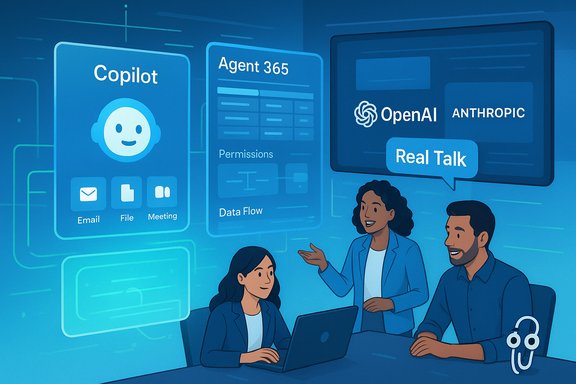
Microsoft used Ignite 2025 to present an integrated vision: Copilot as a platform that can remember, reason, act, and now present itself — all while giving enterprises tools to govern the explosion of AI agents. The announcements clustered around four themes: personalization (Work IQ and memory), multi-model choice (OpenAI and Anthropic models), agent governance (Agent 365 control panel / Agent Dashboard), and consumer-facing polish (Mico avatar and voice mode). News reports and Microsoft documentation confirm these were core pieces of the Ignite presentation and the surrounding Fall release materials. Changes are already visible across the stack: updates to Microsoft 365 Copilot and Copilot Studio, new admin controls in the Microsoft 365 admin center, and fresh UX elements on Windows where Copilot’s voice and multimodal capabilities surface. These moves aim to balance utility and governance — a central product pitch for enterprises considering wide Copilot adoption.
Mico, Work IQ, Agent 365 and multi‑model Copilot are not mere feature flags; they are architectural shifts in how generative AI will be hosted, governed and experienced at work. The next phase — adoption at scale — will be decided by how well organizations can pair the productivity upside with disciplined governance and human-centered policy.
Source: IndexBox Microsoft Copilot Updates 2025: Work IQ, Voice Mode & Agent 365 - News and Statistics - IndexBox
 Background / Overview
Microsoft used Ignite 2025 to present an integrated vision: Copilot as a platform that can remember, reason, act, and now present itself — all while giving enterprises tools to govern the explosion of AI agents. The announcements clustered around four themes: personalization (Work IQ and memory), multi-model choice (OpenAI and Anthropic models), agent governance (Agent 365 control panel / Agent Dashboard), and consumer-facing polish (Mico avatar and voice mode). News reports and Microsoft documentation confirm these were core pieces of the Ignite presentation and the surrounding Fall release materials. Changes are already visible across the stack: updates to Microsoft 365 Copilot and Copilot Studio, new admin controls in the Microsoft 365 admin center, and fresh UX elements on Windows where Copilot’s voice and multimodal capabilities surface. These moves aim to balance utility and governance — a central product pitch for enterprises considering wide Copilot adoption. What Microsoft announced at Ignite and in the Fall release
Work IQ: a role-aware layer for Copilot
Work IQ is a new layer sitting behind Microsoft 365 Copilot and enterprise agents that helps Copilot understand a user’s role, habits and relevant data. It ingests signals from emails, files, and meeting artifacts, uses memory to learn writing style and work routines, and surfaces the right agent or prompt patterns based on context. In practice, Work IQ is meant to reduce repetitive prompts and help the assistant make contextual suggestions (for example, which agent to invoke for a recurring finance or research task).- Key design points:
- Role- and task-aware suggestions that map user prompts to specialized agents.
- Tightly coupled to memory and connectors (email, calendar, files).
- Built with enterprise consent and admin controls in mind.
Agent 365 and the Agent Dashboard: governance meets observability
Agent 365 (sometimes reported as Agent 365 control panel) is Microsoft’s admin-centric response to the expected proliferation of AI agents in the enterprise. It offers:- A visual dashboard showing relationships between people, agents, and data sources.
- Access control to limit agent permissions to specific datasets.
- Inventory and usage metrics (how many agents exist, how many people use them).
- Integration with Copilot Studio and Azure AI Foundry, plus third‑party agents from partners like Adobe and ServiceNow.
Multi-model choice: OpenAI and Anthropic in Copilot
Microsoft explicitly widened Copilot’s model mix. Customers can now select Anthropic’s Claude family alongside OpenAI models for certain Copilot surfaces — initially in Copilot Studio and the Researcher reasoning agent. Microsoft’s documentation and blogs confirm that Anthropic’s Claude Sonnet (and Opus) models are now optional backends, with admins controlling tenant enablement. Microsoft also published learn/support pages explaining that Anthropic models are hosted outside Microsoft-managed environments and that choosing them implies sending data to Anthropic’s infrastructure.- What this enables:
- “Right model for the right task” orchestration: route spreadsheet-heavy or structured tasks to models that empirically perform better on those workloads.
- Multi-vendor resilience — reducing single-vendor dependency.
- Choice at authoring time in Copilot Studio and at session time in Researcher.
Voice Mode, Mico avatar and “Real Talk”
Microsoft introduced a voice-first modality for Copilot and paired it with an optional animated avatar called Mico. Mico is intentionally abstract — a shape-shifting, color-aware orbital avatar that provides listening/processing cues during voice interactions and Learn Live tutoring flows. The visual persona is default-on in some voice experiences but user-toggleable and accompanied by accessibility options for text-only or voice-only interactions. Early previews also noted a lighthearted Easter egg that briefly morphs Mico into a Clippy-like paperclip when prodded — a nostalgia wink rather than a functional revival. Separately, Microsoft outlined a “Real Talk” conversational style designed to make Copilot less sycophantic — the assistant will push back on incorrect assumptions rather than reflexively agreeing. This reflects product and safety design choices after critics warned that overly flattering chatbots can mislead vulnerable users.Financial and adoption context
Microsoft framed these feature announcements against a backdrop of accelerating commercial adoption and solid cloud financials. The company reported Microsoft Cloud revenue of approximately $49.1 billion for a recent quarter, a figure cited consistently in earnings commentary this year. Microsoft also highlights high enterprise traction for Copilot and related toolsets, though public statements differ on exact percentages (we unpack that discrepancy below).Verifiable specifics and the evidence
- Anthropic model availability in Copilot Studio and Researcher is documented in Microsoft’s Copilot blog and support pages. These resources explain admin enablement steps and the data-hosting implications for Anthropic models.
- Agent 365 (agent dashboard/control panel) and Work IQ were announced at Ignite and covered by Reuters and multiple press outlets: Agent 365 provides authorization/quarantine controls and visual mapping between users, agents and data. Work IQ surfaces context from meetings, emails and files to suggest agents and actions.
- The Mico avatar, Copilot voice features, Copilot Groups (multi-person sessions) and Real Talk were included in Microsoft’s Fall Copilot messaging and widely validated by technology coverage and hands-on previews. Those write-ups describe Mico’s intent, optional nature and contexts where it appears.
- Cloud financials: Microsoft’s official quarterly results and summaries report Microsoft Cloud revenue in the high‑tens of billions — figures commonly cited around $46.7–$49.1 billion depending on quarter and reporting. Use the company’s published release for the exact quarter and breakdown.
Where the public numbers diverge (and why it matters)
Microsoft has repeated several adoption metrics across blogs and marketing pages that can appear inconsistent when compared side-by-side:- Microsoft’s Ignite blog previously stated that nearly 70% of the Fortune 500 use Microsoft 365 Copilot.
- Other Microsoft “AI by the Numbers” pages and later communications state higher figures in contexts such as Copilot Studio usage or broader Microsoft AI adoption (percentages like 85% for Microsoft AI overall, or statements that Copilot Studio has been used by organizations including 90% of the Fortune 500 on specific metrics). Those numbers reference different products (Copilot product family vs. Copilot Studio vs. broader Microsoft AI portfolio), so they are not strictly contradictory but are easily conflated.
Strengths: why these changes are strategically sensible
- Practical multi-model orchestration. Letting administrators and authors choose OpenAI or Anthropic models — and routing workloads to the best-performing engine — is a pragmatic step that raises product quality and reduces single-vendor risk. It also acknowledges real performance differences between models on certain tasks (e.g., spreadsheet transforms vs. multi-step reasoning).
- Enterprise-grade governance. Agent 365 and Copilot Studio administrative controls reflect a necessary shift: organizations want agent-level observability and the ability to quarantine misbehaving or over-privileged agents. This fills an urgent operational need as agents multiply.
- Lowering voice friction with UX cues. Mico and voice mode address a human-centered problem: people hesitate to talk to silent UIs. A non-photoreal visual anchor reduces awkwardness, improves turn-taking, and can make learning/tutoring flows less awkward. Microsoft’s emphasis on opt‑out controls and accessibility settings helps preserve choice.
- Broad commercial momentum. Strong cloud results and enterprise traction give Microsoft the runway to invest heavily in AI infrastructure and to offer Copilot as a platform rather than a single app. That scale is a competitive advantage for integrating third-party models and building governance tooling.
Risks, trade-offs and open questions
- Data jurisdiction and compliance when using third‑party models. Anthropic-hosted models process data outside Microsoft-managed environments. Enterprises in regulated sectors must explicitly evaluate whether sending work data to Anthropic (or other external hosts) complies with data residency, DPA, and sectoral regulation. Microsoft’s documentation warns about this, and admins must enable Anthropic per-tenant.
- Agent sprawl and operational risk. Enthusiasm for low-code agent creation (Copilot Studio, Foundry) can lead to hundreds or thousands of internally created agents. Without disciplined governance and lifecycle policies, small agents can become security liabilities, leak sensitive data, or create regulatory headaches. Agent 365 mitigates this but does not replace robust change-control processes and security reviews.
- Over‑personalization vs. privacy. Work IQ’s role-aware features promise productivity gains by learning writing styles and habits. But the same signals are privacy-sensitive. Organizations must define data retention windows, memory scopes, and who can access aggregated or individual insights. Transparency to employees and explicit consent for personal memory are critical.
- Human-AI interaction dangers. Making Copilot more empathetic while training it to push back is a delicate balance. If Copilot pushes back incorrectly or too forcefully, it risks frustrating users; if it is too deferential, it can reinforce errors. Evaluating the calibration of “Real Talk” will require human-in-the-loop safeguards and strong evaluation datasets.
- Vendor and legal complexity. Using Anthropic models routed via AWS or other clouds introduces contractual, security and economic variables. Legal and procurement teams must negotiate acceptable terms and ensure that model usage aligns with corporate policy, especially when models can retain request traces. Microsoft’s own docs call attention to these permutations.
Practical guidance for IT teams and power users
Below is a concise roadmap for teams planning pilots or broader Copilot rollouts after Ignite’s announcements.- Inventory current Copilot and agent usage.
- Catalog who has Copilot seats, the types of agents created and where data connectors exist.
- Define a gatekeeping policy for agent creation.
- Require business justification, risk assessment and a lifecycle owner before an agent is published.
- Configure tenant-level enablement for third‑party models.
- If you plan to enable Anthropic models, follow Microsoft’s admin guidance and document legal, data residency and liability considerations.
- Pilot Work IQ with clear privacy defaults.
- Run a small, consented pilot that measures productivity gains and surfaces privacy trade-offs; define retention and purge controls for personal memory.
- Use Agent 365 / dashboard for observability.
- Onboard the Agent Dashboard early, configure alerts for anomalous agent behavior and export logs to SIEM for continuous monitoring.
- Controlled UX rollouts for voice and Mico.
- Enable voice mode and the Mico avatar for opt-in user groups; track sentiment and task-completion metrics before broad user enablement.
- Establish a model-selection policy.
- Define which workloads may use OpenAI, Anthropic or Microsoft models, and under what legal or technical conditions a switch is authorized.
Developer and partner implications
- Copilot Studio and Azure AI Foundry are now central places for building and deploying agents. Developers should design agents with explicit scopes, robust input sanitization, and observability hooks so that Agent 365 can surface usage data and potential faults. Microsoft’s documented templates and SDKs aim to accelerate agent creation, but with increased velocity comes a need for standardization and secure templates.
- Third‑party ISVs and systems integrators should expect demand for secure, production-ready agent templates and industry-specific connectors. Vendors that can supply baked-in compliance features, redaction, and logging will have a market advantage.
Final assessment — what this means for Windows users, admins and orgs
Microsoft’s Ignite 2025 Copilot updates push the product from helper to platform: Work IQ adds role awareness, Agent 365 addresses governance and observability, multi-model support gives customers choice, and Mico with voice mode humanizes the interface. Together these changes make Copilot more powerful and more complex — capable of real productivity gains, but also introducing new legal, security and operational responsibilities.- For end users: expect more helpful, context-aware assistance (and a friendlier voice UI) — but also more decisions about consent and privacy.
- For IT and compliance teams: these features are powerful tools for automation and ROI, but they require rigorous governance, clear policy, and close collaboration with procurement and legal teams.
- For developers and partners: Copilot Studio and Azure AI Foundry open broader opportunities to deliver enterprise-grade agents — if they bake in compliance, monitoring and cost control.
Mico, Work IQ, Agent 365 and multi‑model Copilot are not mere feature flags; they are architectural shifts in how generative AI will be hosted, governed and experienced at work. The next phase — adoption at scale — will be decided by how well organizations can pair the productivity upside with disciplined governance and human-centered policy.
Source: IndexBox Microsoft Copilot Updates 2025: Work IQ, Voice Mode & Agent 365 - News and Statistics - IndexBox
