

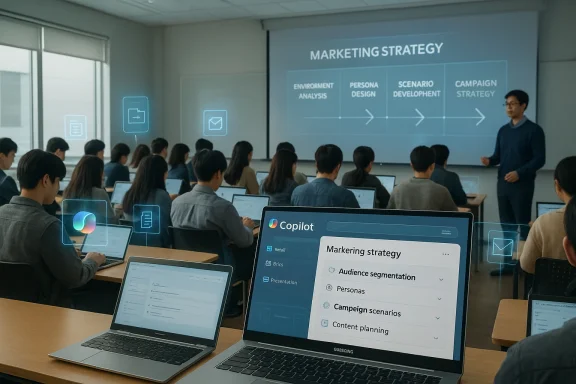
Microsoft Korea’s new capstone project with Sookmyung Women’s University and Samsung Electronics is a small announcement with a much larger meaning: Copilot is moving deeper into the classroom, the PC ecosystem, and the corporate workflow at the same time. The program will have 50 business administration students using Microsoft Copilot and the Copilot+ PC experience inside Windows to build marketing strategy work around Samsung laptops and Microsoft 365 Copilot, while Microsoft says it will study how generative AI changes academic habits and productivity. The fact that the final outputs may feed into Samsung’s actual business tasks makes this more than a symbolic university partnership; it is a real-world test of AI-assisted work, talent development, and ecosystem positioning all at once.
Microsoft has spent the past several years trying to reposition Copilot from a feature name into a full productivity platform. That effort now spans consumer PCs, enterprise subscriptions, browser experiences, education programs, and partner-led integrations, with the company repeatedly emphasizing that AI should not just assist work but reshape how people plan, draft, analyze, and collaborate. In that context, a Korean university capstone is not a side story; it is part of Microsoft’s broader attempt to normalize AI fluency as a baseline skill in business education and in the future workplace.
The Sookmyung project is especially interesting because it binds together three constituencies with distinct incentives. Microsoft gets a living laboratory for measuring how students use Copilot in a structured business setting. Samsung gets a practical marketing research exercise tied to its laptop business. The university gets an industry-facing course that can be framed as employability training in the AI era. Each side can claim value, but each also inherits new questions about dependency on vendor platforms, pedagogy, and outcomes that are difficult to quantify.
This is also happening in a market where education and enterprise AI are no longer separate lanes. Universities increasingly face pressure to teach AI usage as a job skill rather than treat it as an academic curiosity, while employers increasingly expect graduates to understand how tools like Copilot fit into marketing, operations, analysis, and communications. In that sense, the Korean capstone looks less like a one-off project and more like a prototype for how Microsoft wants AI adoption to spread through institutions: through courses, certificates, partner tasks, and measurable productivity workflows.
A final detail matters: the project is framed around Copilot+ PC experience integrated throughout Windows. That means the story is not just about a chatbot in a browser. It is about Microsoft making AI feel native to the device layer, the productivity layer, and the learning layer at once, which is exactly the sort of end-to-end narrative the company has been pushing across other markets and partnerships.
The program also reinforces a broader corporate message that productivity in the AI era is increasingly a function of tool adoption, not just individual talent. If students can use Copilot to identify audiences, generate scenarios, and shape campaign messaging faster, Microsoft can argue that AI literacy is no longer optional. That framing is useful in education because it links abstraction to employability in a way students can immediately understand.
It also helps Microsoft build a social proof narrative around Copilot. If students, professors, and partner companies can point to concrete outcomes, Microsoft can argue that its AI tools are not just for enterprise buyers with large IT budgets. They are part of a broader skills stack for the next generation of business workers.
By tying student deliverables to Samsung’s actual business tasks, the partnership adds a commercial feedback loop. Samsung can review the resulting customer scenarios and marketing guidance, while Microsoft gets to showcase an AI-enhanced hardware ecosystem. It is a neat alignment, but not a neutral one: the project naturally encourages students to view vendor tools as the default route to business productivity.
This design is important because it tests more than prompt-writing. It examines whether students can use AI to connect market context, customer segmentation, campaign logic, and message development into a coherent deliverable. In other words, the capstone asks whether Copilot can accelerate the kind of structured reasoning that business courses claim to teach, not just the drafting of text.
The workflow also gives Microsoft a way to compare student behavior across phases. If the project yields strong outputs in ideation but weaker outputs in validation, that tells a useful story about where AI helps and where human judgment still matters. That kind of insight matters because the AI market is now crowded with claims, and actual workflow evidence is more persuasive than generic enthusiasm.
If students rely too heavily on AI-generated structure, they may produce polished work without building enough analytical depth. If they use it well, they may learn to spend less time on routine drafting and more time on judgment, evidence, and strategy. That tension is central to any serious AI-in-education program, and it is why these capstones are as much about governance as they are about tooling.
The Windows angle also reflects a larger strategic push across Microsoft’s ecosystem: productivity, security, and AI are increasingly being packaged together. This is visible in Microsoft’s broader Copilot messaging, in enterprise rollouts, and in the company’s attempts to make Windows feel more aligned with contemporary AI workloads. In education, that matters because student familiarity with the interface can become a form of platform loyalty.
That said, device-native AI also raises expectations. If Microsoft wants Copilot to be a true productivity layer, users will expect consistency, responsiveness, and clear controls over data use. In a classroom environment, those expectations are even higher because students are learning both a subject and a software workflow at the same time. That is a tough balancing act.
There is nothing inherently wrong with that arrangement. In fact, industry-linked projects often produce stronger outcomes than abstract classroom exercises because they force students to engage with constraints, audiences, and business realities. The concern is not the partnership itself; it is whether the partnership narrows the range of tools and methods students are encouraged to consider. That distinction matters.
At the same time, students do need depth, not just broad exposure. A carefully designed Microsoft-focused project can still be valuable if it teaches transferrable skills: problem framing, prompt discipline, validation, and presentation. The outcome depends less on the brand name than on whether faculty require students to critique the AI’s output instead of simply polishing it.
That broader context matters because it explains why Microsoft keeps investing in pilots that seem small on paper. A university program may not move revenue immediately, but it can influence perception, adoption readiness, and future licensing decisions. In a platform business, those effects compound over time.
That is why these projects matter more than their modest headcounts might suggest. Fifty students is not a mass rollout, but it is enough to create advocates, feedback loops, and a proof point for regional sales teams. In that sense, the capstone is both an educational event and a go-to-market asset.
That arrangement reflects a broader business trend: companies want evidence that AI can improve throughput without sacrificing quality. Universities, meanwhile, are under pressure to demonstrate career readiness. The capstone therefore sits at the intersection of workforce development and operational experimentation.
If the students produce compelling campaign concepts quickly, Microsoft can point to a very practical productivity claim. If the outputs need heavy human correction, that still helps define the boundaries of AI assistance. Either outcome generates useful data for corporate adoption. That is the hidden value of pilot programs.
What makes this worth watching is that the experiment sits squarely inside the next phase of software competition. Vendors are no longer selling only apps; they are selling habits, workflows, and future workforce alignment. Microsoft’s Korean partnership is one more sign that Copilot is being positioned as infrastructure for how people will study, work, and make decisions.
Source: 매일경제 Microsoft Korea announced on the 30th that it will conduct an industry-academic cooperation capstone.. - MK
 Overview
Microsoft has spent the past several years trying to reposition Copilot from a feature name into a full productivity platform. That effort now spans consumer PCs, enterprise subscriptions, browser experiences, education programs, and partner-led integrations, with the company repeatedly emphasizing that AI should not just assist work but reshape how people plan, draft, analyze, and collaborate. In that context, a Korean university capstone is not a side story; it is part of Microsoft’s broader attempt to normalize AI fluency as a baseline skill in business education and in the future workplace.The Sookmyung project is especially interesting because it binds together three constituencies with distinct incentives. Microsoft gets a living laboratory for measuring how students use Copilot in a structured business setting. Samsung gets a practical marketing research exercise tied to its laptop business. The university gets an industry-facing course that can be framed as employability training in the AI era. Each side can claim value, but each also inherits new questions about dependency on vendor platforms, pedagogy, and outcomes that are difficult to quantify.
This is also happening in a market where education and enterprise AI are no longer separate lanes. Universities increasingly face pressure to teach AI usage as a job skill rather than treat it as an academic curiosity, while employers increasingly expect graduates to understand how tools like Copilot fit into marketing, operations, analysis, and communications. In that sense, the Korean capstone looks less like a one-off project and more like a prototype for how Microsoft wants AI adoption to spread through institutions: through courses, certificates, partner tasks, and measurable productivity workflows.
A final detail matters: the project is framed around Copilot+ PC experience integrated throughout Windows. That means the story is not just about a chatbot in a browser. It is about Microsoft making AI feel native to the device layer, the productivity layer, and the learning layer at once, which is exactly the sort of end-to-end narrative the company has been pushing across other markets and partnerships.
Why This Partnership Matters
At first glance, the project looks like a standard industry-academic collaboration: students work on a business problem, a vendor supplies tools, and a sponsor benefits from fresh ideas. But the Microsoft Korea model is more ambitious because it directly links student output to commercial relevance. That turns the capstone into a pilot for how GenAI may influence not only learning but also entry-level work product in marketing, research, and campaign planning.The program also reinforces a broader corporate message that productivity in the AI era is increasingly a function of tool adoption, not just individual talent. If students can use Copilot to identify audiences, generate scenarios, and shape campaign messaging faster, Microsoft can argue that AI literacy is no longer optional. That framing is useful in education because it links abstraction to employability in a way students can immediately understand.
The strategic angle for Microsoft
For Microsoft, the payoff is not limited to goodwill. A capstone like this creates a controlled setting for observing how non-technical users respond to AI assistance, where they struggle, and which workflows benefit most. Those observations are valuable for product messaging, training design, and future campus partnerships.It also helps Microsoft build a social proof narrative around Copilot. If students, professors, and partner companies can point to concrete outcomes, Microsoft can argue that its AI tools are not just for enterprise buyers with large IT budgets. They are part of a broader skills stack for the next generation of business workers.
- Microsoft gains a real-world classroom use case.
- The company can study usage patterns among younger users.
- The partnership supports Copilot’s credibility in education.
- It strengthens the link between Windows devices and AI workflows.
- It creates content and case-study material for future marketing.
Why Samsung is in the mix
Samsung’s role is equally important. The project centers on marketing awareness for Samsung Electronics laptops, which means the capstone is not just about Microsoft’s software message; it is also a device-and-platform story. That matters because Samsung remains one of the most visible Windows hardware partners globally, and AI PC messaging only works if the hardware vendor can make the benefits tangible.By tying student deliverables to Samsung’s actual business tasks, the partnership adds a commercial feedback loop. Samsung can review the resulting customer scenarios and marketing guidance, while Microsoft gets to showcase an AI-enhanced hardware ecosystem. It is a neat alignment, but not a neutral one: the project naturally encourages students to view vendor tools as the default route to business productivity.
What Students Will Actually Do
The most revealing part of the announcement is the structure of the course itself. Students will move through four stages: environment analysis, target customization and persona design, scenario development using Copilot, and finally marketing campaign and content strategy proposals. That is a classic business-school sequence, but the use of Copilot shifts the center of gravity from manual research toward AI-assisted synthesis and iteration.This design is important because it tests more than prompt-writing. It examines whether students can use AI to connect market context, customer segmentation, campaign logic, and message development into a coherent deliverable. In other words, the capstone asks whether Copilot can accelerate the kind of structured reasoning that business courses claim to teach, not just the drafting of text.
The four-stage workflow
The project’s stages reveal Microsoft’s preferred AI narrative: AI as a research assistant, a persona-builder, a scenario engine, and a creative copilot. That is a more ambitious framing than “write an email faster,” because it suggests that generative AI belongs in the middle of strategic work.The workflow also gives Microsoft a way to compare student behavior across phases. If the project yields strong outputs in ideation but weaker outputs in validation, that tells a useful story about where AI helps and where human judgment still matters. That kind of insight matters because the AI market is now crowded with claims, and actual workflow evidence is more persuasive than generic enthusiasm.
- Students will analyze the market environment.
- They will define target segments and personas.
- They will use Copilot to generate campaign scenarios.
- They will propose content strategy and marketing ideas.
- The program concludes with a final presentation and certificate ceremony.
Why this is an educational experiment
The course is, in effect, a live test of whether AI changes how students learn to think. Microsoft says it wants to discover insights into how Copilot changes academic style and productivity, which is a notable phrasing because it implies a shift in learning process, not just output quality. That is where the real debate begins.If students rely too heavily on AI-generated structure, they may produce polished work without building enough analytical depth. If they use it well, they may learn to spend less time on routine drafting and more time on judgment, evidence, and strategy. That tension is central to any serious AI-in-education program, and it is why these capstones are as much about governance as they are about tooling.
Copilot, Copilot+ PC, and the Windows Layer
Microsoft’s emphasis on the Copilot+ PC experience integrated throughout Windows is not a cosmetic detail. It signals the company’s belief that AI should become a device-native layer, not just a cloud service. That matters because users who experience AI as part of the operating system may adopt it more naturally than those who must switch context into a separate app.The Windows angle also reflects a larger strategic push across Microsoft’s ecosystem: productivity, security, and AI are increasingly being packaged together. This is visible in Microsoft’s broader Copilot messaging, in enterprise rollouts, and in the company’s attempts to make Windows feel more aligned with contemporary AI workloads. In education, that matters because student familiarity with the interface can become a form of platform loyalty.
Device familiarity as adoption strategy
One of the most effective ways to drive software adoption is to remove friction. By making Copilot feel embedded in the Windows environment, Microsoft lowers the conceptual barrier for students who may already spend hours on Windows PCs. The result is a smoother onboarding path than a purely browser-based AI tool might offer.That said, device-native AI also raises expectations. If Microsoft wants Copilot to be a true productivity layer, users will expect consistency, responsiveness, and clear controls over data use. In a classroom environment, those expectations are even higher because students are learning both a subject and a software workflow at the same time. That is a tough balancing act.
Consumer and enterprise implications
For consumers, AI-integrated Windows experiences can make everyday computing feel more capable and more modern. For enterprises, however, the story is more complicated because productivity gains must be measured against cost, governance, and policy controls. The education capstone sits in the middle of those worlds and gives Microsoft a bridge narrative: train students now, convert them into users later.- Native integration lowers the barrier to trial.
- It makes Copilot feel like part of the PC rather than a separate service.
- It reinforces Microsoft’s Windows hardware ecosystem.
- It creates continuity between campus skills and workplace tools.
- It also increases the need for governance and usage guidance.
Academic Productivity or Vendor Influence?
The central question in this story is whether the capstone is primarily an educational innovation or a sophisticated vendor strategy. The answer is probably both. Universities increasingly need partnerships that offer students tangible experience, while tech companies increasingly need proof that their AI tools matter outside demo videos and conference stages.There is nothing inherently wrong with that arrangement. In fact, industry-linked projects often produce stronger outcomes than abstract classroom exercises because they force students to engage with constraints, audiences, and business realities. The concern is not the partnership itself; it is whether the partnership narrows the range of tools and methods students are encouraged to consider. That distinction matters.
The risk of tool monoculture
When a curriculum is closely tied to one vendor’s stack, students may internalize that stack as the default answer to every workflow problem. That can be efficient, but it can also reduce exposure to alternative platforms, methods, and trade-offs. In a fast-moving AI market, that is a real concern because the “best” tool today may not be the most relevant one a year from now.At the same time, students do need depth, not just broad exposure. A carefully designed Microsoft-focused project can still be valuable if it teaches transferrable skills: problem framing, prompt discipline, validation, and presentation. The outcome depends less on the brand name than on whether faculty require students to critique the AI’s output instead of simply polishing it.
What Microsoft likely wants to prove
Microsoft likely wants to prove that Copilot helps students think and work faster without replacing judgment. That is a crucial message because Copilot has often been discussed in terms of drafting convenience, while the company wants it seen as a genuine business assistant. Capstone work gives Microsoft a chance to show that AI can meaningfully support analysis, planning, and narrative building.- The project can demonstrate practical AI literacy.
- It can produce case studies for future education deals.
- It can strengthen Microsoft’s claims about productivity gains.
- It can help the company refine campus-facing messaging.
- It can also reveal where human oversight remains essential.
How This Fits Microsoft’s Wider Copilot Push
This Korean capstone should be read alongside Microsoft’s broader pattern of embedding Copilot into more environments and more roles. The company has been pushing Copilot deeper into enterprise workflows, device ecosystems, and institutional settings, suggesting a long-term strategy that treats AI as a platform, not a standalone feature. Recent forum coverage of Microsoft’s enterprise moves shows a similar pattern: Copilot is increasingly framed as something that completes work, orchestrates processes, or shapes the shape of knowledge work itself.That broader context matters because it explains why Microsoft keeps investing in pilots that seem small on paper. A university program may not move revenue immediately, but it can influence perception, adoption readiness, and future licensing decisions. In a platform business, those effects compound over time.
Education as a funnel
Education has always been a strategic battleground for software vendors because it shapes default habits early. If students learn to work inside Microsoft 365, Windows, and Copilot while studying business, they are more likely to bring those habits into internships and jobs. The value of the capstone therefore lies partly in habit formation.That is why these projects matter more than their modest headcounts might suggest. Fifty students is not a mass rollout, but it is enough to create advocates, feedback loops, and a proof point for regional sales teams. In that sense, the capstone is both an educational event and a go-to-market asset.
The public narrative Microsoft wants
Microsoft wants Copilot to be seen as a system-level capability that improves work across contexts. The student capstone reinforces that story by placing Copilot inside a business-school workflow, not merely in a coding lab or IT workshop. That makes the story more relatable to a wider audience.- Copilot is being positioned as an everyday productivity layer.
- Microsoft wants AI competence to feel mainstream, not elite.
- Partnerships help move the product from demo to habit.
- Education programs extend the funnel into the future workforce.
- Regional pilots can become global reference points.
The Enterprise Case Behind the Classroom
Even though the project is academic, it has an unmistakable enterprise logic. The final deliverables are not essays; they are customer scenarios and marketing guidelines that may connect to Samsung’s real business work. That makes the capstone resemble a consulting engagement, except the consultants are students and the toolset is AI-enhanced.That arrangement reflects a broader business trend: companies want evidence that AI can improve throughput without sacrificing quality. Universities, meanwhile, are under pressure to demonstrate career readiness. The capstone therefore sits at the intersection of workforce development and operational experimentation.
Why marketers will watch this closely
Marketing is one of the areas where GenAI is easiest to demonstrate and hardest to govern. It benefits from rapid ideation, audience segmentation, and content drafting, but it also depends on brand judgment, differentiation, and market understanding. That makes it an ideal test case for Copilot’s strengths and weaknesses.If the students produce compelling campaign concepts quickly, Microsoft can point to a very practical productivity claim. If the outputs need heavy human correction, that still helps define the boundaries of AI assistance. Either outcome generates useful data for corporate adoption. That is the hidden value of pilot programs.
The long tail for employers
The more interesting long-term effect may be on hiring. Employers increasingly care less about whether a graduate has merely heard of AI and more about whether they can use it responsibly in a business context. A capstone certificate, especially one tied to real company tasks, can become a signal that students understand how AI tools fit into professional work.- Employers may view AI coursework as a practical differentiator.
- Students gain a portfolio piece with real-world relevance.
- Microsoft gains indirect validation of its training narrative.
- Universities can market themselves as industry-connected.
- Capstone models may spread to other business programs.
Strengths and Opportunities
This initiative has several clear strengths. It aligns vendor, university, and corporate interests; it gives students a concrete applied project; and it produces measurable outputs instead of vague “AI awareness.” It also comes at a moment when AI literacy is rapidly becoming a workplace expectation, making the project timely as well as strategic.- Builds practical AI skills in a business context.
- Creates a bridge between campus learning and corporate work.
- Strengthens Microsoft’s Copilot education narrative.
- Gives Samsung a low-cost source of fresh campaign ideas.
- Helps students build portfolio-ready material.
- Encourages faculty to teach AI with real constraints.
- Reinforces Windows and Microsoft 365 ecosystem familiarity.
Risks and Concerns
The same features that make the project attractive also create risk. When a classroom uses a specific vendor’s tools too heavily, there is always a danger of platform lock-in, over-automation, or superficial learning. There is also the broader issue of whether students are learning to think strategically or merely to produce polished AI-assisted outputs faster.- Tool dependence may narrow exposure to alternatives.
- Students may over-trust AI-generated marketing suggestions.
- Faculty may struggle to assess original thinking versus AI output.
- Data handling and prompt governance may become ambiguous.
- Vendor sponsorship can blur educational neutrality.
- Productivity gains may be overstated without careful evaluation.
- Business relevance can pressure students toward conformity rather than critique.
Looking Ahead
The real test of this capstone will not be the launch announcement but the quality of the final presentations on June 12 and the lessons Microsoft says it learns from the process. If the students can demonstrate sharper reasoning, stronger campaign logic, and more disciplined use of Copilot, the project will become a useful model for other universities. If it produces attractive but thin work, the story will shift toward the limits of AI-assisted business education.What makes this worth watching is that the experiment sits squarely inside the next phase of software competition. Vendors are no longer selling only apps; they are selling habits, workflows, and future workforce alignment. Microsoft’s Korean partnership is one more sign that Copilot is being positioned as infrastructure for how people will study, work, and make decisions.
- The final presentation will reveal how well Copilot supports business reasoning.
- Samsung’s reaction will show whether AI-generated insights are commercially useful.
- Microsoft will likely use the project as a regional reference case.
- Universities may copy the model if the outcomes look strong.
- The broader debate over AI in education will remain focused on governance and originality.
Source: 매일경제 Microsoft Korea announced on the 30th that it will conduct an industry-academic cooperation capstone.. - MK
Last edited:
