

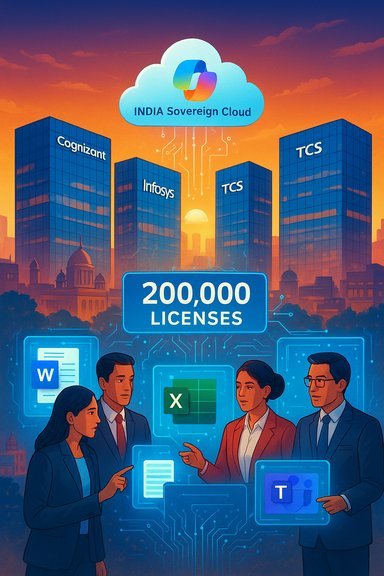
Microsoft’s latest push into the Indian market has taken a major step: four of the country’s largest IT services firms — Cognizant, Infosys, Tata Consultancy Services (TCS) and Wipro — will each deploy more than 50,000 Microsoft Copilot licenses, collectively exceeding 200,000 seats and signaling one of the largest single-enterprise Copilot rollouts to date. The pact, announced alongside a separate multi‑billion-dollar Microsoft investment in Indian cloud and AI infrastructure, frames Microsoft 365 Copilot not just as a productivity tool but as a strategic fulcrum for large-scale digital transformation across services, delivery, and enterprise operations.
Yet the promise comes with significant responsibility. Enterprises must pair technical deployments with rigorous governance, strong data and security controls, transparent auditing, and thoughtful change management. Skilling, phased rollouts, and a focus on verifiable, high-value use cases will determine whether measured productivity gains translate into sustained business value.
Ultimately, this pact is more than a licensing milestone; it’s a blueprint for how large enterprises will operationalize AI at scale — and a reminder that winning the AI era requires more than models and compute. It requires disciplined engineering, ethical guardrails, and pragmatic business design that together turn Copilot from a promise into everyday, dependable productivity.
Source: Free Press Journal Microsoft, Cognizant, Infosys, TCS And Wipro Sign Mega AI Pact To Deploy Over 2 Lakh Copilot Licenses Across India
 Background
Why this matters now
Enterprise adoption of AI moved beyond pilots and point solutions long ago; what we’re seeing now is industrial-scale deployment. The agreement to provision over 200,000 Copilot seats across four major services firms crystallizes a broader industry shift: AI is being embedded into core workflows, not treated as an experimental add‑on. At the same time, Microsoft’s large capital commitment to India’s cloud and AI infrastructure underpins these deployments with capacity, sovereign-ready services, and skilling programs — all essential to run AI at scale.What Microsoft 365 Copilot is, in practice
Microsoft 365 Copilot is a suite of AI capabilities layered into the Microsoft 365 productivity stack and powered by Microsoft’s cloud, models, and integration framework. It combines large language models (LLMs), organizational data connectors, and workspace integrations that let the AI summarize, draft, analyze, and automate tasks across Word, Excel, PowerPoint, Teams, Outlook, and other core tools.- It augments knowledge work by generating first drafts, creating data narratives, and producing meeting summaries.
- It integrates with organizational data (subject to governance) to provide contextual answers and recommendations.
- It’s delivered as a licensed capability tied to Microsoft 365 subscriptions and enterprise deployment models.
The deal: what was announced
The headline numbers
- Four companies — Cognizant, Infosys, TCS and Wipro — will each deploy more than 50,000 Microsoft Copilot licenses.
- The combined deployment therefore surpasses 200,000 licenses, making this one of the largest single coordinated Copilot rollouts.
- The announcements were made in the context of a substantial Microsoft investment in India’s cloud and AI infrastructure, aimed at bolstering capacity, skills, and sovereign-ready cloud options.
Corporate positioning
Each services firm framed the move as a vote of confidence in agentic AI and Microsoft’s stack. Executives described Copilot as a catalyst for shifting from manual, repetitive tasks to human+AI workflows. They emphasized three recurring themes:- Scale — deploying Copilot across tens of thousands of employees.
- Skilling — equipping employees to work with AI and adapt processes.
- Commercial impact — using agentic AI to generate new client services and internal efficiency gains.
Technical and infrastructure implications
Capacity and latency: why local cloud footprint matters
Large-scale LLM usage is compute- and bandwidth-intensive. A deployment that supports hundreds of thousands of active users requires:- Hyperscale compute (GPU-backed clusters) to run models and serve requests with acceptable latency.
- Regional datacenters to reduce round-trip times for user interactions and to meet latency-sensitive workloads.
- Robust networking and storage for model weights, telemetry, and enterprise data connectors.
Integration with enterprise systems
Copilot’s value increases when it can safely access organizational data: CRM, ERP, document repositories, and knowledge bases. That requires:- Secure connectors and identity integration (e.g., single sign-on, conditional access).
- Data classification and access controls to prevent unauthorized exposure of sensitive information.
- Logging, auditing, and observability to track usage, decisions, and potential errors.
Operationalization of models and agentic AI
The deal specifically references agentic AI — systems designed to take initiative, orchestrate multi-step tasks, or act as autonomous agents within defined boundaries. Operationalizing such capabilities at scale raises engineering needs that go beyond simple Copilot integrations:- Orchestration layers that coordinate multi-step workflows.
- Safety filters that intercept or validate agent actions.
- Human-in-the-loop controls where agents propose actions that require human approval.
- Monitoring frameworks to detect drift, abuse, or performance degradation.
Strategic business impact
For the IT services firms
Deploying Copilot at scale positions these IT firms to:- Embed AI into client service delivery, potentially increasing billable outcomes and delivery velocity.
- Offer packaged Copilot-based solutions (industry-specific Copilots, domain agents, or managed Copilot services).
- Upskill their workforce to sell, implement, and customize AI services for customers globally.
For enterprise buyers
Enterprises standing behind these services firms will likely see near-term benefits:- Faster creation of proposals, code, and analysis.
- Higher baseline productivity for knowledge workers.
- Standardized AI-assisted processes that can be scaled across geographies.
Market and competitive effects
A mass Copilot deployment by the largest Indian IT firms effectively creates a force multiplier for Microsoft’s ecosystem. It strengthens Microsoft’s position in enterprise AI and makes competing productivity stacks harder to displace. For rivals, the move raises the bar on integration, scale, and partner-enabled offerings.Risks, governance, and open questions
Data privacy and sovereignty
Large-scale Copilot use inevitably processes corporate and sometimes personal data. Key concerns include:- Ensuring data residency and compliance with local regulations when AI services traverse borders.
- Controlling data leakage where model outputs could inadvertently reveal proprietary information or personally identifiable information (PII).
- Implementing consent and access controls for third-party data and client-owned repositories.
Model accuracy and hallucinations
LLMs can produce convincing but incorrect outputs — a phenomenon known as hallucination. At scale, hallucinations can multiply the cost of remediation or lead to risky business decisions.- Organizations must implement output validation, especially in regulated domains like finance, healthcare, or legal services.
- Human verification workflows and provenance tracking will be essential to maintain trust.
Security and attack vectors
Agentic AI introduces new attack surfaces:- Prompt injection or data poisoning could cause agents to act on malicious inputs.
- Compromised credentials could grant attackers a powerful agent inside an environment.
- Over-permissive connectors could expose sensitive systems to AI-generated actions.
Economic and workforce implications
Large Copilot deployments will reshape work patterns. Potential impacts include:- Rapid productivity gains for knowledge workers who adopt the tools effectively.
- A need to retrain or reassess roles focused on repetitive knowledge tasks.
- Ambiguity around billing and project scoping in a services model that previously measured hours — new pricing models may be required to capture AI-enabled productivity.
Implementation challenges and best practices
Phased rollouts and pilot-to-scale pathways
Large-scale deployments should follow staged approaches:- Pilot: Validate use cases with small cross-functional teams and measure outcomes.
- Integrate: Build secure data connectors and role-based access controls.
- Scale: Expand to broader employee groups with monitoring and SLAs.
- Optimize: Iterate on prompts, fine-tune connectors, and formalize governance.
Governance frameworks that work
A pragmatic governance model for Copilot should include:- Clear ownership for model decisions and human overrides.
- Data stewardship roles to manage connectors and classification.
- Usage policies for sensitive domains and escalation paths for incidents.
- Regular audits of outputs, usage patterns, and cost telemetry.
Skilling and change management
Training employees is not optional. Effective programs include:- Role-based AI literacy training: practical sessions showing how to use Copilot in daily tasks.
- Managerial training on setting expectations and measuring AI-driven outcomes.
- Continuous learning loops that capture feedback and tune integrations.
Regulatory and compliance landscape
Local regulations and global standards
Enterprises operating across borders must reconcile local data protection laws with the global nature of cloud services. Key regulatory vectors include:- Data localization mandates or sectoral restrictions.
- Emerging AI-specific regulation demanding transparency, risk assessments, and human oversight.
- Contractual obligations for client confidentiality and auditability.
Auditable trails and explainability
For regulated sectors, the ability to audit decisions, capture provenance, and provide explainable reasoning is essential. This means logging prompts, model versions, and data sources tied to outputs — not just storing final artifacts.What the pact means for the future of services-led AI
From augmentation to composable productization
Large-scale Copilot adoption signals a move from bespoke, human-dependent services to composable AI products. Expect to see:- Pre-built domain agents for industry verticals (finance reconciliation agents, HR onboarding copilots).
- Managed Copilot-as-a-Service offerings with SLAs and performance guarantees.
- Productized knowledge-layer services that bundle AI, data connectors, and governance.
Competitive differentiation will hinge on domain depth
With Copilot commoditized as a platform capability, differentiation will increasingly come from:- Proprietary domain data and curated knowledge graphs.
- Custom prompts, fine-tuned models, and integration depth.
- Sector-specific compliance and audit capabilities.
Practical advice for enterprise leaders
Do these deployments change procurement decisions?
Yes — procurement must evolve. Consider:- Contractual clarity on data residency, model use, and liability.
- Explicit SLAs and performance metrics for AI services.
- Review of cost models to account for heavy model usage and storage.
Start with high-value, low-risk use cases
Early deployments should favor scenarios where:- Outputs can be validated quickly.
- Errors are low-impact and reversible.
- Productivity gains are measurable.
Invest in monitoring and observability
Operational metrics to track include:- Response time and throughput of Copilot requests.
- Frequency and type of human overrides.
- Cost per active user and per transaction.
- Instances of sensitive data access or flagged content.
Broader implications for the Indian technology ecosystem
Strengthening a services-led AI economy
The intersection of large global hyperscalers and Indian services firms creates a powerful ecosystem:- Services firms gain platform leverage, scale, and new product pathways.
- Hyperscalers secure downstream enterprise demand and local adoption.
- Clients receive mature, enterprise-grade AI integrations supported by local talent.
Geopolitical and sovereignty dimensions
Mass adoption of cloud-based AI raises questions about national control of data, model provenance, and critical infrastructure. Investments in local datacenters and sovereign cloud options address part of this, but long-term sovereignty also requires policies, workforce capacity, and transparent governance — elements governments and industry must jointly steward.Conclusion
The coordinated deployment of more than 200,000 Microsoft Copilot licenses across four premier IT services firms marks a pivotal moment in enterprise AI adoption. It signals a transition from pilot projects to production-grade, organization-wide AI — powered by local cloud capacity, broad skilling efforts, and a new class of agentic capabilities. The potential benefits are substantial: faster delivery, higher productivity, and new AI-enabled offerings that change how knowledge work is performed.Yet the promise comes with significant responsibility. Enterprises must pair technical deployments with rigorous governance, strong data and security controls, transparent auditing, and thoughtful change management. Skilling, phased rollouts, and a focus on verifiable, high-value use cases will determine whether measured productivity gains translate into sustained business value.
Ultimately, this pact is more than a licensing milestone; it’s a blueprint for how large enterprises will operationalize AI at scale — and a reminder that winning the AI era requires more than models and compute. It requires disciplined engineering, ethical guardrails, and pragmatic business design that together turn Copilot from a promise into everyday, dependable productivity.
Source: Free Press Journal Microsoft, Cognizant, Infosys, TCS And Wipro Sign Mega AI Pact To Deploy Over 2 Lakh Copilot Licenses Across India
