

Microsoft faces investor concerns in 2026 because Microsoft 365 Copilot, despite being embedded in the company’s dominant productivity suite, reportedly has fewer than 5 percent of Microsoft 365 customers paying for it while rivals such as Anthropic, Cursor, and Claude Code gain momentum. The worry is not that Microsoft missed AI; it is that Microsoft may have mistaken distribution for inevitability. Copilot was supposed to turn Office into the command center of enterprise AI, but the market is now asking whether the command center is being built by somebody else. For Windows users and IT departments, that question lands directly in the software stack they already manage every day.
Microsoft has spent the past two years making Copilot impossible to miss. It is in Windows, in Edge, in Teams, in Outlook, in Word, in Excel, in GitHub, and across the Azure story that Wall Street has rewarded so richly. If brand exposure were adoption, Copilot would already be one of the most successful enterprise products in software history.
But paid adoption is a harder metric than awareness, and that is where the anxiety begins. A sub-5 percent attach rate across a Microsoft 365 base measured in the hundreds of millions is not a failure in absolute terms; tens of millions of paid users would be a major business for almost any company. For Microsoft, however, the benchmark is different because Copilot has been presented as the next growth layer on top of Office, not merely another add-on.
That distinction matters. Microsoft 365 is one of the most entrenched products in enterprise computing because it is not just software; it is workflow, identity, compliance, storage, calendaring, messaging, records management, and administrative policy all braided together. When Microsoft sells into that base, it normally does so from a position of structural advantage.
Copilot tests whether that advantage still works in the agentic AI era. If a product sitting inside Word, Excel, Outlook, and Teams cannot quickly persuade more than a small fraction of customers to pay extra, investors are right to ask whether the problem is price, capability, packaging, or trust. The uncomfortable possibility is that it may be all four.
For Microsoft, that story was AI leverage. The bull case was elegant: Microsoft invested early in frontier AI, brought those capabilities to Azure, surfaced them inside Microsoft 365, and monetized them through premium subscriptions at enterprise scale. Copilot was not just a product in that narrative. It was the proof that AI spending could become recurring software revenue.
That is why slowing Azure growth and weak Copilot conversion belong in the same investor conversation. Azure’s AI infrastructure spending only looks clean if customers are turning compute into valuable software experiences. Microsoft can rent GPUs, host models, and sell cloud services regardless, but the premium valuation depends on AI becoming a durable expansion engine across the Microsoft stack.
A low Copilot attach rate complicates that story. It suggests that the company has not yet converted AI enthusiasm into a broad willingness to pay among Microsoft 365 customers. In enterprise software, “pilots everywhere” and “budget committed” are very different milestones.
The threat is not merely that Anthropic has a better chatbot. The threat is that the user interface to office work could move above Microsoft’s applications. In that world, Word and Excel remain important file formats and execution surfaces, but the user’s loyalty shifts to the agent that plans, edits, sends, summarizes, reconciles, and follows up.
That is the nightmare scenario for any incumbent software company. The old moat was the application. The new moat may be the agent that knows how to use every application.
Microsoft understands this, which is why its March 2026 move to bring Anthropic technology into Microsoft 365 Copilot was both sensible and revealing. The company framed the shift as a multi-model advantage, and technically that is plausible. Enterprises do not necessarily care whether a workflow is powered by OpenAI, Anthropic, Microsoft’s own models, or a blend of them, as long as governance, reliability, cost, and output quality meet the bar.
But the optics are harder. Microsoft spent years telling customers that Copilot was the AI layer for work. Then, when a rival demonstrated stronger agentic behavior, Microsoft moved to incorporate that rival’s technology. That is not defeat; platform companies do this constantly. It is, however, an admission that the Copilot brand and Microsoft distribution alone are not enough.
The issue is that the original Copilot pitch was simpler and more powerful. Microsoft had the productivity suite, the enterprise graph, the cloud infrastructure, the security model, and privileged access to OpenAI’s technology. Put together, that should have produced a product competitors could not easily match.
The rise of Claude Cowork and other agentic tools complicates that advantage because agents do not need to own the underlying application to create user value. They need permission, context, reasoning, and the ability to take action. Once those capabilities exist through APIs, connectors, browser control, virtual desktops, or sanctioned integrations, the application owner has less control over the experience than it used to.
This is where Windows administrators should pay attention. The same story that played out with browsers and search may now play out with productivity agents. The operating system and application suite still matter, but user behavior can be captured at a higher layer.
Microsoft’s best response is not to insist that Copilot is always the front door. It is to make Copilot the safest, most governable, most deeply integrated way to let multiple AI systems act inside enterprise data. That is a less glamorous story than “we own the AI assistant for work,” but it may be the more durable one.
The difficulty is that Copilot’s value is uneven. A consultant who lives in Teams meetings, PowerPoint decks, and inbox triage may get obvious benefit. A finance analyst may see value if Excel workflows become more reliable. A frontline manager with narrow application needs may not. A legal or compliance department may demand rigorous controls before allowing sensitive data into generative workflows.
That unevenness makes seat-based pricing awkward. Traditional Microsoft 365 licensing works because Office is a baseline utility. AI assistance is closer to a productivity option whose value depends on role, workflow, data readiness, prompt literacy, and organizational trust.
The measurement problem then becomes circular. Companies do not want to pay broadly until they see measurable productivity gains, but they often cannot measure those gains without deploying broadly enough to change workflows. A few enthusiastic users can produce impressive anecdotes. Procurement committees need repeatable evidence.
This is one reason agentic competitors are dangerous. If a rival tool can complete a concrete workflow — reconcile a spreadsheet, draft a follow-up sequence, update a CRM record, compare contract language, prepare a board packet — its value is easier to see. The more AI moves from “assistant that helps you think” to “agent that completes work,” the easier it becomes to attach budget to outcomes rather than seats.
Cursor and Claude Code have become symbols of that faster adoption curve. Their appeal is not merely code completion. They point toward a different model of software development in which the AI system understands a repository, edits across files, runs tests, reasons through errors, and behaves less like autocomplete than a junior collaborator with command-line access.
GitHub Copilot was early and influential, and it deserves credit for normalizing AI coding assistance at scale. But being first in a market that changes every few months is not the same as staying ahead. Developer loyalty follows performance, not procurement inertia.
This matters for Microsoft because developers are taste-makers inside enterprise technology. The tools they adopt often become the assumptions that shape future buying decisions. If the developer community concludes that the best AI work happens outside Microsoft’s branded Copilot family, that perception can leak into broader enterprise confidence.
There is also a deeper platform risk. GitHub is not just a developer product; it is a strategic bridge between Microsoft’s cloud, open-source communities, enterprise DevOps, and AI-assisted software creation. If GitHub Copilot loses mindshare to faster-moving tools, Microsoft risks weakening one of the most important channels through which it turns developer behavior into cloud demand.
That does not mean SaaS disappears. Enterprise software is full of permissions, audit trails, data models, integrations, compliance requirements, and business rules that cannot be replaced by a clever chat window. The graveyard of “this will kill enterprise software” predictions is large.
Still, agents change the unit of value. If an employee once needed five applications to complete a workflow, and an agent can coordinate the same work across systems, the human relationship to software changes. The app becomes infrastructure. The agent becomes the interface. The vendor that owns the interface captures the user’s attention and, eventually, the budget conversation.
This is why Microsoft is both threatened and advantaged. It owns many of the systems of record where work happens, but it also depends on users continuing to value those systems directly. If agents reduce the visible importance of individual applications, Microsoft must ensure it owns enough of the orchestration layer to avoid being abstracted.
Windows itself has lived through versions of this story. The PC did not stop mattering when the browser rose, but the browser changed where value accumulated. Mobile did not kill Windows in the enterprise, but it changed what users expected from devices and apps. AI agents may become another abstraction layer, and Microsoft cannot afford to be merely the place where somebody else’s agent runs.
Those questions favor Microsoft. The company has spent decades building the administrative machinery that enterprises rely on: identity, conditional access, compliance tooling, endpoint management, eDiscovery, audit logs, data-loss prevention, and tenant-level policy. A rival may build a better agentic experience, but it still has to satisfy the boring requirements that decide enterprise deployment.
This is the strongest version of the Copilot defense. Microsoft does not need to have the flashiest agent on every benchmark if it can offer the most governable agent inside the environment companies already trust. In regulated industries, “good enough and auditable” often beats “brilliant and hard to control.”
But that defense has limits. Enterprise trust buys time; it does not excuse mediocrity forever. If users believe external agents are materially more capable, they will pressure IT to approve them. Shadow AI is already the new shadow IT, and Microsoft’s administrative comfort will not prevent employees from seeking better tools when official ones disappoint.
The winning enterprise AI product will need both things: consumer-grade capability and enterprise-grade control. Microsoft has historically been better at the second than the first. Copilot’s challenge is to prove it can deliver both at the speed the market now expects.
That distinction matters because agents are not passive search boxes. They can read, summarize, draft, classify, move, send, schedule, and potentially modify business records. Once an agent has those capabilities, the security model becomes as important as the model quality.
Administrators will need to think about AI agents the way they think about privileged users and automation scripts. What data can the agent see? What actions can it take without approval? Can it cross tenant boundaries? Does it inherit user permissions too broadly? Are prompts and outputs retained? Can administrators investigate what happened after the fact?
Microsoft has an advantage because those questions map naturally onto its existing governance stack. But the company must make the controls legible and usable. If Copilot administration becomes another maze of licenses, portals, policy names, and half-overlapping dashboards, IT departments will not thank Microsoft for adding intelligence to the confusion.
The Windows endpoint also remains part of the story. Agentic workflows that span local files, cloud documents, browsers, and collaboration apps will create new support burdens. Help desks will be asked why an agent produced the wrong version of a file, why a policy blocked an action, why a plugin disappeared, or why one user gets a feature another user cannot see. AI does not eliminate IT complexity; it redistributes it.
The company’s path forward is visible. It needs to make Copilot more agentic, more measurable, more role-specific, and more transparent. It needs to let customers understand when a model is being used, why it was chosen, what data it touched, and what business outcome it produced. It needs to reduce the gap between a dazzling keynote and the daily experience of a skeptical employee.
The Anthropic integration may help. If Claude-powered capabilities make Copilot better at long-running work, Microsoft can credibly argue that customers should not care which model sits underneath a managed enterprise experience. That is a classic platform move: absorb the best components, normalize them inside the Microsoft control plane, and sell the whole package as safer than the open market.
But Microsoft must avoid turning “multi-model” into a euphemism for catch-up. Customers will not pay premium prices for a routing layer unless the result is meaningfully better. Investors will not reward AI capex forever without signs that those investments translate into higher software revenue, stronger retention, or defensible new usage.
This is the central tension of Copilot in 2026. Microsoft has the distribution everyone else wants. Its rivals have the momentum Microsoft cannot simply buy with placement. The winner will be the company that converts impressive AI into trusted work completion at enterprise scale.
The next phase is about delegation. Can the system take a messy business intent and turn it into completed work across documents, calendars, spreadsheets, inboxes, databases, and approvals? Can it do so reliably enough that employees stop treating it as a clever intern and start treating it as part of the operating rhythm of the company?
Claude Cowork struck a nerve because it appeared to answer that question more directly than the first generation of Copilot experiences. Cursor and Claude Code did the same in software development by collapsing the distance between suggestion and execution. In both cases, the market rewarded tools that felt closer to doing the job.
Microsoft’s opportunity is to bring that execution layer into the places where enterprises already live. Its risk is that customers decide the best agent for Microsoft 365 is not necessarily Microsoft’s agent. That would not destroy Office, but it would weaken the AI premium Microsoft has spent years trying to build.
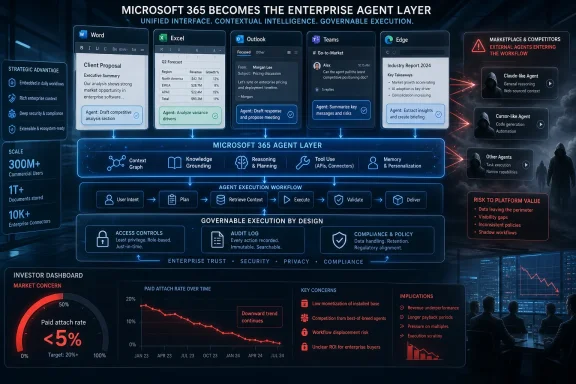 Microsoft’s AI Problem Is Not Visibility, It Is Conversion
Microsoft has spent the past two years making Copilot impossible to miss. It is in Windows, in Edge, in Teams, in Outlook, in Word, in Excel, in GitHub, and across the Azure story that Wall Street has rewarded so richly. If brand exposure were adoption, Copilot would already be one of the most successful enterprise products in software history.But paid adoption is a harder metric than awareness, and that is where the anxiety begins. A sub-5 percent attach rate across a Microsoft 365 base measured in the hundreds of millions is not a failure in absolute terms; tens of millions of paid users would be a major business for almost any company. For Microsoft, however, the benchmark is different because Copilot has been presented as the next growth layer on top of Office, not merely another add-on.
That distinction matters. Microsoft 365 is one of the most entrenched products in enterprise computing because it is not just software; it is workflow, identity, compliance, storage, calendaring, messaging, records management, and administrative policy all braided together. When Microsoft sells into that base, it normally does so from a position of structural advantage.
Copilot tests whether that advantage still works in the agentic AI era. If a product sitting inside Word, Excel, Outlook, and Teams cannot quickly persuade more than a small fraction of customers to pay extra, investors are right to ask whether the problem is price, capability, packaging, or trust. The uncomfortable possibility is that it may be all four.
The January Selloff Was a Vote on the Copilot Thesis
The reported $357 billion one-day market-cap loss in January 2026 should not be read as a referendum on Microsoft’s entire business. Microsoft remains one of the most profitable infrastructure and software companies on the planet, with a deep enterprise moat and a cloud platform embedded in global IT operations. But market panics rarely require total disbelief; they require doubt about the marginal story that justified the last leg upward.For Microsoft, that story was AI leverage. The bull case was elegant: Microsoft invested early in frontier AI, brought those capabilities to Azure, surfaced them inside Microsoft 365, and monetized them through premium subscriptions at enterprise scale. Copilot was not just a product in that narrative. It was the proof that AI spending could become recurring software revenue.
That is why slowing Azure growth and weak Copilot conversion belong in the same investor conversation. Azure’s AI infrastructure spending only looks clean if customers are turning compute into valuable software experiences. Microsoft can rent GPUs, host models, and sell cloud services regardless, but the premium valuation depends on AI becoming a durable expansion engine across the Microsoft stack.
A low Copilot attach rate complicates that story. It suggests that the company has not yet converted AI enthusiasm into a broad willingness to pay among Microsoft 365 customers. In enterprise software, “pilots everywhere” and “budget committed” are very different milestones.
Claude Cowork Made the Threat Legible
Anthropic’s Claude Cowork mattered because it gave investors a simple visual metaphor for Copilot’s risk. Here was a rival agent designed to operate inside the very applications Microsoft owns: Word, Excel, Outlook, and the broader productivity environment where Microsoft should have home-field advantage. If an outside model can manipulate the Microsoft 365 workspace more fluently than Microsoft’s own assistant, the strategic question changes.The threat is not merely that Anthropic has a better chatbot. The threat is that the user interface to office work could move above Microsoft’s applications. In that world, Word and Excel remain important file formats and execution surfaces, but the user’s loyalty shifts to the agent that plans, edits, sends, summarizes, reconciles, and follows up.
That is the nightmare scenario for any incumbent software company. The old moat was the application. The new moat may be the agent that knows how to use every application.
Microsoft understands this, which is why its March 2026 move to bring Anthropic technology into Microsoft 365 Copilot was both sensible and revealing. The company framed the shift as a multi-model advantage, and technically that is plausible. Enterprises do not necessarily care whether a workflow is powered by OpenAI, Anthropic, Microsoft’s own models, or a blend of them, as long as governance, reliability, cost, and output quality meet the bar.
But the optics are harder. Microsoft spent years telling customers that Copilot was the AI layer for work. Then, when a rival demonstrated stronger agentic behavior, Microsoft moved to incorporate that rival’s technology. That is not defeat; platform companies do this constantly. It is, however, an admission that the Copilot brand and Microsoft distribution alone are not enough.
The Multi-Model Pivot Is Smart, But It Dilutes the Original Story
Microsoft’s “multi-model” positioning may age well. In enterprise IT, model pluralism has obvious advantages: different models can be better at different tasks, customers may want redundancy, regulators may scrutinize vendor concentration, and procurement teams may prefer a brokered model over a single-model dependency. Azure and Microsoft 365 are natural places to abstract that complexity.The issue is that the original Copilot pitch was simpler and more powerful. Microsoft had the productivity suite, the enterprise graph, the cloud infrastructure, the security model, and privileged access to OpenAI’s technology. Put together, that should have produced a product competitors could not easily match.
The rise of Claude Cowork and other agentic tools complicates that advantage because agents do not need to own the underlying application to create user value. They need permission, context, reasoning, and the ability to take action. Once those capabilities exist through APIs, connectors, browser control, virtual desktops, or sanctioned integrations, the application owner has less control over the experience than it used to.
This is where Windows administrators should pay attention. The same story that played out with browsers and search may now play out with productivity agents. The operating system and application suite still matter, but user behavior can be captured at a higher layer.
Microsoft’s best response is not to insist that Copilot is always the front door. It is to make Copilot the safest, most governable, most deeply integrated way to let multiple AI systems act inside enterprise data. That is a less glamorous story than “we own the AI assistant for work,” but it may be the more durable one.
Copilot’s Pricing Problem Is Really a Value-Measurement Problem
Copilot’s adoption rate cannot be understood apart from its price. Microsoft 365 Copilot has often been sold as a premium per-user add-on, and enterprise buyers naturally ask whether every information worker needs it. In a world of constrained IT budgets and intense AI experimentation, “interesting” is not enough to justify broad deployment.The difficulty is that Copilot’s value is uneven. A consultant who lives in Teams meetings, PowerPoint decks, and inbox triage may get obvious benefit. A finance analyst may see value if Excel workflows become more reliable. A frontline manager with narrow application needs may not. A legal or compliance department may demand rigorous controls before allowing sensitive data into generative workflows.
That unevenness makes seat-based pricing awkward. Traditional Microsoft 365 licensing works because Office is a baseline utility. AI assistance is closer to a productivity option whose value depends on role, workflow, data readiness, prompt literacy, and organizational trust.
The measurement problem then becomes circular. Companies do not want to pay broadly until they see measurable productivity gains, but they often cannot measure those gains without deploying broadly enough to change workflows. A few enthusiastic users can produce impressive anecdotes. Procurement committees need repeatable evidence.
This is one reason agentic competitors are dangerous. If a rival tool can complete a concrete workflow — reconcile a spreadsheet, draft a follow-up sequence, update a CRM record, compare contract language, prepare a board packet — its value is easier to see. The more AI moves from “assistant that helps you think” to “agent that completes work,” the easier it becomes to attach budget to outcomes rather than seats.
Developer Tools Are the Early-Warning System
The pressure on GitHub Copilot may be more strategically important than the pressure on Microsoft 365 Copilot because developers are unusually fast at switching tools. Enterprises may spend quarters evaluating an Office add-on. Developers can install, test, praise, abandon, and evangelize a coding assistant in days.Cursor and Claude Code have become symbols of that faster adoption curve. Their appeal is not merely code completion. They point toward a different model of software development in which the AI system understands a repository, edits across files, runs tests, reasons through errors, and behaves less like autocomplete than a junior collaborator with command-line access.
GitHub Copilot was early and influential, and it deserves credit for normalizing AI coding assistance at scale. But being first in a market that changes every few months is not the same as staying ahead. Developer loyalty follows performance, not procurement inertia.
This matters for Microsoft because developers are taste-makers inside enterprise technology. The tools they adopt often become the assumptions that shape future buying decisions. If the developer community concludes that the best AI work happens outside Microsoft’s branded Copilot family, that perception can leak into broader enterprise confidence.
There is also a deeper platform risk. GitHub is not just a developer product; it is a strategic bridge between Microsoft’s cloud, open-source communities, enterprise DevOps, and AI-assisted software creation. If GitHub Copilot loses mindshare to faster-moving tools, Microsoft risks weakening one of the most important channels through which it turns developer behavior into cloud demand.
The SaaSpocalypse Frame Is Crude, But the Fear Is Real
“SaaSpocalypse” is an ugly word, but it captures a genuine investor fear. Software-as-a-service companies have long been valued on the assumption that digital workflows become more numerous, more specialized, and more deeply embedded over time. AI agents challenge that assumption by suggesting that users may not need to spend as much time inside specialized interfaces.That does not mean SaaS disappears. Enterprise software is full of permissions, audit trails, data models, integrations, compliance requirements, and business rules that cannot be replaced by a clever chat window. The graveyard of “this will kill enterprise software” predictions is large.
Still, agents change the unit of value. If an employee once needed five applications to complete a workflow, and an agent can coordinate the same work across systems, the human relationship to software changes. The app becomes infrastructure. The agent becomes the interface. The vendor that owns the interface captures the user’s attention and, eventually, the budget conversation.
This is why Microsoft is both threatened and advantaged. It owns many of the systems of record where work happens, but it also depends on users continuing to value those systems directly. If agents reduce the visible importance of individual applications, Microsoft must ensure it owns enough of the orchestration layer to avoid being abstracted.
Windows itself has lived through versions of this story. The PC did not stop mattering when the browser rose, but the browser changed where value accumulated. Mobile did not kill Windows in the enterprise, but it changed what users expected from devices and apps. AI agents may become another abstraction layer, and Microsoft cannot afford to be merely the place where somebody else’s agent runs.
Enterprise IT Will Not Move as Fast as Wall Street
Investors can reprice a stock in one session. Enterprise IT cannot reprice its operating model that quickly, and that gives Microsoft room to maneuver. Large organizations do not adopt autonomous agents simply because a demo looks impressive. They ask where the data goes, who approved the action, how errors are logged, how access is constrained, how retention works, and what happens when an agent sends the wrong file to the wrong person.Those questions favor Microsoft. The company has spent decades building the administrative machinery that enterprises rely on: identity, conditional access, compliance tooling, endpoint management, eDiscovery, audit logs, data-loss prevention, and tenant-level policy. A rival may build a better agentic experience, but it still has to satisfy the boring requirements that decide enterprise deployment.
This is the strongest version of the Copilot defense. Microsoft does not need to have the flashiest agent on every benchmark if it can offer the most governable agent inside the environment companies already trust. In regulated industries, “good enough and auditable” often beats “brilliant and hard to control.”
But that defense has limits. Enterprise trust buys time; it does not excuse mediocrity forever. If users believe external agents are materially more capable, they will pressure IT to approve them. Shadow AI is already the new shadow IT, and Microsoft’s administrative comfort will not prevent employees from seeking better tools when official ones disappoint.
The winning enterprise AI product will need both things: consumer-grade capability and enterprise-grade control. Microsoft has historically been better at the second than the first. Copilot’s challenge is to prove it can deliver both at the speed the market now expects.
Windows Users Are Watching the Office Layer Become an Agent Layer
For WindowsForum readers, the Copilot story is not confined to finance pages. Microsoft’s AI strategy increasingly touches the Windows desktop, Microsoft 365 apps, Edge, Teams, OneDrive, SharePoint, and the administrative controls that govern them. The question is no longer whether AI appears in the stack; it is which AI gets permission to act.That distinction matters because agents are not passive search boxes. They can read, summarize, draft, classify, move, send, schedule, and potentially modify business records. Once an agent has those capabilities, the security model becomes as important as the model quality.
Administrators will need to think about AI agents the way they think about privileged users and automation scripts. What data can the agent see? What actions can it take without approval? Can it cross tenant boundaries? Does it inherit user permissions too broadly? Are prompts and outputs retained? Can administrators investigate what happened after the fact?
Microsoft has an advantage because those questions map naturally onto its existing governance stack. But the company must make the controls legible and usable. If Copilot administration becomes another maze of licenses, portals, policy names, and half-overlapping dashboards, IT departments will not thank Microsoft for adding intelligence to the confusion.
The Windows endpoint also remains part of the story. Agentic workflows that span local files, cloud documents, browsers, and collaboration apps will create new support burdens. Help desks will be asked why an agent produced the wrong version of a file, why a policy blocked an action, why a plugin disappeared, or why one user gets a feature another user cannot see. AI does not eliminate IT complexity; it redistributes it.
Microsoft Can Still Win, But Not by Assuming the Bundle Wins
The most dangerous assumption Microsoft could make is that Copilot wins because Microsoft 365 is already there. Bundling is powerful, but it is not magic. Teams benefited from Microsoft’s distribution, but it also met a specific enterprise need at the right time and became deeply tied to Microsoft 365 identity and collaboration. Copilot has to earn that same inevitability.The company’s path forward is visible. It needs to make Copilot more agentic, more measurable, more role-specific, and more transparent. It needs to let customers understand when a model is being used, why it was chosen, what data it touched, and what business outcome it produced. It needs to reduce the gap between a dazzling keynote and the daily experience of a skeptical employee.
The Anthropic integration may help. If Claude-powered capabilities make Copilot better at long-running work, Microsoft can credibly argue that customers should not care which model sits underneath a managed enterprise experience. That is a classic platform move: absorb the best components, normalize them inside the Microsoft control plane, and sell the whole package as safer than the open market.
But Microsoft must avoid turning “multi-model” into a euphemism for catch-up. Customers will not pay premium prices for a routing layer unless the result is meaningfully better. Investors will not reward AI capex forever without signs that those investments translate into higher software revenue, stronger retention, or defensible new usage.
This is the central tension of Copilot in 2026. Microsoft has the distribution everyone else wants. Its rivals have the momentum Microsoft cannot simply buy with placement. The winner will be the company that converts impressive AI into trusted work completion at enterprise scale.
The Copilot Reckoning Comes Down to Work, Not Chat
The hard lesson from the current investor concern is that the AI market is moving past novelty. Users have seen summaries. They have seen draft emails. They have seen meeting recaps. Those features are useful, but they are no longer enough to justify the grandest claims about transforming productivity.The next phase is about delegation. Can the system take a messy business intent and turn it into completed work across documents, calendars, spreadsheets, inboxes, databases, and approvals? Can it do so reliably enough that employees stop treating it as a clever intern and start treating it as part of the operating rhythm of the company?
Claude Cowork struck a nerve because it appeared to answer that question more directly than the first generation of Copilot experiences. Cursor and Claude Code did the same in software development by collapsing the distance between suggestion and execution. In both cases, the market rewarded tools that felt closer to doing the job.
Microsoft’s opportunity is to bring that execution layer into the places where enterprises already live. Its risk is that customers decide the best agent for Microsoft 365 is not necessarily Microsoft’s agent. That would not destroy Office, but it would weaken the AI premium Microsoft has spent years trying to build.
The Numbers Microsoft Must Make Boring Again
The most important facts in this story are not the loudest ones. The stock-market loss was dramatic, the SaaSpocalypse label is theatrical, and the model rivalry makes for an easy horse race. The quieter numbers will decide whether Copilot becomes a durable business or a costly bundle enhancement.- Microsoft 365 Copilot’s paid attach rate reportedly remains below 5 percent, which is large in user count but modest relative to Microsoft’s addressable base.
- The January 2026 selloff showed that investors now treat Copilot adoption and Azure AI demand as connected parts of the same growth thesis.
- Anthropic’s Claude Cowork changed the competitive frame by making autonomous work inside Microsoft 365 feel like a rival’s strength rather than Microsoft’s default advantage.
- Microsoft’s move to integrate Anthropic technology into Copilot is strategically rational, but it also acknowledges that no single model partnership is enough.
- Developer tooling remains a leading indicator because Cursor and Claude Code can shift technical mindshare faster than enterprise suites can shift procurement.
- The practical enterprise question is no longer whether AI is present in Microsoft 365, but whether it is capable, governable, measurable, and worth buying at scale.
References
- Primary source: Crypto Briefing
Published: 2026-07-02T20:50:09.193667
Loading…
cryptobriefing.com - Official source: microsoft.com
Anthropic joins the multi-model lineup in Microsoft Copilot Studio | Microsoft Copilot Blog
In addition to default OpenAI models, Copilot Studio customers can now build agents with Anthropic models Claude Sonnet 4 and Claude Opus 4.1www.microsoft.com - Official source: news.microsoft.com
Copilot Cowork Now Available in the Frontier Program - Source EMEA
 news.microsoft.com
- Related coverage: windowscentral.com
This is Microsoft's new "Copilot Cowork": An experiment with Anthropic's Claude AI models that plans and delegates your work | Windows Central
Microsoft ships Copilot Cowork to its Frontier program.www.windowscentral.com - Related coverage: techradar.com
Microsoft makes Copilot Cowork open to everyone, and wants to help you tackle even the trickiest work tasks | TechRadar
Copilot Cowork gets an upgrade as it opens to all userswww.techradar.com - Related coverage: axios.com
Microsoft research tools uses Anthropic and OpenAI models
The multi-model method is designed to improve accuracy.www.axios.com
- Related coverage: itpro.com
Anthropic's Cowork tool is coming to Microsoft Copilot | IT Pro
The new Copilot Cowork tool will be made available through a new Microsoft 365 tier at the end of March.www.itpro.com