

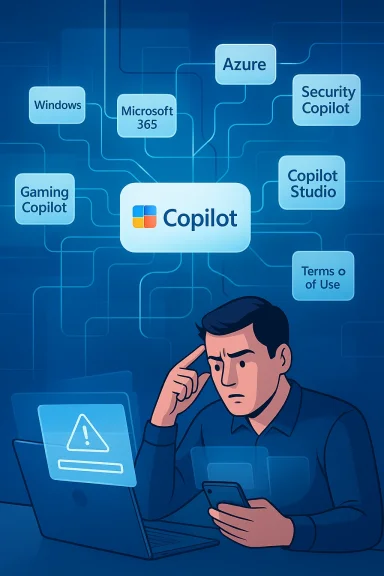
Microsoft’s Copilot brand has become so expansive that the real question is no longer whether the company has one AI strategy, but whether it still has a strategy that ordinary users can actually decode. AI consultant Tey Bannerman’s count of 78 Copilot-branded products, features, and services has now climbed to at least 80 as Gaming Copilot and Microsoft Dragon Copilot were added, and that number is already being treated as a moving target rather than a ceiling. At the same time, Microsoft’s own Copilot terms of use still say Copilot is “for entertainment purposes only,” a legal disclaimer that underscores just how far the branding has drifted from the company’s enterprise-ready marketing.
The Copilot story began with a simple promise: make AI feel native inside the software people already used every day. Microsoft first framed Copilot as a productivity companion in Windows, Bing, and Microsoft 365, where it could sum and help users move faster without forcing them into a new workflow. That original pitch made strategic sense because it fit Microsoft’s historic strength: distribution through familiar products rather than a standalone consumer app.
But the brand did not stay simple for long. Copilot quickly spread into consumer chat, Microsoft 365, Windows, mobile apps, Azure, security, industry-specific offerings, hardware positioning, and tools for building more copilots. Microsoft adescribe Copilot as a layer that can be embedded, extended, governed, and customized across the company’s stack, which makes it less a single assistant than a family name for an AI platform.
That expansion is the source of the confusion now surfacing publicly. Bannerman’s count is not a formal SKU list, but it is a useful map of Microsoft’s branding behavior: one nces, many levels of control. The more Microsoft relies on the Copilot umbrella, the more it risks turning a helpful brand into a taxonomy problem.
The irony is that Microsoft’s AI push is simultaneously stronger and messier than it was a year ago. On the one hand, the company has real distribution power across Windows, Microsoft 365, Azure, and devices. On the other, it now faces the classic platform-era problem: the brand grows faster than the customer’sdat is optional, what is licensed separately, and what is merely a feature tucked inside another product.
The early Copilot framing was coherent because it attached AI to a specific job: helping people work inside familiar Microsoft apps. Once the company realized the brand had traction, it started using the same name as a wrapper for more ambitious ideas: agents, role-based copilots, builder tools, cloud copilots, security copilots, and device-level branding product and started becoming a system.
What changed is that Microsoft found a strong brand and then began applying it everywhere. That move maximized recognition but blurred the lines between consumer assistant, enterprise assistant, in-app feature, and developer platform. Recognition increased. Comprehension ## The platform temptation
A platform company almost always wants one name that can scale across multiple surfaces. Microsoft’s logic is understandable: one brand can unify sales motions, simplify marketing spend, and make AI feel central to the company’s identity. But platform logic has a built-in flaw: once the brand covers too many things, it begins to require explanation instead of providing it.
Tnow sits. It is broad enough to be strategically valuable and vague enough to be cognitively expensive. The very word that was meant to reassure users has become something they must decode. That is not a small branding problem; it is an architectural one.
An 80-product family suggests that Microsoflselling “AI everywhere.” That may sound like strategic clarity in Redmond, but from a buyer’s point of view it can sound like repetition. The user no longer asks what Copilot can do; they ask which Copilot they are actually supposed to use.
In other words, the 80 is meaningful because it captures the feeling customers now have: Copilot is everywhetes it is a chatbot. Sometimes it is a productivity companion. Sometimes it is a role-based assistant. Sometimes it is a platform service. Sometimes it is a builder tool. Sometimes it is a hardware brand.
The result is a paradox. Microsoft has built one of the most recognizable AI names in tech, yet that same recognition now forces users to ask follow-up questions before they can even evaluate theness without brand clarity is expensive awareness.*
Microsoft has reportedly said the wording is legacy language from earlier Copilot branding, when the experience was closer to a search companion. That explanation makes sense historically, but it also confirms the bigger issue: the legal framework was not updated as fast as the product story. When your marketing says “work assistant” and your terms say “entertainment,” users notice.
That contradiction is not unique to Microsoft, but Microsoft is unusually exposed because Copilot is so visible. It sits in Windows, Microsoft 365, and the company’s consumer ecosystem, so any legal oddity gets amplified by reach. The more central Copilot becomes, the more awkward it looks to frame it as something users should not rely on for important advice.
The lesson is simple: if a company wants AI to be trusted in daily work, it cannot let consumer-era language linger on enterprise-era products for too long. Legacy wording becomes narrative sabotage once the product matures.
Recent reporting suggests Microsoft is becomout where Copilot appears in Windows, trimming some surfaces after user backlash. That is a meaningful course correction because the OS is not the same as a standalone app. On the desktop, every extra prompt competes with workflow, familiarity, privacy, and user control.
This is why theimpulse eventually hit a wall. It turns out that ubiquitous AI inside Windows can be read as clutter, not convenience. Microsoft appears to be learning that users want modular AI, not necessarily AI in every pixel.
But hardware branding also magnifies confusion. If Copilot appears on the box, inside the OS, in the browser, and in the productivity suite, the user may assume a single seamless experience. In practice, the experience may depend on account type, device capability, app surface, and license. That gap between expectation and reality is where trust starts to leak.
That is why the business case remains strong even when the branding looks chaotic. Enterprises tolerate complexity if the payoff is compliance, productivity, and integration. They do not need a uditability, access control, and measurable workflow gains. Copilot still has those advantages.
The newer “wave” of Microsoft 365 Copilot messaging pushes even further into agentic workflows, suggesting Microsoft wants Copilot to move from answering prompts to modifying documents, managing context, and helping execute tasks. That is a stronger enterprise story than consumer chat because it ties AI to business outcomes instead of novelty.
That does not make Copilot a weak enterprise product. It makes it a difficult enterprise catalog. The product may be powerful, but the packaging is increasingly a burden. Powerful tools still need clear labels.
The issue is not that Copilot is useless. The issue is that users have to spend too much effort figuring out which Copilot they are using, what it can access, and whether it is the right one for their account or task. A brand that creates recognition without comprehension eventually creates friction.
The company seems to have learned at least part of this lesson. Pulling back Copilot prompts from some low-level Windows experiences suggests Microsoft recognizes that users do not want AI in every context. They want it in the contexts where it feels useful, not intrusi burden nobody wants to count
Brand confusion does not just irritate users; it creates support work. Every extra Copilot variant means more documentation, more onboarding questions, more licensing confusion, more training overhead, and more chances for someone to buy the wrong thing. That is the hidden tax of an umbrella brand that has grown too wide.
This is also where competitors can benefit. A rival with a cleaner naming structure may look more trustworthy simply because it is easier to explain. In software, clarity is not decorative. It is a feature.
The big strategic advantage for Microsoft is distribution. Copilot lives inside Windows, Microsoft 365, Azure, and a broad device ecosystem, which makes it hard to ignore. The big strategic risk is meaning dilution. If users stop knowing what Copilot means, the brand’s reach may outgrow its usefulness.
Competitors should take note. The lesson is not that umbrella branding is bad. The lesson is that umbrella branding needs internal discipline. If the label becomes the strategy, the strategy begins to wobble. A shared name is not a shared experience.
Microsoft still has the stronger enterprise position, but it may be handing competitors a subtle advantage in user comprehension. That advantage compounds because AI is still early enough that trust and clarity shape adoption almost as much as raw capability.
The next phase will likely hinge on segmentation and restraint. If Microsoft formalizes Copilot categories, improves license transparency, and reduces the number of places where AI feels forced, it can preserve the brand’s reach without turning it into a punchline. If it keeps expanding the label faster than it can explain it, then “Copilot” may become the most recognizable confusing name in enterprise software.
What to watch next:
Source: Windows Central "Copilot isn't a naming strategy, it's a survival instinct": Is Microsoft's cockpit flooded with too many Copilots for its AI strategy to make sense?
 Overview
The Copilot story began with a simple promise: make AI feel native inside the software people already used every day. Microsoft first framed Copilot as a productivity companion in Windows, Bing, and Microsoft 365, where it could sum and help users move faster without forcing them into a new workflow. That original pitch made strategic sense because it fit Microsoft’s historic strength: distribution through familiar products rather than a standalone consumer app.But the brand did not stay simple for long. Copilot quickly spread into consumer chat, Microsoft 365, Windows, mobile apps, Azure, security, industry-specific offerings, hardware positioning, and tools for building more copilots. Microsoft adescribe Copilot as a layer that can be embedded, extended, governed, and customized across the company’s stack, which makes it less a single assistant than a family name for an AI platform.
That expansion is the source of the confusion now surfacing publicly. Bannerman’s count is not a formal SKU list, but it is a useful map of Microsoft’s branding behavior: one nces, many levels of control. The more Microsoft relies on the Copilot umbrella, the more it risks turning a helpful brand into a taxonomy problem.
The irony is that Microsoft’s AI push is simultaneously stronger and messier than it was a year ago. On the one hand, the company has real distribution power across Windows, Microsoft 365, Azure, and devices. On the other, it now faces the classic platform-era problem: the brand grows faster than the customer’sdat is optional, what is licensed separately, and what is merely a feature tucked inside another product.
How Microsoft Got Here
Microsoft did not wake up one morning and decide to name everything Copilot. The naming sprawl emerged from a deliberate commercial logic: launch AI where users already work, then extend the label into adjacent products, then use the same brand to connect apps, devices, cloud services, and custom Microsoft way to build a market. It is also a very Microsoft way to create a mess.The early Copilot framing was coherent because it attached AI to a specific job: helping people work inside familiar Microsoft apps. Once the company realized the brand had traction, it started using the same name as a wrapper for more ambitious ideas: agents, role-based copilots, builder tools, cloud copilots, security copilots, and device-level branding product and started becoming a system.
The original promise
Microsoft’s first Copilot messaging was essentially about augmentation. It was supposed to sit beside users, not replace their workflow, and it was framed as a way to save time rather than invent a new software category. That was important because buyers already understood Microsoft 365 as a bundle and Windows as a platform, so Copilot could be sold as an addedrisky reinvention.What changed is that Microsoft found a strong brand and then began applying it everywhere. That move maximized recognition but blurred the lines between consumer assistant, enterprise assistant, in-app feature, and developer platform. Recognition increased. Comprehension ## The platform temptation
A platform company almost always wants one name that can scale across multiple surfaces. Microsoft’s logic is understandable: one brand can unify sales motions, simplify marketing spend, and make AI feel central to the company’s identity. But platform logic has a built-in flaw: once the brand covers too many things, it begins to require explanation instead of providing it.
Tnow sits. It is broad enough to be strategically valuable and vague enough to be cognitively expensive. The very word that was meant to reassure users has become something they must decode. That is not a small branding problem; it is an architectural one.
- Copilot now spans coveloper, and device surfaces.
- The same label is used for apps, embedded features, and builder tools.
- Microsoft benefits from shared brand equity.
- Users pay the cost in confusion and license complexity.
Why the Count Matters
The exact number is less important than what it reveals about Microsoft’s organization. Bannerman’s tally is effectively a snapshot of how many teams found value in naming their work Copilot, which tells us the brand has become an internal coordination device as much as an external marketing term. That is a sign of momentum, but also of fragmentation.An 80-product family suggests that Microsoflselling “AI everywhere.” That may sound like strategic clarity in Redmond, but from a buyer’s point of view it can sound like repetition. The user no longer asks what Copilot can do; they ask which Copilot they are actually supposed to use.
Brand-family count versus product inventory
Bannerman’s number is best understood at, not a legal or procurement inventory. He assembled it from scattered official materials, launch posts, and marketing pages because Microsoft does not maintain a single public master list. That matters because the count tracks Microsoft’s naming behavior, not just its engineering output.In other words, the 80 is meaningful because it captures the feeling customers now have: Copilot is everywhetes it is a chatbot. Sometimes it is a productivity companion. Sometimes it is a role-based assistant. Sometimes it is a platform service. Sometimes it is a builder tool. Sometimes it is a hardware brand.
The problem of one word, many meanings
A strong brand can survive multiple contexts if the promise stays consistent. Copilot, however, now spans terowsing the web, an IT admin managing tenants, and a sales leader buying workflow automation are each seeing a different version of “Copilot.” That is not a naming nuance; it is a practical barrier to understanding.The result is a paradox. Microsoft has built one of the most recognizable AI names in tech, yet that same recognition now forces users to ask follow-up questions before they can even evaluate theness without brand clarity is expensive awareness.*
- Microsoft’s Copilot label is now a family name.
- The family includes consumer, work, vertical, and platform products.
- The count changes as Microsoft adds new launches and variants.
- The real issue is not quantity alone, but meaning drift.
The Terms of Use Problem
Nothing illustrates the Copilot contradiction better than Microsoft’s own terms. The company’s consumer Copilot terms still include the line that Copilot is for entertainment purposes only, even as Microsoft markets Copilot as an everyday productivity and enterprise AI layer. That legal language has become a public embarrassment because it sounds like a disclaimer for a casual toy, not a core component of a modern software stack.Microsoft has reportedly said the wording is legacy language from earlier Copilot branding, when the experience was closer to a search companion. That explanation makes sense historically, but it also confirms the bigger issue: the legal framework was not updated as fast as the product story. When your marketing says “work assistant” and your terms say “entertainment,” users notice.
Legal language versus product marketing
This mismatch matters because AI products live on trust. If users believe the company itself is hedging on reliability, they will be less willing to grant the product permission to matter. Microsoft’s support documentation is more careful, warning users to review outputs and treat generative systems as fallible. But the bluntness of the entertainment disclaimer has already done the viral damage.That contradiction is not unique to Microsoft, but Microsoft is unusually exposed because Copilot is so visible. It sits in Windows, Microsoft 365, and the company’s consumer ecosystem, so any legal oddity gets amplified by reach. The more central Copilot becomes, the more awkward it looks to frame it as something users should not rely on for important advice.
Why trust is now a branding issue
In the AI era, legal phrasing is not separate from brand perception. A company can no longer hide behind fine print when the fine print conflicts with the front-page pitch. Microsoft is asking users and enterprises to adopt Copilot as a habit, yet the terms remind them that the company still wants to limit liability and disclaim overconfidence. That is reasonable legally, but it is messy strategically.The lesson is simple: if a company wants AI to be trusted in daily work, it cannot let consumer-era language linger on enterprise-era products for too long. Legacy wording becomes narrative sabotage once the product matures.
Windows, Hardware, and the Desktop Tension
Windows is where Copilot becomes politically sensitive. Microsoft has repeatedly pushed AI deeper into the operating system, from taskbar integration to the Copilot key to AI features in apps like Paint, Notepad, Photos, and Snipping Tool. That strategy made Copilot feel native, but it also made it feel unavoidable. For many desktop users, unavoidable is not a compliment.Recent reporting suggests Microsoft is becomout where Copilot appears in Windows, trimming some surfaces after user backlash. That is a meaningful course correction because the OS is not the same as a standalone app. On the desktop, every extra prompt competes with workflow, familiarity, privacy, and user control.
Why Windows is different
The desktop is where Microsoft has the most leverage and the least forgiveness. People expect an operating system to stay out of the way unless they ask for help. When Microsoft pushes Copilot too aggressively into system surfaces, it can look less like assistance and more like an agenda. That perception is especially dangerous in enterprise environments, where administrators want predictability and policy control.This is why theimpulse eventually hit a wall. It turns out that ubiquitous AI inside Windows can be read as clutter, not convenience. Microsoft appears to be learning that users want modular AI, not necessarily AI in every pixel.
Copilot+ PCs and the hardware halo
Microsoft’s Copilot+ PC branding extended the label beyond software and into hardware identity. That is smart from a marketing standpoint because it makes AI feel tangible before the user even opens an app. It also creates a halo effect around the broader Windows ecosystem.But hardware branding also magnifies confusion. If Copilot appears on the box, inside the OS, in the browser, and in the productivity suite, the user may assume a single seamless experience. In practice, the experience may depend on account type, device capability, app surface, and license. That gap between expectation and reality is where trust starts to leak.
- Windows gives Copilot reach.
- Windows also magnifies user sensitivity.
- Hardware branding boosts visibility.
- Hardware branding also raises expectation.
Enterprise Strength: The Story That Still Makes Sense
If Copilot is messy anywhere, it is least messy in enterprise software. Microsoft can credibly argue that Copilot belongs inside Microsoft 365, Azure, Security, Dynamics, and Copilot Studio because those are already governed environments with identity, permissions, and data controls. In other words, Microsoft is not just selling AI; it is selling AI that fits the enterprise stack customers already manage.That is why the business case remains strong even when the branding looks chaotic. Enterprises tolerate complexity if the payoff is compliance, productivity, and integration. They do not need a uditability, access control, and measurable workflow gains. Copilot still has those advantages.
Microsoft 365 Copilot as the anchor
Microsoft 365 Copilot remains the cleanest expression of the strategy because it connects naturally to Word, Excel, PowerPoint, Outlook, Teams, and Microsoft Graph. It is the place where Microsoft can show concrete work value rather than abstract AI branding. In that sense, it is the product that makes the entire Copilot family feel more legitimate.The newer “wave” of Microsoft 365 Copilot messaging pushes even further into agentic workflows, suggesting Microsoft wants Copilot to move from answering prompts to modifying documents, managing context, and helping execute tasks. That is a stronger enterprise story than consumer chat because it ties AI to business outcomes instead of novelty.
Why admins care more than marketers
Enterprise buyers care about who can access what, which data sources are connected, how agents are governed, and what gets logged. Those concerns are not solved by a brand. They are solved by a control plane. Microsoft’s challenge is that the more it multiplies Copilot variants, the more procurement and IT teams must map one umbrella name onto many different capabilities.That does not make Copilot a weak enterprise product. It makes it a difficult enterprise catalog. The product may be powerful, but the packaging is increasingly a burden. Powerful tools still need clear labels.
- Enterprise buyers care about governance more than brand simplicity.
- Microsoft 365 Copilot remains the most coherent anchor.
- Copilot Studio strengthens the platform story.
- The more variants Microsoft adds, the harder procurement becomes.
Consumer Confusion and the Clarity Problem
Consumers are dealing with the hardest version of the Copilot story because they encounter the brand in the broadest possible way. They see it on Windows, in Edge, in Bing, on mobile, in hardware marketing, and across app surfaces that do not always behave the same way. To the average user, that looks less like one coherent assistant and more like a maze of related services.The issue is not that Copilot is useless. The issue is that users have to spend too much effort figuring out which Copilot they are using, what it can access, and whether it is the right one for their account or task. A brand that creates recognition without comprehension eventually creates friction.
Why simplicity beats saturation
Microsoft likes brand saturation because saturation makes a company look dominant. But saturation has diminishing returns when every appearance of the brand requires a fresh explanation. At that point, the logo is familiar, but the product is not. That is a dangerous place for an AI assistant to live because users are already cautious about hallucinations, privacy, and hidden behavior.The company seems to have learned at least part of this lesson. Pulling back Copilot prompts from some low-level Windows experiences suggests Microsoft recognizes that users do not want AI in every context. They want it in the contexts where it feels useful, not intrusi burden nobody wants to count
Brand confusion does not just irritate users; it creates support work. Every extra Copilot variant means more documentation, more onboarding questions, more licensing confusion, more training overhead, and more chances for someone to buy the wrong thing. That is the hidden tax of an umbrella brand that has grown too wide.
This is also where competitors can benefit. A rival with a cleaner naming structure may look more trustworthy simply because it is easier to explain. In software, clarity is not decorative. It is a feature.
- Consumers want one answer, not a product matrix.
- Ubiquity is not the same as usability.
- Support costs rise with naming fragmentation.
- Simpler rivals may win by being easier to understand.
The Competitive Implications
Microsoft’s Copilot strategy is both a warning and a playbook for the rest of the AI market. The company is proving that umbrella branding can generate huge awareness, but it is also proving that the same strategy can become a liability if the products underneath the label diverge too far. Rivals are watching closely because Microsoft is running the experiment at a scale they may eventually try to copy.The big strategic advantage for Microsoft is distribution. Copilot lives inside Windows, Microsoft 365, Azure, and a broad device ecosystem, which makes it hard to ignore. The big strategic risk is meaning dilution. If users stop knowing what Copilot means, the brand’s reach may outgrow its usefulness.
Platform power versus naming discipline
Microsoft has an enormous platform moat, but a moat does not automatically create legibility. The company can make Copilot feel unavoidable across work and device categories, yet still fail to make it easy to understand. That combination is unusual: market power and messaging confusion can rise together.Competitors should take note. The lesson is not that umbrella branding is bad. The lesson is that umbrella branding needs internal discipline. If the label becomes the strategy, the strategy begins to wobble. A shared name is not a shared experience.
How rivals can win
Rivals do not need to out-Microsoft Microsoft. They can win by being more legible. A cleaner naming system, fewer SKUs, and more obvious boundaries between consumer, enterprise, and platform products can create the perception of simplicity even when the underlying feature set is smaller. That matters because many buyers prefer products they can explain to colleagues in one sentence.Microsoft still has the stronger enterprise position, but it may be handing competitors a subtle advantage in user comprehension. That advantage compounds because AI is still early enough that trust and clarity shape adoption almost as much as raw capability.
- Microsoft’s scale is still unmatched.
- Brand sprawl creates openings for simpler rivals.
- AI markets reward comprehension as much as capability.
- The strongest competitor may be the easiest one to explain.
Strengths and Opportunities
Microsoft’s Copilot strategy is not failing; it is maturing under pressure. The company still has one of the strongest distribution engines in tech, and it is using that power to embed AI into the places where people already spend their time. The opportunity now is to turn naming sprawl into a more legible family structure before the confusion starts eroding the very brand equity Microsoft worked so hard to build.- Massive reach across Windows, Microsoft 365, Azure, and devices.
- Strong enterprise trust through identity, permissions, and governance.
- Better workflow stickiness when Copilot is embedded in core apps.
- A growing Copilot Studio ecosystem for builders and partners.
- Clear monetization paths through subscriptions, add-ons, and premium tiers.
- Hardware halo effects from Copilot+ PCs and system-level branding.
- Role-based offerings that can target high-value industries and functions.
Risks and Concerns
The risk is not that Microsoft has too little Copilot. The risk is that it has too much Copilot without enough hierarchy. If users, admins, and buyers cannot quickly tell one offering from another, the brand begins to create friction instead of confidence. In AI, where trust is already fragile, that kind of friction can be expensive.- User confusion about which Copilot to use.
- Brand dilution as “Copilot” becomes generic.
- Licensing and procurement complexity for enterprises.
- Support and training overhead across multiple variants.
- Consumer backlash if AI feels invasive in Windows.
- Trust erosion from legal disclaimers that undercut marketing.
- Competitive openings for rivals with cleaner product naming.
Looking Ahead
Microsoft does not need to abandon Copilot to fix Copilot. It needs to decide whether Copilot is a product, a platform, or a brand family with clearer internal rules. The answer may be all three, but if that is the case, Microsoft will need to say so more cleanly than it does today. Otherwise, the company risks winning the AI visibility race while losing the clarity war.The next phase will likely hinge on segmentation and restraint. If Microsoft formalizes Copilot categories, improves license transparency, and reduces the number of places where AI feels forced, it can preserve the brand’s reach without turning it into a punchline. If it keeps expanding the label faster than it can explain it, then “Copilot” may become the most recognizable confusing name in enterprise software.
What to watch next:
- Whether Microsoft publishes clearer Copilot category boundaries.
- Whether the company continues trimming intrusive OS-level Copilot surfaces.
- Whether enterprise packaging becomes easier to understand.
- Whether Copilot Studio becomes the true center of the brand.
- Whether Microsoft updates the “entertainment purposes only” language.
- Whether rival AI products win share through simpler naming.
Source: Windows Central "Copilot isn't a naming strategy, it's a survival instinct": Is Microsoft's cockpit flooded with too many Copilots for its AI strategy to make sense?
