

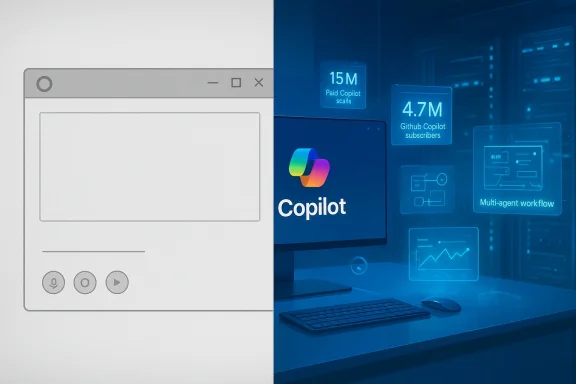
Microsoft’s transition away from Cortana toward the Copilot family of assistants is now more than a product pivot — it’s a measurable market shift, with concrete customer counts, capital investments, and adoption gaps that tell a clear story about where Microsoft’s AI strategy has landed in 2026. Over the past two years Microsoft disclosed hard numbers that reveal both rapid early monetization of AI features and a long runway for growth: Microsoft 365 counts more than 450 million commercial seats while Microsoft 365 Copilot reached roughly 15 million paid seats, leaving a large untapped base; GitHub Copilot has crossed 4.7 million paid subscribers; and Microsoft reported an unusually large $37.5 billion capital‑expenditure quarter largely directed at AI compute — signaling an aggressive, expensive push to build the infrastructure that will host the next generation of productivity assistants.
Microsoft introduced Cortana in 2014 as a consumer-focused, voice‑first assistant for phones and later for Windows, Xbox and third‑party devices. Cortana’s original design emphasized conversational voice commands, calendar and reminder integration, and lightweight contextual help tied to the user’s device profile. Over time, however, the AI landscape changed: generative models enabled assistants to perform far more complex, multi‑step knowledge work — summarizing long documents, drafting business communications, and orchestrating workflows across email, files, meetings and chat.
As Microsoft reoriented its product architecture around the Microsoft Graph, GPT‑class models, and "Copilot" experiences embedded across Microsoft 365, the company began to treat assistance as a productivity layer rather than a standalone voice product. That strategic shift culminated in the removal of Cortana as a distinct Windows experience and a broader emphasis on Copilot as the primary enterprise AI product line.
That same investor narrative included an extraordinary capital‑expenditure quarter of $37.5 billion, with Microsoft saying roughly two‑thirds of that spend went to GPUs/CPUs and short‑lived AI compute capacity — a sign that the company is aggressively building the cloud infrastructure needed to support large‑scale LLM operations. This is not a marginal engineering program; it’s a strategic product bet backed with near‑term, large capital outlay.
Caveat: specific published claims about the exact date of Cortana’s final shutdown (for example a specific August 11, 2023 date) and assertions about support in precisely “13 countries” were included in some summaries, but these particular details were not verifiable across the available internal files I reviewed; treat those as vendor or third‑party claims that need explicit primary confirmation before being quoted as definitive.
Cortana’s era taught Microsoft how to build assistants; Copilot’s era is teaching enterprises how to use them safely and productively at scale. The numbers released so far show real commercial traction, heavy infrastructure bets, and a long runway — a mix that creates as many operational and governance questions as it does opportunity. For IT leaders, the immediate task is not technical evangelism alone but disciplined program management: pilot, measure, secure, and scale. The productivity payoff is real; the cost of getting governance wrong is equally real. The decision to move from voice novelty to enterprise agent should be taken deliberately, and with a clear set of outcomes that define success.
Source: Bayelsa Watch Cortana Statistics By User Adoption And Trends (2026)
 Background / Overview
Microsoft introduced Cortana in 2014 as a consumer-focused, voice‑first assistant for phones and later for Windows, Xbox and third‑party devices. Cortana’s original design emphasized conversational voice commands, calendar and reminder integration, and lightweight contextual help tied to the user’s device profile. Over time, however, the AI landscape changed: generative models enabled assistants to perform far more complex, multi‑step knowledge work — summarizing long documents, drafting business communications, and orchestrating workflows across email, files, meetings and chat.As Microsoft reoriented its product architecture around the Microsoft Graph, GPT‑class models, and "Copilot" experiences embedded across Microsoft 365, the company began to treat assistance as a productivity layer rather than a standalone voice product. That strategic shift culminated in the removal of Cortana as a distinct Windows experience and a broader emphasis on Copilot as the primary enterprise AI product line.
What the Numbers Say: Adoption, Scale, and Monetization
Microsoft 365 and Copilot: Penetration vs. Potential
- Microsoft reports more than 450 million commercial Microsoft 365 seats — a scale that provides an enormous addressable market for any productivity add‑on.
- Within that base, Microsoft disclosed 15 million paid Microsoft 365 Copilot seats during FY2026 reporting — a meaningful commercial footprint, but only a small fraction of total seats (roughly 3.3% of the commercial base by Microsoft’s own arithmetic).
Developer Ecosystem: GitHub Copilot’s Momentum
- GitHub Copilot reached about 4.7 million paid subscribers as of Q2 FY2026, a figure Microsoft presented alongside its broader Copilot disclosures and which reflects continued enterprise and developer demand for AI‑assisted coding. That subscriber count represented a large year‑over‑year jump, cited internally as roughly a 75% increase.
Economics: Price, Revenue and Capital Intensity
Microsoft’s list price for Microsoft 365 Copilot and public estimates of seat fees have yielded revenue projections in the billions. Analysts and internal disclosures indicate an annual revenue run‑rate estimate in the neighborhood of $5.4 billion if Copilot were broadly adopted at the presented price tiers and by the current paid base — illustrating why Microsoft is willing to underwrite heavy infrastructure spending.That same investor narrative included an extraordinary capital‑expenditure quarter of $37.5 billion, with Microsoft saying roughly two‑thirds of that spend went to GPUs/CPUs and short‑lived AI compute capacity — a sign that the company is aggressively building the cloud infrastructure needed to support large‑scale LLM operations. This is not a marginal engineering program; it’s a strategic product bet backed with near‑term, large capital outlay.
The Sunset of Cortana: From Voice Assistant to Enterprise Legacy
Cortana’s arc is familiar to anyone who tracks platform product lifecycles: an early, consumer‑oriented initiative that struggled to find a persistent, profitable role as competing ecosystems and new model capabilities changed the rules.- Cortana debuted as a landmark attempt to bring conversational assistants to Microsoft’s product line and was deeply integrated into Windows 10, Xbox and third‑party hardware in its early years.
- Over time, Microsoft scaled back the standalone Cortana experience and ultimately deprecated the Cortana standalone experience in Windows as the company pivoted toward embedding Copilot and generative AI into the productivity stack. Microsoft’s deprecation and removal of Cortana from mainstream Windows builds is described in internal commentary and tracking documents as a completed transition.
Caveat: specific published claims about the exact date of Cortana’s final shutdown (for example a specific August 11, 2023 date) and assertions about support in precisely “13 countries” were included in some summaries, but these particular details were not verifiable across the available internal files I reviewed; treat those as vendor or third‑party claims that need explicit primary confirmation before being quoted as definitive.
Architecture and Capability: Cortana vs. Copilot (2026)
Cortana (historical profile)
- Architecture: Device‑centric, local profile and scripted intent matching; lightweight cloud support for search and basic contextual signals.
- Interaction model: Voice-first, reactive single‑turn interactions focused on reminders, calendar queries, weather and short web searches.
- Agentic capability: Essentially none — Cortana executed explicit user instructions and had limited cross‑app orchestration.
Copilot (2026 profile)
- Architecture: Multi‑layered AI stack combining Microsoft Graph, LLMs (GPT family and third‑party models such as Claude in some scenarios), and permissioned enterprise context. Copilot is designed to analyze email, files, chats and meetings to produce multi‑step outputs.
- Interaction model: Conversational prompts plus proactive assistance; multi‑agent orchestration via tools like Copilot Studio, permitting sub‑agents to manage finance, HR, IT workflows and more.
- Agentic capability: Multi‑turn, planner/executor agents that can autonomously perform extended tasks (for example, summarizing long contracts, producing slide decks from documents, or partially automating loan application processes in early adopter pilots).
Adoption Dynamics: Why Copilot Converts Slowly (So Far)
Several structural and behavioral factors explain the gap between broad seat numbers and the relatively modest paid Copilot penetration.- Cost and licensing friction: Copilot’s per‑seat pricing and the need to rationalize the spend across large organizations slows rapid, universal purchase. The current mix of paid and free uses creates adoption complexity.
- Change management: Generative AI changes workflows; enterprises require pilots, governance, training, and measurable ROI before they flip a broad switch. Early deployments show productivity gains in specific high‑frequency tasks, but converting that into enterprise‑wide habit requires time.
- User preference and multi‑tool reality: Many knowledge workers use multiple AI tools (e.g., public chat services) alongside integrated Copilot offerings; competing UX and familiarity can blunt in‑app Copilot uptake.
- Security and governance concerns: Organizations slow adoption until they have clear guardrails for data exfiltration, model provenance, and regulatory compliance — particularly where sensitive corporate data is involved.
Risk, Governance and Security: The Tradeoffs of Agentic AI
Microsoft’s move to agentic, multi‑model Copilot experiences raises new enterprise risks that IT leaders must manage explicitly.- Data exposure and exfiltration: Generative assistants operating across email, documents and chat increase the attack surface for inadvertent data leakage. Early security research and operational telemetry highlight practical risks such as malformed prompts that can be chained to expose confidential content. Robust DLP and model‑level controls are required.
- Model provenance and hallucination: Enterprises must plan for model output validation, especially when Copilot generates legal summaries, financial calculations, or compliance content. Human review and auditable generation logs are essential.
- Operational cost and resilience: Large‑scale LLM inference is expensive and power‑hungry; Microsoft’s massive GPU purchases and capex spending reflect that reality. Organizations should be prepared for fluctuating compute economics and integration complexity.
- Governance complexity: When Copilot can act as an agent — routing emails, drafting responses, or initiating workflows — permissioning, escalation paths and human‑in‑the‑loop controls must be defined top to bottom.
What Success Looks Like: Early Wins and Measurable Outcomes
Despite the challenges, pilots and early adopters report measurable, repeatable gains in certain high‑value workflows:- Email triage and first‑draft drafting that reclaim hours per week for knowledge workers.
- Contract summarization and document ingestion that dramatically shorten review cycles.
- Developer productivity gains via GitHub Copilot that accelerate coding velocity and reduce repetitive tasks.
Practical Guidance for IT Leaders (A Short Playbook)
- Establish governance first:
- Define permitted Copilot use cases and data boundaries.
- Deploy DLP rules and logging for Copilot interactions.
- Run targeted pilots:
- Pick 2–4 high-frequency tasks (email triage, contract review, dev code completion) and measure time saved.
- Train and enable users:
- Provide short, role-specific playbooks and templates that show how Copilot improves daily work.
- Measure and iterate:
- Track usage, task completion, accuracy, and business outcomes. Use quantitative metrics (minutes saved, tickets closed) to justify expansion.
- Plan for cost and scale:
- Model seat licensing vs. measured productivity gains and consider phased deployments tied to outcomes.
Strengths, Weaknesses and Strategic Implications
Strengths
- Platform advantage: Microsoft’s combination of Graph data, Office document store and enterprise identity gives Copilot a unique context advantage few competitors can match.
- Monetization path: Paid Copilot seats and GitHub Copilot subscriptions show a viable business model for AI‑assisted productivity.
- Infrastructure commitment: The company’s unprecedented capex shows willingness to bear the heavy costs of LLM deployment at cloud scale.
Weaknesses / Risks
- Penetration gap: Paid Copilot seats are meaningful but still small relative to Microsoft’s installed base, implying a long conversion runway and continued churn risk.
- Operational and governance burden: Agentic capabilities increase the need for security tooling and policy management across organizations.
- User choice and competition: Workers will continue to use multiple tools, and user preference may favor specialized or simpler consumer models in some tasks.
Where Cortana Fits in the Narrative: Legacy, Not Failure
Cortana should be understood as a stepping stone. The research and engineering that went into Cortana’s speech and intent systems informed later, more capable Copilot systems. Cortana’s limited consumer traction and narrower geographic reach made the strategic decision to reallocate effort toward integrated, enterprise‑grade AI a logical evolution rather than a sign of waste. In short, Cortana taught Microsoft how to think about assistants — Copilot is the next chapter, reoriented around knowledge work and enterprise value.Final Assessment and Outlook (2026 and Beyond)
- Microsoft’s pivot from Cortana to Copilot is validated by the numbers: paid Copilot adoption is real and growing, but still early relative to Microsoft’s installed base. The 15 million Copilot seats and 4.7 million GitHub Copilot subscribers represent a credible commercial start, not the finish line.
- The company’s capital spending shows it is prepared to underwrite the expensive infrastructure needed to scale LLMs, but that investment increases the imperative to prove commercial returns and to manage operating costs.
- For enterprises, the practical path is deliberate: pilot where ROI is clear, invest in governance and measurement, and prepare for an era where assistants are teammates rather than passive tools.
Key Takeaways (Quick Reference)
- Scale: Microsoft 365 >450M commercial seats; Microsoft 365 Copilot ≈15M paid seats.
- Developer momentum: GitHub Copilot ≈4.7M paid subscribers.
- Capital intensity: Microsoft disclosed a $37.5B capex quarter heavily weighted toward AI compute.
- Commercial opportunity: Copilot penetration is early (~3.3%), implying a large TAM if Microsoft can convert existing seats.
- Enterprise recommendation: Start with pilots, establish governance, measure ROI, and scale around proven workflows.
Cortana’s era taught Microsoft how to build assistants; Copilot’s era is teaching enterprises how to use them safely and productively at scale. The numbers released so far show real commercial traction, heavy infrastructure bets, and a long runway — a mix that creates as many operational and governance questions as it does opportunity. For IT leaders, the immediate task is not technical evangelism alone but disciplined program management: pilot, measure, secure, and scale. The productivity payoff is real; the cost of getting governance wrong is equally real. The decision to move from voice novelty to enterprise agent should be taken deliberately, and with a clear set of outcomes that define success.
Source: Bayelsa Watch Cortana Statistics By User Adoption And Trends (2026)
