

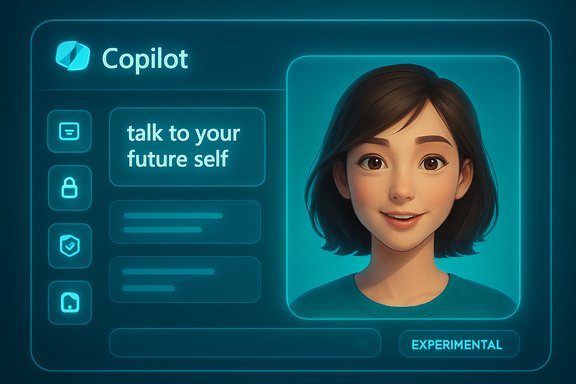
Microsoft’s Copilot is testing a new, quietly surfaced portrait experiment that would let users “talk to a version of themselves from the future” by generating a personalised avatar from a single front‑camera photo and opening a chat with that rendered likeness — a leak that points to a larger push toward persistent, human‑styled AI personas inside Copilot’s visual and chat surfaces.
Background
Microsoft has been steadily transforming Copilot from a single chat widget into a system‑level, multimodal assistant integrated across Windows, Edge, and mobile. The company’s recent Copilot Fall Release introduced an expressive avatar (Mico), group chats, long‑term memory controls, Learn Live tutoring flows and agentic browser Actions — changes covered in multiple outlets and official update streams. These public updates set the stage for more experimental portrait features and personalised visual personas inside Copilot. At the same time, internal interface traces and preview flags discovered by testers and community trackers show additional portrait experiments beyond the publicly announced Mico avatar. One such prototype, revealed in leaked UI traces, is explicitly framed around the idea of conversing with a rendered future version of yourself — a “digital future self” capped by clear technical and privacy constraints.What the leaked experiment proposes
The user flow (as leaked)
- The user is prompted to take a single front‑camera photo (a selfie) inside Copilot.
- Copilot processes that image to produce a static or semi‑animated portrait that resembles the user.
- The interface then launches a chat flow where the user can converse with the rendered portrait — framed in the UI as “talk to a version of yourself from the future.”
- The portrait lives inside Copilot’s existing chat surface rather than a separate app module; it is tied to the single captured image and not a full body scan or continuous live feed.
Key limitations shown in the traces
- The avatar generation relies on one captured image rather than a video or multi‑angle capture; this constrains the fidelity and realism of facial animation.
- The portrait appears to be session‑bound or experimental in nature (exposed to a small group of testers), rather than a broad, polished consumer feature.
- The visual persona is rendered as a static or semi‑animated portrait (not a full real‑time photorealistic body or continuous live video), which may constrain interaction types and contexts.
The technology behind animated portraits (what’s plausible)
Animating a talking portrait from a single image is a solved but still nuanced technical problem. Academic and industry research demonstrates models that can produce convincing talking faces and affective micro‑expressions from a single static image when driven by audio or animation latents. Among the approaches used:- Single‑image talk‑face models that separate identity from expression and animate a static face with lip‑sync and head motions.
- Audio‑driven facial synthesis that uses voice features to guide lip and expression timing.
- Lightweight real‑time animation models that prioritize latency and responsiveness over photoreal fidelity for conversational use.
How this fits alongside Mico and the Fall Release
Microsoft already introduced Mico, a deliberately non‑photoreal, animated avatar that provides nonverbal cues during voice interactions and tutoring flows. Mico is an optional UI presence that changes color and shape to signal listening, empathy, and conversational state — a design choice aimed at avoiding the uncanny valley while improving voice adoption. The newly leaked portrait experiment is distinct: instead of an abstract UI avatar, it seeks to render and talk to a personalised likeness of the user — a different interaction model with unique risks and benefits. Where Mico is a generic visual persona, the “future self” portrait would be a user‑tied visual persona. That shift matters because user‑tied likenesses carry a heavier privacy and identity risk profile than abstract avatars.Why Microsoft might be experimenting with “future self” chats
- Engagement and continuity: A personalised avatar can make voice and reflective interactions feel more intimate and motivating — useful for study, coaching, journaling, or habit work.
- Decision support and perspective: Framing the agent as a future self can nudge users toward long‑term thinking, future‑oriented planning, and continuity of self — a niche psychology that some apps deliberately exploit to influence behavior.
- Personalisation without full persistence: A single‑image portrait offers a middle ground: more personal than Mico, but less invasive than a continuous biometric capture or full‑body digital twin. This may let Microsoft test user appetite for personal avatars while keeping computational and privacy costs lower.
Cross‑checking the public record (what’s verified by independent reporting)
Multiple independent outlets reported on the Copilot Fall Release, Mico, new group chat features, memory controls, and broader Copilot expansions — confirming Microsoft’s strategic pivot toward expressive, personalized Copilot experiences. Coverage from technology press, specialist outlets and news aggregators verifies the company’s public feature set and rollout approach. However, the specific “talk to a version of yourself from the future” portrait flow shows up in leaked interface traces and exploratory previews rather than official Microsoft product pages. Because the discovery was made via internal flags visible to a limited tester group, that claim should be treated as provisional until Microsoft confirms or documents it openly. The leak aligns with Microsoft’s broader portrait experiments but is not the same as the public Mico announcement.Privacy, security, and legal implications
Creating personalised avatars from user photos raises a complex stack of privacy and regulatory issues. Several of these deserve immediate attention:- Biometric likeness: A clear legal and ethical boundary is crossed when a system creates a likeness tied to an identifiable face. Depending on jurisdiction, storing or processing biometric identifiers may trigger specific regulations (e.g., biometric laws in some U.S. states, EU data protection rules, or consent requirements elsewhere).
- Data retention and reuse: Is the captured selfie stored? Is it used to fine‑tune models or to build a persistent profile? The leak suggests a single captured image is used to generate a portrait, but storage and downstream training policies remain unclear. Without rigorous constraints, user photos can be retained or repurposed in harmful ways.
- Voice‑driven persuasion: A “future self” avatar has social influence potency. If the avatar is used to advise on finances, health, or relationships, it may increase trust and decrease scrutiny — raising liability and consumer‑protection questions.
- Identity fraud and impersonation: Rendered likenesses can be misused. If portraits are sharable or can be exported, they could be weaponised to social‑engineer contacts or impersonate a user.
- Bias and misrepresentation: Single‑image animation models have known failure modes across skin tones, facial features, and lighting conditions. Poorly tested portraits can misrepresent or caricature users, eroding trust.
UX and psychological risks
The design choice to let users converse with their own likeness — and to soft‑frame that persona as a “future self” — brings non‑technical risks that product teams must handle carefully:- Emotional transfer and over‑trust: Users may anthropomorphize their portrait and treat its outputs as advice from themselves rather than a model. That increases the chance that users will follow erroneous suggestions with less skepticism.
- Self‑concept distortion: If the “future self” persona provides normative life guidance or projects outcomes, it may anchor users to deterministic narratives or reduce openness to alternative strategies.
- Manipulation by bad actors: If portrait features are misused in social contexts (shared chats, group sessions, or public galleries), they could be repurposed to persuade or mislead others by leveraging a user’s face as a credibility cue.
Enterprise and admin considerations
For IT teams and security professionals, a few practical checklist items are essential if portrait features reach managed environments:- Confirm availability and scope: Check Microsoft’s official Copilot release notes and tenant controls to see if portrait features are permitted on managed devices or for accounts under corporate governance. Do not assume feature parity between consumer and enterprise channels.
- Review data flows: Determine whether selfies or generated portraits are stored in user mailboxes, in separate storage, or transmitted to third‑party services. Tie that to DLP, retention, and audit policies.
- Update acceptable‑use policies: Create guidance for personnel about using AI portraits in client communications, marketing, and confidential contexts.
- Pilot thoroughly: If enabling in enterprise, start with a small pilot (5–10% of representative devices) and monitor for privacy incidents, bias artifacts, and user confusion.
- Enforce consent: Where legal regimes require biometric consent, enforce explicit opt‑in for users and log consents for audit.
Safety design recommendations (for product teams and policymakers)
- Surface explicit, unambiguous consent dialogs before capturing any photo, with clear disclosure about storage, retention, and whether images are used to improve models.
- Provide immediate, one‑click deletion of captured images and any derived portrait artifacts.
- Label portrait chats with persistent UI cues indicating the conversation is with an AI persona and not a real person.
- Limit sharing/export features for user likenesses and block automated sharing in group contexts by default.
- Publish a public privacy and governance FAQ that describes retention windows, training exclusions, and how enterprise tenants can opt out or require admin approval.
How this compares to other avatar and “digital twin” offerings
The market has several players offering avatar and talking‑head services (for example, avatar video generators that create talking presenters from uploaded images or videos). Those commercial services typically:- Require multi‑frame uploads for higher fidelity or accept single‑image workflows with lower realism.
- Offer explicit export and embedding features, which increases sharing risk.
- Charge for custom avatar training and typically store user data under their terms of service.
What to watch next (verification and rollout signals)
- Official documentation: Look for Microsoft’s Copilot release notes and admin guidance to confirm whether portrait experiments are promoted from labs to public preview, and what admin/tenant controls exist.
- Insider channels: Feature flags and staged rollouts often appear first in Windows Insider builds and Copilot app updates; Insiders’ release notes are a reliable signal of staged availability.
- Public statements on privacy: Microsoft has emphasized opt‑in control in previous releases; any portrait rollout should be accompanied by explicit policy pages about biometric and image handling.
Practical advice for Windows users and admins today
- If testing Copilot labs or Insiders builds, avoid using sensitive or extremely personal images for avatar experiments. Use non‑identifiable photos or test accounts when possible.
- For privacy‑minded users: disable automatic uploads or any setting that allows Copilot to train on your content. Use the memory and training opt‑out settings where available.
- For admins: block Copilot experimental features in managed environments until data handling and retention policies are clear. Add Copilot checks to routine security testing and SIEM monitoring.
- For creators and professionals: consider legal and reputational risk before deploying personalised avatars in external communications; prefer synthetic, non‑identifiable avatars for public materials until policies stabilize.
Risks that merit regulatory attention
- The combination of a user’s own face and AI‑generated advice creates a novel persuasion vector that regulators may treat differently from generic AI outputs.
- Biometric classification and consent may be implicated depending on jurisdiction — regulators should consider whether new categories of “AI likeness” require explicit disclosure and recordkeeping.
- Consumer protection bodies will likely evaluate whether portrait‑based advice (health, finance, legal) meets false‑advertising or malpractice standards if deployed without adequate disclaimers.
Conclusion
The leaked Copilot experiment to “talk to a version of yourself from the future” is a telling signal of where Copilot’s visual persona work is headed: from an abstract, optional avatar (Mico) to personalised, user‑tied likenesses that can deliver more intimate and persuasive interactions. The technical approach — a single‑image portrait rendered into a static or semi‑animated talking face — trades off fidelity for convenience and feasibility, enabling faster testers’ previews while avoiding the complexity of full 3D capture.That trade‑off also concentrates risk. Personalised portraits intensify privacy, biometric, trust, and regulatory questions compared with non‑human avatars. Until Microsoft publishes explicit product pages, admin controls, and retention rules for any such feature, the “future self” portrait should be considered an experimental prototype discovered in internal traces rather than a finalized consumer capability. Independent coverage of Copilot’s Fall Release and the Mico avatar confirms the company’s broader direction toward expressive, personalized assistants — but the specific future‑self chat remains a provisional leak that requires official confirmation and robust governance before wide rollout. For Windows users, creators, and IT teams, the prudent posture is straightforward: experiment cautiously, insist on transparent opt‑in and deletion controls, and treat personalised likenesses as higher‑risk features that need explicit policies and tenant governance before adoption.
Source: TestingCatalog Copilot will let users chat with older version of themselves
