

Background
Microsoft’s modern AI strategy grew out of its unusually close relationship with OpenAI. Beginning with early investments and expanding through a multibillion-dollar partnership, Microsoft supplied cloud infrastructure while gaining privileged access to OpenAI models that became foundational to Bing Chat, Microsoft 365 Copilot, GitHub Copilot, Azure OpenAI Service, and the broader Copilot brand.
That arrangement gave Microsoft a major head start in commercial generative AI. It also created a strategic vulnerability: a rapidly expanding portfolio of products depended heavily on models controlled by another company, with their own release schedules, prices, capacity requirements, and technical limitations.
From exclusive advantage to model diversification
Microsoft has spent the past several years reducing the practical consequences of that dependency without abandoning OpenAI. Azure’s model catalog expanded to include systems from Anthropic, Meta, Mistral, Cohere, DeepSeek, xAI, and other developers, alongside Microsoft’s own Phi and MAI model families.
Microsoft Foundry now presents customers with a catalog containing well over a thousand models and variants. The platform supports comparisons, managed endpoints, safety tools, evaluation services, observability, deployment controls, and, in some configurations, model routing behind a common application interface.
This is more than a marketplace strategy. It gives Microsoft the infrastructure needed to substitute one model for another when cost, latency, capacity, regional availability, or policy requirements change.
Copilot is already a multi-model product family
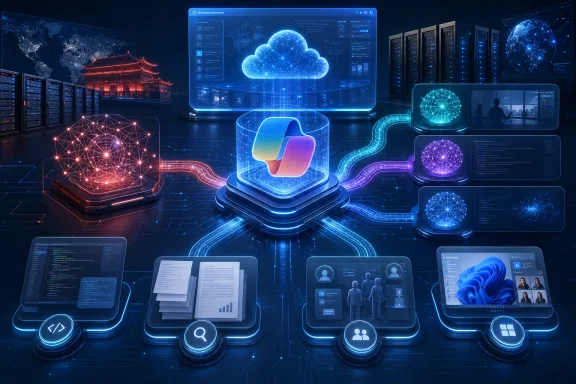
The word Copilot no longer identifies one assistant or one underlying model. It covers consumer Copilot, Microsoft 365 Copilot, Security Copilot, GitHub Copilot, Copilot Studio, Windows experiences, and numerous role-specific agents.
These products already combine foundation models with Microsoft services such as search, Microsoft Graph, identity, retrieval systems, policy enforcement, and application-specific orchestration. In many cases, the foundation model is only one component in a much larger processing chain.
That architecture makes targeted model substitution possible. A smaller or less expensive model can classify a request, summarize a document, select a tool, or generate routine code, while a more capable model handles difficult reasoning. Kimi K3 therefore would not need to replace a flagship OpenAI model everywhere to become commercially important.
What Microsoft Is Reportedly Testing
According to reporting attributed to people familiar with the matter, Microsoft engineers are evaluating whether Kimi K3 could perform some tasks currently handled by OpenAI and Anthropic models inside Copilot. Microsoft is also reportedly working to add Kimi K3 to Azure, extending an existing relationship under which earlier Moonshot AI models have appeared in Microsoft’s cloud model catalog.
Neither Microsoft nor Moonshot AI has announced a broad Kimi K3 deployment across Copilot. The distinction between an internal evaluation, an Azure catalog listing, a limited preview, and production use inside a customer-facing Copilot product remains crucial.
Evaluation does not equal deployment
Large technology companies routinely test new models without shipping them. A promising benchmark result can trigger an internal evaluation, but production adoption requires much more than reproducing a public score.
Microsoft would need to test Kimi K3 across areas including:
- Instruction adherence, because a model must follow hidden system policies consistently across long conversations.
- Tool calling, because Copilot increasingly acts through applications, agents, connectors, and enterprise services.
- Latency, because a powerful model that responds too slowly can degrade interactive experiences.
- Reliability under load, because Copilot serves workloads far larger and less predictable than a benchmark suite.
- Safety and policy compliance, because generated output must satisfy Microsoft’s product and enterprise requirements.
- Cost per completed task, which is more informative than the advertised price per token.
- Regional deployment suitability, particularly where data residency and sovereignty rules apply.
A model could excel at coding demonstrations yet fail Microsoft’s requirements for availability, structured output, multilingual consistency, or resistance to prompt injection. Conversely, it could prove useful for a narrow class of tasks even if it does not become Copilot’s default conversational model.
The most plausible initial workloads
Kimi K3’s reported strengths point toward a limited set of possible early assignments. Coding assistance, repository analysis, long-document processing, agent planning, and generation of structured work products would be logical candidates.
Microsoft could adopt it through several increasingly consequential stages:
- The model could appear in Microsoft Foundry for customers to deploy voluntarily.
- It could enter an internal evaluation pool used by Microsoft’s AI engineering teams.
- It could become an optional model in a Copilot model picker or developer preview.
- It could handle selected background tasks invisible to the user.
- It could become one destination in an automatic model-routing system.
- Only after extensive validation could it power a broadly available Copilot experience by default.
The current reporting appears closest to the first two stages. Claims that Microsoft has already decided to replace OpenAI across Copilot go well beyond the available evidence.
What Makes Kimi K3 Significant
Kimi K3 was unveiled by Beijing-based Moonshot AI in July 2026 as a massive, multimodal mixture-of-experts model designed for long-horizon coding, knowledge work, visual understanding, and deep reasoning. Moonshot describes it as a 2.8-trillion-parameter system with a context window of approximately one million tokens.
Those headline numbers are striking, but they require interpretation. Total parameter count does not directly measure intelligence, speed, or cost, particularly for a sparse mixture-of-experts architecture.
A huge model that does not activate everything at once
In a traditional dense model, every parameter may participate in processing each token. A mixture-of-experts model instead contains many specialized parameter groups and uses a routing mechanism to activate a subset for a particular input.
Kimi K3 reportedly contains hundreds of experts but activates only a limited number for each token. This arrangement can provide the representational capacity of an extremely large model without incurring the full computation cost of activating all 2.8 trillion parameters on every step.
The architecture does not make serving easy. Even inactive weights must be stored, distributed, loaded, and coordinated across accelerator hardware, making memory capacity, interconnect bandwidth, batching, and routing efficiency essential.
Long context changes the type of work a model can attempt
A context window near one million tokens could allow Kimi K3 to ingest large codebases, extensive legal or technical documentation, long research collections, and lengthy agent histories. For Copilot, that creates possibilities beyond simple question-and-answer interactions.
A developer tool could examine relationships across many project files. A workplace agent could reason across multiple reports and meeting records. A security assistant could correlate a larger collection of alerts, policies, and incident notes.
However, maximum context length is not the same as useful context length. Models can lose focus inside enormous prompts, and processing unnecessary material increases latency and cost. Microsoft would still need retrieval, ranking, compression, and context-management systems to decide what information Kimi K3 should see.
Open-weight availability matters—with qualifications
Kimi K3 is described as open weight, with Moonshot indicating that the full weights are scheduled for release by July 27, 2026. Open weights can allow cloud providers and sophisticated organizations to inspect, host, quantize, tune, and optimize a model without sending every request to the developer’s original API.
Open weight is not necessarily synonymous with open source. The practical freedoms depend on the final license, redistribution rights, acceptable-use conditions, training disclosures, and availability of supporting code.
For Microsoft, the central advantage is infrastructure control. If licensing permits, Azure could operate the model within Microsoft-managed environments, optimize it for Azure accelerators, add enterprise controls, and reduce dependence on Moonshot’s own serving capacity.
Why Copilot Needs More Than One Model
Generative AI products are expensive to operate because each interaction consumes accelerator time, memory bandwidth, networking capacity, storage, and energy. The most capable model is not automatically the best choice for every request.
Using a frontier reasoning model to rewrite a short email or classify a support ticket can resemble assigning a supercomputer to perform calculator work. The output may be excellent, but the economics are difficult to justify at global scale.
Routing models by task
A mature Copilot stack can classify each request and send it to the model offering the best combination of quality, latency, and cost. The routing decision might consider the user’s license, requested feature, sensitivity of the data, expected output length, available capacity, and complexity of the task.
A simplified routing system could operate as follows:
- A small Microsoft model handles intent classification and basic transformations.
- A fast general model drafts routine responses and summaries.
- A specialized coding model examines repositories or proposes patches.
- A multimodal model processes screenshots, charts, or interface layouts.
- A frontier reasoning model receives the hardest multi-step requests.
- A locally hosted model handles workloads that cannot leave a controlled environment.
Kimi K3 could compete for several of these positions, particularly coding, visual work, and long-running agent tasks. It does not have to win every category.
Cost per token can be misleading
Model providers commonly advertise input and output token prices, but those figures do not capture the total cost of a successful task. A cheaper model may generate longer answers, require repeated attempts, call tools inefficiently, or make errors that trigger human correction.
Microsoft will therefore care about cost per accepted completion, cost per solved coding task, and cost per successful agent run. A model that costs more per token can still be economical if it completes work in one attempt, while a low-priced model can become expensive if it loops or fails.
This is especially important for autonomous agents. An agent may issue dozens or hundreds of model calls before completing a workflow, magnifying small differences in reasoning efficiency and error rates.
The Azure Opportunity
Kimi K3 may have a more immediate future in Microsoft Foundry than in a mainstream Copilot product. Azure already distributes earlier Moonshot models, including Kimi K2.5 and Kimi K2 Thinking, through Microsoft-managed offerings.
Adding Kimi K3 would let Microsoft answer customer demand without making it a default component of Microsoft 365 or Windows. Enterprises could evaluate it against competing models using their own workloads and governance policies.
Foundry as the neutral control layer
Microsoft’s goal is not merely to host many models. It wants Foundry to become the control plane through which organizations select, deploy, secure, observe, and replace them.
That position can remain valuable regardless of which developer leads the next benchmark. If OpenAI, Anthropic, Moonshot, Meta, DeepSeek, or another laboratory produces the best model for a particular task, Microsoft can still sell the cloud infrastructure, management layer, data services, identity integration, and safety tooling around it.
The strategy resembles earlier cloud transitions. Azure did not need Microsoft to create every database, operating system, or development framework used by its customers. It needed to make Azure a compelling place to run them.
A common interface lowers switching costs
Foundry supports standardized APIs and model-routing concepts intended to reduce the amount of application code tied to one provider. That can make it easier for an enterprise to test Kimi K3 without redesigning an entire application.
Customers still face differences in prompts, context handling, tool schemas, safety behavior, and output structure. Models are not fully interchangeable. Nevertheless, a common Azure endpoint, authentication system, monitoring stack, and billing relationship can remove substantial operational friction.
For Microsoft, this creates a powerful feedback loop. More models attract more developers; more developers generate more usage; greater usage justifies further investment in Azure AI infrastructure.
Implications for Microsoft and OpenAI
Testing Kimi K3 should not be interpreted as proof that Microsoft is ending its OpenAI partnership. OpenAI remains deeply integrated into Microsoft’s cloud and product strategy, and Microsoft continues to offer and operate OpenAI models at enormous scale.
The development does show that the relationship is no longer the only pillar of Microsoft’s AI business. Microsoft must protect its margins, product roadmap, and negotiating position as both companies build increasingly overlapping platforms.
Partnership and competition now coexist
Microsoft and OpenAI simultaneously cooperate and compete. Microsoft supplies infrastructure and distribution, while OpenAI operates its own consumer products, developer platform, enterprise services, and computing arrangements.
Microsoft, meanwhile, develops its own MAI and Phi models, distributes OpenAI competitors through Azure, and embeds third-party models into developer products. This is not an accidental contradiction; it is a deliberate attempt to avoid letting any single laboratory control Microsoft’s product economics.
A successful Kimi K3 evaluation would strengthen Microsoft’s bargaining position. It would demonstrate that selected Copilot workloads can move to alternative models if another provider offers better pricing, capacity, or performance.
OpenAI models still have important advantages
OpenAI’s position cannot be reduced to benchmark scores. Microsoft has years of experience operating, securing, tuning, and integrating OpenAI models, along with mature tooling and established customer expectations.
Switching models can introduce regressions that are difficult to detect. Users may notice changes in tone, formatting, creativity, refusal behavior, factual reliability, or code style even when aggregate evaluation scores improve.
OpenAI also continues to advance its models. Kimi K3 is competing not with a static target but with future GPT and Codex systems, just as Anthropic, Google, Meta, and Microsoft are continuing their own development.
Enterprise Impact
Enterprise customers are likely to welcome broader model choice, but they will also demand precise answers about where data is processed, who operates the model, which legal terms apply, and how Microsoft separates customer prompts from model improvement.
A listing in Foundry does not automatically make a model suitable for every organization. Regulated companies may impose additional restrictions based on the model’s developer, training provenance, deployment region, or software supply chain.
Choice can reduce vendor concentration
A multi-model architecture can improve resilience. If one provider experiences a capacity shortage, raises prices, retires a model, or changes its terms, an organization can shift at least some workloads elsewhere.
Enterprises may also discover that different models excel in different departments. Kimi K3 could perform well for software engineering, while another model remains preferable for customer communications, financial analysis, or legal drafting.
The practical advantages include:
- Organizations can negotiate from a stronger position when multiple models satisfy the same workload.
- Teams can reserve expensive frontier models for requests that genuinely need them.
- Developers can test models against private evaluation sets rather than relying on public leaderboards.
- Regional deployments can be matched to data-residency and latency requirements.
- Open-weight models can support deeper customization when licensing and infrastructure permit.
Governance becomes more complicated
Choice also increases administrative burden. Every model has different failure modes, update schedules, documentation, licensing terms, and safety characteristics.
An organization that approves 20 models without clear controls may create a fragmented environment where employees cannot explain which system processed a document or why an answer changed. Administrators will need approved-model lists, deployment policies, logging, evaluation gates, and workload-specific standards.
Microsoft’s opportunity is to make that complexity manageable. Foundry policies, identity controls, model cards, monitoring, content safety, and centralized billing can become as important as the models themselves.
Consumer and Developer Impact
Most Windows users should not expect a visible “Kimi K3” switch to appear in Copilot immediately. Microsoft may decide that automatic routing produces a simpler experience than asking consumers to understand model names and trade-offs.
Developers are more likely to see explicit choice. GitHub Copilot, Visual Studio Code, Azure development tools, and Foundry environments already expose model selection or custom endpoint capabilities in various forms.
What Windows users might notice
If Kimi K3 entered a consumer-facing Copilot path, users would probably experience the change indirectly. Possible differences could include improved handling of long files, stronger code generation, more capable visual interpretation, or lower waiting times during periods when other model providers are capacity constrained.
Microsoft could also use lower-cost inference to increase usage allowances. Instead of passing the full savings to customers, it might support longer conversations, more agent actions, or additional premium features within existing subscriptions.
The risk is inconsistency. If Copilot silently routes similar prompts to different models, users may receive answers with noticeably different tone, detail, formatting, or safety behavior.
What developers should test
Developers evaluating Kimi K3 should avoid treating a leaderboard position as a deployment decision. Testing should use real repositories, representative tool calls, actual document lengths, and the same system prompts planned for production.
Useful evaluation categories include:
- Patch correctness, including whether generated code compiles and passes tests.
- Repository understanding, especially across distant files and dependencies.
- Tool-call accuracy, including valid arguments and recovery from tool errors.
- Long-context recall, with relevant facts buried among distracting information.
- Security behavior, including prompt injection and malicious repository content.
- Latency under realistic concurrency, rather than a single demonstration request.
- Total task cost, including retries, output length, and failed agent steps.
For Windows developers, local hosting is unlikely to be practical for the full Kimi K3 model on ordinary PCs. Its enormous weight footprint places it in data-center territory, even if smaller quantizations, distilled versions, or remote APIs eventually make the technology easier to access.
Competitive Implications
The reported test sends a message beyond Microsoft and Moonshot AI. Frontier AI models are becoming less exclusive, and major cloud providers are preparing for a market in which model leadership changes frequently.
Amazon Web Services, Google Cloud, Microsoft Azure, and independent inference providers all want to be the venue where customers consume whichever model is currently attractive. The cloud layer may capture lasting value even when model rankings remain volatile.
Pressure on proprietary model pricing
Strong open-weight models place pricing pressure on closed providers. Enterprises become less willing to pay a large premium when a deployable alternative produces acceptable results for a high percentage of requests.
The effect does not require Kimi K3 to beat every proprietary model. It only needs to make enough workloads contestable. Email summarization, document extraction, routine coding, classification, and agent substeps represent enormous aggregate token volume.
Proprietary providers can defend their margins through better reliability, faster models, unique capabilities, enterprise support, and integrated products. But the burden of proof rises as open-weight systems improve.
Azure competes on selection rather than exclusivity
Microsoft once benefited from having unusually close access to OpenAI technology. Its emerging advantage may instead be the breadth of models integrated into a trusted enterprise platform.
This reduces the damage if one supplier falls behind. It also allows Azure to court customers who prefer Anthropic, Moonshot, Meta, DeepSeek, or Microsoft’s own models without forcing them into an OpenAI-only architecture.
The risk is commoditization. If models and APIs become easily interchangeable, cloud providers may compete mainly on inference price. Microsoft is therefore investing in the surrounding stack—data, agents, identity, productivity software, security, and governance—to keep Azure differentiated.
Security, Regulation, and Geopolitics
Kimi K3’s Chinese origin creates scrutiny that would be less intense for a comparable model from a United States or European developer. Government agencies and regulated enterprises will examine not only technical security but also jurisdiction, ownership, legal obligations, and supply-chain exposure.
These concerns do not automatically make Kimi K3 unsafe. They do mean Microsoft would need to explain the deployment architecture with unusual clarity.
Hosting location is only part of the answer
If Microsoft hosts open weights entirely within Azure, customer prompts may not need to travel to Moonshot-controlled servers. That would materially differ from calling a third-party API hosted by the model developer.
Customers would still need to know:
- Whether Moonshot receives telemetry, support data, or incident information.
- Whether Microsoft alone operates the deployed weights.
- Which regions support the model.
- Which contractual terms govern customer data.
- How model updates are obtained, inspected, and approved.
- Whether the model contains hidden network dependencies or external tool integrations.
- How Microsoft evaluates training-data, bias, security, and intellectual-property risks.
The final licensing terms for the weights will also matter. An enterprise cannot assume that “open weight” grants unrestricted commercial use or satisfies internal open-source policies.
Political risk could limit adoption
United States restrictions on advanced semiconductor exports and growing concern about foreign AI systems make Kimi K3 politically sensitive. Some government and defense customers may reject it regardless of where Microsoft hosts the model.
European customers may focus more heavily on transparency, privacy, data boundaries, and compliance with risk-based AI rules. Other regions could see Kimi K3 as a useful alternative to dominant American models.
Microsoft may therefore offer the model in Azure without enabling it in government clouds, sovereign environments, or sensitive Copilot products. Availability is likely to vary by geography and customer category.
Strengths and Opportunities
Kimi K3 gives Microsoft an opportunity to test whether a major open-weight model can compete not only in public benchmarks but inside a globally distributed commercial AI stack.
Potential strategic gains
- Lower inference expense could improve Copilot margins. Even modest savings per completed task become significant across millions of users and agent calls.
- Long-context capability could expand Copilot workloads. Large repositories, document collections, and extended workflows may become easier to process.
- Open weights could give Azure greater operational control. Microsoft may be able to tune deployment, quantization, capacity allocation, and regional hosting.
- Model diversity could reduce supplier concentration. Copilot would be less exposed to one provider’s prices, outages, capacity constraints, or release schedule.
- Kimi K3 could attract developers to Foundry. Customers interested in the model may adopt Azure’s surrounding evaluation, security, and deployment services.
- Competition could accelerate product improvement. OpenAI, Anthropic, Microsoft, and other providers will have stronger incentives to improve price-performance.
- Background routing could make premium AI economical at scale. Microsoft could reserve expensive models for the hardest prompts while assigning routine substeps elsewhere.
The largest opportunity is not a dramatic model replacement. It is the construction of a flexible system in which Microsoft can continuously allocate workloads to the best available engine.
Risks and Concerns
The same flexibility that makes Kimi K3 attractive introduces technical, legal, and political complications. Microsoft’s enterprise reputation means it cannot treat model adoption as a benchmark contest.
Obstacles to production use
- Public benchmarks may not predict Copilot quality. Real users produce ambiguous prompts, malformed files, hostile content, and complex tool failures.
- The model’s size could complicate economical serving. Sparse activation reduces computation, but storing and coordinating trillions of parameters remains demanding.
- Long context may increase latency and cost. Applications must avoid sending huge prompts merely because the model supports them.
- Model routing may create inconsistent experiences. Users could receive different styles or levels of accuracy for similar requests.
- Open-weight licensing may impose limitations. Microsoft must evaluate the final license rather than relying on the open-weight label.
- Security reviews could uncover difficult supply-chain questions. Model artifacts, tokenizers, runtime code, and updates all require inspection.
- Regulatory scrutiny may restrict availability. Government, defense, and critical-infrastructure customers may prohibit Chinese-developed models.
- Customer trust could suffer without transparency. Enterprises will want to know when and where a third-party model processes their data.
- Moonshot’s capacity constraints may affect early access. Heavy demand following launch demonstrates interest but also highlights the difficulty of scaling a new model quickly.
- Rapid model updates can destabilize production systems. A version change that improves benchmarks may alter prompts, tool behavior, or safety characteristics.
Microsoft will need to separate the technical question—whether Kimi K3 performs well—from the product question of where its use is appropriate.
What to Watch Next
The first concrete signal will be an official Kimi K3 listing in Microsoft Foundry, including its deployment type, supported regions, pricing, context limits, data-processing terms, and Microsoft support status. Those details will reveal more than general statements about planned Azure availability.
The scheduled open-weight release on July 27, 2026, is another important milestone. Independent researchers and infrastructure providers will then be better positioned to examine the model, verify architectural claims, test quantized deployments, and study behavior beyond Moonshot’s hosted service.
Signs of deeper Copilot integration
Several developments would indicate that the evaluation is advancing:
- Microsoft adds Kimi K3 to an official Copilot model picker.
- GitHub announces a Kimi K3 preview for coding or agent mode.
- Microsoft documentation identifies Moonshot as a Copilot subprocessor or model provider.
- Foundry publishes Microsoft-run benchmark and safety evaluations.
- Copilot release notes describe improved long-context or coding behavior tied to a new routing system.
- Azure introduces provisioned throughput or reserved capacity for Kimi K3.
- Microsoft discloses that selected Copilot tasks use an open-weight third-party model.
- Enterprise administrators receive controls to permit or block Moonshot models.
Absence of those signals would suggest that Kimi K3 remains primarily an Azure catalog option or an internal experiment.
Performance claims need independent verification
Kimi K3’s strong showing in front-end coding evaluations has helped generate extraordinary attention. Yet leaderboard results can depend on prompt templates, sampling settings, judging methods, hidden test contamination, and the specific model endpoint used.
The most persuasive evidence will come from reproducible tests across software engineering, tool use, long-context reasoning, multilingual work, safety, and production latency. Microsoft’s own decision will likely depend on private evaluations designed around Copilot traffic rather than public benchmark prestige.
Microsoft’s reported Kimi K3 test is best understood not as an imminent divorce from OpenAI but as evidence that the era of the single-model Copilot is ending. Microsoft is building an AI platform capable of combining its own technology with models from competing laboratories, selecting each according to capability, cost, capacity, policy, and customer requirements. If Kimi K3 survives Microsoft’s technical, security, legal, and enterprise reviews, it could become a valuable part of that system—but the larger story is Microsoft’s determination to ensure that no single AI developer controls the future of Copilot or the economics of Azure.
Update: Report puts potential Copilot inference savings at up to $600 million annually (July 24, 2026)
A new WinBuzzer report, citing The Information, says Microsoft could save as much as $600 million annually if it moves selected Copilot workloads to Kimi K3. The estimate is unconfirmed, and neither the eligible workloads nor the assumptions behind the figure have been disclosed.
The claim reinforces the financial incentive for targeted model routing rather than a wholesale replacement of OpenAI or Anthropic systems. At Microsoft 365 Copilot’s reported scale of more than 20 million paid seats, small differences in per-request inference cost could become material—but only if Kimi K3 maintains comparable quality with low retry rates and acceptable latency.
The report also highlights an important limitation: self-hosting open weights does not make inference free. Azure would still need to absorb accelerator capacity, power, networking, operations, security, and reliability costs. Microsoft would therefore need to validate total cost per successful task, not simply compare published token prices.
Moonshot AI has also indicated that demand for Kimi K3 has recently pressured its available GPU capacity, underscoring why sustained Copilot-scale availability would be a key production gate.