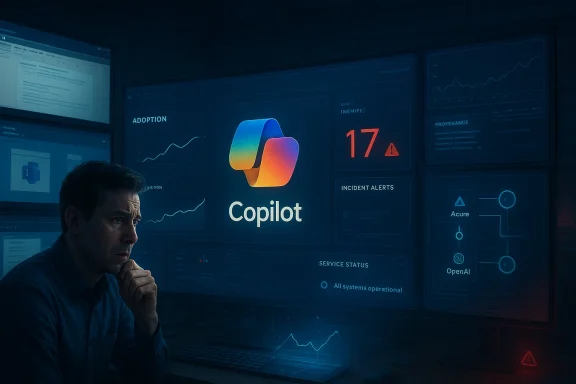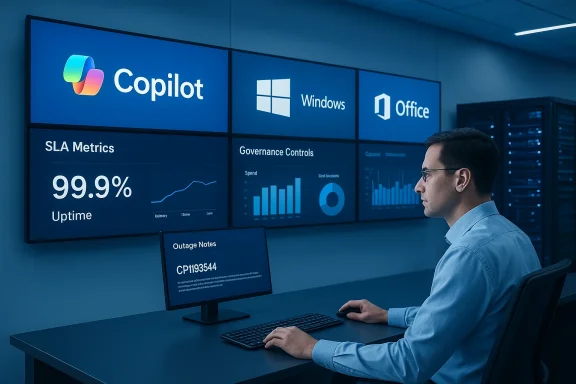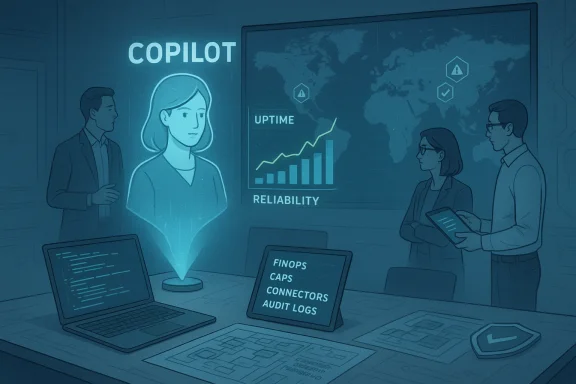
Microsoft’s flagship AI assistant is at a crossroads: once the central plank of a multi‑billion‑dollar platform play, Copilot is now wrestling with reliability failures, adoption friction among paying customers, data-governance anxiety, and intensifying competition — problems that together threaten the near‑term monetization story Microsoft baked into its Azure and Office strategy.
Background
Microsoft launched Copilot as an audacious bet: embed large language models across Windows, Microsoft 365, Teams, GitHub and Azure to turn AI from a feature into a platform-wide layer. The public pitch was simple and powerful — make everyday software genuinely helpful by enabling assistants that can summarize, automate, and act across apps. Internally this vision aligned product upgrades with a cloud consumption thesis: sell seats for productivity copilots while monetizing inference compute through Azure.That dual revenue expectation — per-seat subscriptions plus inference-driven Azure consumption — underpinned both product direction and massive capital spending on GPU infrastructure. Early demos and pilots impressed audiences and boardrooms, and Microsoft moved aggressively to integrate Copilot into the places billions of people work every day. But the transition from eye-catching demos to consistent, large-scale business value has proven far harder than the company signaled.
What’s going wrong: an evidence‑based rundown
Microsoft’s Copilot problems are not a single bug or a bad quarter. They are a set of intertwined technical, commercial, and trust issues that compound each other.1. Reliability and regional outages
Copilot’s architecture mixes client‑side UI, an API/edge routing layer, orchestration services and Azure‑hosted model inference endpoints. When any one of those layers strains — whether through autoscaling limits, database timeouts, or a deployment gone wrong — the user-visible result is a stalled assistant or a generic failure message. In recent months several high‑visibility incidents showed that autoscaling and regional capacity constraints can produce multi‑hour degradations that affect document edits, meeting summaries and file actions across web, desktop and mobile surfaces.The practical impact of these outages is not just annoyance. When an embedded assistant becomes a potential single point of failure for routine workflows, enterprises reevaluate whether to widen access, tie mission‑critical work to it, or roll back deployments entirely.
2. Accuracy, hallucinations, and independent testing
Independent tests and journalistic studies continue to show that large language models — including those powering mainstream copilots — produce significant factual errors and misrepresentations in summarization and question‑answering tasks. Where a productivity assistant promises to save time, hallucinations that require human correction create a “helpfulness tax”: users spend time vetting and editing outputs instead of being sped up by them.This is an industry‑wide problem, not Microsoft‑only, but the consequence for Microsoft is material because Copilot is sold as reliability-enhancing productivity — the user expectation is much higher in enterprise settings than in consumer chat.
3. Fragmented product family and confusing branding
“Copilot” today refers to many different products: developer copilots for code, Microsoft 365 Copilot for productivity apps, Windows Copilot on the OS, Copilot Studio for custom agents, and Azure-hosted copilots for vertical solutions. That multiplicity creates confusion in procurement and engineering teams: buyers struggle to map a specific business problem to the right Copilot SKU or integration pattern, which slows decision cycles and reduces conversion velocity from pilot to enterprise-wide rollout.4. The pilot‑to‑production gap
Pilots often live in curated, controlled environments. They work because data is prepped, prompts are constrained, and edge cases are minimized. When organizations attempt to scale, they must secure connectors to live CRM/ERP systems, handle messy JavaScript UIs and legacy endpoints, and provide airtight access controls and logging. That integration and governance work frequently exceeds expectations and budgets, and many pilots stall when they encounter the engineering and compliance plumbing required for production.5. Pricing, billing and FinOps anxiety
Microsoft’s go‑to commercial model mixes per-seat charges for user access with consumption‑based billing for heavy inference workloads. For some customers, that creates a pricing fog: an unpredictable monthly bill tied to AI activity spikes is hard to reconcile with standard procurement processes. Finance teams increasingly demand FinOps observability, predictable cost caps and chargeback tooling before committing to large seat expansions.6. Data governance and privacy risks
Copilot’s value depends on access to corporate context — calendars, emails, documents, internal knowledge bases. That access simultaneously increases the attack surface for data leakage and raises questions about model‑training reuse, residency, and tenant isolation. Independent reports and surveys have flagged how many sensitive records are accessible within enterprise environments used by copilots, and many regulated organizations are rightly cautious about broad deployment until governance controls, retention policies and auditable logs are matured.7. Competitive pressure and shifting user preference
Beyond technical and commercial frictions, Copilot competes for mindshare with consumer‑grade chat apps and other AI assistants. In some usage metrics and user preference snapshots, alternative models and implementations are capturing attention for being faster, more accurate on certain tasks, or simply easier to discover. When individual employees default to a different assistant for quick tasks, the enterprise conversion funnel weakens.Microsoft’s response — repair, repackage, or re‑pitch?
Microsoft has not been passive. The company has reacted along several axes:- Engineering triage to harden autoscaling and regional resilience after outage incidents.
- Product updates that add governance features, human‑in‑the‑loop controls and more transparent admin consoles.
- Marketing and adoption programs — internal training campaigns and external campaigns aimed at increasing awareness and demonstrating enterprise benefits.
- Diversifying model routing: routing cheap tasks to smaller, tuned models and sending frontier creative tasks to larger models to control inference costs.
- Pushing on-device inference where specialized NPU hardware can reduce latency and data‑exposure footprints for certain workloads.
Why this matters to Microsoft’s business model
Microsoft’s Copilot thesis was meant to deliver two linked revenue streams: seat‑level software monetization and incremental Azure revenue for inference compute. If Copilot scales smoothly into tens or hundreds of millions of productivity seats, Azure gets a durable consumption tailwind. But if adoption remains lumpy, or if customers elect to confine Copilot to read‑only or advisory modes, the compute uplift is smaller and payback on GPU investments lengthens.The company has already committed very large capital expenditures to datacenter and GPU capacity. That investment is defensible if utilization and retention follow the early growth curves, but slower enterprise conversion compresses margins and stretches payback timelines. The commercial tension here is obvious: Microsoft can keep investing to improve product maturity, but investors and boards expect clearer monetization signals.
Strengths Microsoft still controls
It’s important to be precise about Microsoft’s advantages — they are real and material.- Platform reach. Microsoft owns the operating system, the dominant productivity suite, widely used enterprise identity and storage systems, and a major cloud. That integration is an unmatched distribution advantage: Copilot can be embedded at the point of work in a way that independent chat apps cannot replicate easily.
- Enterprise trust muscles. Microsoft’s long history with enterprise governance, identity and compliance gives it domain expertise to design the tenant‑isolation, audit trails and contractual SLAs that regulated industries demand.
- Engineering scale. Few companies can invest as much in datacenter capacity and operational engineering to run inference at global scale. That scale matters for latency, resilience and the ability to ship differentiated on‑device+cloud hybrid experiences.
- Product breadth and ecosystems. Microsoft can stitch Copilot into workflows that already matter — email triage, document drafting, spreadsheet analysis and developer toolchains — enabling combinatorial value that point solutions may struggle to match.
Critical analysis: where Microsoft must improve — fast
Below are the levers that, if executed well, could salvage the Copilot thesis; if not, the product risks becoming an expensive education on what not to do when embedding AI into core business software.- Prioritize reliability over feature expansions. Marketing and demo features are seductive, but enterprise buyers care about predictability. Microsoft must triage recurring failure modes (UI automation brittleness, autoscaling thresholds, regional failover semantics) and fix them before proliferating new agent capabilities.
- Clarify commercial packaging and FinOps tooling. Customers need predictable TCO. Microsoft should ship chargeback, spike protections and cost‑capping tools that allow finance teams to approve pilots with hard limits and clear visibility into inference billing.
- Simplify messaging and product taxonomy. Convert the many “Copilots” into a clear portfolio with explicit problem-to-product mapping. Buyers must know which Copilot product solves which class of problem.
- Ship robust governance and auditability by default. Enterprise admins should be able to enforce data‑access policies, simulate and test agent behaviors in a sandbox, and receive tamper‑resistant logs for regulatory needs.
- Invest in deployability and connectors. Provide hardened, supported connectors for common enterprise systems and reduce the engineering tax on customers by offering first‑party adapters and managed integration services.
- Be candid about accuracy limits and provide approval workflows. Where outputs matter — legal text, regulatory filings, customer communications — default to advisory modes that require human signoff, and make it easy to lock down agentic actions until trust is earned.
- Focus on observability and incident transparency. Publish SLAs for synchronous Copilot features, give large customers visibility into autoscaling behavior, and provide post‑incident analysis that is concrete and actionable.
Practical recommendations for enterprise buyers and admins
For organizations evaluating or deploying Copilot, the immediate playbook should be conservative and staged.- Start with read‑only and advisory modes. Prove value in tasks where the cost of error is low.
- Insist on SLAs, regional resiliency commitments and post‑incident reporting as part of procurement negotiations.
- Apply strict data classification and tenant isolation before enabling deep data connectors.
- Implement FinOps protections: caps on inference spending, alerting on anomalous usage and internal chargeback mechanisms.
- Run pilot test suites that exercise real-world UI intricacies and legacy systems, not just contrived demos.
- Maintain a human‑in‑the‑loop approval requirement for any agentic action that affects customers, billing, legal or HR outcomes.
Broader industry context and risks
Microsoft’s struggles are instructive beyond one product. The industry is grappling with three linked realities:- Accuracy at scale remains imperfect; models are improving but not flawless.
- Operationalizing AI in production requires more than models: it requires connectors, governance, observability and predictable commercial models.
- Customers and regulators are increasingly skeptical about handing sensitive tasks and data to systems whose failure modes are not yet fully predictable.
The political and supply‑chain dimension
Another factor is vendor and hardware dependence. Microsoft’s inference economy currently leans on a narrow set of GPU vendors. Changes in GPU supply or pricing ripple through the cost of inference and ultimately impact product pricing and margins. Microsoft is hedging by supporting smaller, task‑specialized models and on‑device inference, but these are multi‑quarter engineering plays — not immediate fixes.There is also the public perception angle: outages and prominent accuracy failures attract negative headlines that shape procurement committees’ attitudes toward AI investments. Microsoft can blunt that narrative with demonstrable engineering fixes and transparent customer communications, but it must move quickly.
What success looks like
If Microsoft can execute the following, Copilot’s strategic thesis remains viable:- Reduce frequency and duration of user‑visible outages with demonstrable improvements to autoscaling and regional resilience.
- Publish clear governance, auditing and data‑isolation features that assuage regulated industries.
- Deliver FinOps tooling and predictable commercial packaging that lets CFOs greenlight seat expansions.
- Simplify the Copilot product taxonomy and tie each SKU to measurable, repeatable ROI outcomes.
- Show measurable time‑savings in post‑pilot deployments where Copilot replaces routine, repeatable work rather than adding a noisy advisory layer.
Conclusion
Microsoft built a bet—the Copilot thesis—around a plausible and powerful idea: weave AI into the fabric of everyday work and capture new recurring software revenues while monetizing cloud inference. The technical ambition, platform reach and engineering resources to execute that vision are real and material. But ambition without predictable reliability and clear governance is a fragile strategy in enterprise IT.Right now Copilot is running into problems that are as operational as they are algorithmic: outages, hallucinations, confusing product fragmentation, pricing opacity, and governance risks. Those problems slow adoption and reduce the very Azure consumption lifts Microsoft needs to justify its heavy infrastructure bets.
Fixing this will require an unglamorous, meticulous focus — engineering hardening, clearer commercial choices, and governance that speaks to CIOs and compliance officers. If Microsoft can prioritize those fixes and translate them into measurable trust and predictable TCO, Copilot can still fulfill its promise. If not, the product risks becoming an expensive lesson in how platform ubiquity does not automatically translate into durable enterprise trust.
Source: The Wall Street Journal https://www.wsj.com/tech/ai/microsofts-pivotal-ai-product-is-running-into-big-problems-ce235b28/