

Microsoft’s Copilot has crossed a new threshold: Wave 3 doesn’t just draft and summarize — it executes, plans, and returns finished work as a permissioned, long‑running coworker inside Microsoft 365, and Microsoft has bundled that capability into a broader enterprise play that includes a new Agent 365 control plane, a Work IQ intelligence layer, multi‑model support that brings Anthropic’s Claude into the mix, and a premium Microsoft 365 E7 “Frontier” suite priced for enterprise customers.
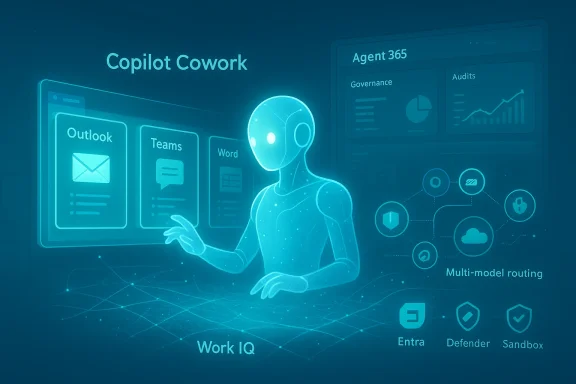
For more than two years Microsoft has progressively embedded large language models into Office and Windows surfaces, evolving Copilot from a sidebar assistant into a platform for workplace automation. Wave 3 — unveiled in early March 2026 — is explicitly framed as the moment Copilot moves from “help me write this” into “do this for me.” Microsoft is delivering that shift via a cluster of coordinated moves: the research‑preview of Copilot Cowork, support for Anthropic’s Claude agent technology inside Copilot, a new agent management/control plane called Agent 365, an intelligence fabric called Work IQ, and a commercial package (Microsoft 365 E7) that bundles these capabilities with hardened security controls.
This isn’t merely a marketing tweak. The announcements describe features that enable Copilot to run multi‑step, long‑running workflows across Outlook, Teams, Word, Excel, PowerPoint and shared files — planning and returning completed artifacts rather than just suggestions. Multiple independent outlets reported the same product names, timelines, and pricing Microsoft published.
Microsoft’s announcement reframes the productivity stack around doing, not just drafting. That’s powerful — but it also makes every enterprise’s operational rigor the principal constraint on success. In the coming months, expect a flurry of pilots, a sharpening of governance tooling, and a deeper industry debate about what it means to give AI the keys to your work. End of article.
Source: HardwareZone Singapore https://www.hardwarezone.com.sg/lif...de-agent-365-enterprise-ai?ref=contentblockl/
 Background / Overview
For more than two years Microsoft has progressively embedded large language models into Office and Windows surfaces, evolving Copilot from a sidebar assistant into a platform for workplace automation. Wave 3 — unveiled in early March 2026 — is explicitly framed as the moment Copilot moves from “help me write this” into “do this for me.” Microsoft is delivering that shift via a cluster of coordinated moves: the research‑preview of Copilot Cowork, support for Anthropic’s Claude agent technology inside Copilot, a new agent management/control plane called Agent 365, an intelligence fabric called Work IQ, and a commercial package (Microsoft 365 E7) that bundles these capabilities with hardened security controls.This isn’t merely a marketing tweak. The announcements describe features that enable Copilot to run multi‑step, long‑running workflows across Outlook, Teams, Word, Excel, PowerPoint and shared files — planning and returning completed artifacts rather than just suggestions. Multiple independent outlets reported the same product names, timelines, and pricing Microsoft published.
What Wave 3 actually introduces
Copilot Cowork: an agent that “does the work”
- What it is: Copilot Cowork is a permissioned, agentic assistant designed to plan, execute, and return finished work for users and teams. It can orchestrate multi‑step processes — from scheduling and long‑running data pulls to building complex spreadsheets and delivering presentation‑ready slides. Microsoft positions it as a “coworker,” able to run tasks autonomously inside a customer tenant under governance controls.
- Availability: Copilot Cowork launched in a limited Research Preview in early March 2026 and is slated to scale through Microsoft’s Frontier program later in March, with broader enterprise availability and commercial packaging tied to the new E7 suite.
Agent 365: the control plane for agents
- What it does: Agent 365 is Microsoft’s dedicated control plane and management surface for deploying, configuring, monitoring, and governing agentic Copilot instances across an organization. It exposes dashboards for adoption, usage, operational health, and compliance reporting — the sort of controls IT teams demand before giving agents broad access.
- Commercial terms: Agent 365 is listed as a separately licensable product in the Frontier package and was announced with a general availability date of May 1, 2026 and a price point reported by Microsoft and multiple outlets.
Work IQ: context that makes agents work reliably
- What it is: Work IQ is a contextual intelligence layer that draws on an organization’s emails, files, meetings, chats, and collaboration signals to give Copilot a work‑specific model of intent, relationships, permissions, and document relevance. That contextual fabric is critical so agents can make decisions about who owns a task, what documents are authoritative, and when to escalate to a human.
Multi‑model support and Anthropic’s Claude
- Model diversity: Wave 3 makes multi‑model orchestration explicit: Microsoft is surfacing Anthropic’s Claude family (including Claude Cowork capabilities) as selectable backends alongside OpenAI and Microsoft models for different workloads. The company says model choice will be governed and routable per workload.
- Partnership shape: Microsoft describes Copilot Cowork as developed in close technical collaboration with Anthropic, incorporating Anthropic’s agent stack and reasoning models into Microsoft’s enterprise sandbox and governance constructs. Independent coverage confirmed the collaboration and integration approach.
The commercial front: Microsoft 365 E7 (Frontier Suite)
- What’s in the bundle: Microsoft 365 E7 packages Microsoft 365 Copilot, Agent 365, Microsoft Entra Suite, Microsoft Defender capabilities, Intune, Purview, and other security/compliance controls intended to secure agents and users. Microsoft published a price of $99 per user per month for the E7 bundle, with Agent 365 also priced as a separate seat license in reporting.
How the new Copilot works — the technical snapshot
Agent architecture and sandboxing
Copilot Cowork runs agentic workloads in a permissioned cloud sandbox inside a customer’s Microsoft 365 tenant. The sandboxing model is designed to isolate agent compute and limit data exfiltration risks while allowing controlled, long‑running access to mailboxes, files, calendars and connectors when explicitly granted. Microsoft stresses this is not a consumer‑style “always‑on” bot; it is a managed, auditable service with administrator and user consent flows.Connectors, scopes, and explicit consent
The agent model uses explicit connectors — opt‑in integrations for Outlook, OneDrive, SharePoint, Google Drive, and other business systems — and a scope model that defines what each agent can read, write or share. Administrators will get governance controls in Agent 365 to approve templates, restrict connectors, and audit agent actions. Early community reporting and preview notes indicate the Copilot can already convert chat outputs into Office files and operate across Gmail and Google Drive when users opt in.Multi‑model routing and “right model for the job”
Wave 3 treats models as interchangeable tools. Administrators and Copilot Studio builders can route tasks to different providers (OpenAI, Microsoft, Anthropic) based on workload sensitivity, reasoning needs, latency, or cost. Microsoft’s articulated goal is model choice plus a unified governance surface so that enterprises can meet policy, regulatory, and contractual obligations while experimenting with diverse models.Why this matters: potential benefits and productivity wins
- Real time-to-value: By converting natural language intent into executed workflows, organizations can reclaim hours from repetitive tasks — meeting summarization, cross‑document analysis, report generation, and routine spreadsheet building can be automated end‑to‑end.
- Scale and persistence: Agents can run long‑running tasks that humans would otherwise monitor — batch data aggregation, nighr multi‑stage report assembly — without tying up human time or requiring human orchestration.
- Contextual accuracy via Work IQ: When Work IQ supplies document lineage, ownership, and relationship signals, agents can prioritize authoritative sources rather than treating all documents equally.
- Enterprise control: Agent 365 and the E7 bundle embed security controls (Entra, Defender) to give IT teams the tooling needed to approve, audit, and remediate agent activity — a necessary hedge for enterprise adoption.
Practical and operational risks — what IT needs to worry about
Even powerful automation introduces new failure modes. Below are the most significant risks organizations should evaluate.1. Data governance and exfiltration risk
Agents that can read mailboxes, files and APIs raise the specter of unintended information flows. Microsoft’s sandboxing and governance are designed to mitigate this, but the attack surface increases — more service principals, more connectors, and more long‑running credentials. Tight scoping, least privilege, and active monitoring are non‑negotiable.2. Hallucination, trust, and auditability
Autonomous agents can produce confident but incorrect outputs. When a Copilot runs a multi‑step workflow and returns a final report, organizations must be able to trace the agent’s reasoning, the documents it used, and the API calls it made. Agent 365’s operational logs and audit trails therefore become critical for legal discoverability and regulatory compliance.3. Long‑running operations and reliability
Agents that persist for hours or days must handle retries, partial failures, and state reconciliation. The business impact of an agent that misapplies a financial transform or duplicates shipments is real; contingency planning, runbooks, and human‑in‑the‑loop checkpoints must be clear. Community previews emphasize Copilot’s new ability to run long jobs, but they also underscore the need for clear orchestration semantics.4. Model governance and vendor risk
Model diversity reduces single‑vendor lock‑in, but it also increases governance complexity: different models have different reliability profiles, latency, cost, and safety tuning. Choosing where to route a query (OpenAI vs Anthropic vs Microsoft) becomes an architectural decision with operational consequences. Microsoft’s multi‑model orchestration mitigates vendor risk, but buyers must still test models against their specific workloads.5. Cost and licensing surprises
The headline E7 price ($99/user/month) and Agent 365 seat price cover premium features and security bundles, but organizations should model real consumption-based costs: per‑agent compute, connector usage, and support tiers can add up quickly. Pricing disclosure is clearer than in earlier Copilot launches, but TCO modeling is essential.Deployment checklist — recommended steps for IT leaders
- Inventory and prioritize: identify repeatable workflows where agents could safely deliver measurable time savings (e.g., expense report generation, recurring data reconciliation).
- Establish a pilot guardrail: select a low‑risk business unit, set a short pilot window, and define success metrics (time saved, accuracy, human review rate).
- Configure Agent 365 policies: define connector allowlists, template approval flows, and role‑based permissions ahead of pilot launch.
- Apply least privilege and consent flows: require explicit user consent for mailbox or drive accescredentials where possible.
- Implement audit and alerting: enable full logging for agent actions, and route high‑risk events to a security operations playbook.
- Run model tests: benchmark outputs from Anthropic Claude, OpenAI, and Microsoft models against real tasks and measure hallucination and data fidelity.
- Validate compliance: map agent activity to regulatory requirements (e.g., GDPR, HIPAA) and involve legal/compliance early.
- Educate users: train staff to interpret agent outputs, apply human verification, and escalate ambiguous cases.
Governance best practices — tightening the control loop
- Use Agent 365 to create an approval flow for any new agent template and require review by security and legal for templates that handle PII or financial data.
- Enforce least privilege: connectors should only expose the minimum set of mailboxes, sites, or APIs the agent requires.
- Record provenance metadata with every agent result so auditors can answer “which agent used which documents at what time.” Work IQ and Agent 365 aim to provide exactly this kind of telemetry.
- Add human checkpoints for decision points that could materially affect customers, finances, or regulatory posture.
Strategic analysis: competition, business optics, and market positioning
Wave 3 is a decisive commercial move. Microsoft is shifting from selling a generative assistant to selling a managed agent ecosystem — one that aims to combine enterprise governance, model choice, and the security posture many large organizations require. That gives Microsoft a differentiated pitch against both pure‑play model vendors and SaaS competitors trying to bolt on LLM features.- For enterprises already using Microsoft 365 at scale, agentization inside the tenant with Entra/Defender/Purview integration is compelling: it reduces friction to adopt while giving IT tools to manage risk. ([microsoft.com](Powering Frontier Transformation with Copilot and agents | Microsoft 365 Blog AI companies, Microsoft’s advantage is breadth: integrated identity, device, security, and productivity surfaces plus a pricing and support model that large customers already understand. Anthropic’s inclusion gives Microsoft an important safety‑tuned model alternative and signals Microsoft’s pivot to multi‑model orchestration rather than single‑provider dependence.
What to watch next (and what remains uncertain)
- Timeline and scale: Microsoft has publicly stated May 1, 2026 for E7 and Agent 365 general availability, with Copilot Cowork in research preview and Frontier rollouts in late March; enterprises should verify availability windows for their regions and tenants.
- Pricing and consumption model clarity: the headline E7 price frames the product, but organizations must get clarity on per‑agent compute billing, connector quotas, and support SLAs.
- Auditability and legal readiness: Microsoft’s published controls are a start, but independent audits and real customer pilots will reveal whether Agent 365’s telemetry meets regulatory discovery needs.
- Safety and model robustness: enterprises should expect to run thorough tests of Claude vs OpenAI models on their specific prompts — model behavior in synthetic demos can differ substantially from real work tasks.
Final verdict: a structural inflection — with caveats
Wave 3 is the most consequential Copilot release yet. It formalizes the movement from “assistant” to autonomous coworker, and Microsoft has sensibly packaged agent control, security, and model choice into enterprise‑focused offerings. For IT leaders, this is both an opportunity and a responsibility: the operational upside is high — measured time savings, continuous automation, and better scale for routine work — but the governance, reliability, and cost questions are real and immediate.- Organizations that move too fast without governance risk both data and reputation.
- Those that pilot responsibly — coupling Agent 365 controls, Work IQ context, and staged rollouts — stand to gain a real productivity multiplier.
Quick action plan for CIOs (next 90 days)
- Form a cross‑functional AI steering committee (security, legal, ops, biz owners).
- Identify 3 pilot workflows and define objective success metrics.
- Reserve a Frontier pilot slot or apply for Copilot Cowork research preview access.
- Enable Agent 365 preview in a test tenant and configure baseline policies.
- Run model A/B tests (Anthropic Claude vs OpenAI) against real prompts.
- Build an incident playbook for agent errors and data incidents.
- Educate pilot users on agent limitations and verification steps.
- Reevaluate procurement and TCO after pilot results.
Microsoft’s announcement reframes the productivity stack around doing, not just drafting. That’s powerful — but it also makes every enterprise’s operational rigor the principal constraint on success. In the coming months, expect a flurry of pilots, a sharpening of governance tooling, and a deeper industry debate about what it means to give AI the keys to your work. End of article.
Source: HardwareZone Singapore https://www.hardwarezone.com.sg/lif...de-agent-365-enterprise-ai?ref=contentblockl/
