

Microsoft’s plan to add 15 data‑center buildings on land once promised to Foxconn has thrust Wisconsin’s electric rates, grid planning and tax policy into the center of a national debate about who pays for the power behind the AI boom — and whether communities that seed that growth will end up footing the bill. )
Mount Pleasant, a village of roughly 27,000 south of Milwaukee, approved Microsoft’s site plans to subdivide and develop additional campuses on land originally acquired for the ill‑fated Foxconn factory. The village board’s recent action authorizes two new campuses containing a total of 15 data centers — nine buildings on a Durand Avenue site and six on International Drive — thtimates could produce more than $13 billion in taxable value.
Those new approvals sit on top of Microsoft’s earlier investments in the same area, where the company has already committed more than $7 billion across two large AI‑scale data center campuses, including the Fairwater project that Microsoft says will house hundreds of thousands of high‑performance accelerators. Reuters and Microsoft’s own communications confirm the combined $7+ billion figure.
At face value the math is straightforward: large capital investment, big construction payrolls for a decade, and substantial long‑term property tax receipts for local schools and services. But beneath that surface are three interlocking policy problems: electricity capacity and rate design, water use and environmee fiscal and social consequences of relying on a few hyperscale tenants for local economic development. The community’s Foxconn experience — large promises, public land transfers, role of eminent domain and infrastructure spending that didn’t deliver the jobs once promised — adds political weight to those concerns.
State regulators, consumer advocates and watchdog groups have questionel contains loopholes that could leave ordinary customers on the hook. PSC staff and groups like the Citizens Utility Board of Wisconsin say the 10‑year contract terms and the proposed 75/25 cost splits for some resources are insufficient to protect ratepayers if market prices, plant dispatch or load assumptions change. They warn revenue shortfalls, volatile wholesale market prices and plant underutilization could lead to cost socialization across the utility’s broader customer base. Tom Content of the Citizens Utility Board has explicitly raised that concern.
The issue is not academic: testimony in PSC filings shows serving the new data centers in Mount Pleasant and Port Washington could roughly double We Energies’ energy demand by 2030 and that the utility is planning tens of billions of dollars in capital investment to meet that load. That scale of system expansion is the central reason this one case has national relevance.
Environmental groups and clean‑energy advocates argue this approach locks in significant emissions and that companies and utilities should instead accelerate low‑carbon firm resources (e.g., long‑duration storage, hydrogen‑ready units or small modular reactors where feasible). The PSC docket has testimony from both sides, and several environmental groups have called for data centers to fund fully dedicated, low‑carbon resources rather than cost‑sharing fossil bridging plants.
A separate political dynamic is the use of nondisclosure agreements (NDAs) and quiet negotiations that preceded many statewide projects. Investigations by Wisconsin Watch found several projects were developed under secrecy at early stages, which inflamed public mistrust and led to legislative proposals to ban NDAs in economic development deals. That lack of transparency is part of why Mount Pleasant’s Foxconn history — involving eminent domain, large state subsidies and fewer-than‑promised jobs — looms large in public memory. Communities now insist on greater teable commitments as conditions of approval.
Wisconsin’s approach will be watched closely. The state’s recent tax changes and the mounting $57.6 billion pipeline of projects create a unique stress test for rate design, utility capital planning and municipal governance. The Public Service Commission’s docket on We Energies’ proposals, the SEC filings from WEC, Microsoft’s public commitments and independent reporting by outlets like Wisconsin Watch, WPR and local press together form the public record that must shape enforceable protections.
In short: the promise is real, but so is the risk. The path forward requires transparent contracts, stronger consumer protections, longer‑term financial security mechanisms and a commitment — from companies, utilities and regulators alike — to tie payments to actual costs and outcomes. Without those guardrails, taxpayers and ordinary ratepayers may end up subsidizing a technology boom they did not invite.
Microsoft’s pledge to “pay our way” is a welcome opening salvo; the hard work is translating that pledge into binding, transparent, and verifiable commitments that survive market swings, technological change and the political cycles that will follow. Until those commitments are on the public record — in utility dockets, municipal agreements and enforceable tariff language — communities should treat high‑level promises as signals, not substitutes for policy safeguards.
Source: Straight Arrow News - SAN Wisconsin electric rates in focus as Microsoft plans 15 new data centers
 Background
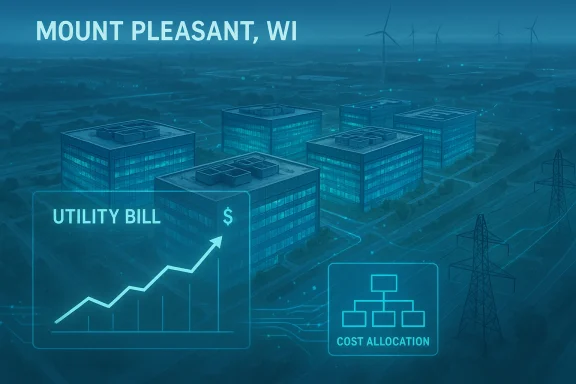
Mount Pleasant, a village of roughly 27,000 south of Milwaukee, approved Microsoft’s site plans to subdivide and develop additional campuses on land originally acquired for the ill‑fated Foxconn factory. The village board’s recent action authorizes two new campuses containing a total of 15 data centers — nine buildings on a Durand Avenue site and six on International Drive — thtimates could produce more than $13 billion in taxable value. Those new approvals sit on top of Microsoft’s earlier investments in the same area, where the company has already committed more than $7 billion across two large AI‑scale data center campuses, including the Fairwater project that Microsoft says will house hundreds of thousands of high‑performance accelerators. Reuters and Microsoft’s own communications confirm the combined $7+ billion figure.
At face value the math is straightforward: large capital investment, big construction payrolls for a decade, and substantial long‑term property tax receipts for local schools and services. But beneath that surface are three interlocking policy problems: electricity capacity and rate design, water use and environmee fiscal and social consequences of relying on a few hyperscale tenants for local economic development. The community’s Foxconn experience — large promises, public land transfers, role of eminent domain and infrastructure spending that didn’t deliver the jobs once promised — adds political weight to those concerns.
Why electricity rates matter — and why Wisconsin is a test case
The energy profile of modern AI data centers
Modern hyperscale AI data centers are not ordinary industrial loads. They require continuous, highly reliable power andegawatts at levels equivalent to small towns. As Microsoft itself has acknowledged in public briefings, power is the binding constraint for large‑scale model training: capacity, dispatchable firm power and transmission are all required to host AI clusters at scale. Microsoft’s Wisconsin projects are explicitly designed for frontier AI training, which amplifies the electric demand profile. emand creates two immediate cost pressures:- Utilities must upgrade distribution systems: substations, transformers, feeders and local lines to handle the concentrated, high‑density load.
- System planners must add generation or contracted firm resources that are dispatchable when intermittent renewables and storage cannot meet peak demands.
The We Energies proposal and the regulatory flashpoint
We Energies (WEC Energy Group) has proposed a rate and contract structure intended to ensure very large industrial customers — including hyperscale data centers — “pay their way” for the incremental investment needed to serve them. In testimony before the Public Service Commission of Wisconsin (PSCW), utility filings and analysts described a plan that would allow data centers to either subscribe to dedicated generation resources or pay for make‑ready distribution work. The plan also contemplates a subscription model where a large customer could pay a large share (for instance, 75 percent) of fixed costs for a new plant while the utility’s other customers would cover a residual share and all fuel costs. We Energies says that approach will keep residential bills from rising as a result of new data‑center load.State regulators, consumer advocates and watchdog groups have questionel contains loopholes that could leave ordinary customers on the hook. PSC staff and groups like the Citizens Utility Board of Wisconsin say the 10‑year contract terms and the proposed 75/25 cost splits for some resources are insufficient to protect ratepayers if market prices, plant dispatch or load assumptions change. They warn revenue shortfalls, volatile wholesale market prices and plant underutilization could lead to cost socialization across the utility’s broader customer base. Tom Content of the Citizens Utility Board has explicitly raised that concern.
The issue is not academic: testimony in PSC filings shows serving the new data centers in Mount Pleasant and Port Washington could roughly double We Energies’ energy demand by 2030 and that the utility is planning tens of billions of dollars in capital investment to meet that load. That scale of system expansion is the central reason this one case has national relevance.
What the numbers say — verified claims and where to be cautious
I verified the most load‑bearing numeric claims against multiple independent sources.- Microsoft’s existing commitment of “more than $7 billion” in Wisconsin data center spending is confirmed by Microsoft’s own blog and press statements and was reported by Reuters. Those two independent sources align on the $7+ billion figure.
- The village’s estimate that the newly approved 15 data centers could add roughly $13 billion in taxable value appears in local reporting and municipal documents reported by Spectrum News, Urban Milwaukee and the Daily Reporter. These independent local outlets cite village documents and meeting records. While taxable value estimates are local projections and depend on eventual buildouts and assessed values, the $13‑billion figure is the village’s working estimate.
- Wisconsin Watch, an investigative nonprofit, reported that seven large data center proposals pending in the state had a combined value above $57.6 billion — a figure picked up in statewide reporting and publicized by WPR. That number signals the sheer scope of the pipeline that state and utilities must factor into planning. I confirmed the Wisconsin Watch tally through reporting that reproduces their findings.
- We Energies’ capital plans to add combustion turbines, RICE units, LNG storage and other infrastructure (amounting to billions) are disclosed in WEC Energy Group’s SEC filings — a primary corporate source that lists project capacities and estimated costs. The company’s SEC filing and independent trade coverage both indicate approvals for projects that together approach roughly $1.5 billion for two plants in southeast Wisconsin, and larger capital plans across the company’s footprint. These filings are the authoritative corporate commitments and are critical to evaluating rate impacts.
- The $13‑billion taxable value is an estimated build‑out projection, not a guaranteed appraisal. If market conditions change, assessed values and tax revenues could fall short of municipal projections. Municipal projections are legitimate planning tools but carry uncertainty.
- The specific allocation mechanics of We Energies’ proposed rate structure — the 75/25 split and ten‑year terms — are policy constructs under review. Several PSC filings and PSC analyst testimonies explicitly ask for stronger bilateral protections and longer contractual horizons; these are active regulatory debates and could change.
Economic upside: jobs, tax base, and local investments
Data centers bring three clear economic benefits at the municipal level:- C: Large campuses create thousands of short‑term construction jobs over multi‑year build cycles. Microsoft estimates over 3,000 construction jobs, and local reporting corroborates large contractor activity during peak build phases.
- Property tax revenue: If assessed and taxed as projected, the new developments will materially augment the local tax base for schools, county services and municipal operations. Local officials estimate tens of millions in annual property tax receipts after tax‑increment financing (TIF) obligations are satisfied.
- Indirect economic activity: Supplier contracts, professional services, training programs and supplier ecosystems (for example, pipelines for cabling, construction services and local suppliers) often expand around a major campus.
Grid planning, generation choices and environmental tradeoffs
Natural gas as the bridging resource — and the political cost
To meet fast‑rising demand, We Energies and other utilities have proposed natural gas‑fired plants and combustion turbines because they are fast to deploy and provide dispatchable capacity. WEC’s own SEC filings detail approved combustion turbine projects and RICE additions, with aggregate costs in the multiple‑hundreds of millions to billions range. The PSC has approved specific projects intended to replace retiring coal units and to provide local firm capacity. Those approvals materially inform the utility’s capital plan and rate case.Environmental groups and clean‑energy advocates argue this approach locks in significant emissions and that companies and utilities should instead accelerate low‑carbon firm resources (e.g., long‑duration storage, hydrogen‑ready units or small modular reactors where feasible). The PSC docket has testimony from both sides, and several environmental groups have called for data centers to fund fully dedicated, low‑carbon resources rather than cost‑sharing fossil bridging plants.
Water and cooling: Microsoft’s pledges vs. community risk
Microsoft has touted closed‑loop, chip‑level liquid cooling and site‑level water‑use reporting — including a public target to reduce water‑use intensity across its fleet. Those commitments aim to minimize evaporative cooling demands and local potable water withdrawals. Microsoft’s public statements and company blog detail these technologies and targets. However, local water systems still face planning, permitting and interconnection concerns; regulators and water utilities will need enforceable reporting and monitoring to verify corporate commitments.The political economy: incentives, secrecy and the Foxconn lesson
Wisconsin’s 2023 legislative changes created favorable tax treatment for large data center investments — sales and use tax exemptions and thresholds tied to county population and capital investment levels. State law changes were enacted as part of broader incentive conversations and are cited by utilities and developers as factors that attract hyperscalers. Independent legal and incentives analysis confirms the program details and thresholds. These incentives reduce upfront costs for developers but also reduce sales tax revenues during construction and early operation, which critics say shifts more of the fiscal burden onto local governments unless carefully designed.A separate political dynamic is the use of nondisclosure agreements (NDAs) and quiet negotiations that preceded many statewide projects. Investigations by Wisconsin Watch found several projects were developed under secrecy at early stages, which inflamed public mistrust and led to legislative proposals to ban NDAs in economic development deals. That lack of transparency is part of why Mount Pleasant’s Foxconn history — involving eminent domain, large state subsidies and fewer-than‑promised jobs — looms large in public memory. Communities now insist on greater teable commitments as conditions of approval.
Risks: stranded assets, rate shock and the “AI bubble” concern
Regulatory testimony and watchdog commentary raise three principal risk scenarios:- Overbuild risk / stranded plant: Utilities build generation and transmission for projected demand that does not materialize or that uses less energy per unit due to efficiency and new cooling methods. If contracted revenues customers could absorb costs via embedded rate recovery. PSC analysts warn that ten‑year payment terms may not match the 30–40 year life of plants, leaving significant tail risk.
- Wholesale market volatility: If utilities rely on merchant market revenues to offset fixed costs of new generation (foexcess capacity into the Midwest ISO market), those revenues are volatile. Testimony in PSC filings pointed out that market revenues are not guaranteed and that modeling should not assume perpetual high wholesale prices.
- Local rate shock and political backlash: Even a small percentage increase in retail bills — magnified by public perception — can become a political liability. Consumer advocates argue rate structures must explicitly insulate residential and small‑business customers from the consequences of major industrial shifts.
What communities and regulators should demand — a pragmatic checklist
To turn corporate promises into enforceable public protections, the following framework should be used by municipal officials, state public utility commissioners and consumer advocates:- Enforceable, public commitments: Require Microsoft and other developers to file site‑specific commitments in public dockets or ordinances with measurable metrics for construction milestones, water reporting, local hiring targets and tax payments. These should not be mere press releases.
- Cost‑causation rate design: Insist on TSAs and rate structures ments to the actual incremental costs of generation and transmission upgrades, with independent auditing of cost allocation and escalation provisions. Model the “higher of” principle where applicable (charge the new customer either the incremental cost or the rolled‑in rate, whichever is higher) to protect legacy customers.
- Longer contractual horizons and robust security: Ten‑year terms are likely insufficient for plants with 30+ year lives. Require longer payment horizons or explicit security mechanisms (letters of credit, escrowed CIACs) that persist through the life of the asset or until alternative compensation is secured.
- Independent scenario modeling and contingency plans: PSCs should require independent third‑party modeling that stress‑tests demand forecasts (including “AI bubble” downside), wholesale price assumptions and interconnection cost lines. Model outcomes should inform whether projects proceed and on what cost‑sharing basis.
- Environmental safeguards and firm clean power: Where possible, condition approvals on the procurement of low‑carbon firm resources or on developer payments that finance renewable + long‑duration storage or other dispatchable clean technologies. This reduces emissions risk and mitigates political opposition.
What this means for Windows admins, CIOs and regional IT strategy
Policy and power constraints upstream have direct operational implications downstream:- Regional capacity risk: IT leaders should map critical workloads to multiple regions and design failo a local data center face curtailment or constrained availability due to grid limits.
- Contract diligence: Enterprises and public agencies negotiating cloud commitments should add clauses for regional substitution, pricing escalation and capacity guarantees tied to firm power procurement.
- Energy‑aware architecture: Expect higher premiums or capacity constraints in regions with aggressive data‑center pipelines. Optimize for energy efficiency: workload scheduling, model pruning, and hardware‑level efficiencies reduce exposure to regional energy shocks.
Conclusion — balancing growth, fairness and reliability
Microsoft’s Mount Pleasant expansion is emblematic of a new phase in the digital economy: hyperscalers are reshaping local infrastructure, jobs markets and energy systems at scales that strain traditional regulatory and planning frameworks. There are legitimate benefits — thousands of construction jobs, local investment, and long‑term tax receipts — but the central policy question remains: how do communities secure those benefits without leaving ordinary ratepayers exposed to stranded costs or rate shocks?Wisconsin’s approach will be watched closely. The state’s recent tax changes and the mounting $57.6 billion pipeline of projects create a unique stress test for rate design, utility capital planning and municipal governance. The Public Service Commission’s docket on We Energies’ proposals, the SEC filings from WEC, Microsoft’s public commitments and independent reporting by outlets like Wisconsin Watch, WPR and local press together form the public record that must shape enforceable protections.
In short: the promise is real, but so is the risk. The path forward requires transparent contracts, stronger consumer protections, longer‑term financial security mechanisms and a commitment — from companies, utilities and regulators alike — to tie payments to actual costs and outcomes. Without those guardrails, taxpayers and ordinary ratepayers may end up subsidizing a technology boom they did not invite.
Microsoft’s pledge to “pay our way” is a welcome opening salvo; the hard work is translating that pledge into binding, transparent, and verifiable commitments that survive market swings, technological change and the political cycles that will follow. Until those commitments are on the public record — in utility dockets, municipal agreements and enforceable tariff language — communities should treat high‑level promises as signals, not substitutes for policy safeguards.
Source: Straight Arrow News - SAN Wisconsin electric rates in focus as Microsoft plans 15 new data centers
