

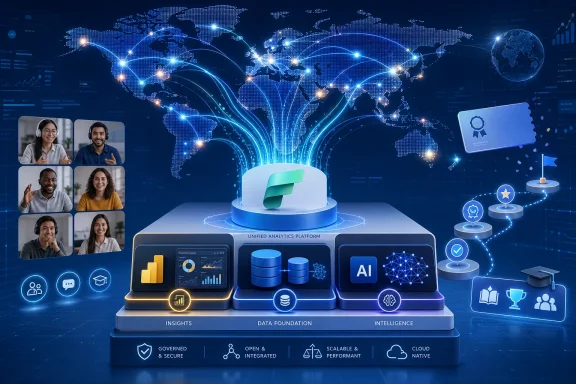
Microsoft’s framing is not subtle. Data is exploding, AI is spreading through the workplace, and platforms that used to live in separate mental buckets — analytics, operational databases, business intelligence, machine learning, application development — are being folded into one continuous data estate. Data Days is therefore not merely a training campaign. It is a signal about where Microsoft thinks the next fight for enterprise AI will be won: not in model demos, but in whether ordinary teams can make governed, useful, repeatable systems out of all this machinery.
Microsoft Turns Training Into Infrastructure
There was a time when vendor skilling events felt adjacent to the product business. You learned a database feature, passed a certification exam, updated your résumé, and moved on. That model now feels quaint because the underlying systems are changing too quickly for skills to remain a periodic maintenance task.
Microsoft is pitching Data Days as a broad, community-driven learning push across its data and AI platform. The program includes live and on-demand training, certification preparation, self-paced Microsoft Learn material, study groups, and community challenges. The certifications in view include PL-300 for Power BI analysts, DP-600 for Fabric analytics engineers, DP-700 for Fabric data engineers, and DP-800 for SQL AI developers.
That list tells its own story. Microsoft is not treating Fabric, Power BI, Azure SQL, and AI application development as isolated product silos. It is bundling them into a professional identity: the data worker who can move from ingestion to governance to analytics to AI-assisted application logic without waiting for a separate priesthood to translate each layer.
This is where the event becomes more interesting than a marketing calendar entry. Data Days is a bet that training has become part of the platform. If an organization cannot create enough people who understand how data flows through Fabric, how SQL participates in AI apps, and how governance changes when models are making or assisting decisions, then the platform’s theoretical capability does not matter much.
The modern data stack is now too consequential to be learned by accident. A Power BI dashboard that once summarized last quarter’s sales may now sit upstream of an AI agent, a retrieval-augmented app, or a workflow that affects customers in real time. The line between analytics and operations is thinner than ever, and the cost of misunderstanding the system has gone up accordingly.
The Skills Gap Has Moved From HR Slideware to the Production Floor
For years, “continuous learning” was the sort of phrase that appeared in corporate training decks right before employees clicked through a mandatory module at 1.25x speed. AI has made the phrase less ignorable. The reason is not that everyone suddenly needs to become a machine learning researcher. It is that AI tools have escaped the lab and arrived in the ordinary workflow before most organizations have built the practices to govern them.
Microsoft’s Work Trend Index reported in 2024 that 75 percent of knowledge workers were already using AI at work, with nearly half of those users having started within the previous six months. Even allowing for the usual caveats around survey methodology, the direction of travel was obvious: AI adoption was not waiting for formal rollouts. Workers were bringing tools into their jobs because the tools were useful enough to justify the risk.
That dynamic creates a familiar enterprise problem in a new form. The business wants productivity. Employees want leverage. IT wants control. Security teams want visibility. Legal and compliance teams want defensible process. Somewhere in the middle sits the data professional, expected to supply trustworthy inputs, explainable outputs, and systems that do not collapse into a pile of hallucinated confidence.
The training burden therefore lands heavily on data teams because AI is only as useful as the data estate beneath it. Poorly modeled data becomes poor context. Inconsistent metadata becomes inconsistent retrieval. Weak governance becomes a compliance incident waiting for a prompt. The glamorous part of AI may be the model, but the operational part is still data plumbing, access control, lineage, quality, and monitoring.
That is why Data Days’ emphasis on practical skilling matters. The event is not promising that a few online sessions will turn a stretched analyst into an AI architect. But it does acknowledge something many enterprises are only now confronting: AI readiness is a workforce architecture problem, not just a procurement decision.
Fabric Is the Centerpiece Because Microsoft Wants One Data Story
Microsoft Fabric remains central to this strategy because it is the company’s attempt to collapse a sprawling analytics toolchain into a unified SaaS-style platform. Fabric brings together capabilities associated with data engineering, data warehousing, real-time analytics, data science, and business intelligence, with OneLake serving as the common storage layer. The pitch is that teams should spend less time stitching together infrastructure and more time producing usable data products.
That pitch has obvious appeal to WindowsForum’s core readership of IT professionals and systems-minded users. Consolidation can reduce friction. It can also concentrate risk. The more an organization standardizes around one data fabric, the more important it becomes that its administrators, developers, and analysts understand the assumptions built into that fabric.
Data Days reflects Microsoft’s desire to make Fabric feel like the default environment for modern data work, not merely another analytics SKU. By pairing Fabric training with Power BI, Azure Databases, and SQL-based AI development, Microsoft is positioning Fabric as connective tissue. It is the place where operational data, analytical workloads, semantic models, and AI use cases are supposed to meet.
That is strategically tidy. In practice, it will be messy. Enterprises carry years of database design decisions, reporting habits, ETL pipelines, governance exceptions, departmental spreadsheets, and “temporary” scripts that became business-critical around 2017. A unified platform does not magically erase that history; it gives organizations a new place to confront it.
This is why skilling is not a soft add-on. A Fabric deployment without trained practitioners can become just another centralized platform that reproduces old confusion at larger scale. The promise of integration depends on whether teams understand not only which button to press, but why the architecture exists and how to avoid misusing it.
SQL Refuses to Leave the AI Conversation
The inclusion of the SQL AI Developer Associate path is particularly telling. For all the talk of vector databases, foundation models, and agentic workflows, SQL remains the language of enterprise memory. It is how businesses have encoded decades of transactions, customer records, financial events, inventory movements, telemetry, and operational truth.
Microsoft’s message is that SQL developers are not being left behind by AI; they are being pulled into it. That makes sense. Many AI applications need structured data as much as they need unstructured documents. A chatbot that cannot reason over orders, entitlements, contracts, devices, or tickets is often a demo rather than a system.
The harder transition is conceptual. SQL professionals are used to deterministic queries, schema discipline, and performance plans that can be inspected and tuned. AI systems introduce probabilistic behavior, prompt sensitivity, retrieval quality issues, and new security boundaries. The SQL developer of the AI era has to think not only about correctness in a database sense, but about how data is exposed to models and how model outputs are constrained by application logic.
That does not diminish SQL’s importance. It increases it. If anything, AI makes the old relational virtues look more valuable: clear schemas, reliable constraints, audited changes, and well-understood permissions. The difference is that those virtues must now operate alongside embeddings, semantic search, orchestration layers, and natural language interfaces that can obscure where answers came from.
This is where certification can be useful if it stays grounded. A credential cannot substitute for production experience, but it can impose a map on a fast-changing landscape. For working developers and DBAs, the point is not to collect badges. It is to learn where their existing expertise still applies and where AI changes the rules.
The Voucher Offer Reveals the Labor Market Beneath the Marketing
Microsoft says a limited number of 100-percent-off exam vouchers will be available for DP-600, DP-700, and DP-800 while supplies last. That detail will attract attention because free certification exams are tangible. It also reveals the labor-market logic behind the event.
Certifications remain imperfect proxies for competence. Anyone who has hired technical staff knows the difference between passing an exam and operating calmly during a bad migration, a broken pipeline, or a compliance review. But certifications still matter because they create shared vocabulary at scale. They tell employers, partners, and internal managers that a worker has at least encountered the canonical version of a platform.
For Microsoft, the incentive is equally clear. A broad base of certified practitioners lowers adoption friction. If more organizations can hire or develop people who understand Fabric engineering, analytics modeling, and SQL-based AI development, Microsoft’s platform becomes less risky to choose. The certification ecosystem is therefore not separate from the sales strategy; it is one of its load-bearing beams.
For workers, the calculation is more personal. AI has injected uncertainty into many technical roles, including data roles that once seemed safely adjacent to automation rather than exposed to it. A certification does not guarantee security, but structured learning can reduce the sense of being overtaken by a platform shift happening elsewhere.
The smartest professionals will treat these events as a way to update their mental models, not just their LinkedIn profiles. The question is not “Which exam can I pass fastest?” It is “Which part of the data-to-AI chain do I understand least well, and how dangerous is that gap becoming in my current job?”
Community Is the Part Microsoft Cannot Fully Automate
One of the more credible parts of Data Days is its emphasis on local and virtual study groups. That may sound quaint in an era of AI tutors and self-paced learning modules, but community is often what turns training into practice. People learn differently when they have to explain a concept, defend an architecture choice, or admit they do not understand why a pipeline failed.
Microsoft has long benefited from community ecosystems around Windows, SQL Server, Power BI, Azure, and developer tools. Fabric is still young enough that community norms matter. How practitioners talk about governance, cost management, deployment patterns, semantic models, and AI integrations will shape the platform’s reputation as much as the official documentation does.
Study groups also solve a problem that enterprises tend to underestimate: accountability. Many workers intend to upskill. Fewer can sustain that effort while tickets, meetings, outages, reporting deadlines, and family life compete for the same hours. A cohort gives learning a calendar and a social cost for drifting away.
There is also a subtler benefit. Community spaces surface the difference between vendor narrative and field reality. Microsoft can present the clean architecture. Practitioners will bring the awkward questions: how to migrate from a legacy warehouse, how to manage tenant sprawl, how to explain capacity costs, how to keep Power BI models from becoming organizational folklore, and how to prevent AI experiments from bypassing governance.
That tension is healthy. The best learning programs do not merely transmit product knowledge downward. They create a feedback loop between the people building the platform and the people trying to make it work inside complicated organizations.
The Data Deluge Claim Is Less Important Than the Operational Consequence
Microsoft’s blog leans on familiar big-data statistics: hundreds of millions of terabytes generated daily, and a large share of the world’s data created in the last two years. Those claims have circulated for years in varying forms, and they are often repeated more confidently than the underlying measurement deserves. The exact number matters less than the operational reality it gestures toward: organizations are drowning in data they cannot consistently understand, govern, or exploit.
That distinction matters because bad statistics can become lazy strategy. Saying “data is growing exponentially” does not tell a CIO which data should be retained, which should be archived, which should feed AI systems, or which should be deleted before it becomes a liability. Volume is the least interesting property of data once the cloud bill arrives and the compliance team starts asking where sensitive fields are replicated.
AI sharpens this problem. In the dashboard era, unused or poorly governed data could remain an expensive nuisance. In the AI era, that same data may become fuel for systems that answer questions, generate summaries, recommend actions, or automate workflows. Suddenly, stale records and ambiguous definitions are not merely inconvenient; they can be amplified.
This is why the conversation has to move beyond enthusiasm for tools. The profession needs better habits around data contracts, lineage, access boundaries, quality metrics, and semantic consistency. Those habits are not glamorous, but they are the difference between AI that helps a business act faster and AI that helps it make mistakes faster.
Data Days can only do so much here. A training event cannot fix a decade of neglected data governance. But it can help normalize the idea that AI readiness begins with data discipline rather than prompt cleverness.
Enterprise IT Will Judge the Program by Monday Morning
For WindowsForum readers, the practical question is not whether Data Days sounds useful in the abstract. It is whether the learning maps to work that administrators, developers, and analysts actually face on Monday morning. That means migrations, permissions, refresh failures, semantic model sprawl, compliance constraints, budget surprises, and executives who want AI results without changing business processes.
Microsoft’s platform strategy often assumes a degree of organizational alignment that real enterprises lack. The data team may want Fabric. The app team may live in Azure SQL and GitHub. The finance department may trust only its Power BI model. Security may be pushing conditional access and data loss prevention. A regional business unit may still rely on exports emailed around as attachments because the “official” system does not answer the question they actually need answered.
Training becomes valuable when it helps people bridge those fractures. A Fabric analytics engineer needs to understand not only lakehouse and warehouse patterns, but also how business users consume metrics. A SQL AI developer needs to understand not only queries and embeddings, but also how authentication, authorization, and data minimization work in production. A Power BI analyst needs to understand not only visuals, but also semantic model governance and the downstream consequences of definitions.
The other Monday morning issue is cost. Unified platforms can simplify procurement, but they can also make consumption harder to predict. Training that ignores cost management is incomplete because technical design choices now have direct financial consequences. Data movement, capacity planning, refresh patterns, model usage, and AI calls all become part of the same operational budget story.
If Data Days gives practitioners realistic patterns, it will be more than a promotional exercise. If it stays at the level of cheerful demos, it will still be useful for orientation but less useful for the people who have to defend architecture choices in change advisory boards and budget reviews.
AI Adoption Without Skilling Becomes Shadow IT With Better Branding
The most important argument behind Data Days is that AI adoption is already happening whether organizations are ready or not. That is the uncomfortable lesson of the last few years. Workers do not wait for perfect governance when a tool saves them time. Departments do not wait for enterprise architecture approval when a prototype impresses a vice president.
This is not necessarily malicious behavior. It is how productivity tools spread. The problem is that AI systems can cross boundaries that older tools did not. They can ingest sensitive context, generate plausible but incorrect outputs, summarize documents with hidden omissions, and produce code that works until it fails under edge conditions.
Skilling is therefore a control mechanism as much as an empowerment mechanism. Trained employees are more likely to know when not to paste data into a tool, when to validate an AI-generated answer, when to ask for lineage, and when a prototype needs a security review. They are also more likely to build systems that IT can support rather than workarounds IT must later unwind.
This is where Microsoft has to walk a fine line. The company benefits when AI feels accessible and urgent. But enterprise customers need the message to include restraint, not just acceleration. “Use AI everywhere” is not a strategy. “Use AI where the data, process, risk model, and human oversight make sense” is less catchy, but more survivable.
Data Days is strongest when read through that more sober lens. It is not a festival for chasing novelty. It is a remediation effort for a workforce that has been handed powerful tools before the surrounding practices have fully matured.
The Career Bet Is Shifting From Tool Expertise to System Fluency
The traditional data career ladder rewarded depth in particular tools: SQL Server, Power BI, Azure Synapse, Python, Spark, SSIS, Analysis Services, and so on. Tool expertise still matters, but AI is pushing the market toward system fluency. Employers increasingly need people who can reason across the full chain of data creation, transformation, governance, consumption, and AI-assisted action.
That shift can be unsettling because it expands the surface area of competence. A data analyst may need to understand how semantic models affect AI answers. A database developer may need to understand vector search and prompt grounding. A data engineer may need to understand business-facing metrics well enough to prevent technically correct pipelines from producing organizational confusion.
The opportunity is that many data professionals already possess the most important foundation: skepticism. Good data people are trained to ask where a number came from, whether a join changed the grain, whether a definition is stable, and whether the dashboard is measuring the business or merely decorating it. Those instincts are invaluable in AI work.
What changes is the need to apply those instincts to less deterministic systems. Instead of simply asking whether a query returns the right rows, teams must ask whether an AI-generated answer is grounded in the right sources, whether retrieval omitted relevant context, whether the model is overconfident, and whether a human decision-maker understands the uncertainty.
That is the career case for continuous learning. Not panic. Not badge chasing. Continuous learning because the profession’s core judgment now has to operate in a larger and stranger environment.
The Real Data Days Prize Is Not the Voucher
Data Days arrives with enough concrete details to be useful, and enough marketing gloss to require a raised eyebrow. The sensible response is neither cynicism nor cheerleading. Treat it as a chance to align your learning with the direction Microsoft is clearly taking its data platform.
- Data Days runs from June 15 through August 7, 2026, and is aimed at professionals working across Microsoft’s data and AI ecosystem.
- The program spans Fabric, Power BI, Azure Databases, and SQL-based AI development rather than treating those areas as separate worlds.
- The certification paths highlighted by Microsoft point to where it sees demand forming: analytics engineering, data engineering, Power BI analysis, and SQL AI development.
- The limited free exam vouchers are useful, but the larger value is the structured learning path and community accountability around it.
- The most practical participants will focus on governance, architecture, security, cost, and production patterns rather than only on feature walkthroughs.
- The event’s real test will be whether it helps working teams move from AI experiments to reliable systems that business users can trust.
Microsoft is right about the broad direction: data and AI work is converging, and professionals who stop learning will find the ground moving under them. The harder truth is that learning cannot be reduced to an event, a badge, or a vendor curriculum. Data Days may help many people find the next rung, but the durable advantage will belong to teams that turn continuous learning into a habit of architecture, governance, and operational judgment — because the next wave of AI will not wait for the last training module to be completed.
References
- Data, AI, and the case for continuous learning Microsoft · 2026-06-15T15:10:10.959372