

Microsoft’s march to make AI an enterprise-native, seat-based utility got bolder this week as the company moved from incremental Copilot rollouts to a coordinated commercial and technical play: a new premium Microsoft 365 tier called E7, the formal general availability timetable for the Agent 365 control plane, and a joint research-preview push with Anthropic around a “cowork” style agent experience that shifts Copilot from helper to coworker. These announcements consolidate licensing, governance and multi‑model choices into a single narrative: Microsoft is treating AI agents as first‑class enterprise citizens—and billing, governing and securing them accordingly. s://www.anthropic.com/news/claude-now-available-in-microsoft-365-copilot)
Microsoft has been layering AI into Microsoft 365 for more than two years, moving from sidebar features to deeply integrated agents inside Word, Excel, Outlook and Teams. That momentum accelerated through 2024–2025 as Microsoft added management surfaces (Copilot Studio), model routing (multi‑model options inside Copilot), and early governance tooling. What changed this month is the vendor tying those technological pieces to a concrete commercial package and release dates—an important inflection for IT procurement, partners and security teams. Public reporting and vendor commentary indicate E7 will bundle the highest‑tier productivity and security features with Copilot seat licensing, Agent 365 governance and Entra identity protections, aiming to simpl for organizations that plan to scale agentic AI.
Microsoft’s channel—roughly half a million partners globally—stands to gain if E7 drives large enterprise upgrades, but partners will also shoulder increased responsibility around agent lifecycle management, policy design and runtime protection. Microsoft executives and partner leaders have emphasized that MSSPs and managed service partners will be central to safe adoption, especially where agents touch regulated data or critical workflows. For partners, Agent 365 represents both a product to resell and a service to operationalize.
Anthropic’s Cowork, and Claude’s rapid enterprise feature cadence, have materially reshaped the vendor landscape. Anthropic’s Cowork—designed as a local, folder‑aware digital coworker with plugins and enterprise integrations—provides an alternate path for organizations that prefer a different model provider, and the market is responding quickly. Anthropic’s own product announcements and press coverage show rapid adoption interest and a focus on audit logging and regulated workflows. Together, these dynamics create a multi‑vendor, multi‑model world where enterprises will gate adoption on the strength of governance and integration rather than raw model performance alone.
The real test will be operationalizing those promises at scale. Vendors can build registries, templates and identity hooks—what matters to enterprises is whether those controls prevent misuse in real time while enabling genuine productivity gains. Partners that can combine governance engineering with managed detection and response will be critical to turning Microsoft’s agent vision into safe, sustainable business value.
Enterprises should start with focused pilots, treat agent deployments like any other privileged automation program, and press vendors for clear metering, verifiable data residency, and runtime enforcement guarantees. The era of the digital coworker is arriving; success will depend on how responsibly organizations design, govern and monitor their new coworkers.
Source: crn.com Microsoft Unveils E7 Suite, Copilot Cowork In Enterprise AI Push
 Background
Microsoft has been layering AI into Microsoft 365 for more than two years, moving from sidebar features to deeply integrated agents inside Word, Excel, Outlook and Teams. That momentum accelerated through 2024–2025 as Microsoft added management surfaces (Copilot Studio), model routing (multi‑model options inside Copilot), and early governance tooling. What changed this month is the vendor tying those technological pieces to a concrete commercial package and release dates—an important inflection for IT procurement, partners and security teams. Public reporting and vendor commentary indicate E7 will bundle the highest‑tier productivity and security features with Copilot seat licensing, Agent 365 governance and Entra identity protections, aiming to simpl for organizations that plan to scale agentic AI.What Microsoft announced (the hard facts)
E7: a new top‑tier Microsoft 365 SKU
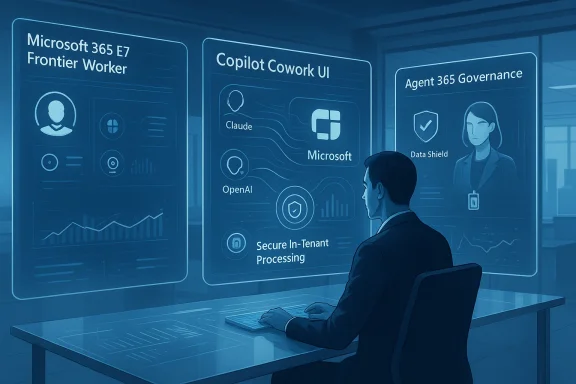
- Microsoft will introduce the Microsoft 365 E7 Frontier Worker Suite as a premium enterprise bundle that folds together Microsoft 365 E5, M365 Copilot, Agent 365, the Entra Suite, and advanced Defender/Intune/Purview capabilities.
- The announced list price for E7 with Teams is reported at $99 per user per month; a slightly reducms* is reported at roughly $90.45 per user per month. Microsoft frames this as being cheaper than purchasing the bundled capabilities individually.
Agent 365 control plane: GA timing and pricing
- The Agent 365 control plane—Microsoft’s single pane for agent discovery, governance, identity and runtime controls—is scheduled for general availability on May 1, 2026, with a stand‑alone price reported at **$15 per user per l include an agent registry, tenant‑level security policy templates enforceable via Microsoft Admin Center, agent performance and adoption reporting, and identity controls that allow each agent to receive a unique Entra identity and conditional access policies.
Copilot Cowork and Anthropic collaboration
- Microsoft will include a research preview this month for Copilot Cowork, an agentic capability built in collaboration with Anthropic (the maker of Claude). Cowork is positioned as a “digital coworker” that can orchestrate end‑to‑end work—assembling documents, preparing meeting materials, interacting with email and collaborating across files—while keeping data within enterprise boundaries. Microsoft says Cowork will leverage its enterprise data protection (EDP) and WorkIQ layers to ground agent behavior in organizational context without moving data out of tenant controls. Anthropic’s own Cowork/Cowork plugins announcements and Microsoft’s multi‑model Copilot work underscore this integration.
Price movement context
- These new offerings coincide with a broader Microsoft price adjustment scheduled for July 1, 2026—an increase across several Microsoft 365 tiers. Microsoft’s own pricing communications and subsequent reporting show incremental increases to E5, E3 and other suites, which shift the relative economics of the new E7 bundle versus buying licenses à la carte. Microsoft’s published pricing guidance and licensing updates provide the context for those changes.
Why this matters: the strategic stakes
For IT and security teams: governance becomes a front‑row concern
Microsoft’s thesis is explicit: agents will be created by and for business users at scale, not just by developers. That’s a productivity promise and a governance headache in one sentence. Agent 365 is intended to give administrators visibility into the volume, identity, behavior and risk posture of agents across a tenant—a single control plane to answer questions that previously required stitching together logs, device telemetry and ad hoc inventories. The ability to assign a unique Entra identity to an agent, apply conditional access and use device compliance signals for runtime decisions is important because agents running with broad privileges, or misconfigured data access, would be high‑value targets for adversaries.For procurement and finance: new price and procurement dynamics
E7 packages the highest security and seat‑based Copilot pricing into one SKU, simplifying procurement for organizations committed to agentized workflows. But it also raises questions about flexibility: will every organization want the packaged Entra/Defender/Purview tools, or will some prefer selective purchases? Pricing increases to E3/E5 ahead of E7’s GA suggest Microsoft is nudging customers toward the bundle as a cost‑efficient path if they plan to deploy Copilot broadly. Procurement teams will need to model seat counts, agent footprints and companion costs (e.g., Compliance, storage, Purview) to assess total cost of ownership. ([microsoft.com](Microsoft 365 Pricing and Packaging Updates | Microsoft Licensing Resources MSSPs: new managed offerings—and new responsibilitiesMicrosoft’s channel—roughly half a million partners globally—stands to gain if E7 drives large enterprise upgrades, but partners will also shoulder increased responsibility around agent lifecycle management, policy design and runtime protection. Microsoft executives and partner leaders have emphasized that MSSPs and managed service partners will be central to safe adoption, especially where agents touch regulated data or critical workflows. For partners, Agent 365 represents both a product to resell and a service to operationalize.
For the platform competition: multi‑model becomes real
Perhaps the most consequential technical trend underpinning these announcements is multi‑model orchestration. Microsoft is no longer presenting Copilot as a single‑provider product. Anthropic’s Claude models are now selectable within Copilot surfaces (Researcher, Copilot Studio), and Microsoft has said it will auto‑route workloads to the best‑suited model. Adding Anthropic—and working with Anthropic’s Cowork concept—injects model choice into the heart of Microsoft’s proposition and challenges the narrative that Copilot equals a single engine. That has ripple effects across cost, compliance and performance.What’s strong about Microsoft’s approach
- Integrated governance and identity for agents. Agent 365’s Entra integration—giving each agent a unique identity and conditional access—addresses a glaring operational need: agents running in enterprise contexts require the same identity hygiene as human users. This is a concrete, actionable control that reduces attack surface if applied comprehensively.
- Commercial simplicity for high‑adoption customers. E7 consolidates high‑value components into a single SKU. For organizations moving large numbers of seats to Copilot and planning agent deployments across departments, the bundle simplifies vendor negotiation and license management.
- Multi‑model flexibility reduces vendor risk. By offering Anthropic alongside OpenAI and Microsoft‑tuned models, Microsoft can route workloads to the model that best fits the task (coding, research, summarization), while letting enterprises select providers they trust or prefer for specific data classifications.
- Investment in telemetry and observability. Agent 365’s promise of agent maps, performance reports and usage telemetry is aligned with how enterprises operationalize complex distributed systems—visibility is the first prerequisite for control.
Where the risks and open questions remain
- Agent sprawl and licensing complexity. Treating agents as billable seats or entities raises practical questions: how is an agent counted? Per identity? Per task? Per runtime? If every department can spin up dozens of agents, license consumption could balloon unpredictably. Microsoft’s registry and admin tooling will help, but procurement teams will need clear metering definitions before committing to scale.
- Operational maturity of governance controls. Agent 365 promises enforceable tenant templates and risk signals; however, enforcement at runtime (stopping an agent mid‑flight, preventing data exfiltration across connected plugins) is dramatically harder than policy design. Some Defender/Purview protections are slated to remain in public preview beyond GA—meaning production‑grade runtime protection may lag adoption. Organizations should assume a phased risk posture.
- Data residency and third‑party routing. Multi‑model orchestration is powerful, but when Copilot routes a task to Anthropic or an external model, enterprises must be confident the data handling guarantees meet regulatory requirements. Microsoft says Cowork and Copilot can operate without moving data out of enterprise boundaries, but customers should validate the technical implementation (e.g., sub‑processor relationships, in‑tenant processing, encryption semantics). Where models are provided by external vendors, contractual and technical guarantees must be explicit.
- Attack surface from agents with identities. While giving agents Entra identities is novel and useful, it also creates high‑value targets: an attacker who compromises an agent identity with broad access could move laterally with automated actions. Identity protection, conditional access, and device compliance signals must be applied conservatively; naive deployments risk amplifying the impact of a single compromise.
- Vendor and model governance fragmentation. Adding Anthropic models to Copilot improves choice but complicates governance: how does an enterprise set model‑level policies if some models are better for coding and others for summarization? Model selection, testing, and approved usage matrices are now necessary governance artifacts.
Practical guidance — what security, IT and procurement teams should do now
Short term (0–30 days)
- Inventory current Copilot usage and experimental agents. Use existing logs to identify users, tenant apps and any preview agents in use. If you already participated in early Copilot or Frontier programs, treat those agents as high‑priority for review.
- Map sensitive data flows. Determine which data sets agents could access (HR, finance, customer PII) and assess whether those data categories require different model routing or on‑tenant-only processing.
- Engage legal and compliance. Begin drafting amendments for sub‑processor and data handling with vendors (OpenAI, Anthropic) and align procurement with legal on model choice constraints.
Mid term (1–3 months)
- Pilot Agent 365 and Entra integration. Use the Agent 365 registry and tenant templates in a controlled pilot to validate identity lifecycle, conditional access rules and alerting workflows. Use pilot results to draft org‑wide agent policy templates.
- Design a model‑usage policy matrix. Create a simple authorization matrix: which roles, data classes, and tasks may use which models or agent types. Include approval workflows and logging/audit requirements.
- Train SOC and MSSP teams. Ensure SOC playbooks account for agent‑initiated actions (automated email dispatches, file modifications) and that MSSPs can respond to anomalous agent behavior.
Long term (3–12 months)
- Adopt runtime enforcement and inline prevention. Move from detection to prevention where possible—blocking suspicious agent actions before they execute. Validate runtime protections for agent gateways and plugins.
- Meter and control cost. Work with procurement to monitor agent license consumption and set quotas or automated alerts when agent counts or activity exceed budgets.
- Operationalize auditability and explainability. Maintain immutable logs of agent decisions and data access; enforce human‑in‑the‑loop checkpoints for high‑risk decisions.
Channel and partner implications
Microsoft’s channel will have an outsized role in enterprise adoption. Managed service and security partners should move quickly to package three complementary offerings:- A discovery and risk assessment service for agent readiness.
- An Agent 365 managed governance offering: registry management, policy templates, conditional access configuration, and agent identity lifecycle.
- An incident response and forensic capability for agent misuse or compromise.
Competitive and market dynamics
Microsoft’s move to bundle security, identity and Copilot seats makes the company more than a productivity vendor: it aims to be the enterprise agent platform. That marketplace shift will pressure incumbents (Salesforce, Oracle, IBM) to match not only feature sets but governance tooling.Anthropic’s Cowork, and Claude’s rapid enterprise feature cadence, have materially reshaped the vendor landscape. Anthropic’s Cowork—designed as a local, folder‑aware digital coworker with plugins and enterprise integrations—provides an alternate path for organizations that prefer a different model provider, and the market is responding quickly. Anthropic’s own product announcements and press coverage show rapid adoption interest and a focus on audit logging and regulated workflows. Together, these dynamics create a multi‑vendor, multi‑model world where enterprises will gate adoption on the strength of governance and integration rather than raw model performance alone.
Tough questions Microsoft and customers still need to answer
- How will metering and billing work when the same business unit runs dozens of ephemeral agents across teams? Will agents be billed per identity, per active session, or by CPU/compute consumption?
- Are Microsoft’s runtime controls—particularly threat protection for agent gateways—sufficient for organizations in highly regulated industries, or will there be a significant lag between policy design and effective prevention?
- When Copilot routes tasks to third‑party models (Anthropic, OpenAI, partner models), what is the verifiable technical boundary ensuring data never leaves enterprise control? Enterprises must demand clear technical attestation, not just contractual assurances.
- How will regulators view automated agents with identities acting on behalf of users, especially in finance, healthcare and government sectors? Audit trails, human‑in‑the‑loop checkpoints and model documentation will be essential.
Bottom line — what this means for enterprise AI in 2026
Microsoft’s E7 bundle, Agent 365 GA timeline and the Copilot Cowork research preview with Anthropic together mark a maturation of the enterprise AI story. The shift is twofold: technologically, Copilot is now a multi‑model, agent‑driven orchestration platform; commercially, Microsoft is packaging governance, identity and premium Copilot seats as a single enterprise SKU. For organizations, that promises easier procurement and stronger governance—but it also erects new operational hurdles: agent inventory, identity hygiene, runtime enforcement and cost control.The real test will be operationalizing those promises at scale. Vendors can build registries, templates and identity hooks—what matters to enterprises is whether those controls prevent misuse in real time while enabling genuine productivity gains. Partners that can combine governance engineering with managed detection and response will be critical to turning Microsoft’s agent vision into safe, sustainable business value.
Enterprises should start with focused pilots, treat agent deployments like any other privileged automation program, and press vendors for clear metering, verifiable data residency, and runtime enforcement guarantees. The era of the digital coworker is arriving; success will depend on how responsibly organizations design, govern and monitor their new coworkers.
Quick checklist for IT leaders (actionable next steps)
- Inventory existing Copilot and preview agent usage today.
- Run a scoped Agent 365 pilot with high‑risk data sets behind additional controls.
- Create a model‑usage and approval matrix aligned with legal and compliance.
- Configure Entra conditional access and identity protection for agent identities.
- Engage channel partners for ongoing governance, staffing and incident readiness.
Source: crn.com Microsoft Unveils E7 Suite, Copilot Cowork In Enterprise AI Push