

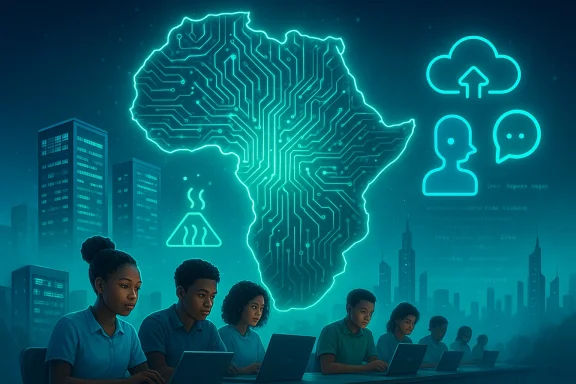
Microsoft’s latest move to widen AI access in Africa reads like a play straight out of the cloud wars: a large-scale skilling promise, telco bundling to accelerate distribution, and heavy investment in local infrastructure — all timed to blunt the influence of a rising Chinese open‑source rival. The company says it will use its Microsoft Elevate initiative to scale AI literacy and tooling across the continent, expand commercial availability through a partnership with MTN Group, and continue heavy cloud and data‑centre investment in South Africa and East Africa. The plan, if executed, could reshape who builds and benefits from AI in Africa — but it also brings familiar risks around sovereignty, competition, and the real-world value of mass training programmes.
Microsoft has been aggressive about turning corporate AI momentum into geopolitical and economic influence. In late 2025 and into 2026 the company consolidated several strands of that strategy under the Microsoft Elevate umbrella: a global skilling and product push that includes education and workforce credentials, targeted country investments, and strategic partnerships with local carriers and governments.
At the centre of the recent announcements are three interlocking elements:
In public pledges made to multilateral fora, Microsoft framed Microsoft Elevate as a programmatic commitment to train and credential large numbers of people — a global target measured in the tens of millions. Those public materials are consistent with Microsoft’s global skilling posture over the past three years, which combines free learning, paid certification, and partnerships with governments, universities, and non‑profits.
Because factual precision matters here, readers should treat the “3 million Africans in 2026” figure as a reportable claim attributed to regional media coverage and secondary reporting. Microsoft has publicly committed to training large cohorts globally under Elevate, and it has announced region‑specific programmes and partnerships that would make a multi‑million African target operationally possible; however, the exact 3‑million‑in‑2026 phrasing has not been located in a single, unambiguous Microsoft primary statement. That caveat is important when judging promises against deliverables.
The joint offering includes:
That pattern matters for two reasons:
This is both economic competition and soft power. Whoever controls the platforms, tooling, and developer ecosystems in Africa is in the best position to shape which use cases, language models, and governance norms take root.
This capital is not purely rhetorical. It expands Azure capacity, supports enterprise customers, and underpins Elevate’s training-to-employment pipeline by offering local compute for development, testing, and production deployments.
The Kenyan project is strategically valuable:
This funnel — learn on Microsoft Elevate, build on Azure, deploy with Copilot integrations, and get investor introductions — is an effective enterprise strategy for ecosystem control. It can stimulate startups and innovation, but it also concentrates much of the emerging value chain inside one vendor’s orbit.
For African founders the tradeoff is real: deeper access and credits vs. long‑term dependence. That choice will shape whether Africa’s AI future is multi‑platform and locally governed or heavily integrated with a small set of global cloud providers.
That strategy can deliver meaningful benefits if it is matched by credible governance, transparent delivery metrics, and conscious policies to ensure local value capture. Otherwise, it risks repeating familiar patterns: headline pledges that produce limited local economic change and lock governments and businesses into long‑term dependencies.
For African governments, civil society, and technologists the moment demands both pragmatism and vigilance. Pragmatism in seizing the practical benefits of faster access to powerful tools; vigilance in ensuring those tools serve public interest, protect citizens, and seed local entrepreneurial opportunity. The outcome will not be decided by press releases or pledges alone — it will be written in procurement contracts, university curricula, data‑governance laws, and the next generation of African startups that either build on local soil or export their talent abroad.
Source: Techloy Microsoft Plans to Train 3 Million Africans in AI as It Takes on China’s DeepSeek
 Background / Overview
Microsoft has been aggressive about turning corporate AI momentum into geopolitical and economic influence. In late 2025 and into 2026 the company consolidated several strands of that strategy under the Microsoft Elevate umbrella: a global skilling and product push that includes education and workforce credentials, targeted country investments, and strategic partnerships with local carriers and governments.At the centre of the recent announcements are three interlocking elements:
- A regional skilling ambition for Africa tied to Microsoft Elevate and local partners.
- A distribution deal with MTN Group that bundles Microsoft 365 and Microsoft Copilot into consumer and enterprise offerings across MTN markets.
- Expanded physical cloud and AI infrastructure — including a multi‑billion rand investment in South Africa and a geothermal‑powered cloud region project in Kenya in partnership structures that involve G42 and local stakeholders.
Microsoft Elevate: scale, promise, and the reality check
What Microsoft Elevate says it will do
Microsoft Elevate is presented as a broad, global initiative to equip people with in‑demand AI credentials and practical training. Corporate statements and multilateral announcements tied to the initiative emphasise two objectives: widening AI literacy and growing local capability to build AI solutions using Microsoft tools like Azure, GitHub, and the Copilot product family.In public pledges made to multilateral fora, Microsoft framed Microsoft Elevate as a programmatic commitment to train and credential large numbers of people — a global target measured in the tens of millions. Those public materials are consistent with Microsoft’s global skilling posture over the past three years, which combines free learning, paid certification, and partnerships with governments, universities, and non‑profits.
The “3 million Africans in 2026” claim — verified, ambiguous, flagged
Several industry outlets reported that Microsoft will train “three million Africans in AI in 2026” as part of Microsoft Elevate. This number has circulated in summaries of regional interviews and secondary reporting. Microsoft’s broader Elevate pledges and previous regional skilling commitments make such a target plausible — the global Elevate pledge itself contains multi‑million targets — but a clear, standalone Microsoft press release explicitly stating a continental target of exactly “3 million in 2026” is not found in the company’s primary announcements.Because factual precision matters here, readers should treat the “3 million Africans in 2026” figure as a reportable claim attributed to regional media coverage and secondary reporting. Microsoft has publicly committed to training large cohorts globally under Elevate, and it has announced region‑specific programmes and partnerships that would make a multi‑million African target operationally possible; however, the exact 3‑million‑in‑2026 phrasing has not been located in a single, unambiguous Microsoft primary statement. That caveat is important when judging promises against deliverables.
Why mass training is necessary — and why it’s not sufficient
Mass AI skilling is an essential building block: companies need trained users, governments need literate workforces, and startups need developer and data talent. Microsoft’s approach mixes:- Short courses and self‑paced learning,
- Institutional partnerships (universities, schools, public institutions),
- Credentials and pathways to paid opportunities,
- Product‑specific enablement (teaching Copilot, Azure services, GitHub workflows).
- Low completion or low employability post‑training when courses are not matched to employer demand.
- A disconnect between product‑specific training and open generative AI fundamentals.
- Uneven geographic reach, where urban elites benefit disproportionately compared to rural populations.
- A skills ecosystem that lacks absorptive capacity — jobs, venture funding, and local compute to turn skills into products.
The MTN deal: distribution at telco scale
What the partnership does
Microsoft’s strategic agreement with MTN Group effectively bundles Microsoft 365 and Microsoft Copilot into MTN’s consumer and enterprise offerings in selected markets. MTN — which crossed the 300‑million subscriber milestone in late 2025 — offers Microsoft an expansive digital distribution channel across Africa’s major markets, from Nigeria and South Africa to parts of francophone West and East Africa.The joint offering includes:
- Microsoft 365 and Copilot accessibility across devices (computers, phones, tablets).
- Built‑in security features such as phishing protection and data‑loss prevention.
- Integration routes for enterprise customers via MTN’s enterprise sales and partner channels.
Why telco bundling matters
Telco bundling is a proven way to leapfrog distribution challenges in markets where paid desktop software adoption is fragmented and where mobile connectivity is the dominant access path. For Microsoft, the upside is:- Rapid reach to millions of subscribers.
- Easier billing and payment integration in markets where credit card penetration is low.
- Closer cooperation with local enterprise customers via MTN’s channel.
The catch: affordability, data costs, and lock‑in
The partnership’s promise depends heavily on local affordability and telco pricing. Bundling productivity tools into telco plans can lower upfront cost barriers, but it can also:- Tie customers into vendor ecosystems that make switching expensive.
- Create single‑provider dependency for both connectivity and productivity tooling.
- Side‑step important local policy questions about data governance, portability, and public interest access.
DeepSeek and the geopolitics of open‑source AI in Africa
The rise of DeepSeek in the Global South
Microsoft’s own diffusion reporting (and a range of independent outlets) documents an unexpected market: in many developing economies DeepSeek — a Chinese open‑source AI platform — has gained outsized share by appearing by default on low‑cost devices and by being free and permissive. Microsoft’s January diffusion analysis reported DeepSeek market shares in several African markets in the low‑teens and, in some cases, higher penetration in low‑adoption environments.That pattern matters for two reasons:
- Access trumps nuance in many markets. Low cost and pre‑installation can beat model quality if a population lacks reliable paid access or if local languages and modalities are poorly supported by incumbent Western services.
- Open models can become geopolitical vectors. Microsoft’s reporting warns that open‑source platforms can extend influence into regions where Western platforms are less available.
What Microsoft’s push signals
Microsoft is explicit: competition from Chinese platforms like DeepSeek is a factor in its regional strategy. The company’s response blends product availability (Copilot via MTN), skilling to bind developers to Azure ecosystems, and localized infrastructure to reassure governments about data residency.This is both economic competition and soft power. Whoever controls the platforms, tooling, and developer ecosystems in Africa is in the best position to shape which use cases, language models, and governance norms take root.
Open‑source or proprietary: tradeoffs
Open‑source models have clear advantages: they lower cost and enable local experimentation. But they also raise concerns about:- Security and supply‑chain provenance when models are forked and deployed without consistent governance.
- Data privacy when models are embedded in low‑assurance devices.
- The risk that local ecosystems become dependent on third‑party forks that lack long‑term maintenance.
Infrastructure and the physical layer: South Africa and Kenya
ZAR 5.4 billion into South African cloud and AI infrastructure
Microsoft has committed to expand cloud and AI infrastructure in South Africa via a ZAR 5.4 billion investment. Microsoft and market reporting place the investment timeline through the end of 2026 (or commitments into 2027 in earlier statements). Currency conversions vary — public reports list the figure in rand and provide differing USD equivalents depending on the date and exchange assumptions — but the headline rand commitment is consistent across Microsoft’s regional communications.This capital is not purely rhetorical. It expands Azure capacity, supports enterprise customers, and underpins Elevate’s training-to-employment pipeline by offering local compute for development, testing, and production deployments.
Geothermal‑powered cloud region in Kenya
A significant piece of the infrastructure story is the East Africa cloud region plans anchored near Kenya’s Olkaria geothermal fields. That project — structured with G42, local partners, and Kenyan stakeholders — was announced earlier as a large geothermal‑powered data‑centre campus designed to provide renewable, resilient power for hyperscale operations.The Kenyan project is strategically valuable:
- Geothermal offers a stable baseload renewable power source in regions where grid reliability is variable.
- A nearby Azure region reduces latency for developer and enterprise customers.
- Local capacity makes sovereignty, compliance, and government contracts easier to manage.
Startups, the Founder Hub, and the developer funnel
Microsoft is emphasising pipelines beyond raw training: the Startup Founders Hub, GitHub access, Azure credits, and investor matchmaking are being presented as the next steps to turn skills into companies. Those resources tilt the ecosystem toward Microsoft stacks by giving preferential access and credits for developers who commit to Azure and GitHub infrastructure.This funnel — learn on Microsoft Elevate, build on Azure, deploy with Copilot integrations, and get investor introductions — is an effective enterprise strategy for ecosystem control. It can stimulate startups and innovation, but it also concentrates much of the emerging value chain inside one vendor’s orbit.
For African founders the tradeoff is real: deeper access and credits vs. long‑term dependence. That choice will shape whether Africa’s AI future is multi‑platform and locally governed or heavily integrated with a small set of global cloud providers.
Risks, blind spots, and governance gaps
1) Data sovereignty and regulatory complexity
Mass training and telco bundling do not eliminate governance questions. Africa is a patchwork of data protection laws at varying maturity levels. Large cloud investments and telco‑platform bundles will inevitably channel personal and enterprise data through third‑party infrastructure. Governments and regulators must negotiate contracts that protect citizens, ensure auditability, and avoid excessive vendor lock‑in.2) Vendor lock‑in and economic dependence
The combination of training, credits, and commercial bundling is a powerful retention mechanism. It helps customers adopt AI fast — but it may make it expensive to switch later. African procurement policies should emphasise portability, open standards, and vendor neutrality where possible.3) Skilling without absorptive capacity
Training millions is laudable, but if local economies lack the jobs, startups, or procurement flows that absorb learners, the social ROI is limited. That risk is especially acute for short, online certificates that aren’t tied to hiring pathways or local internships.4) Security and supply chain risk from open models
Open‑source models like DeepSeek can be rapidly adopted, but if deployed without strong governance — vulnerability management, provenance tracking, and red‑teaming — they can become security liabilities for organisations and states. Conversely, proprietary stacks can provide governance but concentrate sensitive telemetry and control.5) Geopolitical contest and digital influence
When global technology competition reaches highly strategic regions, the consequences go beyond market share. Talent pipelines, standards, and the normative architecture of AI governance are all at stake. Africa, with its demographic dividend and rapid mobile adoption, is a prize for both commercial and geopolitical reasons; that invites pressure and risk.Practical recommendations for policymakers and African tech leaders
- Demand clear, measurable deliverables on skilling commitments.
- Require public reporting on completion rates, job outcomes, and geographic distribution.
- Insist on portability and open standards in procurement.
- Contracts should include data export guarantees, audit rights, and exit timelines.
- Create absorptive pathways for learners.
- Link public training programmes to internships, SME credits, and local procurement quotas.
- Strengthen multi‑stakeholder governance of model deployment.
- Require security assessments, provenance logs, and red‑team results before large‑scale public deployments.
- Use infrastructure projects to ensure local value capture.
- Require local hiring, capacity transfer, and vendor responsibilities for skills development beyond headline donations.
- Treat open‑source and proprietary models as complementary.
- Foster a mixed environment where open models are used for experimentation but critical public services run on governed, auditable platforms.
What success looks like — and what failure would mean
Success would be more than millions of course completions. It would mean:- New African startups building with local language models and deploying them on local cloud regions.
- Governments and enterprises that can audit, configure, and control AI tools.
- Jobs and firms created because training fed into real contracts and procurement.
- A pluralistic AI ecosystem where open‑source innovation and commercial platforms coexist under robust governance.
- Large cohorts of credentialed learners who cannot find relevant work.
- Concentration of data and market power under a few global firms with weak local accountability.
- Proliferation of insecure or biased deployments that harm citizens and reduce public trust.
Conclusion
Microsoft’s push in Africa — combining Microsoft Elevate skilling, MTN distribution, and expanded cloud infrastructure — is a textbook example of modern platform strategy: train the users, control the stack, and own the distribution. It is also a geopolitical response to an emergent competitor: open‑source Chinese platforms that have gained traction in parts of the Global South.That strategy can deliver meaningful benefits if it is matched by credible governance, transparent delivery metrics, and conscious policies to ensure local value capture. Otherwise, it risks repeating familiar patterns: headline pledges that produce limited local economic change and lock governments and businesses into long‑term dependencies.
For African governments, civil society, and technologists the moment demands both pragmatism and vigilance. Pragmatism in seizing the practical benefits of faster access to powerful tools; vigilance in ensuring those tools serve public interest, protect citizens, and seed local entrepreneurial opportunity. The outcome will not be decided by press releases or pledges alone — it will be written in procurement contracts, university curricula, data‑governance laws, and the next generation of African startups that either build on local soil or export their talent abroad.
Source: Techloy Microsoft Plans to Train 3 Million Africans in AI as It Takes on China’s DeepSeek
